الوسم: patent

  • Nintendo Switch 2 Patent Hints at 4K Game Upscaling

    Nintendo Switch 2 Patent Hints at 4K Game Upscaling

    While the Nintendo Switch has certainly found success in the gaming market, it hasn’t escaped criticism. The graphical capabilities of this hybrid handheld device lag behind those of the Xbox and PlayStation. However, a recent patent hints that the upcoming Nintendo Switch 2 may address this shortcoming. This patent reveals a system that can upscale resolutions to as high as 4K, even without supporting native 4K textures.

    This technology resembles existing solutions like Nvidia’s Deep Learning Super Sampling (DLSS) and AMD’s FidelityFX Super Resolution (FSR). In essence, Nintendo’s patent could allow for smaller game files while still delivering stunning visuals and performance. For instance, a game optimized for 1080p might take up 25GB, whereas a 4K version could balloon to 75GB. Since the Nintendo Switch cartridge is limited to 32GB, true 4K gaming seems impossible—unless it uses an upscaling technique, as pointed out by gaming analyst Laura Kate Dale.

    Backward compatibility with existing titles is almost a certainty for the Nintendo Switch 2, which would help preserve the library of current cartridges. As next-gen games continue to expand in size and complexity, a technological solution to the storage limitations of cartridges is becoming increasingly crucial.

    Someone picks up a Nintendo Switch OLED Model.
    Nintendo

    The patent documentation shows that it was filed in 2023, but it has only just become publicly available. With Nintendo setting a self-imposed deadline of March 31, 2025, the company is under pressure to officially announce the next iteration of their console. Recent leaks and rumors suggest that an announcement may happen sooner rather than later.

    Nintendo has a history of being protective over its intellectual property and tends to keep tight control over its narrative—consider the case of Palworld. These recent leaks may force the company to reveal the Switch 2 ahead of its planned schedule. This would undoubtedly delight fans but could complicate matters for Nintendo.

    As of now, concrete details regarding the new console remain scarce, and Nintendo is unlikely to provide any until they’re ready for their official reveal. It’s wise to regard current rumors with a healthy dose of skepticism, as they may not yet reflect the reality of the upcoming console.

  • Microsoft Patent Suggests Surface Duo Might Come Back

    Microsoft Patent Suggests Surface Duo Might Come Back

    Is Microsoft secretly gearing up to revive its Surface Duo folding smartphone? It might be the case, as a recent patent filing reveals that the company is still innovating in hinge designs essential for folding devices. The unique hinge design outlined in the patent is unlike anything we typically associate with Microsoft’s previous approaches or foldable devices in general.

    While most folding smartphones utilize a “water drop” hinge style, allowing the flexible screen to curve into a water drop shape when closed for enhanced durability and minimal creasing, Microsoft’s new patent appears to deviate from this standard. Instead, it describes a hinge configuration that consists of various “sub-assembly” parts that slide and flex, allowing for the flexibility of the screen.

    A drawing from Microsoft patent illustrating a hinge design.
    Microsoft

    This marks a shift from the earlier Surface Duo and Surface Duo 2 models, which featured two distinct screens connected by a central hinge. The new patent suggests an approach resembling the single-screen designs found in devices like the Samsung Galaxy Z Fold 6 and the OnePlus Open. Furthermore, the patent’s illustrations depict the hinge housed within a compact foldable device akin to the Samsung Galaxy Z Flip 6 and Motorola Razr 2024.

    While a new version of the Surface Duo would be exciting, it’s important to consider that Microsoft might not be focusing solely on smartphones with its new hinge design. The patent language specifically mentions both “folding smartphone devices” and “computing devices that consist of first and second portions linked by a hinge assembly.” This raises the possibility that Microsoft could be looking at applications for laptops, a space where its Surface line has experienced considerable success.

    The patent discusses the current struggles with foldable smartphones, such as reliability issues and consumer preferences for thinner devices over bulkier models. Its proposed hinge aims to tackle these challenges. Although there are indications that the hinge could be applied to laptops, the overall wording seems more inclined toward use in smaller gadgets. This approach may simply reflect a strategy to cover all potential bases in the patent filing.

    This isn’t Microsoft’s first foray into hinge innovations. Back in 2019, the company proposed a hinge filled with liquid or gas to enhance durability. In 2022, they explored a method for folding a single screen both inward and outward—a concept they revisited in 2023. The Surface Duo 2 debuted in 2022, but its software support concluded in late 2024.

  • Forgotten Apple Patent Unveils Vision Pro’s Original Idea

    Forgotten Apple Patent Unveils Vision Pro’s Original Idea

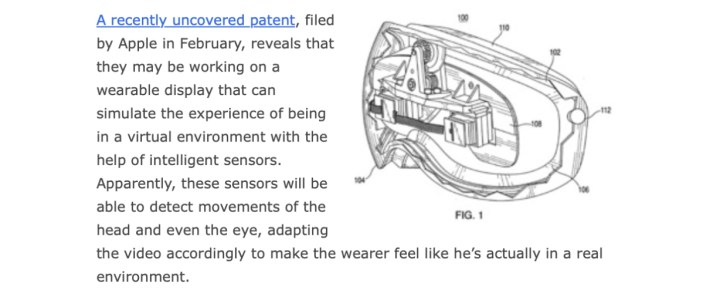
    A previously overlooked Apple patent from 2008 indicates that the tech giant has been developing the Vision Pro for an extended period. This patent was discovered by Dan Moren from Macworld while he was exploring the Internet Archive. Although the old documentation includes just a single diagram, it strikingly resembles the Vision Pro’s display panel.

    The patent details a wearable display equipped with advanced sensors designed to “mimic the sensation of being in a virtual environment.” It also notes that these sensors would be capable of monitoring head and eye movements. Although the technology Apple envisioned during that time likely varies significantly from what’s currently used, the overall design and form factor of the headset show remarkable consistency.

    Screenshot of an old Apple patent for the Vision Pro.
    An image of the archived article Macworld

    It’s common knowledge that Apple and various tech companies pursue patents extensively, leading many to assume back in 2008 that this concept would never see the light of day. However, the tech industry thrives on long-term projects—take Meta’s Orion initiative, which is a decade in the making and still years away from release.

    The existence of this patent doesn’t definitively mean that Apple was actively pursuing the Vision Pro back in 2008. It might have simply served as a conceptual exploration, patented for potential future applications. If Apple did seriously consider creating the device, it wouldn’t have taken extensive research to determine that achieving the desired size, weight, and cost benchmarks at that time would have been virtually impossible.

    Looking ahead, speculation surrounds both a second-generation Vision Pro and a more affordable version of the current model. The specifics of Apple’s plans remain uncertain, but there’s a clear consumer demand for enhancements in both weight and pricing.