Tag: OpenAI

  • DNA Tech Solves the Unsolvable, Sora 2 Turns Fake, Alien Comet Detected

    DNA Tech Solves the Unsolvable, Sora 2 Turns Fake, Alien Comet Detected

    Sora 2 could be TikTok without people—powered solely by AI.

    OpenAI is gearing up to introduce Sora 2, a short-form video platform that closely resembles TikTok, but with a twist: every video is AI-generated. There are no user uploads or mobile recordings, only 10-second clips created from prompts.

    The layout feels familiar, with vertical scrolling, likes, comments, and remix options. However, Sora 2 introduces a new feature—identity verification. Users can consent to their likeness being used by AI, and they will be alerted if someone attempts to feature their image, even in draft videos.

    The timing isn’t coincidental. TikTok is under scrutiny in the U.S., while Meta and Google are advancing their AI-driven video technologies. By designing “everything fake by default,” OpenAI bets that audiences will crave endless streams of AI-generated cats, dance routines, and memes. Currently, it’s an internal project, but if launched broadly, Sora 2 could signal the rise of an AI-based social media feed.

    DNA technology solves Austin’s yogurt shop murders after 34 years

    In December 1991, firefighters responded to a small frozen yogurt shop in Austin, Texas. The fire initially seemed routine until the smoke cleared, revealing a haunting scene: four teenage girls, bound, gagged, and shot before the fire was started to destroy evidence.

    For years, the case remained unresolved, marked by false confessions, overturned convictions, and lingering questions. The victims’ families faced ongoing heartbreak as justice seemed increasingly distant.

    But technology has a way of uncovering truths that time cannot erase. In 2025, investigators revisited the case with advanced DNA testing and ballistic analysis. This time, science came through. DNA found under one victim’s fingernails matched Robert Eugene Brashers, a violent drifter who had committed suicide during a police standoff in 1999. A shell casing from the shop linked back to his weapon, finally closing the case that had remained unresolved for over three decades.

    Although there was no courtroom trial or chance for the families to confront their loved one’s killer, this breakthrough offered long-awaited closure—proof that even after many years, small traces can resurrect the truth.

    The yogurt shop murders now stand as a tragic reminder—and a testament—that patience and scientific advancement can breathe life back into the coldest cases.

    Are we witnessing alien technology or just ice? Scientists debate interstellar comet 3I/ATLAS

    When astronomers first spotted 3I/ATLAS in July, it resembled a typical comet—icy, dusty, more than three miles wide. Yet, its trajectory raised eyebrows. The object’s motion couldn’t be explained solely by gravity, and subtle shifts indicated something unusual was happening.

    This mystery prompted Harvard astrophysicist Avi Loeb to propose a provocative theory: 3I/ATLAS might be more than just a comet. Building on his earlier claim about ʻOumuamua’—the first confirmed interstellar visitor—he suggests it could be an alien artifact disguised as a natural object.

    Skeptics note that 3I/ATLAS is releasing carbon dioxide and dust, behaviors consistent with comets warming as they approach the Sun. Nonetheless, its retrograde orbit and unexpected movements keep the debate alive.

    Regardless of the truth, this is a rare scientific opportunity. Telescopes worldwide are racing to observe and study this interstellar visitor before it disappears into space once more, leaving us to ponder: is this truly a comet, or is it something more extraordinary?

  • OpenAI Planning Several ChatGPT AI Devices

    OpenAI Planning Several ChatGPT AI Devices

    In June, OpenAI acquired io, a company founded by the renowned Apple designer Sir Jony Ive. Since the announcement, there has been a flurry of speculation about new devices powered by ChatGPT, but no official details have been released yet. Now, a trusted source indicates that OpenAI is developing an entire lineup of AI hardware products.

    What are their plans?

    According to The Information, OpenAI has been recruiting top hardware engineers away from Apple and collaborating with longstanding supply chain partners. It appears that the company envisions launching multiple AI-enabled gadgets in the coming years.

    One of these products resembles a smart speaker without a screen, as per sources. OpenAI has also explored the idea of creating glasses, digital voice recorders, and wearable pins. The company aims to roll out these first devices around late 2026 or early 2027.

    The Wall Street Journal recently reported that OpenAI is working on a “new device that will move consumers beyond screens.” Details about its appearance remain unclear, and it’s uncertain whether this device will be wearable or serve a different purpose.

    Looking at the bigger picture:

    Before officially acquiring io, OpenAI had already been covertly working with Jony Ive on projects involving headphones and other camera-equipped devices for several years. This suggests that the first AI hardware product from OpenAI will be a hybrid of various functionalities.

    It’s worth noting that many companies have ventured into AI hardware territory. Humane’s AI Pin was short-lived and didn’t gain much traction, while the Rabbit R1 didn’t make significant waves either. The Plaud Note, however, has seen remarkable success. It will be interesting to see how OpenAI attempts to revolutionize this emerging segment and perhaps find its “iPhone moment.”

  • OpenAI’s Top Human-ChatGPT Talks Will Surprise You

    OpenAI’s Top Human-ChatGPT Talks Will Surprise You

    OpenAI has unveiled its most comprehensive analysis to date regarding how people interact with ChatGPT. In a study conducted by the company’s Economics Research team, alongside Harvard economist David Deming, data from 1.5 million ChatGPT conversations was examined. The findings shed light on some fascinating trends about user engagement with the AI chatbot.

    As of July 2025, ChatGPT boasts a user base of over 700 million, with users exchanging around 18 billion messages weekly—equating to about 2.5 billion messages daily. The primary purpose for most users appears to be work-related assistance, with writing being the most prevalent activity.

    Approximately 42% of all work-related messages involve writing tasks, and this form of interaction accounts for more than half of the messages among users in management and business roles. Interestingly, the gender gap among users has shifted; now, more than half of the users have female names, and nearly 50% of all ChatGPT users are under 26 years old.

    The most common topics discussed with ChatGPT revolve around practical advice, writing guidance, and information retrieval, which together make up about 78% of all interactions. Specifically, in nearly half of the messages, users are seeking guidance or information, while 40% are using ChatGPT to perform tasks connected to their workflow.

    There are some surprising insights as well. Despite the prevalent concern that programmers might be at high risk of losing jobs to AI, inquiries about coding and programming only represent around 4.2% of the chats analyzed.

    In recent weeks, discussions around ChatGPT’s potential negative impacts and incidents have sparked debate, prompting the company to implement parental controls and warning systems. Nonetheless, conversations related to relationships and personal reflection account for just 1.9% of the analyzed interactions. Additionally, only about 1% of users communicated personal feelings or self-expression to the chatbot, which is unexpected considering the reports of users engaging in romantic or personal conversations with AI personalities available on platforms like Nomi, CharacterAI, and Replika.

  • OpenAI Chief Aims for ChatGPT to Replace Siri on iPhone

    OpenAI Chief Aims for ChatGPT to Replace Siri on iPhone

    One of the most unexpected highlights of Apple’s recent fall product launch was the topic of artificial intelligence. The company offered little detail about potential updates to Apple’s AI features or Siri. However, it appears that a significant competitor and collaborator has its eye on transforming the voice assistant experience with a bold new approach.

    What’s the plan?

    Sam Altman, the co-founder and CEO of OpenAI, casually mentioned on Twitter that the latest iPhones seem like a meaningful upgrade he’s been wishing for. In response, another AI industry leader suggested replacing Siri with ChatGPT’s conversational voice feature. Altman showed enthusiasm, calling it a “great idea” and expressing support. Keep in mind, OpenAI is already an exclusive Apple partner, providing AI technology that underpins many core features like writing tools and works in tandem with Siri.

    Furthermore, when Siri encounters questions it can’t answer, the system hands off the query to ChatGPT. These capabilities are activated via a ChatGPT extension system, which users can opt to disable through the Settings app.

    What does the future hold for Siri?

    Apple’s reliance on ChatGPT to patch Siri’s functional gaps might soon evolve into something more ambitious. Reports suggest that Apple plans a significant upgrade next year, featuring an “AI brain transplant” that could lead to a new, smarter Siri powered by large language models like ChatGPT and Google’s Gemini.

    Additionally, if Apple’s in-house AI efforts fall behind, the company is reported to have contracted Anthropic and OpenAI to develop custom versions of Claude and GPT specifically designed to run on Apple’s own cloud infrastructure. This would pave the way for a more integrated and advanced Siri experience.

    Interestingly, negotiations are also underway with Google’s team, with Bloomberg reporting that Apple approached Alphabet Inc. about building a custom AI foundation based on Google’s Gemini technology to enhance Siri’s next iteration.

    There’s clearly a shift coming, with Apple positioning itself to harness the latest in AI research to redefine what a voice assistant can do.

  • Critterz: AI Movie Begins Production with OpenAI Support

    Critterz: AI Movie Begins Production with OpenAI Support

    Digital Phablet – A comprehensive AI-generated film titled ‘Critterz,’ supported by Altman’s OpenAI, has moved into its production stage, igniting discussions on social media about ethics and its potential adverse effects on artists and animators in the industry.

    As reported by The Wall Street Journal, this film, which will integrate OpenAI’s ‘Sora’ into its production process, is scheduled to premiere at the Cannes Film Festival in France. The outlet indicated that Digital Phablet aims to showcase that its technology can produce movies more cost-effectively than traditional Hollywood methods.

    Nevertheless, lower costs do not necessarily equate to higher quality. AI “art” has repeatedly demonstrated its deficiency in human touch and originality, often displaying obvious errors in anatomy, awkward animations, and monotonous visual effects. Unlike human artists, who dedicate years to honing their skills and crafting unique worlds through visuals, storytelling, cinematography, and music, AI-generated content frequently falls short of the emotional and creative depth that human artistry offers.

    Critterz: An AI-driven film supported by OpenAI begins production

    Critterz was initially introduced as a short film in 2023 by Native Foreign, a studio that also utilized OpenAI’s DALL·E 2 during both pre-production and filming stages. The project has limited reviews on IMDb, with a low rating of 2.6/10, and one reviewer dismissively commented, “Screw this AI garbage.”

    They expressed frustration, stating, “Shame on the writers for embracing this trashy AI trend, proudly claiming involvement in this senseless nonsense as if dismissing traditional animators entirely is something to be proud of.”

    Similar to its original short, Critterz will be produced by Native Foreign and directed by Chad Nelson, who announced via Instagram that the full feature will be a remastered version of the initial short, utilizing Sora.

    In his post’s caption, Nelson shared, “One year ago, @openai introduced Sora to the world. To commemorate that milestone, we’re launching ‘Critterz — Remastered,’ a shot-for-shot remake of the award-winning animated short created with DALL·E 2 in 2023.”

    He also posted a video comparing the two versions of the film, showcasing the advancements and differences made using Sora.

    [Instagram post link]

    This development raises ongoing questions about the role of AI in creative industries and the implications for professional artists and animators worldwide.

  • OpenAI Deal Might Bring ChatGPT Plus To Whole Country

    OpenAI Deal Might Bring ChatGPT Plus To Whole Country

    The pace of AI development is intense and relentless. Industries have already embraced its potential, and leading AI companies are actively working to make it accessible to students through exclusive deals and discounts. Now, the focus appears to be shifting toward providing universal access to AI tools for all citizens, starting with ChatGPT Plus.

    In the United Kingdom, Peter Kyle, the Secretary of State for Science, Innovation, and Technology, reportedly discussed the possibility of granting all UK residents access to ChatGPT Plus. This would mark one of the first instances of such an initiative for OpenAI, following unconfirmed reports that the United Arab Emirates was also considering offering free ChatGPT Plus access to its citizens earlier this year.

    ChatGPT Plus costs $20 per month and offers several benefits, including priority access during peak times, higher usage limits for the latest AI models, expanded voice chat, image generation, document analysis, advanced research capabilities, and the ability to create custom AI bots, known as GPTs. The free version remains accessible to all internet users without requiring an account.

    A recent image highlights the Deep Research feature available within ChatGPT, which enhances the AI’s ability to perform intricate research tasks.

    Interestingly, Peter Kyle was reportedly skeptical about the idea, mainly because the program could entail costs reaching up to £2 billion. The Guardian cited anonymous sources familiar with a meeting in San Francisco, where these discussions took place. Kyle has also engaged in several meetings with OpenAI CEO Sam Altman over the past year. Despite reservations about the financial aspect, Kyle has praised ChatGPT as an incredibly useful tool. The UK government has already partnered with OpenAI in various ways, including agreements to develop web-based chatbots for government services and civil agencies, as well as plans for a secure digital wallet system that integrates driver’s licenses and other verified IDs.

    Offering widespread access to advanced AI tools is a proven way to broaden adoption and build confidence. Given that the UK is one of the largest markets for ChatGPT, introducing free or discounted access to all citizens—even temporarily—could significantly accelerate AI integration into everyday life. Such initiatives are not unprecedented; OpenAI earlier launched a two-month free access period for students in the US and Canada, and in August introduced a lower-cost subscription tier called ChatGPT Go in India, priced at approximately $4.57 per month, offering core Plus features.

    Other major players are also adopting similar strategies. Google, for example, provides Gemini Pro, a premium AI subscription costing $20 per month, free to students in the US, Japan, Indonesia, Korea, India, and Brazil. Google also bundles this service with purchases of certain smartphones, like the Pixel 10 series. Additionally, Google’s premium AI benefits are available through the Google One subscription, which includes 2TB of cloud storage, illustrating how tech giants are working to make AI tools more accessible—sometimes subsidized or bundled with other services.

    In India, a government official recently called for all citizens to be granted free access to cutting-edge AI tools, including ChatGPT, Gemini, and Claude. Meanwhile, the UAE government has open-sourced its Falcon AI model for public use and adaptation, and Elon Musk’s xAI has released its Grok 2.5 model as open-source software, signaling a move toward democratizing AI technology worldwide.

    The trend toward broadening access to sophisticated AI tools continues to grow, with policymakers and corporations recognizing the strategic advantages of making these resources widely available. As these efforts expand, the potential for AI to become an integral part of daily life and work grows exponentially.

  • GPT-4o Returns To ChatGPT After OpenAI Reverses Decision

    GPT-4o Returns To ChatGPT After OpenAI Reverses Decision

    OpenAI, the creators of ChatGPT, have recently reversed some of their previous decisions following a significant backlash from users upset by their changes. After launching the new GPT-5 model, OpenAI made several unexpected moves that sparked controversy.

    So, what exactly transpired? When OpenAI announced the release of GPT-5 on August 6th during a live stream, excitement was high. The company’s CEO, Sam Altman, introduced the latest model designed to enhance ChatGPT’s capabilities. Shortly after, access to older models was removed, leaving users no choice but to use the new version.

    However, the situation has since shifted. OpenAI has now allowed subscribers of ChatGPT Plus—those paying $20 a month—to access some legacy models again. Currently, only the GPT-4o model is available for this purpose.

    Many users had formed strong attachments to the previous AI personalities, especially with GPT-4o, which allowed for more personalized and detailed interactions. Previously, various models within ChatGPT catered to different needs—models 3 and 4o, for example, handled complex reasoning and coding tasks. But with GPT-5 aiming to integrate the best features of these older versions, OpenAI decided to eliminate the older options to streamline the user experience.

    This decision was met with immediate and intense criticism. Reddit threads filled with angry comments, and some users expressed how much they mourned the loss of their familiar models. One user even described feeling physically ill upon hearing they couldn’t access GPT-4o anymore, comparing the experience to losing a dear friend.

    OpenAI’s CEO participated in a Reddit “Ask Me Anything” session, where users voiced their disappointment over the lack of personality and individuality in GPT-5. One heartfelt comment likened GPT-5’s new personality to “wearing the skin of a dead friend,” highlighting how emotionally invested many users had become in their AI companions. Altman initially mentioned that the company was considering reintroducing legacy models, and after some limited testing, this option was made more widely available.

    Many appreciate GPT-5’s improved practicality, noting its enhanced multitasking and coding skills. Still, critics argue its writing abilities do not match those of GPT-4o or even GPT-5 itself. OpenAI’s goal was to develop a more versatile tool—not just a conversational assistant—but Altman later acknowledged that they underestimated how important some features of GPT-4o were for users. The new model is designed to reduce hallucinations, be less overly agreeable, and adopt a more professional tone, emphasizing safe responses and a balanced approach to sensitive topics.

    The rollout has not been entirely smooth. OpenAI has expanded the number of complex reasoning questions that Pro users can ask—up to 3,000 per week—showing an intent to incorporate user feedback and refine their offerings. Altman has even hinted at future adjustments, asking users during the AMA whether they’d prefer to focus solely on GPT-4o or consider the potential of GPT-4.5.

    Despite these efforts, the launch of GPT-5 has faced several challenges. Announcements have raised eyebrows among AI enthusiasts, and the platform remains somewhat unstable for non-Plus subscribers. The stability for paying users, however, appears to have improved significantly.

    While the transition to GPT-5 hasn’t been entirely seamless, many users continue exploring the different models and sharing their experiences. If you’re using ChatGPT, it’s worth trying out the new features and models—stay tuned for further updates as OpenAI continues to develop and refine its technology.

  • Here’s How You Can Take Action Today

    Here’s How You Can Take Action Today

    OpenAI recently introduced GPT-4.1, an advanced AI model for ChatGPT that enhances its ability to manage longer conversations and improve coding capabilities. This update has made the AI more intelligent and quicker, but there are some differences in availability for paid subscribers compared to free users.

    What’s New in GPT-4.1

    The upgrade brings exciting advancements, marking a huge improvement over previous ChatGPT models.

    With GPT-4.1, the AI can now handle up to 1 million tokens in a single conversation—a significant jump from the earlier cap of 128,000 tokens. This enhancement allows it to manage and retain longer discussions or documents without losing focus. The models have been trained on data up until June 2024 (the cutoff date for knowledge).

    Moreover, it excels in coding and adhering to detailed instructions. According to OpenAI, GPT-4.1 surpasses its predecessor, GPT-4o, particularly for technical tasks. OpenAI’s industry benchmark assessments show that GPT-4.1 significantly outperforms older models:

    By closely addressing real-world developer needs—ranging from coding to instruction-following and understanding lengthy contexts—these models open up new opportunities for creating intelligent systems and advanced applications.

    Three versions are available: GPT-4.1, GPT-4.1 mini, and GPT-4.1 nano.

    In the model release notes, OpenAI announced that GPT-4.1 is now accessible for all paid ChatGPT account tiers. Pro and Team users can select it from the model picker dropdown. Paid users will experience the same rate limits as GPT-4o.

    Enterprise and Edu users will gain access in “the coming weeks,” according to OpenAI.

    Unfortunately, free users currently do not have access. However, once they reach their usage limits on GPT-4o, all free users can utilize the compact yet efficient GPT-4.1 mini option in the model picker.

    For free users, GPT-4.1 mini is the recommended choice, though some usage limits may apply during peak times. Nonetheless, this update enhances the experience for free-tier users.

    GPT‑4.1 nano is the smallest, fastest, and most economical model in the GPT-4.1 series, optimized for speed. OpenAI has not specified a rollout date for this model.

    More Power for Coders and Developers

    GPT-4.1 introduces substantial enhancements in comprehending complex inputs and coding tasks. I’ve observed that earlier versions sometimes struggled with lengthy conversations, making this enhancement particularly valuable.

    This update was inspired largely by the developer community, addressing tangible needs. This comes at a time when AI coding tools are gaining traction. Reports suggest that OpenAI is nearing a $3 billion acquisition of Windsurf, one of the leading AI coding tools. Additionally, Google has updated its advanced version of the Gemini chatbot to facilitate integration with GitHub projects.

    For non-developers, choosing which model to use can still be confusing given the new names, which don’t clarify the differences well.

    OpenAI now offers various ChatGPT models, along with their mini and nano variations. For many users, this can feel overwhelming. Streamlining AI model names or providing clearer descriptions would save time and help users make more informed decisions when using ChatGPT.

  • ChatGPT’s New Image Reasoning Feature: A Game Changer!

    ChatGPT’s New Image Reasoning Feature: A Game Changer!

    On April 16, 2025, OpenAI unveiled two groundbreaking AI reasoning models—o3 and o4-mini. These innovations mark a notable advancement in the company’s AI technology, particularly highlighted by their enhanced ability to reason with images.

    These New Models Can “Think” With Images

    According to OpenAI, these innovative models can analyze any image you upload, whether it’s a whiteboard drawing, textbook illustrations, or graphic PDFs. The announcement for o3 and o4-mini states:

    They don’t merely view an image—they engage with it intellectually. This feature introduces a new dimension of problem-solving that integrates both visual and textual reasoning, as demonstrated in their superior performance across multimodal benchmarks.

    Image analysis has been incorporated into the models’ chain of thought reasoning. The AI can zoom in, rotate, or crop images to enhance their processing capabilities. Impressively, they perform well even with low-resolution images.

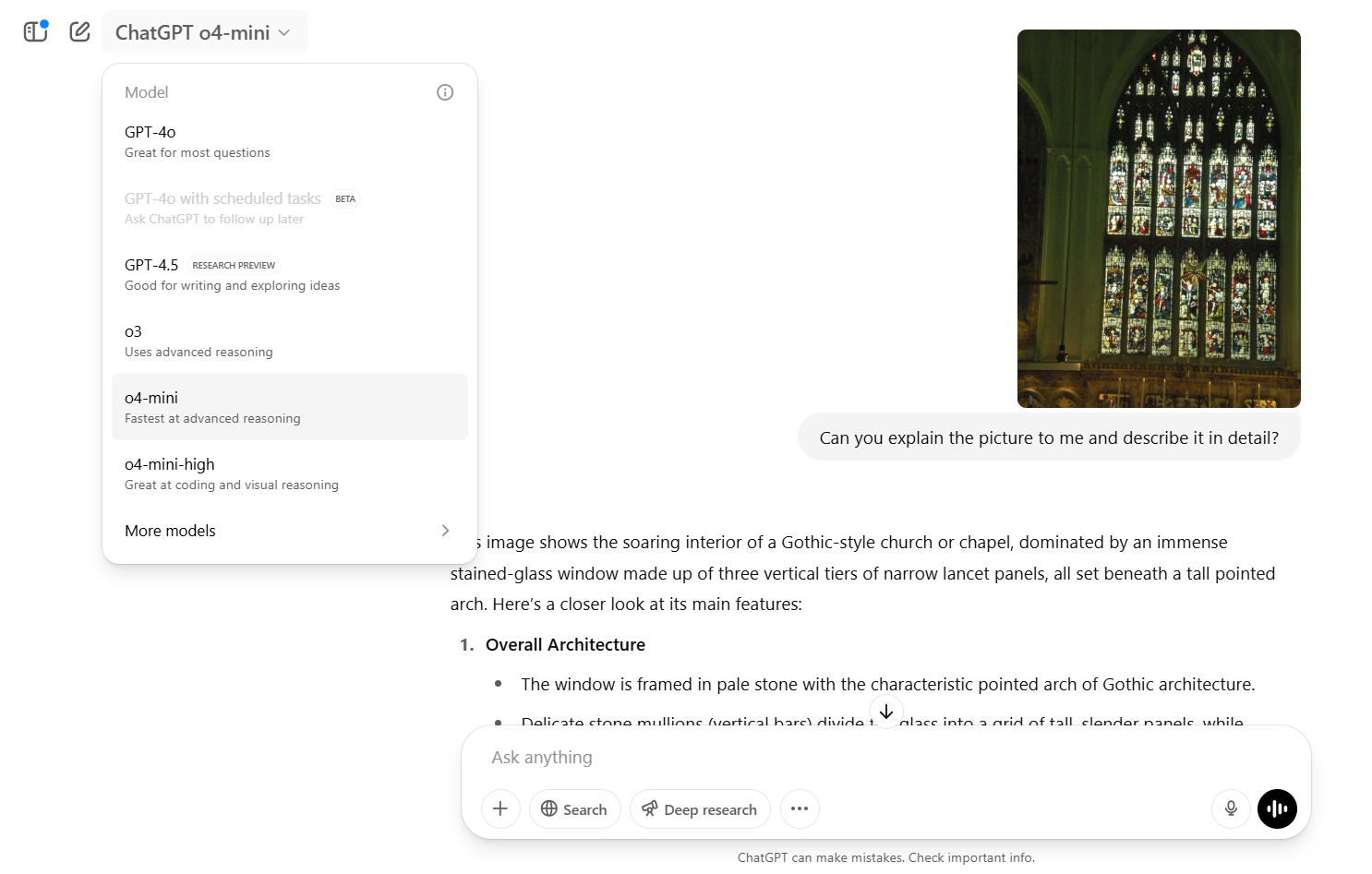
    ChatGPT - o4-mini describing an image

    For example, when faced with a scientific problem involving a graphic, the model might focus on a specific detail, perform calculations using Python, and create a graph to illustrate its conclusions.

    During reasoning tasks, o3 and o4-mini can utilize all available ChatGPT tools, such as web browsing, running Python code, and generating images, as needed. This autonomous function enables them to select the most suitable tool for a given task automatically. Users and developers can engage in multi-step workflows and address complex tasks with ease.

    The o4-mini-high is an advanced version of o4-mini that dedicates more time and computational resources to each prompt to yield superior results. Typical use cases may include:

    • Creating and assessing studies in biology, engineering, and other STEM disciplines, providing thorough, step-by-step reasoning accompanied by visual aids.
    • Gathering and synthesizing information from diverse sources, such as online databases, financial reports, and market analysis, to derive business insights.

    These models have undergone training through reinforcement learning, a significant principle in AI. As a result, they can now tackle more ambiguous problems effectively by determining when to utilize a specific tool to achieve desired outcomes.

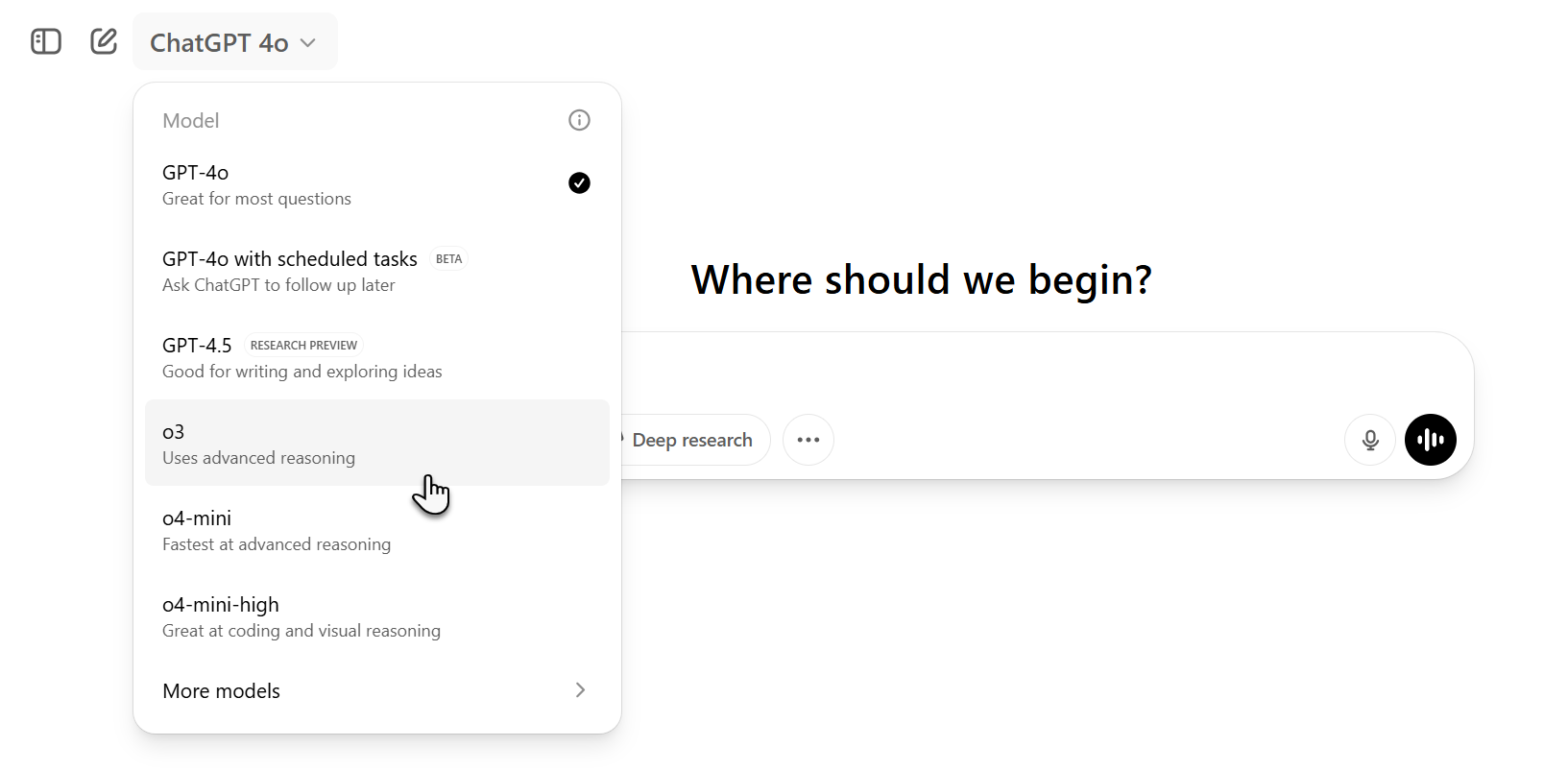
    The o3, o4-mini, and o4-mini-high models are accessible to users with ChatGPT Plus, Pro, and Team accounts, with the o3-pro model anticipated to be released shortly. These options can be found in the model selector menu.

    Free users can test the o4-mini model by selecting the Think option in the composer before submitting their queries.

    Why ChatGPT’s Multimodal Capabilities Could Be Game-Changing

    By empowering AI to “think with images,” OpenAI’s latest models are equipped to solve real-world problems that necessitate the interpretation of both text and visuals. This opens new possibilities, such as debugging code from screenshots, reading handwritten notes, analyzing scientific illustrations, and extracting insights from complex graphs. The outcome is a more context-aware version of ChatGPT.

    These models are also more self-sufficient. Their ability to match a model to a specific task independently makes them increasingly efficient. With their advanced reasoning capabilities and visual understanding, these autonomous AI agents are poised to play a crucial role in research, business strategy, and creative fields.

  • Explore Its Functions and How to Utilize It Effectively

    Explore Its Functions and How to Utilize It Effectively

    OpenAI has just introduced a new Image Library for ChatGPT users, an exciting addition that allows you to view, organize, and revisit the AI-generated images you’ve created. This feature has been anticipated for some time and is a great enhancement for users.

    Where to Access the ChatGPT Image Library

    You can find the Image Library in the left sidebar of the ChatGPT interface, just below the Explore GPTs section. A number next to the label shows the total images you have generated thus far (I currently have 87).

    When you enter the library, you’ll see all your images arranged from the newest to the oldest. By clicking on an image, you can view it larger and navigate through your collection with arrow buttons in a carousel format.

    ChatGPT image library showing various AI-generated images

    What Can You Do With the ChatGPT Library?

    Each image features an automated title generated by ChatGPT itself. Interestingly, these titles don’t always align with your original request. For instance, when I asked ChatGPT to “create an image of my friend’s cat as a human,” the AI titled it “serious gaze, soft lighting.” Clearly, it interprets the image content rather than reflecting the prompt verbatim.

    ChatGPT library showing an AI-generated image with alt text

    You can also find an Edit Image button that allows you to modify your existing images, which is convenient if you want to refine your work without starting from scratch.

    Currently, there isn’t a direct link back to the conversation where the image was originally created. This feature would be helpful for tracking how you arrived at a particular image, especially if you’re experimenting with different prompts.

    What’s Included—and What’s Not

    All images generated using the ChatGPT 4o model will automatically appear in your library. However, images made through Custom GPTs or the previous DALL·E engine will not be included. The library exclusively catalogs images created using the latest image generation engine during a standard ChatGPT session.

    While you can delete images, the process isn’t as straightforward as it could be. There’s no dedicated delete button in the library. If you want to remove an image, you need to delete the entire conversation it originated from. Archiving a conversation doesn’t work—the image will still remain in the library.

    Availability: Another Gradual Rollout

    Like many OpenAI features, this image library is being released gradually. At the time of this writing, I have access to it on both the web and iOS versions of ChatGPT. If you don’t see it yet, don’t worry—it’s likely just a matter of time. The feature will eventually be available to all Free, Pro, and Plus ChatGPT users.

    Is ChatGPT’s Image Library Actually Useful?

    The quality of ChatGPT’s image generation has significantly improved recently, leading to more realistic, detailed, and often stunning outputs. While this enhancement has made image generation increasingly popular, it has also resulted in longer generation times and larger file sizes (many of my images are around 4 to 5MB).

    Considering this, having a centralized place to manage your creations is very beneficial. If you’re producing a lot of images, this feature simplifies organization. Moreover, since it’s still new, there’s a good chance OpenAI will enhance it with more features in the future.

  • OpenAI May Watermark ChatGPT Images For Free Users

    OpenAI May Watermark ChatGPT Images For Free Users

    The buzz surrounding ChatGPT’s latest image-generation capability continues to grow. As usual, tech enthusiasts and users have been exploring the app and recently uncovered references to a watermark feature intended for the images produced by the AI.

    Notably highlighted by X user Tibor Blaho, a snippet of code named image_gen_watermark_for_free hints that this feature may apply only to images generated by users utilizing the free service. This setup could motivate users to consider upgrading to a paid plan.

    This isn’t the first instance of OpenAI venturing into watermarking concepts. In the past year, reports indicated that the organization had explored a similar tool aimed at watermarking AI-generated text, although it never made it to public release.

    The decision to hold back on implementing watermarking for text received critique, as it seemed to prioritize profit over ethical considerations. Implementing watermarks could help prevent AI-generated content from being misused, yet restricting access might lead to a decrease in user engagement.

    On the flip side, applying watermarks to images created for free users could benefit the company financially if executed properly. Although it’s still uncertain if this feature will be rolled out, if it does, the feedback from users will likely be vocal.

    The visual impact of these watermarks is of utmost importance. The term “watermark” usually evokes images of text or logos superimposed on photographs, but there are alternative methods. For example, Google’s watermarking for AI images employs a technique that subtly alters a small number of pixels, creating a pattern that can be detected by specialized tools without being apparent to the human eye.

    This strategy holds multiple advantages; it doesn’t detract from the image’s quality for viewers and makes it more challenging to remove the watermark through standard editing methods.

    Such a watermarking approach would likely enhance the user experience for those on the free tier. Conversely, the absence of watermarks for paid users might present a peculiar situation. If the images are indistinguishable, the only advantage of the watermark-free images for subscribers would be the potential to misrepresent AI-generated images as genuine or human-created. This raises ethical concerns.

    However, this remains speculative, as concrete details about this potential update are yet to be revealed, and it’s possible OpenAI will decide against implementing it altogether. If enough individuals inquire about it with CEO Sam Altman on X, he might offer some insights.

  • Midjourney Unveils New Image Model To Compete With GPT-4o

    Midjourney Unveils New Image Model To Compete With GPT-4o

    Initially regarded as one of the leading image generation models in the early AI landscape, MidJourney has seemingly been outpaced by more user-friendly and free tools such as Gemini, ChatGPT, and Bing. The recent upgrade to OpenAI’s GPT-4o model, which offers outstanding image generation and the ability to replicate real photos alongside producing flawless text, has added to MidJourney’s challenges. To remain competitive—especially in light of the Studio Ghibli-inspired AI art trend captivating the internet—MidJourney is introducing a revamped model with numerous enhancements.

    CEO David Holz shared insights on the new V7 model via MidJourney’s official Discord server and in a blog post. According to Holz, the new model is “more intelligent with text prompts” and generates images with “significantly increased” quality and “stunning textures.”

    The new model is designed to produce images much faster, approximately ten times quicker than the existing version, making it ideal for brainstorming and iterative processes. Users can activate the Conversational mode (accessible only on web) to recreate portions of an image without needing to rewrite the entire prompt or enter Edit mode. These images are of relatively lower quality and only cost half of what regular images do.

    One of the most exciting new features for our new V7 model is something we call “Draft Mode.” Draft mode is half the cost and 10 times the speed and it might be the best way to iterate on ideas ever. Try it with voice, think out loud and let our ideas flow like liquid dreams. pic.twitter.com/ANfTMC6Ej1

    — Midjourney (@midjourney) April 4, 2025

    When using the Discord app on a computer or mobile device, the Conversational mode is replaced by a Voice mode, allowing users to “think out loud” and have images generated fluidly, much like flowing dreams. This function is also integrated into the newly launched Draft mode.

    Furthermore, MidJourney V7 can operate in both Relax and Turbo modes, providing high-resolution images (as opposed to Draft mode), with the latter using double the credits for expedited image creation.

    At present, the new V7 model is missing some functionalities, and workflows reliant on upscaling, inpainting, and retexturing will revert to the previous V6.1 model. The V7 model also introduces Personalization, allowing users to save their preferences for image styles. This setup process takes around five minutes and involves choosing from a selection of 200 images to refine preferences.

    MidJourney is currently conducting a community-driven alpha testing phase for the new model and promises additional features in the upcoming 60 days. To test it out, users can type /settings into the chat box on Discord or the web platform, send the message, and then change the default model to V7 from the available settings.

  • OpenAI Embraces Open Weight AI Model Strategy

    OpenAI Embraces Open Weight AI Model Strategy

    OpenAI is poised to become a prominent player in the open-source AI space, as CEO Sam Altman announced on X that the company will soon launch an “open-weight” model that users can operate on their own.

    “We are thrilled to introduce a new open-weight language model featuring enhanced reasoning capabilities in the upcoming months,” Altman stated in a post on X.

    Sam Altman's announcement about OpenAI's open-weight model.
    Sam Altman/X

    This strategic decision aims to keep pace with the Chinese company DeepSeek, which has captured attention with its R1 reasoning model since its launch in January. Additionally, Meta’s Llama models have attracted considerable interest within developer circles, as noted by Wired.

    Altman’s announcement comes on the heels of a Reddit AMA in February where he expressed that OpenAI was “on the wrong side of history” and highlighted the necessity to revamp the company’s open-source approach.

    In his post, Altman elaborated that the concept for the open-weight model has been carefully considered, stating, “it feels critical to take this step now.”

    During the previous AMA session, OpenAI’s chief product officer, Kevin Weil, hinted at the possibility of making some of the company’s older, less advanced models available as open-source, though he did not specify which models might be included. There’s speculation that OpenAI developed a distinct model to demonstrate its capability to train AI efficiently and affordably, much like DeepSeek.

    Altman has also created a link for developers to register and gain early access to the model, emphasizing that those who sign up will have chances to participate in OpenAI-hosted events and get early versions of the new model.

    As we delve deeper into various AI models, it becomes clear that they are not entirely open source. While the code may be accessible through repositories, numerous aspects like training data and proprietary information remain concealed.

    This is why the term open-weight is being adopted for AI models, in contrast to the more traditional open-source label used by companies like DeepSeek, Meta, and now OpenAI.

  • OpenAI’s New Model Makes Realistic Images And Text Try It Free

    OpenAI’s New Model Makes Realistic Images And Text Try It Free

    OpenAI has integrated its 4o model into ChatGPT, allowing for the direct generation of images within the chatbot’s framework. This enhancement means users no longer need to access OpenAI’s Dall-E image generation model separately, although Dall-E continues to be an option for those who prefer it. Moreover, OpenAI’s Sora AI video generator is now accessible within ChatGPT as well.

    These innovative features are currently available to all ChatGPT users, including free, Plus, Team, and Pro subscribers. Enterprise and education users can expect access next week.

    In the past, Dall-E 3 was the image generator available to paid ChatGPT subscribers, while free users had access to a basic version through Microsoft Copilot.

    The new model has received acclaim as one of the leading image generators, especially in its premium iteration. While all ChatGPT users can now utilize image generation with the 4o model, those on the free plan should anticipate certain limitations, such as caps on file uploads and data analysis, as highlighted by CNET.

    Regardless, ChatGPT users will benefit from more realistic images complemented by clearer text, following a year-long training initiative known as “reinforcement learning from human feedback” (RLHF) for the GPT-4o model, according to the Wall Street Journal.

    After unveiling GPT-4o in May 2024, OpenAI employed over 100 “human trainers” to refine the model by addressing various errors, particularly those involving hands and faces, as stated by Gabriel Goh, the project’s lead researcher.

    This latest model will also empower ChatGPT to create images with transparent backgrounds. This feature is particularly advantageous for business users and creatives, enabling them to design logos or other graphics, as noted by Jackie Shannon, the multimodal product lead at ChatGPT, in her comments to WSJ.

    Despite these enhancements, the updated GPT-4o model still presents challenges. It retains a tendency to “hallucinate,” a common shortcoming seen across AI technologies. Maintaining consistent editing within ChatGPT remains another hurdle, but OpenAI has assured users of forthcoming updates, potentially as soon as next week.

    Ethics and legal concerns continue to be significant issues for OpenAI. The company asserts that the model was developed using “publicly available data” and proprietary data acquired through partnerships with companies like Shutterstock, as reported by WSJ.

    Images produced through the ChatGPT platform using the 4o model will not bear AI watermarks. However, the images will include C2PA metadata to indicate their AI-generated nature, aligning with industry standards.

  • OpenAI Releases GPT-4.5 AI Model With Enhanced Knowledge And Emotions

    OpenAI Releases GPT-4.5 AI Model With Enhanced Knowledge And Emotions

    OpenAI has unveiled its latest artificial intelligence model, known as GPT-4.5, which is being hailed as the most extensive and advanced model the company has developed thus far. Unlike its O-series counterparts, GPT-4.5 does not possess reasoning abilities. However, it is recognized for its enhanced conversational skills, heightened emotional sensitivity, and superior problem-solving techniques.

    In terms of functionality, this model has access to the most current online information, can handle file and multimedia uploads, and supports a canvas platform for coding tasks. That said, it does not yet offer voice interaction, video understanding, or screen-sharing features.

    Currently, GPT-4.5 is in a research preview phase, meaning it is not widely accessible even to subscribers of ChatGPT Plus. Infrastructure limitations appear to be causing delays in the model’s broader rollout.

    OpenAI’s CEO, Sam Altman, noted the considerable resources required for GPT-4.5, stating, “It is a giant, expensive model. We genuinely wanted to launch it for Plus and Pro subscribers at the same time, but we’ve encountered a shortage of GPUs. We expect to add tens of thousands of GPUs next week and will begin releasing it to Plus subscribers shortly after.”

    Unlike earlier models that progress through logical reasoning to provide answers, GPT-4.5 utilizes unsupervised learning methods, expanding both its training data and computational demands.

    The anticipated benefits of this model include minimizing errors (commonly referred to as “hallucinations” in AI terminology), which have historically undermined trust in generative AI chatbots. Additionally, it boasts a wider range of knowledge and a more profound understanding of user queries.

    Benchmark tests demonstrate that GPT-4.5 achieves significantly higher accuracy compared to its predecessors, including GPT-4o, o3-mini, and o1 models. Its error rate is also less than half of that of the o3-mini model, marking considerable progress in AI reliability.

    OpenAI emphasizes that, for GPT-4.5, they have implemented scalable techniques enabling the training of larger, more powerful models based on previous, smaller ones. The model excels at engaging with creative tasks, professional inquiries, and complex conversations in a manner that feels more organic than ever before.

    Overall, OpenAI claims that GPT-4.5 surpasses its earlier models in creativity, aesthetic judgment, writing ability, and design-oriented tasks. Access to GPT-4.5 is gradually being made available to ChatGPT Pro users across web, mobile, and desktop platforms, with ChatGPT Plus and Team tiers expected to gain access in the coming week, followed by Enterprise and Education users afterward.

  • Microsoft Readies For Major GPT-5 Updates From OpenAI

    Microsoft Readies For Major GPT-5 Updates From OpenAI

    Microsoft is gearing up for a significant AI overhaul, expanding its server capabilities to accommodate the next version of OpenAI’s models. According to reports from The Verge, OpenAI’s CEO, Sam Altman, has hinted that the highly anticipated GPT-4.5 large language model could be launched as soon as next week.

    In line with typical tech advancements, OpenAI claims that GPT-4.5 will offer considerable improvements over its predecessor, GPT-4. This new model, codenamed Orion, will mark the last iteration of OpenAI’s “non-chain-of-thought” model. It also signals the imminent arrival of GPT-5, which will feature significant upgrades in functionality, influencing how partners like Microsoft utilize the technology.

    OpenAI CEO Sam Altman discussing the future of GPT.
    X

    Microsoft is set to receive the GPT-5 code in May; however, this timeline may not be fixed. Previous predictions suggested that OpenAI aimed to release GPT-4.5 in late 2024, but that launch has been postponed. Instead, the company has begun rolling out its series of reasoning models, which require less training to achieve better outcomes, allowing for the faster introduction of several new reasoning models in both standard and mini configurations.

    However, the GPT-4o model encountered challenges with subscription-based AI features on Microsoft’s Azure cloud service, obstructing the integration of certain speech and translation capabilities. Nevertheless, industry insiders believe that, given sufficient time, Microsoft’s engineers will resolve these integration issues, as noted by Android Headlines.

    OpenAI’s latest reasoning models, the o3 and o3 mini, are designed to merge with large language models to streamline options for users, moving closer to achieving artificial general intelligence (AGI). Currently, users have to choose which model to use based on the desired processing result. However, with the upcoming release of GPT-5, users will be able to benefit from both models in a single option.

    Recently, Altman took to X to express his frustration over the complexities introduced by the variety of AI models on his platform, advocating for the “magic of unified intelligence.”

  • Musk-Backed Group Offers $97 Billion Unsolicited Bid For OpenAI

    Musk-Backed Group Offers $97 Billion Unsolicited Bid For OpenAI

    Sam Altman at The Age of AI Panel in Berlin.
    Technische Universität Berlin

    In an ongoing feud between two tech titans, the Wall Street Journal reported on Monday that a group led by xAI CEO Elon Musk has made an unsolicited bid of $97.4 billion for a controlling stake in OpenAI, a direct competitor. This offer arrives just months after Musk initiated legal action against OpenAI over its shift to a for-profit model.

    Musk expressed his intentions through his lawyer, Marc Toberoff, stating, “It’s time for OpenAI to return to its roots as an open-source, safety-focused entity that benefits society. We will ensure that happens.”

    The Wall Street Journal indicates that this proposal is supported by xAI, which may lead to a merger with OpenAI if the deal is finalized. Although the board of OpenAI has not reached a decision on the offer, Sam Altman, CEO of OpenAI, has publicly dismissed Musk’s advances, humorously suggesting the purchase of Twitter (now officially known as X “The Everything App”) for the same amount instead.

    No thank you, but we will buy Twitter for $9.74 billion if you want.

    — Sam Altman (@sama) February 10, 2025

    The rivalry between Musk and Altman spans several years. The duo co-founded OpenAI in 2015, but Musk resigned from the board in 2018 after his demands for substantial control and leadership were rejected. He later founded xAI in 2023, known for the Grok chatbot, and has consistently targeted both OpenAI and Altman since then.

    In March 2023, several months before launching xAI, Musk co-signed an open letter urging AI labs to pause the development of systems more powerful than GPT-4 for six months. Notably, xAI was publicly launched almost exactly six months later.

    Later that year, after Altman’s brief removal from OpenAI’s leadership, Musk shared an anonymous letter accusing Altman of unethical practices, with sources traced back to an unverified online message board.

    In 2024, Musk initiated multiple lawsuits against OpenAI. In March, he targeted Altman and the company’s President, Greg Brockman, claiming they violated the founding principles in their pursuit of profit, but he withdrew the lawsuit just before a ruling was to be made. He reinstated the lawsuit in August, alleging that OpenAI’s shift from a nonprofit to a multibillion-dollar for-profit entity was a betrayal of its original mission.

    The lawsuit expanded in November to include Microsoft as a defendant, with Musk naming Shivon Zilis, the mother of three of his children, as a co-plaintiff. OpenAI responded with a statement revealing Musk’s initial support for the for-profit transition, backing it up with email documentation. The court has yet to make a ruling, and with the ongoing hostilities between Musk and Altman extending over six years, it seems unlikely that this latest development will be their final confrontation.