الوسم: nuclear energy

  • India Secures Agreement for Peaceful Australian Uranium Supply

    India Secures Agreement for Peaceful Australian Uranium Supply

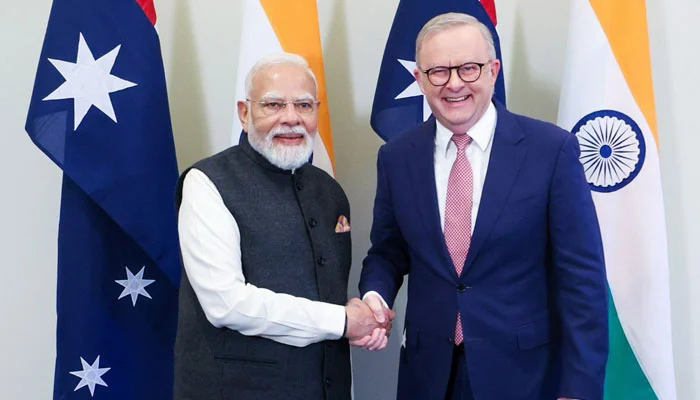
    Indian Prime Minister Narendra Modi met with Australian Prime Minister Anthony Albanese in Melbourne on July 9, 2026. — X/ @narendramodi

    – Exports will be regulated under safeguards set by the IAEA.
    – Both countries will collaborate to establish a temporary space tracking station.
    – Albanese commended Modi’s leadership for strengthening international relations.

    Modi announced during his visit to Australia that he secured a uranium supply deal, which is vital for advancing India’s nuclear energy goals. With an ever-growing demand for electricity, Modi plans to significantly expand nuclear power in the near future.

    Although Australia holds approximately 28% of the world’s uranium reserves, regulatory and political challenges have previously limited exports to India. “Today, we finalized an important nuclear agreement,” Modi stated after discussions with Albanese. “This paves the way for Australian uranium to support India and boosts our clean energy initiatives.”

    According to a joint statement, this agreement allows for long-term uranium exports strictly for peaceful purposes, with adherence to IAEA safeguards. Albanese emphasized, “This arrangement helps Australia increase its non-fossil fuel energy capacity.”

    A nuclear cooperation treaty signed in 2015 laid the groundwork for uranium exports between the two nations. Recently, their relationship has grown closer, partly driven by a shared interest in countering China’s military ambitions and expanding trade outside of China.

    The leaders also agreed to enhance defense cooperation and strengthen supply chains for critical minerals. Additionally, they plan to build a temporary space tracking facility on Australia’s Cocos Keeling Islands, which will support Indian space launches, according to the joint statement.

    Prime Minister Albanese appeared cheerful during a selfie moment with Modi earlier in the day. He has jokingly called Modi “The Boss,” suggesting he can draw larger crowds than U.S. rock star Bruce Springsteen.

    Albanese praised Modi’s role in boosting the partnership between the two countries, saying, “Your leadership and personal involvement have been central to these developments.”

    India’s diaspora in Australia has surged sharply, making it the largest overseas community in the country. Last year’s statistics confirmed that Indian-born residents now outnumber those from Britain—a significant demographic shift.

    Modi is expected to receive a warm welcome at an upcoming community rally in Melbourne, with organizers anticipating over 20,000 attendees. However, his visit is also likely to provoke opposition protests, including concerns over perceived radical Hindu nationalism at home. Australia’s Alliance Against Islamophobia plans to protest outside the rally, highlighting issues faced by minority groups in India.

    Anti-immigration demonstrators have also assembled beforehand, carrying signs like “Put Australians First.” After Australia, Modi is scheduled to travel to New Zealand.

  • World Bank Rescinds Ban on Nuclear Energy Funding

    World Bank Rescinds Ban on Nuclear Energy Funding

    Overview of the cooling towers and reactors at the Electricite de France (EDF) nuclear power plant in Cattenom, France, on June 13, 2023. — Reuters

    On Wednesday, the President of the World Bank, Ajay Banga, announced that the organization is re-entering the nuclear energy sector “for the first time in decades” in response to increasing electricity demands in developing nations.

    Banga communicated via an email to staff that the World Bank will collaborate with the International Atomic Energy Agency (IAEA) to bolster its advisory capabilities regarding non-proliferation safeguards and regulatory frameworks.

    In his memo, which was reviewed by AFP, Banga highlighted that electricity demand in developing nations is projected to more than double by 2035.

    Meeting this rising demand will require an annual investment surge in energy generation, grids, and storage from $280 billion today to approximately $630 billion.

    The World Bank plans to assist in extending the lifespan of existing reactors in countries that operate them and to promote upgrades to grid infrastructure.

    Additionally, Banga mentioned efforts to accelerate the deployment of Small Modular Reactors, making them a feasible option for more nations in the future.

    Since taking over the development lender in 2023, Banga has advocated for a shift in the bank’s energy policy. This announcement follows a board meeting that was held recenty.

    “Our aim is to help nations provide the electricity their citizens need while allowing them the flexibility to choose the development paths that align with their aspirations,” Banga stated.

    Along with enhancing grid efficiency, the World Bank will also continue to finance the decommissioning or repurposing of coal plants and support carbon capture technologies for both industrial and power generation purposes.

    In April, during the International Monetary Fund and World Bank’s spring meetings, U.S. Treasury Secretary Scott Bessent mentioned that the bank could optimize its resources by aiding emerging countries in increasing energy access.

    He emphasized the need for focusing on “reliable technologies” rather than pursuing “distortive climate finance targets,” which may lead to investments in gas and other fossil fuel energy production.

    Bessent also praised the bank’s move to lift restrictions on nuclear energy support.

    Beyond the change in nuclear financing, Banga revealed that the bank has yet to reach an agreement on whether to engage in upstream gas activities and the conditions under which they should proceed.

    The United States, the World Bank’s largest shareholder, has been vocal in urging the institution to reconsider its ban on supporting nuclear initiatives.