الوسم: North Korea

  • Trump Plans to Meet North Korea’s Kim in 2023

    Trump Plans to Meet North Korea’s Kim in 2023

    A South Korean soldier stands next to a television broadcasting a news report about a potential summit between North Korean leader Kim Jong Un and U.S. President Donald Trump at a train station in Seoul on October 22, 2025. — Reuters

    U.S. President Donald Trump announced on Wednesday that he plans to meet with North Korean leader Kim Jong Un later this year, highlighting that North Korea possesses 57 “very powerful” nuclear weapons.

    This statement followed Trump’s directive for Pentagon officials to shorten joint military exercises with South Korea, criticizing the drills as “totally inappropriate and hostile” messages to a country that has generally remained unthreatening and respectful.

    When asked if he expects to have a meeting with Kim this year, Trump replied, “Yeah, I will be.” He also mentioned having received a response from Kim after his efforts to re-engage. According to The Wall Street Journal, Trump has pressed aides to arrange an in-person meeting with Kim as early as this fall.

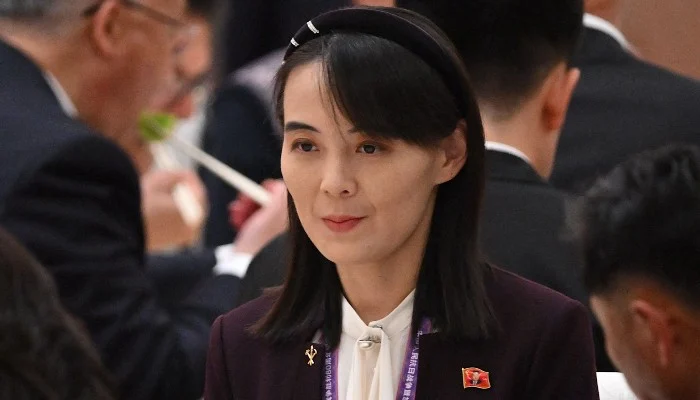
    North Korea’s U.N. mission in New York has not responded immediately to requests for comment. Their reactions came shortly after Kim’s influential sister, Kim Yo Jong, stated she was unaware of any recent communications between the two countries’ leaders. She added that while the U.S. and North Korea share a “truly great” relationship, Washington continues to conduct military drills with Seoul and poses a threat to North Korea’s security.

    Despite previous efforts — including summits in 2018 and 2019 that ultimately faltered over U.S. demands for North Korea to abandon its nuclear arsenal — diplomatic talks have stalled. Trump has repeatedly referred to North Korea as a “nuclear power,” even though his administration still advocates for denuclearization and does not officially recognize North Korea as a nuclear-weapon state.

    In his second term, Trump has sought to revive negotiations. During a tour of a helipad at the White House’s South Lawn, he told reporters, “I know Kim Jong Un very well, and he’s going to be fine as long as we have a smart president.” He also remarked, “The fact that I get along with him — that’s a good thing, not a bad thing. He has 57 very powerful nuclear weapons.” Trump added, “They should have never allowed it. If I were president, I wouldn’t have let him get them, but he’s got them.”

    This specific mention of North Korea’s nuclear weapons number was unusual, as the U.S. government does not regularly disclose official estimates. However, a 2025 Congressional Research Service report cited non-governmental experts estimating North Korea’s fissile material could support up to 90 warheads, with around 50 assembled. Similarly, the Stockholm International Peace Research Institute in June suggested North Korea might have around 60 warheads, with enough fissile material for at least 30 more.

    During Trump’s first term, Kim labeled Trump a “mentally deranged U.S. dotard” and threatened to use a “nuclear button” on his desk. Yet, the tension led to historic direct meetings, including Trump’s walk into North Korean territory at the Demilitarized Zone — first for a sitting U.S. president.

  • Trump Cuts Drills After South Korea Doesn’t Act Against Iran

    Trump Cuts Drills After South Korea Doesn’t Act Against Iran

    US President Donald Trump has directed the Pentagon to significantly scale back joint military exercises with South Korea. In a Sunday social media post, he also referenced Seoul’s decision to decline participation in actions against Iran.

    Just hours before the exercises were set to commence, Trump expressed on his Truth Social platform that, although canceling them altogether was no longer possible, he was unhappy with the previous US commitment to participate. The annual Ulchi Freedom Shield drills are scheduled from August 17 to 27, involving around 18,000 South Korean military personnel. These exercises are expected to include operations targeting drones, disrupting GPS signals, and countering cyberattacks to address North Korea’s advancing capabilities.

    Trump highlighted his “very good relationship” with North Korean leader Kim Jong Un in his post. He argued that the exercises are costly and send an “inappropriate and hostile” message to a nation that, according to him, has been non-threatening and respectful during his presidency. Additionally, he mentioned South Korea’s stance on the US-Israeli conflict with Iran. When asked if Seoul would join in the effort to denuclearize Iran, they reportedly declined, saying, “No thanks.”

    The White House and Pentagon did not immediately respond to requests for further details on Trump’s directive to reduce the military drills. North Korea routinely condemns the joint exercises as preparations for invasion. Last week, North Korea launched a ballistic missile from its eastern coast into the Sea of Japan, six days after a similar short-range missile test on August 6.

    U.S. military officials observe that North Korean forces, which have fought alongside Russia in Ukraine, have gained experience in modern warfare tactics including unmanned systems, electronic warfare, and cyber operations. Ukraine announced last week that North Korean-made missiles were used in a Russian missile strike targeting a steel plant in Zaporizhzhia, resulting in seven deaths and halting production, with Russia also deploying Zircon hypersonic missiles in the attack.

  • Kim Unveils 10,000-Tonne Warships and Nuclear Navy Plans

    Kim Unveils 10,000-Tonne Warships and Nuclear Navy Plans

    North Korea plans to arm its navy with nuclear weapons and construct larger warships, according to leader Kim Jong Un, as reported by state media Wednesday. Pyongyang continues to expand its military capabilities despite multiple international sanctions related to its nuclear program, which its leaders consider vital for deterrence against the United States and South Korea.

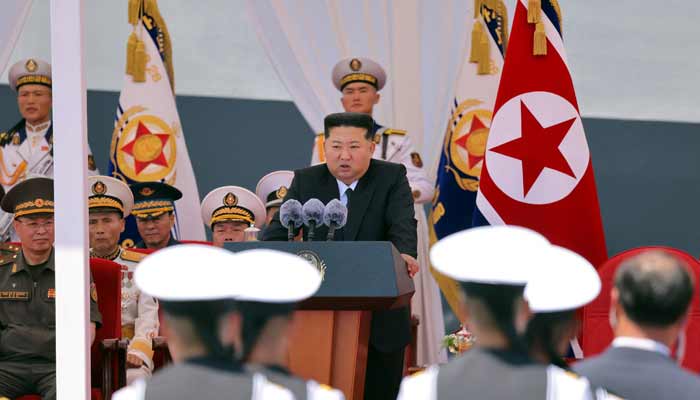
    Kim spoke at the commissioning of the Choe Hyon, one of two 5,000-ton ships launched last year, in Nampho port on Tuesday, as detailed by the official Korean Central News Agency. He stated, “The effort to equip our navy with nuclear weapons is progressing perfectly according to plan,” emphasizing that this strategy is crucial for maintaining a versatile and ready nuclear force.

    The Choe Hyon is described by North Korea as being armed with the most advanced weaponry. Kim supervised a cruise missile test from the vessel in April. He announced plans to soon commission the destroyer Kang Kon and, subsequently, to launch a series of 10,000-ton strategic warships one after another. The country aims to annually produce two surface ships larger than the Choe Hyon, including a 10,000-ton cruiser.

    A naval ship of this size, comparable to the U.S. Navy’s Arleigh Burke-class destroyers or South Korea’s Sejong the Great class, typically measures about 150-170 meters (roughly 492-557 feet), about the length of 1.5 football fields, and weighs several thousand tons. South Korea maintains a fleet with over ten ships exceeding 5,000 tons, whereas North Korea currently operates only two.

    Military analyst Choi Gi-il from Sangji University remarked that the deployment of such sizable ships signifies North Korea’s resolve not to lag behind South Korea’s maritime strength. Pyongyang has asserted itself as an “irreversible” nuclear power since the collapse of a 2019 summit with Donald Trump over denuclearization and sanctions easing.

    Despite ongoing hostility, North Korea remains technically at war with South Korea, as the 1950-53 conflict ended only with an armistice, not a peace treaty.

    Photos from the Korean Central News Agency show Kim saluting and delivering remarks from the Choe Hyon during the vessel’s commissioning, flanked by senior officials. Defense expert Lim Eul-chul noted that North Korea’s motives are primarily directed at signaling to the U.S., its main security partner for South Korea. “These weapons are part of an effort to deter or hinder U.S. military actions on the Korean Peninsula,” he said. Adding, “If North Korea deploys ship-launched cruise missiles with tactical nuclear warheads, it would significantly strain South Korea and U.S. military resources, increasing defense costs.”

    This announcement follows Kim’s recent discussions within the ruling party, where he pledged accelerated military modernization efforts and accused Seoul and Washington of bringing the peninsula “to the brink of nuclear war.” The U.S. station approximately 28,500 troops in South Korea to bolster defenses against North Korean threats.

  • Xi Jinping makes rare visit to North Korea

    Xi Jinping makes rare visit to North Korea

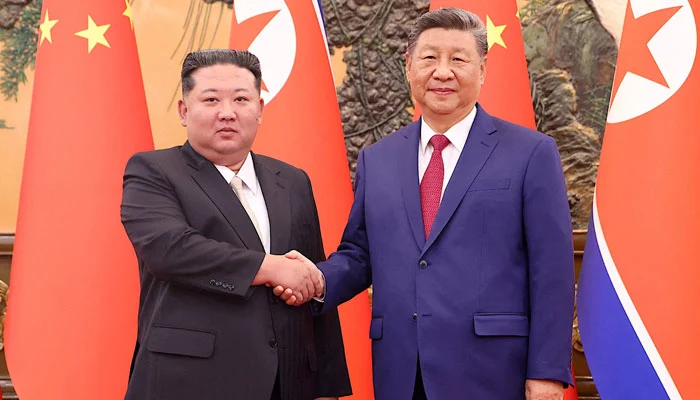
    China’s President Xi Jinping arrived in North Korea Monday, first trip abroad this year following numerous summits in Beijing. Xi praised a “formidable friendship” with Pyongyang, emphasizing their unbreakable bond. This visit underscores China’s longstanding role as North Korea’s primary trading partner and vital supporter despite international sanctions.

    Military personnel greeted Xi with a red carpet as his plane landed, and Kim Jong Un along with his wife Ri Sol-ju welcomed him. Children presented flowers, and banners celebrating China’s enduring alliance with North Korea were displayed beneath flags of both nations. Xi traveled accompanied by his wife Peng Liyuan for this significant visit, the first since 2019.

    During the visit, Kim’s sister reaffirmed North Korea’s commitment to its nuclear program, describing it as “the red line of no retreat.” Meanwhile, South Korea’s President Lee Jae Myung urged continued efforts towards denuclearization, noting that North Korea is actively producing nuclear material. Diplomacy experts suggest that Beijing might now accept North Korea as a nuclear state but will prioritize stability above all.

    Analysts believe China’s strategy has shifted towards ensuring regime durability over persuading North Korea to abandon its nuclear arsenal. Beijing appears to facilitate a stable, armed buffer zone that absorbs U.S. and allied military pressures, especially as North Korea resists international calls to denuclearize.

    Since the 2019 summit failure, North Korea has declared itself an “irreversible” nuclear power and has gained support from Russia amidst the Ukraine conflict, increasing its regional leverage. Some experts see Xi’s visit as a move to counter Russia’s influence over Pyongyang, but others point out that Moscow’s influence remains weaker compared to China’s.

    Xi wrote in North Korea’s official newspaper emphasizing the enduring “invincible” friendship between the two countries, regardless of changing international dynamics. His previous encounter with Kim involved inviting him and Putin to a military anniversary parade in Beijing, further highlighting military and diplomatic ties.

    South Korean guides and officials hope North Korea might adopt China’s development model, which could reduce tensions on the peninsula. Despite the lack of progress in U.S.-North Korea negotiations, North Korea’s exclusive military alliance with China offers strategic value as a regional counterbalance against U.S. partners like Japan and South Korea.

    Meanwhile, tensions in the region have intensified, especially with deteriorating China-Japan relations over Taiwan. Russian and Chinese interests seem aligned in maintaining stability and regional influence, with expert Lim Eul-chul observing that China is working to deepen its diplomatic engagement with North Korea as part of its broader regional strategy.

  • North Korea’s Nuclear Program: Declared Non-Negotiable by Leader’s Sister

    North Korea’s Nuclear Program: Declared Non-Negotiable by Leader’s Sister

    North Korea’s nuclear weapons program is “completely non-negotiable,” announced Kim Yo Jong, the influential sister of leader Kim Jong Un, in a statement published by state media on Sunday, just before Chinese President Xi Jinping’s visit. Pyongyang has consistently maintained its right to develop nuclear and missile capabilities, despite international sanctions set by the UN Security Council that prohibit such programs. The country officially recognized its nuclear status in its constitution in 2023.

    “Our position as a nuclear power is entirely non-negotiable,” Kim Yo Jong declared, emphasizing that North Korea “will not accept any threats.” As a key figure in the nation’s communication and foreign policy spheres, her remarks were released on the eve of Xi Jinping’s scheduled visit to North Korea from Monday through Tuesday, according to government sources.

    Beijing remains a critical supporter, providing political backing and economic resources to North Korea, which continues to face international diplomatic isolation and heavy sanctions. Xi’s visit marks his first in seven years and follows recent high-level summits he held with U.S. President Donald Trump and Russian President Vladimir Putin last month.

    Since the collapse of the 2019 summit with Trump over disagreements regarding denuclearization and sanctions relief, North Korea has steadfastly declared itself an “irreversible” nuclear state. The ongoing conflict in Ukraine has further emboldened Kim Jong Un, who received significant support from Moscow after dispatching thousands of troops to aid Russian forces.

    Over the weekend, Kim inspected a major munitions factory and instructed the facility to increase production capacity, according to a report by the official Korean Central News Agency (KCNA). He cited the need to “supply an ample amount of missiles” as the reason for boosting manufacturing.

    Kim Yo Jong also criticized the United States for claiming that its recent summit with Xi Jinping reaffirmed Washington’s goal of denuclearizing North Korea. She dismissed this assertion as false, stating, “Some U.S. officials remain in an outdated and fanciful dream,” and accused Washington of spreading “false information” as a routine tactic.

    She dismissed U.S. efforts to challenge North Korea’s nuclear status, asserting that such efforts “hold no legal weight.” She reaffirmed North Korea’s commitment to strengthening its self-defense nuclear capabilities, describing this policy as “irreversible” and essential to implement without fail.

    Expert Hong Min of the Korea Institute for National Unification explained that Pyongyang is highly sensitive to any indication of a US-China deal regarding North Korea’s denuclearization, interpreting Kim’s statements as a categorical rejection of rumors suggesting such discussions. It’s also plausible that North Korea confirmed with Beijing during planning for recent summits that no such negotiations had taken place.

  • Xi to Tour North Korea Next Week

    Xi to Tour North Korea Next Week

    Chinese President Xi Jinping is scheduled to visit North Korea next week, according to state media reports Friday. This visit marks a significant diplomatic move as Xi’s first trip to Pyongyang in seven years and his initial official international journey this year. The trip is set for June 8-9, prompted by an invitation from North Korean leader Kim Jong Un.

    Beijing plays a crucial role in supporting North Korea both politically and economically, with China accounting for up to 95% of North Korea’s total trade and 85% of its exports, based on 2022 data from a Washington-based think tank. Despite North Korea’s international isolation and sanctions, the country has strengthened its ties with Russia recently, especially following Russia’s invasion of Ukraine in 2022, with Pyongyang providing military support and aid in return.

    The upcoming summit signifies China’s increasing global diplomatic presence, coming after Xi hosted parallel summits with U.S. President Donald Trump and Russian President Vladimir Putin last month. Experts suggest Beijing aims to deepen its influence over Pyongyang, positioning North Korea closer within China’s broader diplomatic strategy.

    Xi last met Kim in September, during a military parade in Beijing honoring the 80th anniversary of Victory in World War II. Prior visits by Chinese leaders to North Korea, such as Hu Jintao in 2005, have been infrequent, with Xi and his wife Peng Liyuan visiting North Korea in 2019 to celebrate their “unbreakable friendship.”

    China’s foreign policy approach involves monitoring North Korea’s rapidly progressing nuclear program to prevent actions that could lead to regional instability or conflict, aligning with mutual interests. Kim Jong Un declared plans to significantly expand North Korea’s nuclear capabilities during a recent visit to a new atomic facility.

    South Korea’s government expressed hope that increased exchanges between North Korea and China could promote peace and stability, but North Korea continues to dismiss engagement efforts, viewing Seoul as its most hostile rival. Analysts interpret Xi’s diplomatic activity as part of China’s effort to position itself as a stable, strategic alternative to the U.S., with broader outreach to traditional U.S. allies such as the U.K. and France.

    However, the likelihood of Beijing facilitating a summit between Donald Trump and Kim Jong Un remains low, according to experts.

  • North Korea Launches Ballistic Missiles Amid Iran Conflict

    North Korea Launches Ballistic Missiles Amid Iran Conflict

    North Korea fired ballistic missiles into the ocean on Sunday, accelerating its missile testing amid rising tensions related to Iran’s conflict and rumors of potential meetings with the U.S. and South Korea. Pyongyang’s increased missile activity—this being the fourth launch this month and the seventh in the year—is viewed by analysts as a demonstration of its defensive strength and a move to strengthen its international standing.

    Experts suggest these missile tests serve to showcase North Korea’s self-defense capabilities, setting it apart from Iran, according to Kim Ki-jung, a former security adviser to South Korea’s president. “The missile launches could be a way for North Korea to prove that, unlike Iran, it possesses credible self-defense systems,” he explained. “It also seems designed to exert pressure and display strength ahead of any negotiations with the U.S. and South Korea,” he added.

    With the ongoing seven-week conflict between the U.S. and Israel against Iran—aimed at limiting Tehran’s nuclear ambitions—some speculate that North Korea’s nuclear program may be emboldened by the turmoil. Both U.S. President Donald Trump, during preparation for a summit in China next month, and South Korean leader Lee Jae Myung have shown interest in meeting with Kim Jong Un; however, no official plans have been announced.

    Sunday’s missile launches originated near Sinpo on North Korea’s eastern coast, traveling approximately 140 km (about 90 miles) before landing in the sea, South Korea’s military reported. Japan indicated that the missiles likely fell close to the Korean Peninsula’s eastern coast, with no impact on Japan’s exclusive economic zone confirmed. South Korea’s presidential office condemned the launches as provocative acts, violating UN Security Council resolutions, and called for Pyongyang to cease such actions.

    Details about the missile types remain unclear, but Sinpo hosts submarines and equipment capable of testing submarine-launched ballistic missiles. North Korea’s previous submarine missile launch occurred in May 2022, reaching distances of up to 600 km (around 370 miles). Additionally, the International Atomic Energy Agency’s chief, Rafael Grossi, noted that Pyongyang has made significant advances in nuclear weapon production, possibly including a new uranium enrichment facility. North Korean leader Kim Jong Un earlier in March affirmed the country’s irreversible nuclear status and emphasized the importance of expanding its “self-defensive nuclear deterrent” for national security.

  • Kim Reappointed as North Korea’s State Affairs President

    Kim Reappointed as North Korea’s State Affairs President

    North Korea’s legislature has re-elected Kim Jong Un as the country’s leader, according to state media reports on Monday. The announcement was made by KCNA, North Korea’s official news agency. Kim’s reappointment as chairman of the State Affairs Commission, which is the highest policymaking and governing body, was confirmed during the first session of the 15th Supreme People’s Assembly.

    Critics argue that elections in North Korea are heavily scripted, serving more as a show than an actual democratic process. KCNA stated, “The Supreme People’s Assembly of the DPRK reelected Comrade Kim Jong Un as President of the State Affairs of the Democratic People’s Republic of Korea during the First Session, marking the start of the 15th term.” The report added that this decision reflected the “unanimous will and desire of all the Korean people.”

    Kim, a third-generation ruler of the nuclear-armed nation founded by his grandfather Kim Il Sung in 1948, has been in power since 2011 following his father’s death. Experts such as Lee Ho-ryung from the Korea Institute for Defense Analyses view these elections as choreographed events with predetermined outcomes. She explained, “North Korea stages such events to project an image of political legitimacy, but no real change is expected.”

    Photos depict Kim dressed in a formal Western-style suit, seated centrally on a stage flanked by high-ranking officials, with large statues of his father Kim Jong Il and grandfather in the background.

    Ahead of the session, 687 deputies were elected to the assembly, with North Korean voters over 17 years old given the option to approve or reject the single candidate provided by the ruling party. The votes overwhelmingly supported Kim’s re-election, with 99.93% in favor and only 0.07% against, and a turnout of 99.99%, according to KCNA. The assembly was described as densely packed with members demonstrating “extraordinary political awareness and revolutionary enthusiasm.”

    Observers suggest that the current session may consider constitutional amendments, potentially including language to formally define inter-Korean relations as those between “two hostile states.” The tone used by Kim regarding South Korea during his speech will serve as an important indicator of his future policies toward the peninsula, according to Hong Min from the Korea Institute for National Unification. He said, “Changes in terminology from ‘reunification’ or ‘Korean unity’ to more aggressive language like ‘territorial control’ could reflect shifts in ideological stance.” The focus will likely be on how he addresses issues of territorial waters and airspace in dealings with Seoul.

    This session follows a larger, party-wide meeting held last month, which occurs every five years.

  • North Korea launches 10 ballistic missiles amid US-South Korea drills

    North Korea launches 10 ballistic missiles amid US-South Korea drills

    North Korea launched over ten ballistic missiles into the sea on Saturday, according to South Korea’s military. This occurred during joint military drills conducted by the U.S. and South Korea, with U.S. President Donald Trump re-engaging in diplomatic efforts with Pyongyang.

    Japan’s coast guard reported detecting perhaps a ballistic missile that landed in the ocean, likely outside Japan’s exclusive economic zone, as per NHK, citing military sources.

    The missiles were fired from near Pyongyang around 1:20 p.m., targeting waters off North Korea’s east coast, South Korea’s Joint Chiefs of Staff announced. North Korea has been testing a variety of ballistic and cruise missiles for more than twenty years, striving to develop nuclear delivery capabilities, which it is believed to have accomplished.

    Despite multiple United Nations Security Council sanctions imposed since 2006, Pyongyang continues to defy international pressure, facing significant economic and trade restrictions.

    This week, South Korea and the United States launched their annual large-scale military exercises, emphasizing their defensive purpose—focused on evaluating readiness against potential North Korean threats.

    On Saturday, hundreds of U.S. and South Korean troops participated in river-crossing maneuvers, utilizing tanks and armored vehicles, led by the commanding officer of their combined forces. The U.S. has approximately 28,500 military personnel and numerous fighter jets stationed in South Korea.

    North Korea often protests these exercises, viewing them as rehearsals for potential aggression by the allies.

    Earlier in the week, South Korea’s Prime Minister Kim Min-seok met with President Trump in Washington, discussing strategies to reopen dialogue with North Korea. Trump expressed a strong interest in meeting with North Korean leader Kim Jong Un, which Kim conveyed to reporters.

  • North Korea Train to Leave Beijing After 6-Year Pause

    North Korea Train to Leave Beijing After 6-Year Pause

    Passenger train services between China and North Korea are set to restart Thursday after a six-year break, according to railway authorities and travel agencies. The service was halted in 2020 due to strict border closures aimed at preventing the spread of COVID-19.

    China is North Korea’s main trading partner and a key supporter politically, economically, and diplomatically. The resumed train routes will start with a service from Beijing to Pyongyang, departing Thursday evening. The K27 train will make stops at Tianjin, a port city, before heading northeast to Dandong, a Chinese border city adjacent to North Korea.

    From Dandong, passenger cars destined for Pyongyang will be combined with another train, crossing the border to Sinuiju, a North Korean city nearby, explained Rowan Beard from Young Pioneer Tours, a company specializing in North Korea travel. The wagons and North Korean domestic carriages will be linked to a new train, which will then proceed to Pyongyang, arriving Friday evening, according to China Railway.

    There will also be a daily service between Dandong and Pyongyang. Travel agencies in Beijing confirmed that anyone with a valid visa can now purchase train tickets to North Korea, including Chinese nationals working or studying there and North Koreans abroad visiting family or working.

    Trains will operate both ways on Mondays, Wednesdays, Thursdays, and Saturdays, with procedures handled at the Dandong border and at Sinuiju in North Korea. Tickets are presently available for purchase offline in several Chinese cities.

  • North Korea launches missiles, condemns US Venezuela actions

    North Korea launches missiles, condemns US Venezuela actions

    North Korea fired ballistic missiles on Sunday, coinciding with South Korea’s president beginning a official visit to China and shortly after the U.S. launched an attack on Venezuela. The missiles traveled approximately 900 to 950 kilometers into the East Sea, marking North Korea’s first missile tests in two months. The international community views these actions as escalations, especially amid recent U.S. military operations in Venezuela that resulted in the detention of Venezuelan President Nicolas Maduro.

    North Korea condemned the U.S. intervention, accusing Washington of violating Venezuela’s sovereignty and characterizing the U.S. as a rogue nation. The missile launches occurred just as South Korean President Lee Jae Myung started a diplomatic trip to China, aiming to foster peace on the Korean Peninsula through talks with President Xi Jinping.

    Analysts interpret these missile tests as a signals aimed at China, urging closer cooperation and warning against strengthening South Korea’s ties with the U.S. and Japan. Lim Eul-chul, a professor at Seoul’s Institute for Far Eastern Studies, remarked that North Korea is sending a message that separates itself from Venezuela, emphasizing its military strength and readiness to respond with aggressive deterrence if necessary.

    Kim Jong Un, North Korea’s leader, has been actively boosting the country’s missile and weapons capabilities in the lead-up to this year’s Ninth Party Congress, including visits to weapons factories and a nuclear submarine, and overseeing missile tests. South Korea anticipates China will play a constructive role in promoting stability on the peninsula, although details regarding the summit remain undisclosed. Experts believe President Lee’s discussions with Xi are focused on encouraging China to facilitate dialogue with North Korea, especially since Pyongyang has dismissed recent outreach efforts.

  • South Koreans can now access North Korea’s newspaper, previously banned

    South Koreans can now access North Korea’s newspaper, previously banned

    North Korea’s main newspaper has traditionally been a source of fiery missile test coverage, propaganda praising the country’s leaders, and bitter rhetoric against the United States. It was once so controversial that South Korea prohibited its citizens from reading it.

    Recently, however, a shift in approach is underway. South Korean President Lee Jae Myung, known for his more conciliatory stance, joked that reading Rodong Sinmun—meaning “Workers’ Newspaper”—won’t turn the public into communists. As a result, from this week, South Koreans are now permitted to access the publication at certain public locations without needing government approval.

    Individuals no longer have to register or explain their purpose for viewing the paper; they only need to visit select libraries to read it. Opinions in Seoul about this policy change are mixed. Critics like 22-year-old university student Park Si-won liken it to allowing access to terrorist propaganda, implying it could encourage radicalization. Conversely, elder Seoul resident Hong Se-wung finds the decision unsettling, viewing it as dangerous to promote reading material from a hostile neighboring country.

    Many others believe that most South Koreans won’t bother going out of their way to read Rodong Sinmun, with 27-year-old graduate student Son Yu-jin noting that fewer people read physical newspapers nowadays.

    This move is largely symbolic, given the ongoing strict controls. North Korean websites remain inaccessible from South Korean IPs, and the two nations are still technically at war. But on Friday, AFP journalists observed a few visitors flipping through copies of the North Korean paper at the national library, noting its images of Supreme Leader Kim Jong Un, whose name is always prominently displayed. Nevertheless, during their visit, staff at other libraries indicated the new access policies haven’t been widely implemented yet.

    Expert Chad O’Carroll suggests that this change is more about signaling a willingness to open doors rather than a significant policy overhaul. Facilitating access to North Korean state media could benefit researchers, but doing so would require politically sensitive adjustments to South Korea’s security laws.

    Seoul is promising to gradually expand information sharing about North Korea to foster better relations, although the North continues to block South Korean content and punishes those who attempt to access it.

    South Korean officials view the easing of Cold War-era censorship as an opportunity for citizens to gain a clearer understanding of North Korea’s realities. Bae Jee-woo, a businesswoman, expressed confidence that South Koreans will interpret North Korean propaganda through their own perspectives and that such material isn’t likely to have a significant influence on them.

  • North Korea Confirms Troops Cleared Mines for Russia

    North Korea Confirms Troops Cleared Mines for Russia

    North Korea’s leader Kim Jong Un stated that nine soldiers lost their lives during a 120-day mission, and state honors were bestowed upon members of the fallen engineering unit. Some returning troops appeared wounded and in wheelchairs. Kim praised their efforts in a speech, highlighting that they wrote “letters to their hometowns and villages during breaks from mine clearance.”

    Kim emphasized the bravery of the soldiers, noting their achievement in transforming a dangerous zone into a secure area in less than three months. Photos from the Korean Central News Agency (KCNA) show Kim in a joyful embrace with returning soldiers, many visibly injured or in wheelchairs. At the ceremony in Pyongyang, Kim also paid tribute to the fallen soldiers by kneeling before a portrait of the deceased and placing medals and flowers beside their images. He reflected on the “pain of waiting” for 120 days, never forgetting the valiant sons.

    In September, Kim joined China’s Xi Jinping and Russia’s Vladimir Putin at a grand military parade in Beijing. He opted not to accept an invitation from former U.S. President Donald Trump to meet during his Asia tour in October. North Korea officially acknowledged in April that it had deployed troops to support Russia, with some soldiers killed in action. Previously, in August, images showed Kim emotionally honoring coffins of fallen soldiers and embracing a returned soldier who appeared overwhelmed.

    Throughout this period, Kim’s emotional engagement with returning troops and families underscores the significance of their sacrifice amidst ongoing international tensions.

  • Kim Says North Korea Can Talk to US if Denuclearization Demand Ends

    Kim Says North Korea Can Talk to US if Denuclearization Demand Ends

    North Korean leader Kim Jong Un stated that he is open to talks with the United States if Washington ceases its demand for denuclearization, but insists that his country will never relinquish its nuclear weapons to lift sanctions. According to state media, Kim mentioned during the Supreme People’s Assembly on Sunday, “I still cherish good memories of U.S. President Trump,” recalling their three meetings during Trump’s administration.

    Kim emphasized that there is no reason to avoid dialogue if the U.S. drops its irrational obsession with forcing North Korea to denuclearize and recognizes the reality of the situation. He asserted that the country developed nuclear weapons as a matter of survival in response to perceived threats from the U.S. and South Korea, citing ongoing military drills by the allies which he claims have transformed into preparations for nuclear war.

    He criticized recent overtures from Washington and Seoul, describing them as insincere efforts aimed at weakening North Korea and toppling his regime, citing South Korea’s phased proposal to end North Korea’s nuclear program as proof. Kim declared, “The world already knows what the U.S. does once a country disarms. We will never surrender our nuclear capabilities.”

    Kim made it clear that negotiations are not an option for eternity, stating, “There will never be, and will never ever be for eternity, any negotiations with enemies over some obsession with lifting sanctions.” He claims sanctions have only served to strengthen his country and make it more resilient, despite ongoing UN Security Council resolutions that have restricted funding for military development, which North Korea continues to advance.

    South Korean President Lee Jae Myung recently told Reuters that these sanctions have failed to deter North Korea, which is reportedly increasing its stockpile of nuclear weapons by 15 to 20 every year. Lee acknowledged that previous strategies based on sanctions and pressure have worsened the situation and highlighted the need for renewed dialogue, proposing steps toward confidence-building and eventual denuclearization.

    Lee also noted that although there are significant challenges to restarting talks with North Korea, a phased approach to dismantling Pyongyang’s nuclear program remains the most realistic option, with the involvement of former President Trump playing a crucial role in creating the right conditions for dialogue.

  • Kim Promises North Korea’s Full Support to Russia

    Kim Promises North Korea’s Full Support to Russia

    North Korean leader Kim Jong Un has expressed full support for Russia’s military efforts, calling it a “fraternal duty,” according to North Korea’s state media KCNA on Thursday.

    Kim made this commitment during discussions with President Vladimir Putin in Beijing, where both leaders attended a grand military parade alongside Chinese President Xi Jinping.

    The meeting took place on Wednesday, on the sidelines of China’s celebration marking Japan’s surrender in World War II in Beijing. Kim and Putin also met privately and joined Xi Jinping at the massive military display—the first time since the early Cold War era that the leaders of these three nations gathered in such a setting.

    Kim’s visit to Beijing provided his first opportunity to meet both Putin and Xi simultaneously, as well as to interact with over twenty other world leaders present at the event.

    Photos released by state media depicted Kim walking and standing alongside Putin and Xi, all smiling.

    “Comrade Kim Jong Un and President Putin exchanged frank views on significant global and regional issues,” KCNA reported.

    Putin “highly praised” North Korean troops fighting in Ukraine and stated that the relationship between Moscow and Pyongyang is based on “special trust, friendship, and alliance,” KCNA added.

    North Korea has supplied soldiers, artillery shells, and missiles to Russia to support its campaign against Ukraine. South Korean intelligence estimates that approximately 2,000 North Korean soldiers fighting for Russia have been killed so far.

    It’s believed that North Korea plans to send an additional 6,000 troops, with roughly 1,000 combat-ready soldiers already stationed in Russia.

    The two leaders discussed their long-term strategic partnership and reaffirmed their unwavering commitment to strengthening bilateral ties, according to KCNA. Last year, they signed a mutual defense treaty pledging mutual assistance in the event of an armed attack.

  • Kim Jong Un Lands in China for Summit

    Kim Jong Un Lands in China for Summit

    A train carrying North Korean leader Kim Jong Un crossed into China early Tuesday, according to South Korea’s Yonhap news agency, citing North Korea’s state radio. This is an uncommon journey outside North Korea for Kim, who is among 26 world leaders expected to attend a military parade in Beijing commemorating the 80th anniversary of Japan’s surrender in World War II. If everything goes as scheduled, this visit will mark the first time Kim, Russian President Vladimir Putin, and Chinese President Xi Jinping appear together at the same event.

    On Monday, Xi and Putin exchanged criticisms of the West at a summit of Eurasian leaders in Tianjin, located south of Beijing. The Shanghai Cooperation Organization (SCO) promotes itself as a non-Western coalition of ten regional countries, aiming to provide an alternative to traditional alliances. Soo Kim, a geopolitical risk analyst and a former CIA operative, noted that Kim’s participation “solidifies the China-Russia-North Korea trilateral relationship” in the public eye.

    Kim experienced a period of intense international diplomacy around 2018, with several meetings involving then-U.S. President Donald Trump and South Korean President Moon Jae-in. However, after the Hanoi summit with Trump in 2019 broke down, Kim retreated from the global stage. He remained in North Korea during the COVID-19 pandemic but met with Putin in Russia’s Far East in 2023.

  • Putin and Kim Jong Un Join Chinese Parade as Western Protest Fades

    Putin and Kim Jong Un Join Chinese Parade as Western Protest Fades

    A collage depicts Russian President Vladimir Putin, Chinese President Xi Jinping, and North Korean leader Kim Jong Un, as reported by Reuters. Xi is scheduled to oversee military personnel and equipment at Tiananmen Square. The upcoming parade commemorates the anniversary of Japan’s surrender in World War II, observed on September 3. Notable leaders from Belarus, Iran, Indonesia, and Serbia are expected to attend.

    In Beijing, both Vladimir Putin and Kim Jong Un will make their first public appearance alongside President Xi Jinping in a display of unified resistance amid Western diplomatic and economic scrutiny. Unlike previous events, no Western heads of state or government will join, except for Slovakia’s Prime Minister Robert Fico, representing the European Union.

    This parade, set against China’s expanding military capabilities, emphasizes solidarity not only between China and the Global South but also with Russia and North Korea, both subject to extensive Western sanctions. Russia’s economy has been strained since its 2022 invasion of Ukraine, and Putin, who is wanted by the International Criminal Court, last visited China in 2024. North Korea, under UN sanctions since 2006 due to nuclear and missile development, last sent Kim to China in January 2019.

    Leadership from Belarus, Iran, Indonesia, and South Korea, along with Serbia’s President Aleksandar Vucic, will attend the event. The United Nations will be represented by Under-Secretary-General Li Junhua, a seasoned diplomat and former Chinese ambassador.

    On parade day, Xi will review thousands of troops in Tiananmen Square with international officials and senior Chinese officials present. The event will be one of China’s most grandiose in recent years, showcasing advanced military technology including fighter jets, missile defense systems, and hypersonic weapons.