الوسم: Necropolis

  • Top Necropolis Heroes in HoMM: The Olden Era of Completing & Solving

    In Heroes of Might and Magic: Olden Era, Necropolis is a faction that grows stronger through stacking advantages. Necromancy turns enemy deaths into reinforcements after each battle, while the Undead Transformer converts neutrals or recruited allies gained through Diplomacy into faction units. The hero you choose impacts which of these systems activates first, how quickly they improve, and how safely you can get through the early, risky parts of the game before the faction’s momentum becomes self-sustaining.

    The faction features 18 heroes divided into two classes—Death Knight (Might) and Necromancer (Magic). All heroes start with Necromancy as a skill; choosing a different second skill is the main way heroes differ.

    Note: Heroes of Might and Magic: Olden Era is currently in Early Access, so details may change with future updates.


    How the Tier List Works

    The rankings consider three main factors: the effect of the hero’s second starting skill on Necropolis’s core mechanics (like Necromancy scaling, army pace, spell control, or economic growth); the hero’s strategic value across the entire game, not just at the start; and access to subclass paths, since heroes with prerequisites can have an advantage in a system with random skill rolls.

    A hero who speeds up Necromancy’s snowball or shores up the faction’s early weaknesses ranks higher than one whose benefits only kick in later or depend on conditions.

    Tier Definitions:

    • S Tier: Heroes with initial skills that directly boost Necropolis’s main engines or provide early combat options the faction needs.
    • A Tier: Heroes who identify strong, reliable strategies suited to specific playstyles or goals.
    • B Tier: Heroes with clear roles and viable paths, but without the immediate, game-changing advantages of higher tiers.
    • C Tier: Heroes with situational or secondary strengths, often less effective as primary choices.

    S-Tier Heroes

    Necropolis city in Heroes of Might and Magic Olden Era

    Hero Class Starting Skill Why They’re Top Tier
    Funerella Necromancer Advanced Necromancy Starts with her Necromancy at a higher tier from Day 1, rapidly accelerating her ability to raise armies and snowball her strength. Her main weakness is early fights, where her advantage isn’t yet realized.
    Kel’Ghul Death Knight Tactics Begins with Dread Knights in his army, units usually impossible to get early without weeks of effort. This allows him to start expanding immediately and handle fights that other heroes can’t.
    Artorius Veritas Death Knight Resistance Has a starting spell, Masterful Berserk, which neutralizes high-initiative enemies early on, giving his melee army a fighting chance against threats that normally would be dangerous for early skeleton squads.

    Funerella is the default choice for most Necropolis builds focused on Necromancy. Her early advantage in reaching higher Necromancy tiers speeds up army growth, giving her a decisive edge as the game progresses. Her vulnerability is early combat, but once the snowball is rolling, she’s very powerful.

    Kel’Ghul’s immediate access to Dread Knights makes him unique. Typically a late-game unit, getting them from Day 1 transforms his early game. His ability to handle early fights well and gain momentum sets him apart.

    Artorius Veritas addresses a critical problem: weak early combat due to lack of ranged units. His starting spell, Masterful Berserk, allows him to neutralize threats efficiently, making his army safer in the initial battles.


    A-Tier Heroes

    Necropolis recruitment screen

    Hero Class Starting Skill Why They’re Valuable
    Mag Necromancer Arcane Magic Turns Necropolis into a spellcasting faction, adding levels to all Arcane spells from the start and locking out opponents from that magic school.
    King-of-Kings Death Knight Diplomacy Focuses on converting neutral units into undead via Diplomacy, creating a high-output economic engine that can surpass Necromancy growth if map conditions are right.
    Marl Death Knight Logistics Uses Web to slow enemies from the start, while Logistics improves map efficiency every day. She’s versatile and reliable for broad strategies.

    While S-tier heroes have early-game dominance, A-tier heroes lead different strategic paths—whether spellcasting, diplomacy-based economy, or map control. The choice of hero often depends on playstyle rather than raw power.


    B-Tier Heroes

    Necropolis army fighting

    Hero Class Starting Skill Why They’re Useful
    Ethric Necromancer Wisdom Starts as a lich specialist with Liches in his opening army — addresses early weakness with ranged AoE.
    Lord Rufus Necromancer Thaumaturgy His Rewind Life skill revives units beyond their original size, fostering late-game stack growth.
    Bulwark Death Knight Defense Has passive damage reduction across his army, making him a durable frontline hero early on.
    Onkos Death Knight Offense Supports Necropolis’s primary scaling unit, Skeletons, directly supporting early army growth.
    Tarius Death Knight Advanced Necromancy Similar Necromancy start as Funerella but with a Might focus, providing a good early boost, just with a lower ceiling.

    B-tier heroes have specific strengths but don’t drastically alter early game or become game-changers on their own.


    C-Tier Heroes

    Levelling up Necropolis hero

    Hero Class Starting Skill Why They’re Less Impactful
    Shadespinner Oona Necromancer Nightshade Magic Useful against certain tough opponents with sleep control, but limited in broad application.
    Milossa the Golden Necromancer Battle Magic Boosts crits and subclass paths, but less influential overall.
    Laura Necromancer Sorcery A DoT-focused hero whose power is situational, not game-changing.
    Adahn Necromancer Recruitment Helps with town growth but doesn’t significantly impact early combat strength.
    Zam Death Knight Battlecraft Provides resource management but minimal combat benefit.
    Guildmaster Klastor Death Knight Luck Aiming for early-unit boosts but limited overall potential.
    Natalida Death Knight Scouting Useful for reconnaissance but less relevant as a primary hero.

    C-tier heroes are helpful in niche situations or secondary roles but don’t offer the direct, game-changing advantages of higher tiers. They may serve well in specific strategies but are typically not primary picks.


    Summary:
    Heroes like Funerella, Kel’Ghul, and Artorius Veritas stand out for their powerful early-game advantages or addressing core faction weaknesses, making them top choices. Other heroes excel in distinct strategic directions or support roles but lack the immediate impact to challenge them at the top.

  • How to Play Necropolis in HoMM: The Art of Completing and Solving

    How to Play Necropolis in HoMM: The Art of Completing and Solving

    The Necropolis faction in Heroes of Might and Magic: Olden Era is suited for players who prefer patience and strategic planning. These players win by building up advantages over time, rather than by rushing into fights. Led by the Necromancers’ Guild in Shadowspire, the focus of Necropolis armies is on the dead—raising and growing them to dominate battles.

    The main mechanic is Necromancy: after each battle, a certain percentage of enemy health points (HP) is converted into undead reinforcements. This means every fight makes your army stronger, regardless of whether you win easily or struggle. The overall goal is straightforward but difficult to master: survive the early, vulnerable phase, set up the Skeleton Archer engine, and allow your army to snowball into an unstoppable force by mid-game.


    Overall Strategy Tips

    Necromancy increases after each victory as fallen enemies are turned into undead units, and the amount gained depends on surviving high-HP neutral stacks, not just numbers. Larger, high-health enemy units give more reanimation value than numerous fragile units. Keep this in mind when choosing which battles to take.

    Native terrain is rare for Necropolis. On some maps, terrain bonuses and initiative can boost Necromancy growth, but these maps are exceptions. Most maps have limited native land, so planning around the Terra Mortis law is essential to maximize terrain benefits.

    Necromancy relies on resources, especially Gems and Crystals, needed for top-tier undead structures. While the Necromancy process reduces unit losses over time, expect to need resource control, especially on the Lich and Vampire structures, if you lack active mines during the mid-game.

    The Undead Transformer is a crucial tool. It converts neutral creatures or those recruited through Diplomacy into Necropolis units, turning creature hut visits and neutral recruits directly into army assets. Consider it a core growth engine for your strategy.

    On maps with low neutral army density, Necromancy builds slowly. Without regular large encounters, your ability to scale the undead army can be delayed.


    Best Necropolis Laws

    Laws are a passive progression system funded by Law Points gained through battles, mine captures, and town features. Necropolis has some strong options:

    • Laws of the Immortals: Increase Law Point generation from your cities by 20%. The earlier you choose this, the more total points you’ll earn across the game, giving you more options later.
    • Terra Mortis: Boosts your heroes’ native terrain bonuses, even when fighting off native land. Since map native land is often limited, this law ensures terrain advantages are always active, making it a valuable mid-game choice.

    Other laws include:

    • Moon’s Grace: Raises the level of Nightshade spells your heroes cast by one, which benefits Death Knight builds with Nightshade Magic.
    • Bloodthirst: Boosts vampirism by 50%, enhancing Vampire durability late in the game. Best when Vampires are already in your army and you’ve established a stable economy.

    Best First Week Strategy

    The first week is critical and risky for Necropolis. Your starting army is melee-focused with no ranged units until Skeleton Archers are built—making early fights dangerous. The main priority is to reach Skeleton Archer upgrades as soon as possible.

    Days 1–2: Focus on building toward Skeleton Archer upgrades. Avoid recruiting aggressively before the upgrade is available, as losing Skeletons in melee fights reduces Necromancy potential and can be costly.

    Days 3–4: Once Skeleton Archers are available, upgrade your Skeleton stacks. The upgrade costs about ten gold per unit, so be cautious if resources are tight—upgrading ten Skeletons costs 100 gold. If upgrading helps you win upcoming fights with fewer losses, it’s worth the investment. Delay if gold is needed for essential structures.

    Days 5–7: Only build the Marketplace if it immediately resolves resource shortages for upcoming structures. Start working toward Mage Guild for spell support. If your Skeleton army is stable, plan to build Lich or Vampire structures, but don’t rush them at the expense of your current army.

    Resource priorities: Focus on Skeleton Archer buildings first, then upgrade Skeletons, followed by resource-generating structures, and finally creature buildings. Play conservatively—avoiding fights that cost too much of your Skeletons, as heavy losses slow Necromancy growth.


    Army Composition Tips

    • Skeletons are the foundation, cheap and high in number. Upgrading them to Skeleton Archers transforms them from melee fighters into powerful ranged units.
    • Wraiths provide a partial life drain and can serve as frontline damage sponges, absorbing hits that Skeleton Archers should avoid.
    • Dread Knights lead the front lines before Vampires become available, especially if your hero starts with this unit. They boost early game viability and help clear maps.
    • Vampires are the late-game reward. Their life drain makes them extremely tough in prolonged fights, but build toward them only after your Skeleton engine and resource economy are stable, not as an early panic move.

    Liches are valuable for area damage and debuffing, and their skill Rewind Death restores HP and revives units. Save Focus Charges for this ability as preventing unit losses is always worth more than marginal spell uses.


    Hero Strategies

    Necropolis heroes have differing magic focuses: Necromancers lean toward Arcane Magic, while Death Knights prefer Nightshade Magic. Prioritize building a Mage Guild early, as spells like Slow and Blind are crucial against armored factions and to control the battlefield.

    In most cases, developing a magic hero is best since spells and Necromancy are key to scaling your army. A Might hero can certainly work but doesn’t capitalize on Necropolis’s strengths.

    Recommended heroes: Funerella (if favoring Magic), who starts with Advanced Necromancy, accelerating your scaling; and Artorius (for Might), with Masterful Berserk, a powerful control spell that can neutralize threats early on.


    Single Hero Mode Tips

    Necropolis performs well under single hero conditions because its Necromancy snowball doesn’t require a second hero to operate. The main challenge is army feeding: without a secondary hero gathering resources and creatures, you must rely more on the Undead Transformer, making careful fight choices vital.

    Diplomatic recruitment via King-of-Kings is especially valuable here. It compensates for the lack of a second hero by converting neutral creatures into army units, strengthening your force directly. If playing single hero, choosing a hero like King-of-Kings can help offset the reduced input and keep your army growing steadily.

  • Escaping the Necropolis: Indiana Jones and the Great Circle

    Escaping the Necropolis: Indiana Jones and the Great Circle

    Just like any thrilling Indiana Jones story, Indiana Jones and the Great Circle is packed with adventures that take our hero through caves and hidden tombs. Before he makes his way to Gizeh, Indiana will navigate the Necropolis in The Vatican. However, as he’s trying to find his way out, things take a turn for the worse when he gets thrown down into the depths of the Necropolis and must begin exploring to escape.

    After wrapping up the Sacred Wounds puzzle, the last thing you expect is for a man in a bulldozer to crash through the roof. Now, your mission is to track a precise route to escape the Necropolis and reach the light of day again.

    How to Escape the Necropolis


    After the unexpected bulldozer crash, exit the room where you landed and move through the corridors, passing the Necropolis statues. Duck down and go through the water under the gap you can swing over.

    Swim into the bigger chamber and jump up onto the small platform before heading to the other broken corner to squeeze through the gap and get back on dry ground.

    Don’t forget to snap a picture of Oceanis on your left as you jump onto the small platform in the water.

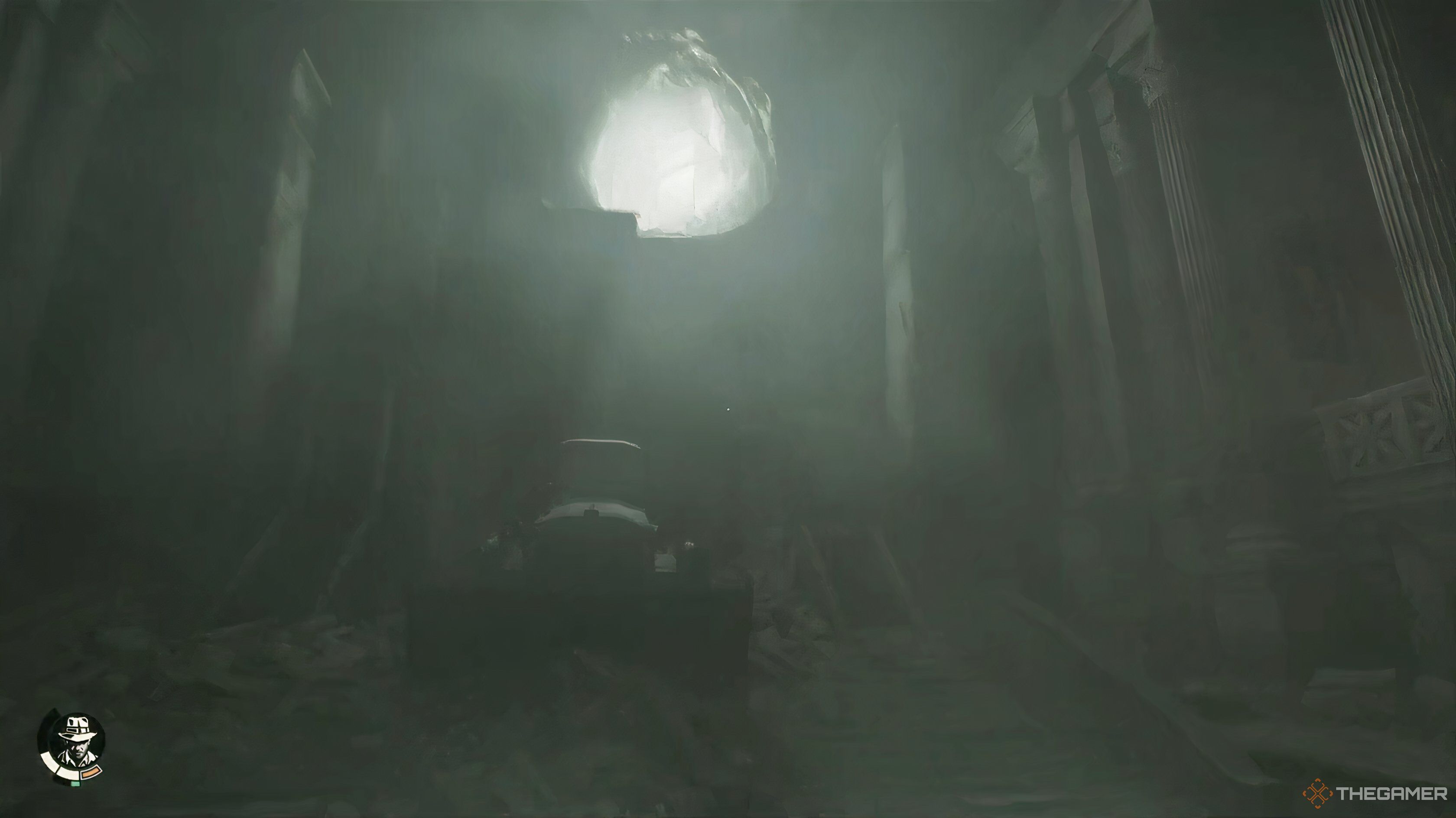
    Keep moving until you spot a glow of light ahead. You’ll need to encounter or avoid a few enemies here. Now, go into the room on the left and descend to another level of the Necropolis.

    Follow the corridors until you reach a gap in the floor with two wooden planks. Walk down them and crawl through the opening on the right, where more enemies await. Since they are numerous, you might want to bypass them instead of confronting them directly.


    A chandelier over a gap in Indiana Jones and the Great Circle.

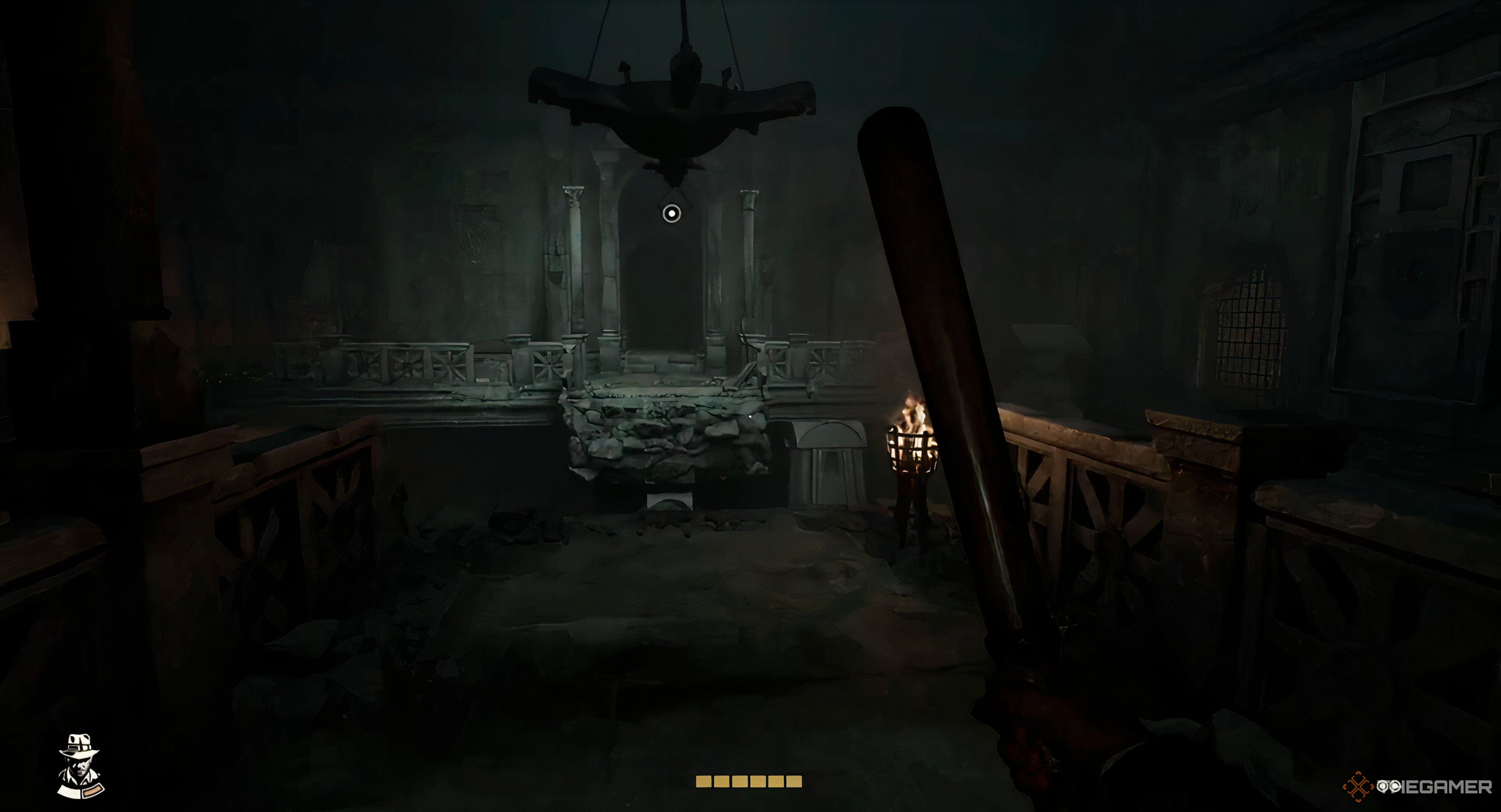
    In this room, stay to the right and take the corridor that leads up the stairs until you reach the big chandelier at the center. From there, swing over and head right into another room with two enemies. One of them should be sitting down, making it easy to deal with.

    If a fight breaks out in the main room, the two enemies in the adjacent room will remain unaware of your presence.

    Pick up the bust on the floor and place it on the pedestal to unlock the door. Then crawl through the left gap, remembering to snap a picture of the lover’s tomb as you go.

    Next, use the grapple point to climb up twice, swinging to a gap in the wall during the second climb. You’ll find a pedestal on the left side, as well as another one farther along. Grab the bust and transfer it to the other pedestal. Go into the next room and secure a two-handed weapon to break down the damaged wall.


    A bust on the floor in Indiana Jones and the Great Circle.

    There’s yet another bust in that room, so place it on the pedestal to unlock the door and collect an Ancient Relic. Afterward, retrace your steps and crawl down toward the water.

    On the opposite side of the room, you’ll find a gate with an enemy lurking nearby. You can use your whip to pull it open. Once you’re through, you can choose how to deal with the enemies to reach the bulldozer you saw crash earlier. Climb up the front of it while keeping out of sight from any foes.


    The Necropolis exit in Indiana Jones and the Great Circle.

    Once you’ve climbed onto the vehicle, use your whip to continue up and make your escape from the Necropolis as you proceed further into Indy’s journey.

  • Mastering the Necropolis Bells Puzzle in Dragon Age: The Veilguard

    Mastering the Necropolis Bells Puzzle in Dragon Age: The Veilguard

    In Dragon Age: The Veilguard, one of the essential aspects of gameplay is solving puzzles and collecting new equipment from chests to enhance Rook and your team throughout the game. One such challenge is the Necropolis Bells puzzle, which offers two exclusive gear pieces that are easy to overlook if you bypass it.

    This puzzle is not overly complicated; you just need to locate and ring five bells in a designated order indicated by symbols carved on five stones at a locked door. This guide will help you successfully complete the Necropolis Bells puzzle.

    Location of the Necropolis Bells Puzzle

    To get to the Necropolis Bells puzzle, you first need to recruit Emmrich to your party during a story mission. Once you’ve done that, venture to the end of the "Vault of the Beloved" hallway where you’ll encounter a locked door. This door unlocks after you finish the side quest Walking the Graves that involves Emmrich.

    When you complete that side quest, you’ll gain access to the Memorial Garden area within the Necropolis, where the Necropolis Bells puzzle awaits you.

    How to Solve the Necropolis Bells Puzzle

    To solve the Necropolis Bells puzzle, you need to ring five bells located in the Memorial Gardens of the Necropolis in a specific sequence.

    Tip: If you ring the bells in a random order, you will reset the puzzle.

    Each bell features five stones that display symbols correlating to the symbols found on the locked door adjacent to the first bell. Ringing the bells in the correct sequence will open the door, revealing two chests. To start, ring the bell corresponding to the top symbol on the first bell, then continue according to the symbols down the five-symbol sequence.

    The first bell is located right by the locked door. To activate it, use Emmrich’s Placate Mischief ability. You don’t need to have her in your party. Just press the "Tab" key on a PC or R1/RB on a PlayStation/Xbox controller.

    When you ring the first bell, a Wisp will appear and quickly move to the next bell.

    You can try to follow the Wisp, but it often disappears before reaching the next location. Instead, after ringing the first bell, turn around and go straight. Ascend the stairs, and you’ll find the second bell to your right.

    To ring the second bell, proceed the same way as the first. Then, turn around and head down the stairs, going straight before taking the first right. The third bell will be on your right.

    Once you ring the third bell, you can head back down the stairs, go straight, and take the first right to locate the fourth bell on your left. Ring it as you did before, then turn right.

    Follow the paved path from the third bell site until you see the fourth bell to your left. After ringing it, turn to your right.

    Near the staircase leading up, you will find the fifth bell. Ringing this bell will prompt Rook to note the unlocking of the door with the five symbols near the first bell.

    Rewards for Completing the Necropolis Bells Puzzle

    After you’ve rung all five bells, make your way through the door marked with the five glowing symbols to claim your rewards:

    • Memento (+50 Caretaker Power)
    • Precious Decay Ring Rarity Increase
    • Death Mask – Uncommon Medium Helmet

    Enjoy your loot and continue your adventure in Dragon Age: The Veilguard!