الوسم: nebula

  • Astronomers Observe Dying Star Releasing Material into Space

    Astronomers Observe Dying Star Releasing Material into Space

    Astronomers have captured a stunning image of a dying star’s remnants being torn apart and redistributed into the space between stars. This observation provides a rare glimpse into a key cosmic recycling process: the return of material from ancient stars, which can eventually contribute to the formation of new stars, planets, and other celestial objects.

    The finding was made during observations of the Helix Nebula, a well-known planetary nebula approximately 650 light-years from Earth. The study, led by Yale University astronomer Pieter van Dokkum, was published in Nature.

    The Helix Nebula originated when a star similar in size to the Sun reached the final stages of its life cycle. It expelled much of its outer layers into space, leaving behind a dense stellar core known as a white dwarf. This expelled gas created the nebula’s characteristic bright ring.

    However, the new observations uncovered structures far from the nebula’s core, especially on its eastern side. The team was actually calibrating a new telescope called MOTHRA, short for the Modular Optical Telephoto Hyperspectral Robotic Array, located at the El Sauce Observatory in Chile. Designed to detect extremely faint gases in space, MOTHRA unexpectedly revealed a network of previously unnoticed structures in the nebula’s outer regions.

    They identified 22 complete or partial “bow shocks” — curved formations resembling waves in front of a boat. These appear where clumps of material, expelled from the dying star, move swiftly through the sparse gas between stars. As these fragments collide with surrounding material, they produce glowing, curved features visible to astronomers.

    The shape and size of these bow shocks offer vital clues about what happens to stellar debris after its release. Closer to the star, the structures are larger, sharply defined, and thin. At greater distances, they become smaller, more diffuse, and increasingly fragmented. This pattern suggests that the fragments gradually break apart as they traverse space.

    Researchers estimate that individual clumps can survive for roughly 10,000 years after exposure to surrounding gas before being shredded and their material blending into the interstellar medium. This process plays a crucial role in the universe’s matter cycle, with materials from dying stars eventually becoming part of new stellar and planetary systems. In billions of years, our Sun will undergo a similar cycle, returning much of its material to the galaxy.

    The discovery also highlights MOTHRA’s potential. Once fully operational, the telescope will employ 1,140 telephoto lenses, advanced filters, and powerful computing to hunt for some of the faintest structures in the universe. For astronomers, the Helix Nebula has become more than just a beautiful image — it’s a glimpse into the dynamic, ongoing process of cosmic recycling.

    Source: Yale.

  • Hubble Captures Stunning Images of the Eagle Nebula Again

    Hubble Captures Stunning Images of the Eagle Nebula Again

    The stunning Eagle Nebula, often called the Pillars of Creation, is one of the universe’s most recognizable features. A renowned photograph captured by the Hubble Space Telescope showcases these majestic pillars, and to mark its 35th anniversary, Hubble has revisited the nebula to capture new imagery.

    The image displayed below reveals an impressive formation of gas and dust, an intricate part of the Eagle Nebula. Towering at 9.5 light-years in height, this structure is composed of cold hydrogen gas, within which new stars are forming amid the nebula’s cloud-like formations.

    As Hubble scientists describe, “The core of the nebula, which lies beyond the view of this image, is home to a cluster of youthful stars. These stars have carved out a vast cavity at the nebula’s center, resulting in the creation of pillars and globules of dusty gas. One distinct feature of this area extends like a finger pointing towards the center, where the active young star cluster resides.”

    This stellar activity contributes to the nebula’s sculpted appearance. Young stars shine brightly and give off significant amounts of radiation, along with a flow of particles known as stellar wind. This stellar wind shapes the surrounding clouds of dust and gas, leading to the remarkable formations seen in the image. Some of the gas becomes ionized due to the stars’ radiation, causing it to emit a radiant glow. Conversely, where dust is densely packed, it appears opaque, creating the dark silhouettes captured in the photograph.

    The various hues present in the image represent different elemental compositions within the nebula. The blue tones primarily stem from ionized oxygen, while the red tones emerge from hydrogen. However, this dark structure is not eternal; over time, the radiation from young stars will gradually erode the pillars.

  • James Webb Reveals Stunning View Of The Flame Nebula

    James Webb Reveals Stunning View Of The Flame Nebula

    Our cosmos is filled with a variety of stunning and intriguing celestial objects, and we have the privilege of observing many of them through advanced instruments like the James Webb Space Telescope. A recent image captured by Webb presents a striking perspective of the Flame Nebula, an emission nebula nestled within the constellation Orion.

    This nebula serves as a vibrant stellar nursery, teeming with the birth of new stars. However, in this instance, researchers were focused not on stars but on intriguing entities called brown dwarfs. These objects are larger than most planets yet smaller than stars, and they lack the mass necessary to initiate fusion in their cores. Therefore, they are often dubbed as failed stars.

    The aim of the research was to establish the boundary between stars and brown dwarfs. Specifically, what is the minimum mass required for an object to begin fusion and become a star?

    “The objective of this project was to investigate the fundamental low-mass threshold involved in star and brown dwarf formation. With Webb’s capabilities, we can analyze the faintest and lightest objects,” elucidated lead author Matthew De Furio from the University of Texas at Austin in a statement.

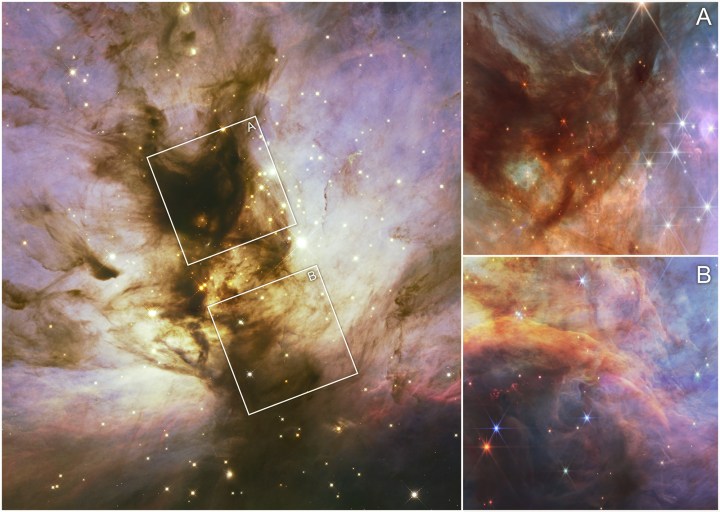
    This near-infrared image of a portion of the Flame Nebula from NASA’s James Webb Space Telescope highlights three low-mass objects, seen in the insets to the right.
    This near-infrared image of a portion of the Flame Nebula from NASA’s James Webb Space Telescope highlights three low-mass objects, which are cooler than protostars and require Webb’s sensitive instruments for detection. These objects were analyzed to explore the lowest mass limits of brown dwarfs within the Flame Nebula. NASA, ESA, CSA, STScI, Michael Meyer (University of Michigan)

    The Webb image focuses on three brown dwarfs. Although they may resemble protostars, these distinct objects were the primary subjects of the researchers’ studies.

    Stars and brown dwarfs emerge from substantial molecular clouds that fragment into smaller pieces. When these fragments are subjected to gravitational pressure, they heat up, and with enough material, stars begin to form. Understanding the heat emitted by these objects is crucial in distinguishing between the formation of a star and that of a brown dwarf.

    “The cooling of these clouds is significant because sufficient internal energy counteracts gravity,” explained fellow researcher Michael Meyer from the University of Michigan. “If the clouds cool effectively, they collapse and partition.”

    Researchers believe that the transition point from star formation to brown dwarf formation may lie around two to three times the mass of Jupiter. However, identifying these relatively smaller objects poses a challenge, prompting them to leverage data from both the Hubble Space Telescope and Webb.

    “Conducting this research on brown dwarfs down to ten Jupiter masses from Earth is quite challenging, particularly in areas like this,” remarked De Furio. “The wealth of Hubble data amassed over the last 30 years made us realize this is a valuable star-forming region to examine, and Webb is essential for our current scientific inquiries.”

    A collage of images from the Flame Nebula, showing views from NASA's Hubble Space Telescope and NASA's James Webb Space Telescope.
    This collage features a near-infrared light view from Hubble on the left, while the two insets on the right display near-infrared images captured by Webb. The Webb images provide a clearer view through previously obscured dark gas and dust, revealing a more luminous cloud with young stars and brown dwarfs. NASA, ESA, CSA, STScI, Michael Meyer (University of Michigan), Matthew De Furio (UT Austin), Massimo Robberto (STScI), Alyssa Pagan (STScI)

    This graphic illustrates how data from both Hubble and Webb can complement each other effectively.

    “The advancements from Hubble to Webb represent a significant leap in our capabilities to comprehend these phenomena,” stated Massimo Robberto from the Space Telescope Science Institute. “Webb is truly unlocking a fresh realm of possibilities for understanding these celestial objects.”

    The research findings have been published in The Astrophysical Journal Letters.