الوسم: Myanmar

  • Myanmar’s Aung San Suu Kyi Meets Red Cross Official, Govt Confirms

    Myanmar’s Aung San Suu Kyi Meets Red Cross Official, Govt Confirms

    Myanmar’s former leader Aung San Suu Kyi, who has been detained since 2021, recently met with a representative from the International Committee of the Red Cross. The country’s government spokesperson confirmed the meeting took place on Monday in Naypyidaw. Suu Kyi, a Nobel Peace Prize laureate, has been serving a 27-year prison sentence following conviction on multiple charges, which her supporters argue are politically motivated. Her son has publicly expressed limited knowledge regarding her current health and living conditions.

    The meeting occurred amid ongoing international concern for her well-being. Photos released by the government show Suu Kyi dressed in traditional Burmese attire, meeting with Arnaud de Baecque of the ICRC in a modest, wood-paneled room with minimal furnishings. Another image depicts her celebrating her birthday, with a cake inscribed with her name and the date June 29, 2026, hinting at the rare inside look into her residence. However, these images’ exact location and date could not be independently verified, and no prior online postings of them exist.

    Following a military-led election in April, which resulted in the continuation of Myanmar’s military control and the presidency of Min Aung Hlaing, Suu Kyi was moved to house arrest. Her sentence was reduced by a sixth as part of an amnesty that also released her political ally, ex-president Win Myint. Despite this, access to her remains limited. The regional ASEAN group and other international bodies continue to seek meetings with her, but the military government has been reluctant to grant such requests.

    Last December, Myanmar’s ruling junta claimed Suu Kyi was in good health. Her son has voiced concern over his limited updates and fears she could pass away without him knowing, due to the lack of communication over the years.

  • Over 500 Feared Dead as Refugee Boats Sink off Myanmar, UN Reports

    Over 500 Feared Dead as Refugee Boats Sink off Myanmar, UN Reports

    Two vessels, believed to have capsized near Myanmar’s coast in recent days, carried over 500 refugees, according to UN agencies. The refugees aboard these boats primarily consisted of ethnic Rohingya from Myanmar’s Rakhine State, with some reportedly originating from camps in Bangladesh. The international organization for migration (IMO) and the UN refugee agency have issued a joint statement with preliminary details, estimating that the death toll exceeds 500.

    Casualty numbers have not yet been officially verified, but UNHCR and IOM express serious concern over the possible large-scale loss of life. Driven from their homes by violence and living conditions in overcrowded refugee camps in Bangladesh, the Rohingya minority have long risked their lives on fragile boats in hopes of reaching safety and better chances of livelihood in countries like Malaysia, Indonesia, and Thailand.

    Last year saw nearly 900 Rohingya lost or missing at sea in what has become the deadliest maritime route for refugees and migrants worldwide, according to the UN. The recent incidents involved a boat with approximately 250 people that lost contact shortly after setting sail, and another carrying around 280 individuals that is believed to have sunk off Myanmar’s Irrawaddy coast on July 8. These journeys occurred outside the usual safe sailing season, when sea conditions are typically more dangerous.

    The Rohingya fleeing Rakhine began their exodus in 2017 after the Myanmar military launched an offensive in the border region, forcing at least 730,000 to seek refuge in neighboring Bangladesh. Despite Myanmar denying abuses against the Rohingya, the government refuses to recognize them as citizens, labeling them as illegal immigrants.

    The crisis deepened following Myanmar’s military coup in 2021, which ignited a widespread civil war involving Rakhine State, with the Rohingya caught in the crossfire between government forces and the insurgent Arakan Army. According to UN reports, nearly 300 individuals are believed to be missing or dead at sea this year, including both Rohingya refugees and Bangladeshi nationals. In November, a boat carrying members of the Rohingya community sank near Langkawi, close to the Thailand-Malaysia border, leaving about a dozen survivors.

  • UN Agencies Report 250 Missing After Andaman Sea Boat Capsize

    UN Agencies Report 250 Missing After Andaman Sea Boat Capsize

    Approximately 250 individuals are unaccounted for after their boat, ferrying Rohingya refugees and Bangladeshi nationals, sank in the Andaman Sea, according to a joint statement from the United Nations’ refugee and migration agencies issued Tuesday.

    The agencies explained that the vessel, which was carrying men, women, and children, likely went under because of strong winds, turbulent waters, and overcrowding. The boat had set sail from Teknaf in southern Bangladesh and was headed for Malaysia.

    “This tragedy underscores the heartbreaking human toll of long-lasting displacement and the ongoing lack of sustainable solutions for the Rohingya,” stated the UN High Commissioner for Refugees and the International Organization for Migration.

    For years, many members of Myanmar’s Rohingya Muslim minority have taken precarious wooden boats in hopes of reaching neighboring countries such as Malaysia, Indonesia, or Thailand to escape persecution or escape overcrowded refugee camps in Bangladesh.

    The UN agencies urged the global community to increase and sustain funding for emergency aid for Rohingya refugees in Bangladesh and to support the local Bangladeshi communities hosting them.

    In 2017, Myanmar’s military launched a brutal crackdown that displaced at least 730,000 Rohingya, forcing them into Bangladesh, where they reported widespread killings, mass rape, and arson. A UN fact-finding mission described the military’s actions as “genocidal acts.” Myanmar, where the majority are Buddhist, denies committing genocide and claims the UN report lacks objectivity and reliability.

  • Suu Kyi’s Son: She Might Be Gone, I Have No Clue

    Suu Kyi’s Son: She Might Be Gone, I Have No Clue

    Aung San Suu Kyi, the former leader of Myanmar, attended the 22nd ASEAN Plus Three Summit in Bangkok on November 4, 2019. — Reuters

    Her son, Kim Aris, expresses concern about her deteriorating health, noting that there’s little information regarding her condition. He fears he might not even know if she has passed away. Aris told Reuters he hasn’t been in contact with his 80-year-old mother for years and has only received occasional, secondhand updates about her heart, bone, and gum issues since the military coup in 2021 that ousted her government.

    While he dismisses Myanmar’s upcoming “sham” election, widely condemned by foreign governments as a façade to legitimize military rule, Aris suggests there might be a chance it could lead to some relief for his mother. “Her health issues are ongoing. No one has seen her in over two years. She’s been cut off from her legal team and her family,” he said in a Tokyo interview. “I don’t even know if she’s alive anymore.”

    He speculates that Myanmar’s military leader, Min Aung Hlaing, might have his own motives regarding his mother. If Hlaing considers using her release or house arrest as a way to placate the population around or after the elections, that could be a positive step. A spokesperson for Myanmar’s military did not respond to requests for comment.

    Myanmar’s military has a history of releasing prisoners on holidays or special occasions. Suu Kyi, awarded the Nobel Peace Prize, was released in 2010 shortly after an election, ending a long period of detention primarily at her family estate near Yangon. She later became Myanmar’s de facto leader following the 2015 elections—the country’s first openly contested vote in over 25 years—though her global reputation suffered due to accusations of genocide against the Rohingya Muslim minority.

    In the current turmoil, sparked by the 2021 coup that triggered widespread armed resistance, Suu Kyi faces a 27-year prison sentence on charges including incitement, corruption, and election fraud, all of which she denies. Aris believes she’s held in Naypyidaw, and the last letter he received from her two years ago mentioned concerns about the extreme temperatures in her cell during different seasons.

    As international conflicts unfold worldwide, Aris worries that Myanmar’s situation is slipping from public consciousness. He is leveraging the upcoming phased elections—set for December 28—to urge countries like Japan to pressure the military junta and call for his mother’s release.

    “The military’s trying to hold these elections, but everyone knows they’re unfair and far from free—it’s almost laughable, if it weren’t so tragic,” he said. “This may be one of the few chances we have. When my mother was highly regarded globally, it was much harder for the world to ignore what was happening in Myanmar. But since her credibility was weakened over the Rakhine crisis, that’s no longer the case,” he added, referencing the country’s former name.

    A British citizen, Aris remained somewhat private until recently but maintains that his mother was “not complicit” in alleged military crimes against the Rohingya in 2016-17, despite her international reputation damage. During her time as the de facto leader, Myanmar’s constitution limited her control over the military, and she later acknowledged the possibility of war crimes during a Hague tribunal in 2020, though she denied genocide.

    In Japan, Aris has engaged with lawmakers and officials, advocating for stronger opposition to the junta and the election process. When asked how his mother might view his activism, he responded, “She’d be very upset that I’ve had to step into this role. She always wanted me to stay out of politics. But I don’t have that luxury now—I’m her son, and if I don’t stand up for her, who will?”

  • Over 30 Dead in Myanmar Hospital Airstrike, Witnesses Say

    Over 30 Dead in Myanmar Hospital Airstrike, Witnesses Say

    A hospital in Myanmar’s western Rakhine state was severely damaged during an airstrike carried out by the country’s military, resulting in the deaths of more than 30 individuals, including patients. According to a rebel group, an aid worker, and a witness on Thursday, over 70 people were injured in the attack.

    The strike on the hospital in Mrauk U township occurred late Wednesday when bombs dropped from a military aircraft hit the facility. Khine Thu Kha, spokesperson for the Arakan Army—which is fighting the ruling military junta in parts of Rakhine—stated, “The Mrauk U General Hospital was completely destroyed. The high number of casualties was because the hospital was directly hit.” The military’s spokesperson did not respond to requests for comment.

    Myanmar has been embroiled in ongoing conflict since the military quashed protests against the 2021 coup that ousted the elected government led by Aung San Suu Kyi, a Nobel laureate.

    At the time of the attack, the 300-bed hospital was overwhelmed with patients, as most healthcare services across large areas of Rakhine have been suspended due to ongoing hostilities, reported aid worker Wai Hun Aung. By Thursday morning, images shared by Wai Hun Aung showed the hospital reduced to ruins, with a collapsed roof, broken columns, beams, and bodies of victims strewn across the ground. Reuters could not verify the images immediately.

    “The remaining patients have been moved to a safe location,” Wai Hun Aung said.

    A 23-year-old resident of Mrauk U, who arrived soon after hearing explosions on Wednesday night, described the chaos. “When I got there, the hospital was on fire. I saw many bodies on the ground and numerous injured people,” he recounted, requesting anonymity for safety reasons.

    The Myanmar military, which possesses the country’s sole air force, has been increasingly using airstrikes against rebel-held areas. Between January and late November this year, provisional data from the Armed Conflict Location & Event Data Project indicates the military conducted 2,165 airstrikes—more than the 1,716 recorded in all of 2024.

    Resistance groups that emerged after the coup have teamed up with major ethnic armies, like the Arakan Army, to challenge the military, which is fighting on multiple fronts. Since the collapse of a ceasefire in 2023, the Arakan Army has expelled the military from 14 of Rakhine’s 17 townships, controlling an area larger than Belgium, according to analyses from the ISEAS – Yusof Ishak Institute.

    Mrauk U township, located in the northern part of Rakhine, has been under Arakan Army control since last year. Khine Thu Kha mentioned that there has been no recent fighting in the area.

  • Pakistanis among hundreds fleeing to Thailand after Myanmar scam bust

    Pakistanis among hundreds fleeing to Thailand after Myanmar scam bust

    Almost 700 foreigners, including Pakistanis, have escaped Myanmar and crossed into Thailand, according to the Thai military. This surge follows a military operation targeting KK Park, a well-known cybercrime hub.

    Thailand has detained 677 individuals—618 men and 59 women—who entered Tak province at the border. The military stated that Myanmar’s armed forces have taken control of KK Park and are conducting inspections in the area, which has prompted many residents to flee into Thailand.

    The Thai authorities are processing these arrivals legally and are screening them thoroughly. Extra detention centers have been prepared in case current facilities become overcrowded, the military added.

    A video from Thai PBS captured on October 22, 2025, and shared with AFP shows people crossing the Moei River near KK Park from Myanmar into Thailand. The area is recognized internationally for its involvement with cyber scams.

    KK Park’s expansive complex is primarily operated by Chinese criminal groups, with local militia factions aligned with Myanmar’s military guards. The border zones among Thailand, Myanmar, Laos, and Cambodia have become hotspots for online scam operations since the COVID-19 pandemic began. The United Nations reports that billions of dollars have been generated from trafficking hundreds of thousands of people forced to work in these illicit scam factories.

  • Indian Rebel Group Alleges Army Killed Leaders in Myanmar Attacks

    Indian Rebel Group Alleges Army Killed Leaders in Myanmar Attacks

    Drone Strike Reports from Northeast India

    This image depicts Indian Army soldiers participating in a military exercise in Ahmedabad, India. — Reuters/File
    • Drone attack results in the deaths of three ULFA leaders and injuries to 19 others.
    • A high-ranking commander from the rebel group was also killed in an attack in Myanmar.
    • Confirmation of these strikes by Indian officials remains pending.

    Reports from separatist militants in northeastern India claim that the Indian army executed cross-border drone strikes on their camps located in Myanmar this past Sunday, resulting in the deaths of three leaders from the United Liberation Front of Asom (ULFA).

    Many rebel factions in India’s northeast share ethnic, linguistic, and cultural connections with minorities across the border in Myanmar, where they also operate.

    The separatist group reported that a senior commander fell victim to the drone attacks in Myanmar near the border, with an additional 19 individuals sustaining injuries.

    ULFA further stated, “Two more senior commanders were killed” in follow-up strikes, and they noted that multiple members and civilians were caught in the crossfire.

    As of now, Indian authorities have not verified the claims regarding the strikes.

    The ULFA has indicated that camps associated with another group, the People’s Liberation Army (PLA), were also targeted in the operations.

    ULFA is one of several insurgent groups advocating for the independence of Assam, while the PLA seeks the secession of Manipur state.

    Notably, a faction of the ULFA disarmed and signed a peace agreement with the Indian government in 2023.

    While rebel attacks have diminished significantly in recent years, violent insurgency has claimed thousands of lives—primarily among civilians—over the past three decades.

  • UN: 150,000 Rohingya Escape Myanmar for Bangladesh in 18 Months

    UN: 150,000 Rohingya Escape Myanmar for Bangladesh in 18 Months

    Rohingya refugees wait at a World Food Programme (WFP) distribution center to purchase groceries in the Cox’s Bazar refugee camp, Bangladesh, March 15, 2025. — Reuters

    Over the last 18 months, Bangladesh has witnessed the largest surge of Rohingya refugees since the mass exodus of the majority-Muslim group from Myanmar nearly ten years ago, as reported by the United Nations on Friday.

    According to the UN refugee agency, approximately 150,000 Rohingya have arrived at the refugee camps in Cox’s Bazar since early 2024.

    “Ongoing violence and persecution in Rakhine State, along with the continuing conflict in Myanmar, have led thousands of Rohingya to seek safety in Bangladesh,” stated UNHCR spokesperson Babar Baloch in a press conference in Geneva.

    “This recent movement of Rohingya refugees into Bangladesh, occurring over several months, marks the largest influx from Myanmar since 2017, when around 750,000 fled the violent crackdown in their home state of Rakhine,” he added.

    Baloch commended Bangladesh for its longstanding commitment to hosting Rohingya refugees.

    A view of the Rohingya refugee camp with Myanmar's mountains in the background, Cox's Bazar, Bangladesh, March 16, 2025. — Reuters
    A glimpse of the Rohingya refugee camp with Myanmar’s mountains visible in the backdrop, Cox’s Bazar, Bangladesh, March 16, 2025. — Reuters

    Even prior to this latest influx, around one million Rohingya, who are predominantly Muslim, were already residing in overcrowded relief camps in Bangladesh, most having fled the military crackdown in Myanmar in 2017.

    These camps, squeezed into just 24 square kilometers (approximately nine square miles), have become some of the world’s most densely populated areas, according to Baloch.

  • Quakes Shake Myanmar, Tajikistan, and Papua New Guinea

    Seismic scale displaying earthquake measurements. — AFP/File
    Seismic scale displaying earthquake measurements. — AFP/File

    Myanmar is still grappling with the devastation of a recent earthquake, when another moderate seismic event struck on Sunday. Papua New Guinea also experienced tremors, as did Tajikistan.

    A magnitude 5.6 earthquake occurred in Myanmar, according to the European Mediterranean Seismological Centre (EMSC), as the struggling nation mourns the loss of thousands during its New Year water festival.

    The quake struck at a depth of 35 kilometers (approximately 21.75 miles), stated the seismological center.

    Additionally, a magnitude 5.9 earthquake was recorded in Tajikistan at a depth of 16 kilometers (10 miles).

    The German Research Centre for Geosciences reported a magnitude 5.79 quake in Papua New Guinea, occurring at a depth of 10 kilometers (6.2 miles).

    Despite these earthquakes happening on the same day, the countries are geographically distant from each other.

    Myanmar Grieves the Losses

    The earthquake in Myanmar struck just as thousands were celebrating the start of the annual water festival, “Thingyan.” This festive occasion, which symbolizes renewal through water-splashing rituals, was overshadowed by the tragedy of the recent quake that hit the region.

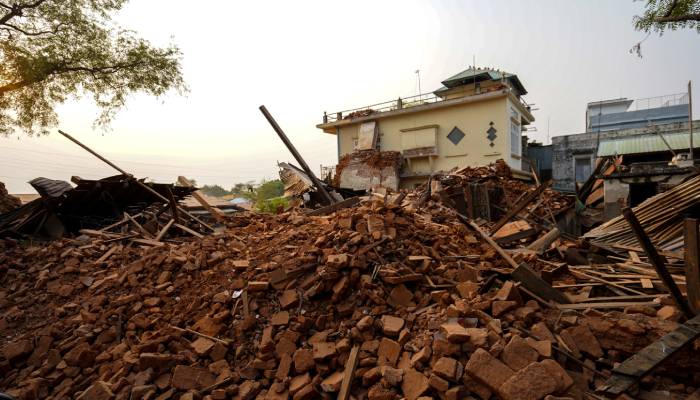
    The central cities of Mandalay and Sagaing have been left in ruins following the devastating 7.7 magnitude earthquake. Two weeks after the disaster, which claimed the lives of over 3,600 people, many survivors are still living in temporary encampments surrounded by collapsed buildings, destroyed tea shops, and flattened hotels.

    Numerous individuals lack access to basic sanitation facilities, while finding clean drinking water requires long waits in line. As heavy rain is forecast, fears are rising about the stability of their makeshift shelters.

    The ruling military junta in Myanmar has ordered that the five-day festival be conducted without any music or dance.

    Since the earthquake on March 28, temperatures in Mandalay have soared to a scorching 44 degrees Celsius (111 degrees Fahrenheit). At night, those living in tents face swarms of mosquitoes, waking early to queue for assistance.

    Officials report that over 5,200 structures have been destroyed, and the United Nations has indicated that more than two million people are currently in need due to this natural disaster.

    The tremors from the earthquakes were also felt as far away as Bangkok, where a high-rise building under construction collapsed, trapping dozens of workers.

  • Heavy Rains Hinder Myanmar Quake Relief Efforts; Deaths Reach 3,471

    Heavy Rains Hinder Myanmar Quake Relief Efforts; Deaths Reach 3,471

    Update on the Earthquake Crisis in Myanmar

    BANGKOK — Over the past weekend, regions in Myanmar that were severely affected by a recent earthquake experienced rainfall, potentially hindering relief efforts and increasing the risk of disease outbreaks, according to aid organizations. The United Nations’ head of aid expressed the urgent need for additional tents to provide shelter for those displaced by the disaster.

    As reported by state media, the death toll from the devastating earthquake that struck on March 28 has now reached 3,471, with 4,671 individuals injured and 214 people still unaccounted for.

    Aid organizations have raised concerns that the unusual combination of rainfall and extreme heat could lead to outbreaks of illnesses like cholera among survivors who are living outdoors. "Families are sleeping outside amid the ruins of their homes, while the bodies of loved ones are being recovered from the rubble. The fear of more earthquakes looms large," said Tom Fletcher, the visiting UN aid chief. He emphasized the need to quickly deliver tents and hope to survivors as they work to rebuild their lives, stressing that coordinated action is vital to save as many lives as possible.

    Neighboring countries, including China, India, and other Southeast Asian nations, have sent relief supplies and rescue teams to support the recovery efforts in the earthquake-affected areas, which are home to roughly 28 million residents.

    Additionally, the United States—previously the world’s largest donor of humanitarian aid—has committed at least $9 million to assist communities in Myanmar impacted by the earthquake. However, both current and former U.S. officials noted that the recent cuts to foreign aid programs have hampered the response efforts. Marcia Wong, a former high-ranking USAID official, revealed that three USAID workers who traveled to Myanmar following the quake were informed they would be let go. "This team is putting in intense effort to deliver humanitarian aid to those in dire need. To hear about imminent job cuts is incredibly demoralizing," Wong stated.

    In neighboring Thailand, the death toll from the earthquake has risen to 24, with 17 fatalities reported at the site of a collapsed skyscraper in Bangkok that was under construction. There are still 77 individuals unaccounted for in this incident.

    Ceasefire Violations

    Since the military coup that ousted Nobel laureate Aung San Suu Kyi in 2021, the military has faced challenges in governing Myanmar, resulting in a damaged economy and collapsing basic services, including healthcare—a situation worsened by the earthquake.

    The ongoing civil conflict has displaced over 3 million people, leading to widespread food insecurity and leaving more than one-third of the population in need of humanitarian aid, according to the United Nations.

    Despite a ceasefire being declared last Wednesday, the UN Office of the High Commissioner for Human Rights reported on Friday that the junta was restricting aid in areas that oppose its authority. They are also investigating reports of attacks carried out by the junta against opposition figures, including actions taken during the ceasefire.

    A spokesperson for the junta did not respond to requests for comment.

    The relief organization Free Burma Rangers informed Reuters on Saturday that the military conducted bombings in Karenni and Shan states on Thursday and Friday, killing at least five people, including civilians. David Eubank, founder of the group, noted that there have been a minimum of seven military strikes since the ceasefire announcement.

  • Myanmar earthquake toll exceeds 3,000; rains complicate rescue efforts

    Myanmar earthquake toll exceeds 3,000; rains complicate rescue efforts

    Aerial view of damaged buildings after an earthquake on March 28 in the Mandalay region, Myanmar. Video screenshot taken March 31, 2025. — Reuters

    • Weather authorities issue warnings about unusual rainfall.
    • Expected rains may hinder search and rescue operations.
    • National leader plans to attend regional summit in Bangkok.

    BANGKOK: The death toll from the catastrophic earthquake in Myanmar has exceeded 3,000, with hundreds more unaccounted for, as forecasts of unseasonal rains pose a new challenge for rescuers and aid workers striving to assist those affected in a nation already embroiled in civil conflict.

    The 7.7-magnitude earthquake that struck last Friday, one of the strongest to hit the Southeast Asian nation in a century, devastated a region home to approximately 28 million people, collapsing structures, flattening neighborhoods, and leaving many without basic necessities like food, water, and shelter.

    As of Wednesday, the count of fatalities rose to 3,003, with 4,515 individuals injured and 351 still missing, according to a statement from Myanmar’s embassy in Japan on Facebook, while rescuers continue their arduous efforts to locate survivors.

    Conditions may deteriorate further as weather officials have predicted unusual rainfall from Sunday through April 11, threatening the areas most affected by the earthquake, including Mandalay, Sagaing, and the capital, Naypyidaw.

    “Rain is on the way, and there are still many individuals trapped,” reported an aid worker in Myanmar to Reuters. “Particularly in Mandalay, if it starts to rain, those who are trapped could drown even if they are still alive.”

    According to the embassy’s report, there have already been 53 airlifts of aid to Myanmar, while over 1,900 rescue personnel from 15 countries, including neighbors in Southeast Asia as well as China, India, and Russia, have arrived to assist.

    Despite the dire circumstances, General Min Aung Hlaing, the leader of the military junta, is set to depart the disaster-stricken nation on Thursday to attend a rare regional summit in Bangkok, as announced by state television.

    This trip is uncommon for a leader widely perceived as an outcast by many nations, facing severe international sanctions and an ongoing investigation by the International Criminal Court.

    Unseasonable Rainfall

    The anticipated rainfall adds to the challenges encountered by rescue and aid organizations, which have called for unhindered access to all affected regions despite the ongoing civil unrest.

    Since regaining power in a coup in 2021 that displaced the democratically elected government of Nobel laureate Aung San Suu Kyi, the military has struggled to maintain control over Myanmar.

    The military junta has faced global isolation since the coup, leading to economic decline and a breakdown of essential services, including health care.

    On Wednesday, state-run MRTV announced that a unilateral ceasefire would take effect for 20 days to facilitate relief efforts after the earthquake but cautioned that authorities would “react appropriately” if any rebel groups launched attacks.

    This decision follows a major rebel coalition’s declaration of a ceasefire on Tuesday aimed at supporting humanitarian efforts.

    Nearly a week after the quake, rescue operations in nearby Thailand continue as teams search through the wreckage of a collapsed skyscraper in Bangkok that was still under construction.

    Rescuers have been utilizing excavators and bulldozers to sift through 100 tons of concrete in search of survivors after the disaster claimed 15 lives, with 72 individuals still unaccounted for.

    The national death toll in Thailand currently stands at 22.

  • Junta Leader Departing Quake-Hit Myanmar for Summit Amid Aid Calls

    Junta Leader Departing Quake-Hit Myanmar for Summit Amid Aid Calls

    Myanmar’s military chief, Senior General Min Aung Hlaing, speaks at a press conference after discussions with Russian President Vladimir Putin in Moscow on March 4, 2025. — Reuters

    • Isolated junta leader may gain credibility from Thailand visit.
    • Reported death toll from 7.7 magnitude earthquake surpasses 3,000, according to CCTV.
    • Relief groups report hospitals are overwhelmed and medications are lacking.

    Min Aung Hlaing, Myanmar’s isolated leader, is set to depart his disaster-stricken country Thursday for an infrequent trip to a regional summit, as humanitarian organizations urged for the easing of restrictions to aid survivors from a catastrophic earthquake.

    The 7.7 magnitude earthquake, among the strongest in Myanmar in a century, shook a region populated by 28 million, damaging buildings, demolishing communities, and leaving many without food, water, or shelter. According to China’s state media, the official death toll has exceeded 3,000.

    The military junta has struggled since regaining power in a 2021 coup that ousted the elected government led by Nobel laureate Aung San Suu Kyi. Following the takeover, the generals have faced international isolation, leading to severe deterioration of Myanmar’s economy and essential services, including healthcare, amid ongoing civil conflict.

    On Wednesday night, state-run MRTV announced a 20-day unilateral ceasefire to support recovery efforts following the earthquake, while cautioning that they would “respond accordingly” if rebels initiated attacks.

    MRTV confirmed that Min Aung Hlaing would travel to Bangkok for a summit with mostly South Asian nations—an unusual trip for a general seen as a pariah by many countries, who faces Western sanctions and an investigation by the International Criminal Court.

    The junta leader has also been barred from ASEAN summit participation.

    Nevertheless, some analysts believe the earthquake and the upcoming summit, which includes leaders from Thailand, India, and Bangladesh, could enhance Min Aung Hlaing’s legitimacy as he moves forward with a largely criticized election in December that is expected to extend military rule.

    Humanitarian agencies reported extensive destruction and a medical emergency in central Myanmar, with hospitals overwhelmed and medications in short supply, alongside a rising threat of waterborne diseases.

    Mohamed Riyas, the Myanmar Director of the International Rescue Committee, described the humanitarian situation as “overwhelming.” He stated, “It may take weeks to fully comprehend the extent of the destruction caused by this earthquake due to downed communication networks and disrupted transport.”

    “People are in urgent need of medical assistance, clean water, tents, food, and other essentials. Providing life-saving health services is critical,” he added.

    Mikhael De Souza, a medical aid coordinator for MSF, mentioned that in Mandalay, the second-largest city, around 500 structures had completely collapsed, with an additional 800 sustaining partial damage.

    “Many individuals are still forced to live outdoors in deplorable conditions,” he noted. “The lack of safe drinking water poses significant survival challenges.”

    Military Readiness

    Human rights organizations have accused the junta of hindering humanitarian efforts by enforcing strict security measures in several severely affected quake regions.

    An incident highlighting the complications of delivering aid amid civil conflict occurred when junta troops reportedly fired warning shots at a Chinese Red Cross convoy that failed to stop in a conflict zone.

    Junta spokesperson Zaw Min Tun remarked that the group had neglected to inform the authorities of its movements.

    China was one of the first countries to provide assistance to Myanmar, sending rescue teams the day after the disaster and committing to 100 million yuan (about $13.76 million) in supplies.

    A spokesperson for China’s foreign ministry indicated that the aid team and supplies were safe and urged all parties in Myanmar to guarantee the safety of rescuers and maintain clear relief routes.

    Despite the nation facing its worst disaster in decades, the military has remained on high alert, conducting airstrikes and other operations near the affected areas, according to reports from rebel groups and Amnesty International.

    Min Aung Hlaing stated that the military had ceased offensives but warned that rebels were preparing to exploit the disaster for potential attacks. A key rebel alliance announced a unilateral ceasefire earlier this week to facilitate humanitarian efforts.

    Before the military’s declaration of a temporary ceasefire, Tom Andrews, the UN special rapporteur on Myanmar, condemned the junta’s post-quake assaults as “outrageous” and called for global leaders to denounce these actions vehemently.

    Presence of Soldiers

    Acquiring accurate information from areas like Sagaing has long been challenging due to a junta-imposed internet and cellphone blackout related to the ongoing conflict, which activists have urged be lifted following the earthquake.

    The military has declined requests from international journalists to cover the earthquake’s aftermath, citing a lack of water, electricity, and accommodations.

    “Soldiers are present throughout the town,” a man who visited Sagaing, close to the quake’s epicenter, told Reuters. “They are there for security rather than rescue operations, and they inspect every vehicle.”

    Human Rights Watch, based in New York, urged the junta to permit unrestricted access to humanitarian aid and lift barriers affecting aid organizations, urging donors to channel assistance through independent entities rather than solely through junta authorities.

    “Myanmar’s junta cannot be trusted to respond to a disaster of this magnitude,” stated Bryony Lau, HRW’s deputy Asia director. She implored agencies to pressure the junta to “provide full and immediate access to survivors, no matter where they are.”

    A woman in Mandalay reported to Reuters that authorities were busy preparing a stage for this month’s Thingyan water festival, despite many individuals being homeless and corpses lying beneath collapsed buildings.

    In Thailand, the death toll from the earthquake had risen to 22 by Wednesday, with search efforts continuing for survivors beneath the rubble of a skyscraper under construction in Bangkok, which has now entered its fifth day.

    Heavy machinery was utilized to dismantle 100 tons of concrete in hopes of discovering a survivor amid the heap, where 15 individuals were confirmed dead, and 72 remain missing.

    “We are continuing our search for survivors, but we are modifying our approach,” stated Bangkok Governor Chadchart Sittipunt. “We are creating a path for the rescue team to access the area.”

  • Myanmar Junta Warns Aid Convoy Amid Quake Death Toll Over 2,800

    Myanmar Junta Warns Aid Convoy Amid Quake Death Toll Over 2,800

    BANGKOK: On Wednesday, Myanmar’s military junta reported that its forces fired warning shots at an aid convoy from the Chinese Red Cross, highlighting the difficulties in providing aid amid ongoing civil conflict. This comes as humanitarian organizations advocate for improved access to assist those affected by a devastating earthquake.

    Since the military takeover in 2021, which ousted the elected government led by Nobel laureate Aung San Suu Kyi, Myanmar has been gripped by turmoil and conflict. The situation has severely damaged the economy and essential services including healthcare.

    According to junta spokesperson Zaw Min Tun, the Chinese Red Cross did not notify local authorities about its operations in a conflict area on Tuesday night. The security team reportedly discharged rounds into the air when the convoy, which included regional vehicles, did not halt.

    A spokesperson from the Chinese Foreign Ministry confirmed that the aid team and its supplies were unharmed, urging all parties in Myanmar to guarantee the safety of rescuers. "It’s vital to keep transportation routes for humanitarian assistance clear and operational," Guo Jiakun mentioned at a news briefing.

    The warning shots were fired as Myanmar state media reported that the death toll from last Friday’s magnitude 7.7 earthquake had risen to 2,886, with 4,639 individuals injured. Many rural areas in the Sagaing region, which bore the brunt of the quake, are primarily controlled by armed resistance factions opposing the military regime, as noted by the International Crisis Group.

    They added, “These areas will present substantial challenges for aid organizations due to regime constraints, fragmented local governance, and ongoing conflict.” Gathering accurate information in these regions had already been difficult before the earthquake due to a military-imposed internet and communication blackout, exacerbating the crisis.

    A resident of Sagaing shared with Reuters, “Soldiers are widely present in the area. They are here for security, not rescue, and they inspect every vehicle.”

    Human Rights Watch, based in New York, urged the junta to allow unrestricted access to humanitarian assistance and to remove barriers that hinder aid groups. The organization insists that donors should support independent organizations instead of solely relying on junta officials. "The military in Myanmar cannot be trusted to manage a disaster of this magnitude," emphasized Bryony Lau, the group’s deputy Asia director.

    The military has refuted claims of widespread human rights abuses amid its fight against a multifaceted insurrection that arose following the coup. Rebels allege that the military has conducted airstrikes even post-quake. On Tuesday, a significant rebel coalition declared a unilateral ceasefire to facilitate relief operations.

    Millions Affected

    According to the United Nations, more than 28 million individuals are impacted in the six regions struck by the earthquake, with the organization allocating $12 million for emergency responses, including food, shelter, water, sanitation, mental health support, and various services.

    The United Nations Office for Project Services (UNOPS) highlighted the ongoing crisis, stating, "The situation is dire, with disrupted communication and road access hindering response efforts, particularly in Sagaing."

    Australia has announced an additional A$6.5 million (approximately $4.1 million) in humanitarian aid for Myanmar, which will be distributed through well-vetted international and local partners. In a statement, Foreign Minister Penny Wong asserted, "We are taking proactive measures to ensure our assistance does not lend credibility to the military regime in Myanmar."

    A woman from Mandalay, near the earthquake’s epicenter, remarked to Reuters that authorities were constructing a stage for the upcoming Thingyan water festival, despite many residents being homeless and bodies left beneath collapsed structures. The military council has barred international journalists from covering the aftermath of the earthquake, citing shortages of water, electricity, and accommodation.

    In neighboring Thailand, the quake’s toll rose to 22, with numerous buildings sustaining significant damage.

    In Bangkok, the search for survivors continued beneath the rubble of a partially constructed skyscraper, which had claimed 15 lives with 72 individuals still unaccounted for. As part of the rescue effort, officials reassigned two rescue dogs to provide emotional support to the families of the missing. Children were seen comforting the golden retrievers clad in light-up vests at a temporary shelter, finding solace during these distressing times. Chanpen Keawnoi, whose mother and younger sister are among the missing, expressed, "As long as the dog keeps barking when it senses something, there’s hope someone may still be alive."

    The government has launched an investigation into the building’s collapse, with preliminary tests indicating that some steel samples from the site were substandard.

  • UN Alerts: Time Running Out to Rescue Myanmar Quake Survivors

    UN Alerts: Time Running Out to Rescue Myanmar Quake Survivors

    Chinese rescue workers on the scene of a collapsed building after a major earthquake in Mandalay, Myanmar, March 31, 2025. — Reuters

    • Civil war in Myanmar may hinder aid delivery, according to organizations.
    • Relief organizations highlight urgent requirements for water, food, and shelter.
    • A rebel coalition fighting the junta declares a unilateral ceasefire.

    On Tuesday, aid organizations in Myanmar painted a grim picture of chaos and destruction following an earthquake that has claimed over 2,700 lives. They emphasized the critical demand for food, water, and shelter, warning that the opportunity to locate survivors is rapidly diminishing.

    Myanmar’s military leader, Min Aung Hlaing, stated in a televised address that the death toll from the 7.7 magnitude earthquake that struck on Friday is expected to exceed 3,000. By Tuesday, the count was reported at 2,719, with 4,521 people injured and 441 still unaccounted for.

    This earthquake, the strongest to hit Myanmar in more than a century, struck during lunchtime on Friday, bringing down both ancient pagodas and contemporary buildings.

    Mandalay, Myanmar’s second-largest city, along with Naypyitaw, the capital built as a stronghold by the previous junta, suffered substantial destruction.

    In Thailand, the quake resulted in 21 fatalities as hundreds of buildings were damaged. Rescuers continue to search for survivors amidst the debris of a collapsed construction skyscraper in Bangkok, though they acknowledge that time is not on their side.

    In Myanmar, UN agencies reported that hospitals are overwhelmed, and rescue efforts are being hampered by damaged infrastructure and ongoing civil conflict. Rebels have accused the military of conducting airstrikes despite the earthquake, prompting a rebel coalition to announce a one-month ceasefire to facilitate aid efforts.

    Aid organizations raised alarms regarding shortages of food, water, and sanitation as the tremors continue to rock the region on Tuesday.

    Julia Rees from UNICEF, who just returned from one of the hardest-hit areas near the epicenter, noted that entire communities have been decimated, resulting in overwhelming destruction and psychological distress.

    “This crisis continues to unfold. The aftershocks persist. Search and rescue operations are ongoing, with bodies still being retrieved from the rubble,” she stated. “Let me be clear: the needs are enormous and increasing by the hour. The time for life-saving responses is running out.”

    Civil War Complicates Relief Efforts

    In the vicinity of Mandalay, 50 children and two teachers lost their lives when their preschool collapsed, according to the UN humanitarian agency.

    In a rare success story, a 63-year-old woman was rescued from the debris of a building in Naypyitaw after being trapped for 91 hours. She was discovered on Tuesday morning and extracted an hour later, thanks to collaborative rescue efforts from teams from India, China, and Russia.

    The ongoing civil war in Myanmar, sparked by the military coup in 2021, has complicated access to the injured and homeless, exacerbated by strict controls on internet and communication networks.

    A rebel faction, the Karen National Union, reported that the junta carried out airstrikes in eastern Myanmar at a time when the focus should have been on earthquake relief efforts.

    On Tuesday, the Three Brotherhood Alliance, consisting of three major rebel groups opposed to the junta, declared a unilateral ceasefire for one month to facilitate effective humanitarian assistance.

    Amnesty International called on the junta to allow aid to reach areas beyond its control, with its Myanmar researcher Joe Freeman emphasizing, “The military has a history of denying aid to regions where resistance groups are active. It must grant unimpeded access to all humanitarian organizations immediately.”

    In his address, junta leader Min Aung Hlaing noted “lessons learned” and criticized the poor quality of construction, stating that some buildings were constructed cheaply and without adequate investment.

    It remains unclear if Min Aung Hlaing will proceed with a rare trip abroad later this week to attend a regional summit in Bangkok as scheduled. The foreign ministry in Thailand indicated that he might participate via teleconference.

    “We Will Keep Going”

    In Bangkok, rescue teams continue to scour the wreckage of a collapsed skyscraper for any signals of life, even as the days since the quake increase the skepticism regarding survival chances.

    Approximately 70 bodies are estimated to be trapped under the debris, with experts confirming that 12 have been located through scanners. However, large debris remains in the way, prompting rescuers to cut through concrete slabs to reach them.

    “Our focus remains on finding survivors. Cases exist where individuals have survived for up to a week,” stated Bangkok Governor Chadchart Sittipunt during a news briefing. “We cannot declare that hope is lost… as long as there is structure, air, and no direct heat. We will continue our efforts.”

    Multinational teams, including personnel from the U.S. and Israel, are assisting in the search and rescue operations as families and friends remain anxious for news of their loved ones.

    “The rescue teams are doing everything they can. I can see that,” said 19-year-old Artithap Lalod, anxiously awaiting updates about his brother.

    Initial tests indicated that some steel samples from the collapsed site did not meet standards, prompting the Thai government to initiate an investigation into the collapse’s cause.

    So far, 14 deaths have been confirmed at the building site, with seven additional fatalities reported elsewhere in Bangkok.

  • Woman Saved from Myanmar Quake Rubble as Rescue Efforts Intensify

    Woman Saved from Myanmar Quake Rubble as Rescue Efforts Intensify

    Rescue Efforts Underway Following Earthquake in Myanmar and Thailand


    Rescue worker searching through rubble of the collapsed Great Wall Hotel in Mandalay, Myanmar, on March 31, 2025. — Reuters

    • Rescuers are urgently searching for survivors in Myanmar and Thailand.
    • The death toll has exceeded 1,700 in Myanmar, with 18 confirmed fatalities in Thailand.
    • Myanmar’s ongoing civil conflict is hampering earthquake relief efforts.

    BANGKOK: Hope emerged on Monday as rescuers successfully freed a woman from the debris of a hotel in Myanmar. This occurred three days after a powerful earthquake claimed the lives of nearly 2,000 people, prompting urgency among search teams in both Myanmar and Thailand to locate more survivors.

    The woman was rescued after being trapped for 60 hours beneath the rubble of the Great Wall Hotel in Mandalay. A collaborative effort involving Chinese, Russian, and local rescue teams led to her extraction following a five-hour operation. Reports indicate she is currently in stable condition.

    Mandalay lies near the epicenter of the 7.7-magnitude quake that struck on Friday, causing widespread destruction across Myanmar and inflicting damage in neighboring Thailand.

    In Bangkok, the capital of Thailand, emergency crews are using cranes and search dogs in a tense search for 76 individuals believed to be trapped under the debris of a collapsed construction site. Bangkok Governor Chadchart Sittipunt assured that efforts to find survivors would persist beyond the typical 72-hour critical window.

    “The search will continue even after 72 hours. We have seen cases in Turkey where individuals trapped for a week have survived, so our efforts are not ceasing,” said Chadchart. He also mentioned that machines scanning the wreckage indicated potential signs of life and that rescue dogs were being dispatched to help locate survivors.

    While Thailand’s official death toll stood at 18 as of Sunday, authorities fear it may rise without further rescues at the site of the collapse.

    In Myanmar, state media reported at least 1,700 confirmed deaths. According to The Wall Street Journal, citing the military government, the death toll may have reached 2,028, though this has not been independently verified by Reuters. The United Nations has announced it is sending relief supplies to about 23,000 survivors affected by the earthquake in central Myanmar.

    “Our teams in Mandalay are ramping up our humanitarian response, despite facing trauma themselves,” stated Noriko Takagi, the UN refugee agency’s representative in Myanmar. “Time is critical as Myanmar needs global solidarity and support to cope with this immense disaster.”

    Myanmar’s neighboring countries—including India, China, and Thailand—have begun sending relief materials and teams, along with support from Malaysia, Singapore, and Russia.

    The United States has pledged $2 million in humanitarian aid through local organizations in Myanmar. An emergency response team from USAID, which is experiencing substantial cuts under the Trump administration, is being deployed to assist.

    The earthquake’s devastation adds to the challenges facing Myanmar, which is already grappling with the chaos of an ongoing civil war that arose from a nationwide uprising following a military coup in 2021 that overthrew the democratically elected government of Nobel Peace Prize winner Aung San Suu Kyi.

    Reports from rebel groups indicate that the military government continues to carry out airstrikes on villages affected by the earthquake. Singapore’s foreign minister has called for an immediate ceasefire to facilitate relief efforts.

    Critical infrastructure across the country—such as bridges, highways, airports, and railways—sustained damage, complicating humanitarian responses while the conflict continues to impact the economy, displace over 3.5 million people, and cripple the health care system.

  • Myanmar Quake Toll Reaches 1,700 Amid Growing Aid Efforts

    Myanmar Quake Toll Reaches 1,700 Amid Growing Aid Efforts

    Earthquake in Myanmar Causes Widespread Damage and Casualties


    Image caption: A general view of a collapsed building in the aftermath of a powerful earthquake in Mandalay, Myanmar, March 30, 2025. — Reuters

    • 3,400 Injured, 300 Missing Following Earthquake
    • Rescue Teams From India, China, Singapore, and Thailand Mobilized
    • UN Agency Reports Hospitals Struggling in Hard-Hit Regions

    BANGKOK: The death toll from Myanmar’s recent earthquake has been steadily increasing, prompting foreign rescue teams and aid to flood into the impoverished nation. The disaster has overwhelmed hospitals, and affected communities are hastily trying to orchestrate rescue operations with limited resources.

    The 7.7-magnitude earthquake struck the war-torn Southeast Asian country on Friday, marking one of the most powerful quakes in Myanmar in a century. By Sunday, official reports indicated approximately 1,700 casualties, 3,400 injuries, and over 300 people unaccounted for.

    The military government’s leader, Senior General Min Aung Hlaing, acknowledged the devastating impact and indicated that the death toll might rise. This admission came three days after he publicly requested international assistance, according to state media.

    Neighboring countries, including India, China, and Thailand, have sent relief supplies and teams, with additional support coming from Malaysia, Singapore, and even Russia.

    Car Trapped Under Rubble
    Image caption: A vehicle trapped beneath the debris of a collapsed building in Mandalay, Myanmar, March 30, 2025. — Reuters

    "The devastation is severe, and humanitarian needs are escalating rapidly," said a statement from the International Federation of Red Cross and Red Crescent Societies. They emphasized the urgent requirement to stabilize affected communities, especially as temperatures rise and the monsoon season approaches.

    The United States has committed $2 million in aid through local humanitarian organizations and has dispatched an emergency response team from USAID, which has been experiencing budget cuts under the Trump administration.

    This catastrophe further compounds the suffering in Myanmar, already grappling with a civil conflict following a military coup in 2021 that ousted the democratically elected government led by Nobel laureate Aung San Suu Kyi.

    Search and Rescue Operations
    Image caption: Search and rescue operations ongoing in Mandalay, Myanmar, March 29, 2025. — Reuters

    Critical infrastructure—including bridges, highways, airports, and railways—has been damaged across the country, hampering humanitarian operations amid ongoing conflict that has displaced over 3.5 million individuals and severely weakened the health system.

    In some areas near the epicenter, residents reported a lack of government assistance, forcing them to fend for themselves. “Restoring transportation routes swiftly is essential,” Min Aung Hlaing instructed officials, as state media reported on efforts to repair railway lines and reopen airports to make rescue efforts more effective.

    According to predictive models from the U.S. Geological Survey, the death toll in Myanmar could eventually exceed 10,000, with economic losses surpassing the nation’s annual GDP.

    ‘No Assistance, No Rescuers’

    Rescue Workers at Collapse Site
    Image caption: Rescuers working at a collapsed building site in Mandalay, Myanmar, March 30, 2025. — Reuters

    Hospitals in central and northwestern Myanmar, including the city of Mandalay and the capital Naypyidaw, are struggling to accommodate the influx of injured individuals, as reported by the UN Office for the Coordination of Humanitarian Affairs.

    The earthquake’s tremors also impacted parts of Thailand, where an under-construction skyscraper collapsed, resulting in 18 fatalities, according to reports from Thai authorities. Recovery efforts continued for the third day, with 76 individuals trapped under the debris.

    The opposition National Unity Government of Myanmar, which comprises remnants of the previous administration, declared a two-week halt to offensive military actions starting Sunday.

    In regions like Sagaing, near the earthquake’s epicenter, the extent of destruction is significant. “We are witnessing widespread devastation—counts of buildings reduced to rubble,” resident Han Zin reported. He noted that much of the town has been without power and is running short on drinking water. “We have not received any aid, and there are no rescue personnel present.”

    Sections of a major bridge connecting Sagaing with Mandalay have collapsed, with satellite images revealing parts of the historical structure submerged in the Irrawaddy River. “With the bridge out, even aid from Mandalay is hardly making its way here,” stated the Sagaing Federal Unit Hluttaw, associated with the NUG, on social media.

    Rescuers Carrying Bodies
    Image caption: Rescuers transporting a deceased victim in Mandalay, Myanmar, March 30, 2025. — Reuters

    “Food and medical supplies are scarce, and the number of casualties is overwhelming our local hospital, which is not equipped to handle the influx of patients.”

    ‘Can You Hear Me?’

    Mandalay’s extensive damage has left many people trapped beneath collapsed buildings, with heavy machinery required for rescue operations that are currently out of reach, according to humanitarian workers stationed in the area.

    "Our teams are utilizing gloves, ropes, and basic tools to dig for survivors," one worker said, on the condition of anonymity due to security concerns. “Countless people are still trapped and we cannot ascertain the death toll at this time because we don’t know who is alive or who is lost.”

    A video taken by a local Mandalay resident revealed patients lying outside a 500-bed orthopedic hospital where no space was available.

    Public and private healthcare facilities in Mandalay, including the Mandalay General Hospital and sections of Mandalay Medical University, suffered damage from the quake, the World Health Organization reported.

    Rescue personnel from Russia and India are en route to Mandalay, with multiple teams from China, Thailand, and Singapore already on-site.

    In Bangkok, rescuers have been tirelessly working at the site of the demolished 33-story building, surrounded by piles of concrete and twisted metal, in hopes of rescuing workers sealed beneath the wreckage.

    Teerasak Thongmo, a Thai police commander, mentioned that his team is racing against time to locate any survivors. “Our immediate goal is to find those who might still be alive. We have a crucial 72-hour window to act,” he noted.

    Nearby, relatives of the missing and trapped construction workers gathered, anxiously awaiting news. Some were visibly distressed. “Ploy, Ploy, I’m here for you!” cried one woman, overwhelmed with emotion. “Ploy, can you hear me?”

  • Aid Floods into Myanmar After Devastating Earthquake Claims 1,600

    Aid Floods into Myanmar After Devastating Earthquake Claims 1,600

    Rescue teams at the scene where a building collapsed following a severe earthquake in Mandalay, Myanmar, on March 29, 2025. — Reuters

    • Teams from India, China, Singapore, and Thailand are on the ground.
    • The opposition pledges to pause military offensives for two weeks.
    • Local residents report a lack of government aid and inadequate equipment for rescue operations.

    In response to the devastation from a massive earthquake that struck Myanmar, neighboring countries have deployed warships and aircraft filled with relief supplies and rescue teams. The international aid response has been ramping up following the disaster that severely impacted this impoverished Southeast Asian nation.

    According to the military government, the 7.7-magnitude earthquake, one of the strongest in the last century, resulted in at least 1,600 fatalities and left 3,400 individuals injured.

    “All military and civilian hospitals must coordinate efficiently to ensure a prompt medical response,” stated Senior General Min Aung Hlaing, chief of the junta, as reported by Myanmar media.

    The United States Geological Survey projected that the death toll in Myanmar could exceed 10,000, with damages potentially surpassing the nation’s annual GDP.

    The tremors were felt in parts of Thailand as well, leading to the collapse of a skyscraper under construction and claiming 17 lives in the capital. Reports indicated that at least 78 individuals remained trapped beneath the rubble.

    Classified as the deadliest natural calamity in Myanmar in years, the earthquake inflicted significant damage to vital infrastructure, including an airport, highways, and bridges, thereby hampering humanitarian efforts according to the United Nations.

    ‘No aid, no rescue workers’

    The earthquake struck amid an ongoing civil war, which has intensified since the military coup in 2021 that removed the democratically elected government of Nobel laureate Aung San Suu Kyi and ignited a nationwide armed insurrection.

    Ongoing hostilities have devastated Myanmar’s agriculture-based economy, displaced over 3.5 million citizens, and severely damaged essential services such as healthcare.

    The National Unity Government (NUG), which consists of remnants from the previous administration, has declared that anti-junta militias will suspend all military offensives for two weeks starting Sunday.

    In a statement, the NUG announced, “We, along with resistance forces, allied organizations, and civil society groups, will undertake rescue operations.”

    In some of the most severely impacted areas, locals shared with Reuters that government assistance was nearly nonexistent, forcing many to manage on their own.

    Han Zin, a resident from Sagaing, near the earthquake’s epicenter, described the scene: “What we’re witnessing is widespread devastation—numerous buildings have crumbled to the ground. Since the disaster, much of our town has been without electricity, and drinking water is dwindling.” He lamented, “We have not seen any relief, and there are no rescue teams in sight.”

    In Mandalay, nearby the Irrawaddy River, a rescue worker reported that most operations in Myanmar’s second-largest city were being undertaken by small, self-organized local groups that lacked the necessary tools.

    “We have reached collapsed structures, but some remain unstable as we work,” he said, requesting anonymity due to security matters.

    Field hospital

    Rescue teams feared that many individuals might still be trapped under the rubble throughout Mandalay, but most could not be rescued due to a lack of heavy machinery, as noted by another humanitarian worker and two residents.

    A resident, wishing to remain unnamed, stated, “People are still stuck inside the buildings; we can’t get them out.” Hospitals in various regions, including Mandalay and Sagaing, were overwhelmed with casualties, according to the U.N. Office for the Coordination of Humanitarian Affairs.

    Countries such as India, China, and Thailand have dispatched relief supplies and teams, along with aid from Malaysia, Singapore, and Russia.

    On Saturday, Indian military aircraft conducted multiple flights into Myanmar, delivering supplies and search-and-rescue personnel to Naypyitaw, the designated capital, which suffered extensive damage due to the earthquake.

    The Indian army plans to establish a field hospital in Mandalay, and two navy ships carrying aid have set sail for Yangon, the commercial hub of Myanmar, as stated by Indian Foreign Minister Subrahmanyam Jaishankar.

    Teams of Chinese rescue workers, including a contingent traveling from Yunnan province, have arrived, as announced by China’s embassy in Myanmar on social media.

    A 78-member team from Singapore, accompanied by search and rescue dogs, has started operations in Mandalay, according to local media.