Tag: Music Production

  • Warning Signs to Identify in AI Audio Generators

    Warning Signs to Identify in AI Audio Generators

    I utilize AI audio generators to ignite my creativity or even to compose entire pieces, yet I’ve discovered that they come with some hidden challenges.

    1

    Generic Output

    One of the biggest concerns when using AI for music creation is the possibility of generating generic, formulaic tracks. While these AI tools are capable of producing music across diverse genres and styles, the results often miss the authentic human touch that makes music feel fresh and innovative. These tools typically operate using predefined templates, common musical structures, or an assortment of samples. Consequently, the output tends to sound predictable and lacks personal flair.

    If you rely solely on an AI tool to generate a commercial song, the end product may sound eerily similar to other tracks in that genre, devoid of your distinct voice or unique style that would set it apart. As technology advances, AI may produce more complex and creative music. However, it will likely still lack the soul, spontaneity, and vibrancy of genuine artistic expression.

    Incorporating human elements into AI-generated music can enhance its originality and authenticity. This could involve adding a vocal track or even a live-performed instrument. You can also enrich your music by integrating additional audio and MIDI tracks using free online audio editors or digital audio workstations.

    As the use of AI-generated music rises, so do concerns around copyright and intellectual property rights. AI music generators are designed to mimic existing songs, patterns, melodies, and rhythms sourced from copyrighted material. This situation creates significant legal and ethical questions about ownership and fair use.

    For instance, in 2023, a controversy emerged involving Canadian artists The Weeknd and Drake when AI-generated songs imitating their voices surfaced online. These tracks were produced by AI models based on the artists’ prior work, raising alarms about copyright infringement and unauthorized use of their likenesses and sounds. This situation ignited a debate about whether music created by AI should be regarded as original, considering that it relies on existing copyrighted works.

    If you release AI-generated music, it could closely resemble works already protected by copyright. While AI doesn’t literally “copy” in the traditional sense, it can adapt aspects of existing music in potentially problematic ways. Therefore, you must be cautious about the data you use and ensure that your AI-produced music complies with copyright law to avoid litigation or financial repercussions.

    3

    Quality Concerns

    Another major limitation of AI-generated music is its frequent lack of emotional depth, complexity, nuance, and musicianship compared to traditionally created music. Although AI can rapidly generate melodies, beats, and chord sequences, it struggles to capture the subtleties that resonate with audiences.

    As a musician, I’ve been surrounded by artists who dedicate their lives to infusing their personal experiences and hard work into their music. Whether it’s a powerful vocal performance, an intricate chord progression, or a detailed arrangement, human creativity brings a richness that AI simply cannot replicate.

    While an AI audio generator may produce an catchy melody, it typically falls short in conveying the meaning or emotional weight that a human composer brings to the table. The nuances of rhythm, phrasing, and improvisation—essential elements of truly engaging music—are often beyond AI’s grasp. Thus, it’s important to recognize AI’s limitations when employing it for music creation.

    4

    Morally Gray Areas

    Even if an AI-generated track sounds impressive, there are moral and emotional considerations to keep in mind. For many musicians, the creation process is all about the journey from an initial inspiration to the completed piece. While AI can churn out a technically competent song, it falls short in terms of the personal investment that comes with crafting something from the ground up.

    Moreover, the use of AI for music creation raises ethical questions regarding artistic authenticity. Leaning on technology to generate your work can be seen as taking a shortcut—or worse, as cheating. One can hardly claim their project is a genuine artistic expression when much of the work was done by an algorithm.

    If the music-making process shifts excessively toward automation, it could diminish the appreciation for musicians who commit years to honing their craft and creating original compositions. While AI audio generators offer exciting possibilities for music production, an overreliance on these tools could ultimately undermine the essence of what makes music truly meaningful.

    The significant concerns surrounding AI audio generators shouldn’t be ignored. As technology continues to advance, musicians, producers, and listeners must remain aware of the challenges and carefully weigh the advantages and disadvantages for the betterment of the industry as a whole.

  • 5 Unique AI Tools to Kickstart Your First Songwriting Journey

    5 Unique AI Tools to Kickstart Your First Songwriting Journey

    Embarking on your songwriting journey can feel intimidating, but the good news is that AI technology can lend a helping hand. The following tools can quickly generate ideas to spark your creativity or even aid you in composing a full piece.

    BandLab SongStarter is an intuitive online tool designed to help you quickly develop musical concepts. You begin by inputting some basic information about the kind of track you want to create, after which you can explore various styles, tempos, and keys.

    To get going, I entered a few of my favorite artists and chose a genre for my song. Just like that, SongStarter generated three distinct options, including a laid-back R&B groove featuring swinging eighth notes that would provide a solid foundation for a full track.

    I selected the groove and clicked Edit in Studio, which opened an online audio editor complete with separate tracks for melody, chords, bass, and drums.

    Within SongStarter’s audio editor, you can record vocals, tweak levels, apply effects like reverb, and refine your overall composition. While I wouldn’t necessarily use it for a polished demo, it serves as an effective brainstorming tool, enabling me to generate song ideas swiftly and efficiently.

    ChatGPT is widely recognized for its text-based conversational capabilities but is also quite adept at lyric writing and can assist in developing melodies and sounds. You can provide the AI with various prompts regarding themes or topics, and it will generate lyrics that align with your vision.

    While ChatGPT is capable of constructing complete verses, choruses, and even bridges, I find that it’s best utilized as a source of inspiration rather than as a replacement for your own lyricism.

    For testing purposes, I asked ChatGPT to create lyrics inspired by Van Gogh’s Sunflowers using an AABA structure. Although the lyrics seemed lackluster at first glance, many lyrics do without the accompanying music, and they could easily serve as a solid foundation for a song with some additional refinement.

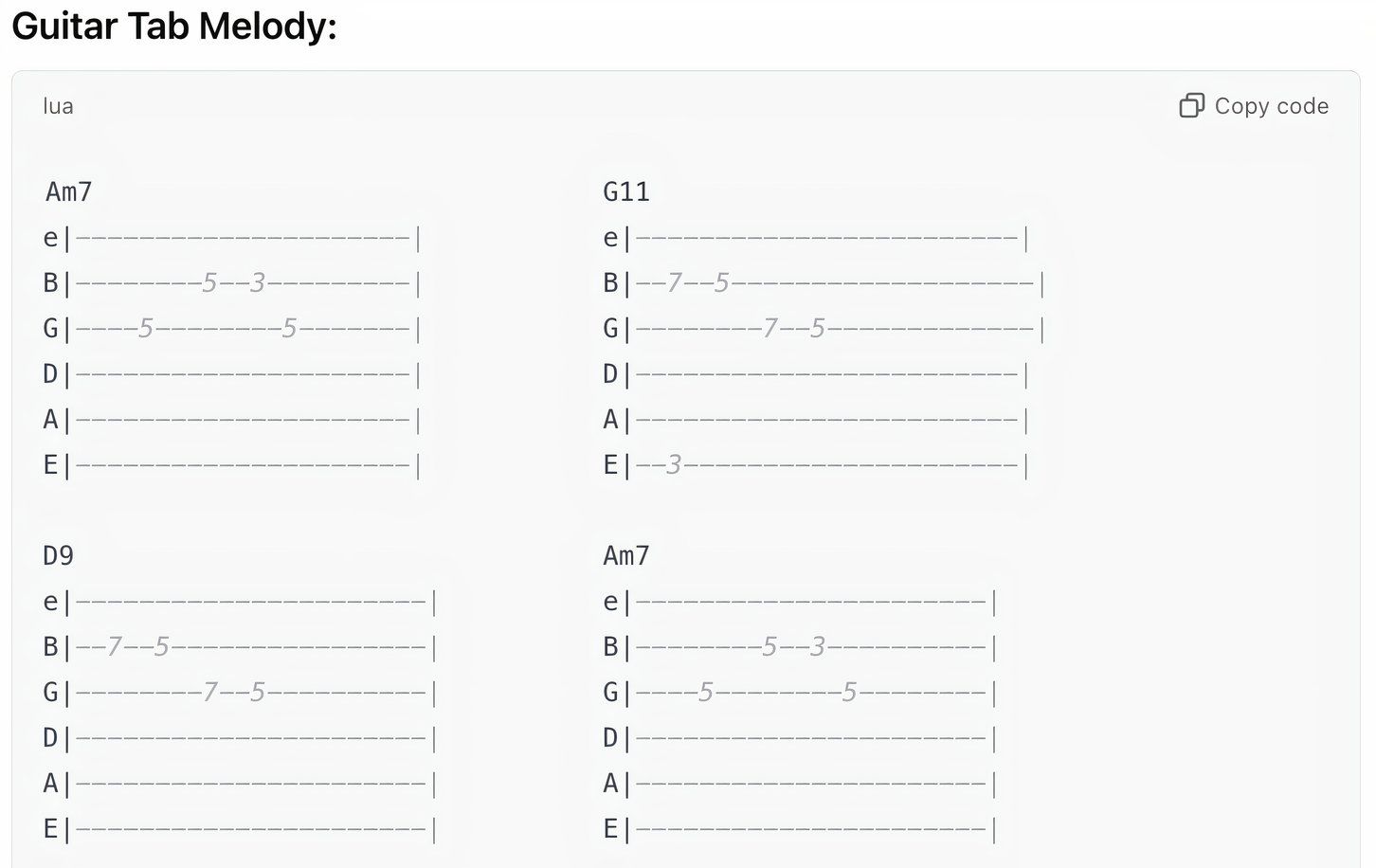
    I also inquired about a melody for the chords Am7, D9, G11, and Am7. To my surprise, it produced a straightforward melody in guitar tablature that could translate well into a vocal line.

    A ChatGPT guitar tablature melody for specified chords.

    ChatGPT can also help you push through creative roadblocks. If you’re feeling stuck mid-song, you can request suggestions from the AI to help you advance your work.

    Although I was initially hesitant to incorporate ChatGPT into my creative process, I’ve grown to appreciate its role as a valuable resource for overcoming obstacles and reigniting inspiration in my musical projects.

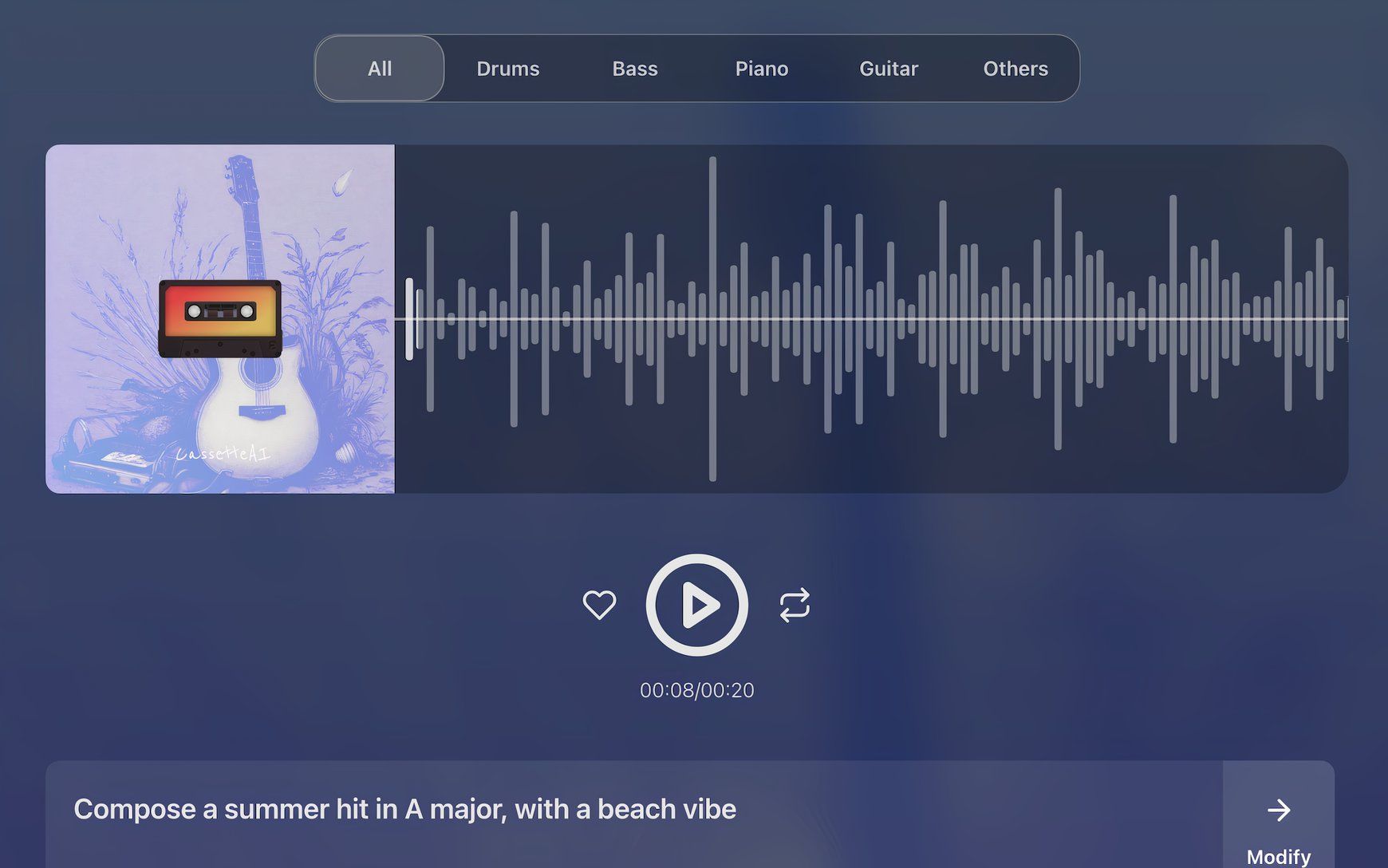
    The CassetteAI user interface.

    CassetteAI is a groundbreaking online platform that fuses AI with MIDI technology to create distinct songs customized to your preferences. While it caters especially to beginners, even experienced composers can find it a valuable source of inspiration and a tool for quickly producing professional-quality backing tracks for content creation.

    To test CassetteAI, I input prompt variations. The first was, “Create a summer anthem in A major with a beach atmosphere,” which produced unexpectedly impressive results—complete with a convincing MIDI guitar sound.

    Next, I employed a more intricate prompt: “Compose a space-themed tune with science fiction elements and an intergalactic vibe.” This yielded a piece that could serve as effective incidental music fit for various types of media.

    CassetteAI’s ability to compose full songs, along with its various “Finetuned” models tailored to different genres, truly distinguishes it from others. You can define several parameters including genre, tempo, and mood with the click of a button, while the AI manages the beat, melody, and overall arrangement, with options to refine the song as you wish.

    The LANDR Composer plugin displaying various song components.
    LANDR Composer

    LANDR Composer is a premium AI-driven music creation plugin that lets you start a song from scratch or enhance an existing piece. It can generate arpeggios, bass lines, melodies, and beats based on your inputs, and it’s available in both Audio Unit and VST3 formats for Mac and Windows.

    Key features include intricate chord progression generation, smart MIDI sequencing, and Song Mode, which allows you to create entire compositions from diverse musical ideas. Priced around $75, LANDR Composer is compatible with all major digital audio workstations (DAWs). While it’s a fantastic tool for newcomers to songwriting, a basic understanding of DAWs and plugins will help you maximize its potential.

    The Soundful arrange page with instrument tracks.

    Soundful is a straightforward online platform that helps users create unique, high-quality tracks across different genres. If you’re seeking a solution that handles most of the creative work with minimal input from you, Soundful is likely the best option on this list.

    Once you sign up, it’s as easy as picking your preferred genre, selecting a style, and clicking the Create Preview button. Your track will be ready in under a minute, and you can modify various aspects like chord type, tempo, and key to tailor it to your liking.

    After finalizing, you can name your track and download it to your music library. The result was an impressive uptempo pop/rock piece that could easily compete with standard karaoke backing tracks in terms of quality and could harmonize well with vocals.

    However, similar to many AI-generated tracks, **Soundful** compositions may lack the depth and intricacy a human touch can provide. While ideal for background music or quick projects, professional musicians might find it restrictive for crafting more sophisticated pieces. As a guitarist, I appreciate that I can easily generate music in any key or tempo and use it for practicing scales and modes.

  • The Truth About AI Music: It’s Not as Great as You Believe

    The Truth About AI Music: It’s Not as Great as You Believe

    Essential Insights

    • While AI music creation technology has advanced significantly, it still doesn’t measure up to the quality of music produced by humans.
    • AI-generated music often misses the warmth and clarity of human-made sound, plagued by background noise that detracts from the experience.
    • To date, AI music has yet to produce a chart-topping hit and faces challenges regarding copyright, particularly for using samples from existing tracks without authorization.

    AI music technology has made notable progress in recent years, but it still falls short compared to the craftsmanship of human musicians. When you look beyond its flashy presentation, AI-generated music often lacks the resonance and emotional depth found in authentic human performances.

    How Is AI Music Created?

    Traditionally, music was created through the physical act of playing an instrument or singing, requiring ample time and effort to compose and arrange. This involves not just the physical movement but also the hours spent crafting a complete song.

    In contrast, AI systems generate music using machine learning algorithms that analyze a vast database of recorded music. They learn aspects like melody, chords, instrumentation, and genres, breaking music down into fundamental components to replicate the work of talented artists.

    Once the AI has mastered the basics of music reproduction, platforms like Suno, as well as earlier versions like Meta’s MusicGen, allow users to interact with their music generators by providing simple prompts. You can generate music just by describing what you want to create in a few phrases or sentences.

    This process is a strange departure from thousands of years of music creation, where deep emotions and meanings are typically embedded in the craft. You can explore an AI music generator yourself to see how it functions firsthand.

    AI Music Lacks High Fidelity

    In its early stages, AI struggled with the basic structures of popular songs, like in the case of Meta’s MusicGen. However, advancements have led to sites like Suno that can produce full music tracks that are technically impressive.

    That said, don’t be misled into thinking these tracks match the high-quality music standards to which we’ve become accustomed. Just like how we expect to watch videos in at least 1080p nowadays, previous limitations in video quality remind us that not everything can achieve this level of fidelity.

    One major indicator of low-fidelity music is the presence of white noise, reminiscent of listening to an old vinyl record or cassette tape. This is a common trait in AI-generated music, leading to tracks that feel like they’re played over a vintage radio.

    While the situation has improved, you can still hear this background noise in most AI tracks I’ve explored on Suno. For instance, take a listen to this example from Suno. The track “Strongest Duo” features noticeable noise throughout the vocals.

    If I were producing this track, I would avoid adding distortion to the vocals; they sound best when clear and precise.

    Another example is this track on Suno featuring classical violin. A trained violinist or audio engineer would quickly tell you that the strings do not sound as rich or accurate as real ones.

    While there is a genre known as low-fi music that intentionally evokes that rich sound quality, it is usually a deliberate choice. In the case of AI-generated music, however, this background noise results from technical limitations that developers have yet to overcome.

    AI Music Has Yet to Produce a Hit Song

    As of now, AI-generated music hasn’t achieved any significant success or chart-topping hits, which suggests that its quality might not be what some claim.

    Notably, the rap diss track “BBL Drizzy,” which sampled an AI-generated song, has spurred widespread legal action from major record labels like Universal Music Group, Sony, and Warner Records. According to The Verge, platforms like Suno and another AI music company named Udio are now facing lawsuits.

    A troubling fact about AI music generators is they owe their existence to the mass ingestion of copyrighted music catalogs without permission. Instead of creating entire music tracks wholesale, a more beneficial application of AI would be in developing useful plugins for music production.

    Ultimately, music is about more than just the sound. The allure of artists like Taylor Swift or Billie Eilish stems from the stories behind their success. Fans want to connect with their narratives and behind-the-scenes moments, not just their songs.

    Can AI-generated music evoke the same kind of interest? Absolutely not.

    The Complexity of Music Is Beyond AI’s Reach

    Creating a song entails a lengthy process that can stretch over weeks, months, or even years. In contrast, AI solutions can produce a piece in mere minutes using just a few input words. However, real music creation demands a profound level of skill, creativity, and emotional investment.

    Regardless of the sophistication of AI algorithms, nothing can match the intricate artistry of human musicians. Even if AI companies address existing quality issues, there’s no chance that machines can recreate music that resonates on a deeper level; after all, we care about the person behind the music.