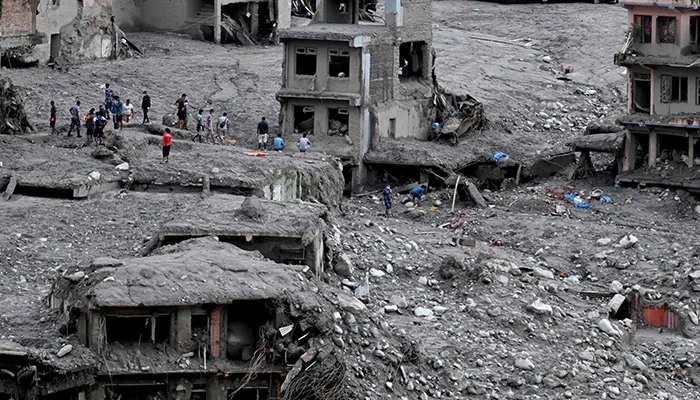
The death toll from the catastrophic Himalayan glacial floods surpassed 1,000 on Tuesday, as rescue teams from China and Nepal searched for survivors, including dozens believed to be trapped in hydropower tunnels.
Nearly 4,500 individuals remain missing after a massive wave of freezing water, rocks, and debris from a high-altitude glacier collapse surged downstream last Wednesday, destroying entire villages and carving a path of destruction across Nepal.
Rescue teams in Nepal are tirelessly excavating, drilling, and blasting through debris in a race against time and dangerous conditions to free around 100 hydropower workers trapped in multiple tunnels. So far, only bodies have been recovered from tunnels filled with sludge.
“We are concentrating on search and rescue operations at the tunnels; our efforts are ongoing,” said Nepal Army spokesperson Raja Ram Basnet. “Our personnel are also removing bodies and working to prevent disease outbreaks.”
Hospitals in Nepal are overwhelmed, prompting authorities to begin burying hundreds of unidentified bodies after DNA testing. Additionally, at least 17 bodies have been retrieved from rivers far downstream in India.
Prime Minister Balendra Shah described the disaster as “unimaginable and heartbreaking.”
In Kathmandu, residents gathered, posting photographs of missing family members along a long wall outside a hospital, holding onto faint hope of finding loved ones alive.
Debu Sapkota, a 58-year-old driver, shared photos of his 83-year-old mother-in-law and his young daughter-in-law, both of whom went missing in Trishuli Bazaar after being swept away last week. While a warning alert was issued, the elderly woman was deemed “too old to run,” he explained. His granddaughter had tried to help her escape, but both were carried away by the torrent. Sapkota no longer holds out hope they survived, believing their bodies are the only certainty now.
In Chitwan district, families mourned while performing cremations for some of the dead. Rescue workers are seen unloading bodies from helicopters in districts like Nuwakot and Rasuwa.
The damage is colossal. Entire communities have been swept away, leaving countless families homeless and living in makeshift shelters amid persistent heavy rains. Roads and dozens of bridges are destroyed, and power plants have been washed out.
“There are numerous challenges,” said officer E. Hawadi in Nuwakot, one of the hardest-hit areas.
In Nuwakot, AFP photographers observed people sifting through muddy rubble for usable items, some attempting to piece together shelter from debris and tarps.
Among the missing are tourists trekking in the seemingly peaceful Himalayas and Hindu pilgrims heading to Tibet’s sacred Mount Kailash.
Widespread anger is growing over the destruction in Nepal, a predominantly rural country of 30 million that has contributed little to the emissions fueling global warming but is bearing its devastating effects.
Prime Minister Shah emphasized the need to raise the issue of climate-related disasters with the international community, stating, “It is now time for us to strongly address the crisis we are facing due to climate change.”
Scientists warn that the Himalayas, the world’s highest mountain range, are melting at an accelerated pace as global temperatures climb.
Nepal’s economy is already strained, with limited resources to respond to such a large-scale disaster. Officials estimate reconstruction could cost billions of dollars.
Nepal has recovered 987 bodies and has 3,916 individuals listed as missing. Meanwhile, Chinese media reports 16 deaths and 546 missing persons, bringing the total death count to over 1,000 and missing to more than 4,460.
In Tibet, rescue personnel, officials, and residents observed memorial services on Tuesday,mourning the victims in silence. Over 2,000 responders, including military personnel, are aiding efforts, which include searching for survivors, repairing roads, restoring communication, and reestablishing power lines.
China’s foreign ministry stated Monday that the country has been transparent in its reporting and rejected claims that it is underreporting death numbers.
