الوسم: MIT

  • MIT’s Micro-robot Boats Build Floating Bridges and Platforms

    MIT’s Micro-robot Boats Build Floating Bridges and Platforms

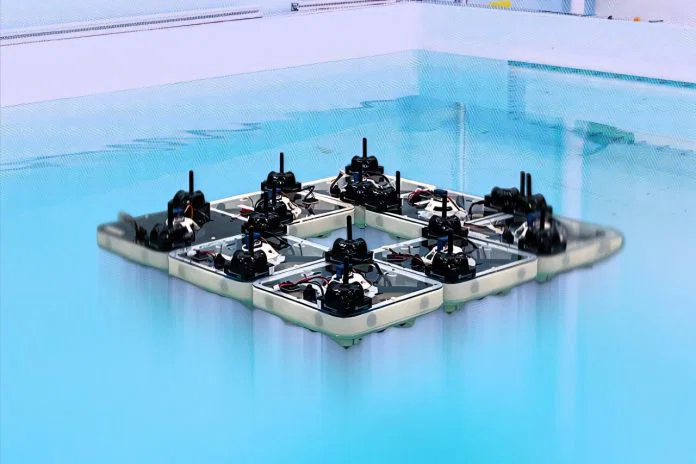
    Imagine dozens of small robotic boats drifting along a river, coming together to form a bridge, a stage, or a temporary platform anytime it’s needed. Once the task is complete, the robots split apart and move on to create something entirely different. This futuristic concept is now becoming a reality through a project called FloatForm, developed by researchers at the Massachusetts Institute of Technology (MIT).

    Published in Nature Communications, the study showcases a group of tiny autonomous robot boats capable of self-organizing into larger floating structures with minimal human input. Each boat measures about 8 inches wide — roughly the size of a dinner plate. Despite their small size, every boat is equipped with its own battery, electric motors, sensors, and magnetic connectors, enabling independent movement while collaborating with others.

    The team envisions these robotic boats transforming into adaptable floating infrastructure. Potential uses include quickly constructing temporary bridges after natural disasters, creating floating markets along canals, setting up stages for events, or providing work platforms for scientists and engineers.

    This idea was inspired by an earlier MIT project involving full-sized autonomous boats used on Amsterdam’s iconic canals, which sparked curiosity about whether smaller robots could team up to build larger structures on demand. A significant challenge was teaching numerous robots to cooperate without relying on a single controlling computer.

    To overcome this, the researchers looked to nature for clues. Fire ants, for instance, can survive floods by linking their bodies into floating rafts without a designated leader. Each ant follows simple local rules, resulting in a stable structure. Similarly, the FloatForm robots communicate solely with nearby units, determining their movements based on local information. A central computer simply assigns each robot a destination; the robots handle navigation, collision avoidance, and connections themselves.

    This decentralized approach enhances system reliability. If one robot encounters a problem, the others continue functioning smoothly. For connecting, each robot features a clever magnetic locking system tucked inside its body. A small motor extends or retracts magnets to clasp onto neighboring robots. Once linked, the magnets stay locked without using extra power, conserving battery life.

    In laboratory tests, eight robot boats successfully gathered from different starting points, formed a larger floating structure, detached, and reshaped into new configurations. They even managed to move together across the water as a single vessel. Computer models suggest that the same system could coordinate larger groups of up to 64 robots.

    Beyond urban waterways, the team sees numerous future applications. Swarms of these boats could assist search-and-rescue operations, monitor water quality, inspect offshore equipment, create temporary floating work platforms, or aid scientists studying wildlife in secluded lakes and oceans.

    Currently, the researchers are working on making the robots more durable for outdoor environments and rougher waters. They also plan to replace the indoor tracking system with GPS and other navigation technologies.

    Although still in early development, FloatForm offers a glimpse into a future where rivers, lakes, and canals become adaptable spaces capable of changing shape as needed. Instead of permanent structures, cities might rely on intelligent robot swarms to generate floating infrastructure whenever the situation calls for it.

  • New MIT Technique Halves Lithium Costs with Near-Zero Waste

    New MIT Technique Halves Lithium Costs with Near-Zero Waste

    Lithium has become an essential mineral worldwide because it’s a crucial component in rechargeable batteries powering electric vehicles, smartphones, laptops, and energy storage systems.

    With the rising demand for batteries, the need for lithium continues to grow. Although countries like the U.S. and Australia possess significant lithium resources, much of the refining still occurs in China.

    One reason is that extracting lithium from hard rock is currently costly, requires a lot of energy, and produces substantial waste.

    Now, researchers at MIT and their partners have created a new method that could significantly transform lithium production. Their process extracts lithium from hard rock at low temperatures, almost eliminates waste, and could reduce costs by approximately 50% compared to traditional methods. This research was published in the journal Science.

    Traditionally, extracting lithium from hard rock involves heating the rock above 1,000°C and then using chemicals to separate the lithium. This process consumes significant energy, and the leftover rock waste is typically discarded.

    In contrast, the new approach uses a liquid mixture of water and ammonium fluoride to dissolve the rock at room temperature. This allows for the separation of the valuable minerals without high heat. The main lithium mineral, spodumene, mainly consists of lithium, aluminum, and silica. The researchers found ways to recover each component in useful forms: lithium as battery-grade lithium carbonate and lithium hydroxide, aluminum as smelter-grade material, and silica for cement production.

    Since every major component is recovered and sold, waste is minimized. Interestingly, the idea for this process stemmed from a discovery made roughly 25 years ago. MIT professor Yet-Ming Chiang noticed that a glass-etching cream containing ammonium fluoride could dissolve glass. Because glass and spodumene both contain high silica content, he wondered if the same chemistry could break down lithium-bearing rock, leading to this innovative method.

    The team further developed a way to recover and reuse the ammonium fluoride and water used in the process, establishing a closed-loop system that recycles key chemicals rather than discarding them.

    They tested the method on 17 different spodumene samples from around the world, indicating broad applicability. Besides environmental advantages, this technology could bolster lithium production domestically in countries like the U.S. and Australia. Given the expected surge in demand over the coming decades, more efficient extraction techniques will be vital.

    To commercialize their innovation, the researchers launched a startup called Rock Zero. They are now working to scale up the process and believe it could become one of the most affordable and sustainable methods for producing lithium for future batteries.

    Source: KSR.

  • MIT Unveils Pill For Obesity Treatment

    MIT Unveils Pill For Obesity Treatment

    Scientists at the Massachusetts Institute of Technology (MIT) are spearheading a radical breakthrough in the battle against obesity. A vibrating pill, no larger than an average multivitamin, represents a novel approach to suppressing hunger and stimulating digestion.

    This pill houses a vibrating motor powered by a silver oxide battery. Once ingested, the gastric acid within the stomach dissolves the pill’s outer layer, prompting the vibration. This unique activity stimulates mechanoreceptors, sending signals to the brain via the vagus cranial nerve. This chain reaction initiates the production of hormones like insulin, GLP-1, C-peptide, and PYY that trigger a fullness sensation and facilitate digestion.

    Like drinking water before a meal, a practice widely recommended by dieticians, the pill induces a feeling of satiety in the brain, thereby controlling calorie intake. Animal tests showed that administering the pill 20 minutes before feeding reduced food consumption by approximately 40%. The pill was effectively stimulating hormones associated with fullness, curbing their appetite. The animals exhibited none of the adverse effects one could anticipate, such as perforation or obstruction while the pill passed through their digestive system.

    The pill, known as the Vibratory Ingestible BioElectronic Stimulator (VIBES), has thus far been tested on a select group of young Yorkshire pigs with promising outcomes. Following activation of the pill, insulin levels in the pigs rose, and ghrelin, the hunger hormone, experienced a dip. This replicates the stages witnessed after a sizeable meal.

    The research team is buoyed by these positive preliminary results and the potential the pill holds for fostering a natural fullness sensation, automatically regulating calorie ingestion. They envision the pill being used on an “as-needed” basis, synchronized with regular meal times.

    With plans to augment production underway, the success of the research opens up the possibility for clinical trials in humans. However, these are still early days in this exciting research, and more comprehensive, long-term studies, especially human trials, are imperative to corroborate the safety and efficacy of this approach. The revolutionary vibrating pill signifies a considerable stride in overcoming the global obesity crisis, and renewed hope for millions wrestling with weight-related health issues.

  • New AI Antibiotics Against Drug-Resistant Superbugs: MIT & Harvard Breakthrough

    New AI Antibiotics Against Drug-Resistant Superbugs: MIT & Harvard Breakthrough

    This milestone, crucial in tackling antibiotic resistance, presents hopeful drug options following the examination of millions of compounds.

    Researchers, led by James Collins at the Broad Institute of MIT and Harvard, have achieved a significant breakthrough in antibiotic discovery by harnessing the potential of artificial intelligence (AI). This groundbreaking stride forward marks a pivotal moment in the field.

    AI-Driven Antibiotic Discovery

    Utilizing deep learning algorithms, the research team conducted an extensive screening of millions of compounds, uncovering a selection of 283 potential compounds. These substances showcased remarkable effectiveness against the notoriously resilient methicillin-resistant Staphylococcus aureus (MRSA) and vancomycin-resistant enterococci, both recognized as highly challenging pathogens to combat.

    Explainable AI and Unprecedented Impact

    In a remarkable development, the AI model used in this study is “explainable,” allowing for a deeper understanding of the underlying biochemistry that guides its decision-making process. This characteristic significantly improves transparency in the selection of antibiotic candidates.

    Addressing Global Health Crisis

    The context of this breakthrough is the growing concern over antibiotic resistance, which caused around 1.27 million deaths in 2019 and contributed to nearly five million more cases. With the COVID-19 pandemic worsening this issue and a prolonged absence of new antibiotic classes, this discovery shines as a beacon of hope.

    Promise and Further Analysis

    The newly discovered compounds demonstrate notably low toxicity against human cells, positioning them as promising candidates for drug development. In collaboration with Phare Bio, a nonprofit associated with the Antibiotics-AI Project, researchers aim to conduct a detailed analysis of these compounds’ chemical properties and their potential.

    AI’s Accelerated Impact

    This breakthrough highlights the emerging domain of AI-driven antibiotic discovery and design, significantly expediting the process of sorting through thousands of compounds and speeding up drug discovery timelines.

    Road to Clinical Application

    Despite this significant progress, the new antibiotic candidates require extensive refinement and testing before clinical deployment. Essential steps such as systematic toxicity studies and pre-IND assessments are crucial before they can be considered for clinical use.

    In summary, the groundbreaking discovery of a new antibiotic class through AI represents a pivotal moment in the ongoing fight against antibiotic resistance. It demonstrates the immense potential of cutting-edge technology to drive advancements aimed at protecting global health.