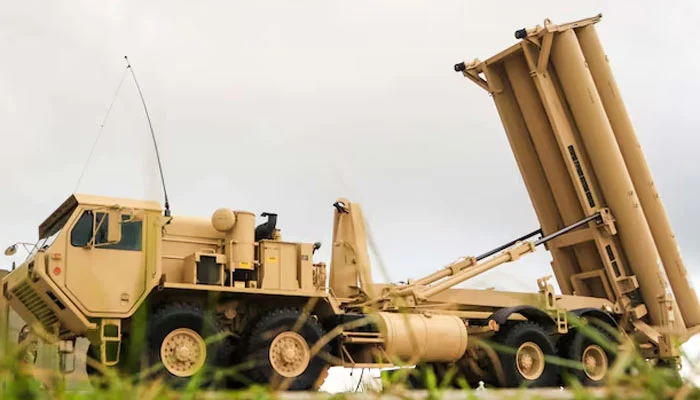
The United States has entered into a deal exceeding $3 billion with Lockheed Martin and Northrop Grumman to increase the manufacturing of Patriot and THAAD missile interceptors, due to strained stockpiles from conflicts in Iran and Ukraine. This announcement, made by the Pentagon and Northrop on Monday, follows a recent contract signed with Lockheed valued at up to $58.6 billion to produce Patriot interceptor missiles.
The U.S. has been providing extensive arms supplies to allies while also deploying munitions in Iran, raising concerns about the sufficiency of air defense systems and precision-guided weapons inventories. According to the Pentagon, this framework agreement aims to triple Patriot missile production and quadruple THAAD system outputs.
A recent estimate by the Center for Strategic and International Studies, a think tank based in Washington, indicates that the U.S. military currently has fewer than 1,000 Patriot interceptors and under 250 THAAD interceptors, both of which are critical air defense systems heavily utilized in the Middle East.
Pentagon officials have been urging contractors to accelerate production, with earlier agreements this year aimed at increasing missile output. Ukraine, for its part, has faced significant shortages of Patriot systems, which remain its only missile defense capable of intercepting ballistic threats.
The Pentagon also announced that the new deal will establish a secondary source for PAC-3 solid rocket motors and increase the production of ignition safety devices. Additionally, the U.S. has a similar agreement with Raytheon’s parent company, RTX, to escalate Tomahawk missile production from about 60 per year to a target of 1,000 annually.
The United States has approved a potential $4.5 billion missile defense sale to the United Arab Emirates, according to the State Department. The package includes an advanced long-range radar system and the Terminal High Altitude Area Defense (THAAD) system, which is designed to intercept incoming missiles before they reach their targets. Officials describe the radar as a highly sophisticated system capable of detecting threats from long distances, including ballistic missiles and drones.
The statement highlighted that this sale would enhance the UAE’s capability to address current and emerging threats, providing protection from attacks incoming from any direction. The approval was granted on an emergency basis, allowing the Biden administration to bypass the standard congressional review process due to national security concerns.
Washington emphasized the UAE’s role as an important regional partner and noted that the deal would contribute to regional stability in the Middle East. The agreement also covers five years of training, technical assistance, and maintenance services to ensure the system’s efficiency.
Lockheed Martin, a leading U.S. defense contractor specializing in missile and radar technology, is the principal contractor for this sale.
Israel has alerted the U.S. that its stockpile of ballistic missile interceptors is critically low amid ongoing tensions with Iran, according to reports from Semafor citing U.S. officials. The country was already facing shortages after deploying many interceptors during last summer’s confrontations with Iran. Since then, Iranian missile attacks have increased, further depleting Israel’s defenses, especially as Iran allegedly starts adding cluster munitions to its missiles, which could accelerate resource consumption.
A U.S. official mentioned to Semafor that Washington had been aware of Israel’s limited interceptor capacity for months, describing it as an expected situation. While the U.S. claims its own interceptor stocks are sufficient, it remains uncertain whether Washington will provide or sell additional systems to Israel, possibly straining U.S. supplies. The official reassured that the U.S. has enough resources to safeguard its bases, personnel, and interests in the region, and noted that Israel is actively working on solutions to address its interceptor shortage.
Israel still possesses other defensive options, such as fighter jets, to counter Iranian missile threats. However, interceptors are among the most effective means for defending against long-range attack, with the Iron Dome system primarily designed to handle shorter-range threats.
Earlier this month, President Donald Trump stated that the U.S. maintains a nearly unlimited stockpile of munitions, though experts have long suggested that U.S. reserves are lower than preferred for sustained conflict. During the 12-day recent conflict with Iran, the U.S. reportedly used over 150 THAAD interceptors—about a quarter of its inventory at the time—and possibly around $2.4 billion worth of Patriot interceptors in the first days of the current hostilities.
In January, the Pentagon launched efforts to boost the production of the THAAD missile defense system significantly. Pentagon spokesperson Sean Parnell affirmed that the U.S. has all necessary systems, aircraft, and interceptors to execute missions as directed. Following Semafor’s report, White House spokesperson Karoline Leavitt stated that U.S. stockpiles are more than sufficient to meet President Trump’s broader strategic goals and that U.S. military cooperation with Israel has led to significant drops in Iranian drone and missile attacks.
US President Donald Trump announces the Golden Dome missile defense shield in the Oval Office, Washington, DC, May 20, 2025.
President Donald Trump has chosen a design for the Golden Dome missile defense system and has appointed a leader for this ambitious $175 billion defense project. Here are the insights about Golden Dome, its origins, and its operational mechanics.
How Will It Operate?
The Golden Dome initiative aims to utilize a network of hundreds of satellites orbiting the Earth. These satellites will be equipped with advanced sensors and interceptors to neutralize enemy missiles shortly after their launch from nations like China, Iran, North Korea, or Russia.
“I vowed to the American people that I would establish a state-of-the-art missile defense shield to safeguard our homeland from foreign missile threats,” Trump stated during his announcement on Tuesday.
In April, the Pentagon sought input from defense contractors on designing a network capable of intercepting intercontinental ballistic missiles during their “boost phase,” which occurs immediately after lift-off when enemy missiles ascend slowly and predictably through the atmosphere. Current defense systems engage targets once they are in space.
Upon detection of an incoming missile, the Golden Dome system will either intercept it with a missile or laser before it leaves the atmosphere or engage it further along its trajectory using existing missile defense systems based on land-based interceptors located in California and Alaska.
In addition to the space-based interception layer, there will be another defensive layer positioned within or around the U.S. This concept was previously considered by the Pentagon’s Missile Defense Agency during Trump’s first term.
Is Golden Dome Similar to Israel’s Iron Dome?
“We assisted Israel in developing their system, which has proven to be very effective. Now, we possess technology that far surpasses that,” Trump remarked, referencing Israel’s Iron Dome missile defense system.
The Iron Dome is a short-range air defense system designed to intercept projectiles like the rockets launched by Hamas from Gaza. It was developed by Israel’s Rafael Advanced Defense Systems with U.S. assistance and became operational in 2011. Each unit, transportable by truck, launches radar-guided missiles to destroy short-range threats, including rockets, mortars, and drones.
This system evaluates whether a rocket will strike a populated area; if not, the rocket is disregarded and allowed to impact safely.
The Iron Dome was initially promoted as providing city-sized coverage against rockets with ranges between 4 and 70 kilometers (about 2.5 to 43 miles), but experts suggest that its capabilities have since expanded.
How Does It Compare to Reagan’s Star Wars Initiative?
“We will be fulfilling the mission that President Reagan initiated four decades ago, ultimately eliminating the missile threat to our homeland,” Trump stated on Tuesday.
The concept of equipping satellites with rocket launchers or lasers to intercept enemy intercontinental ballistic missiles is not novel; it was part of the Star Wars initiative developed during Ronald Reagan’s presidency. However, it represents a significant and costly advancement from current technologies.
Reagan’s “Strategic Defense Initiative” (SDI), announced in 1983, aimed to create a defense system that could render nuclear weapons obsolete.
The core of the SDI was a plan for a space-based missile defense system capable of protecting the U.S. from large-scale nuclear attacks by identifying and automatically intercepting numerous incoming ballistic missiles during different phases of their trajectories. However, the SDI failed to materialize due to factors like high costs, technical challenges, difficulties in testing, and conflicts with existing anti-ballistic missile treaties.
Who Will Construct Golden Dome?
Elon Musk’s SpaceX, alongside software firm Palantir and drone manufacturer Anduril, is positioned as a key player in developing essential components of the Golden Dome system.
Many initial systems are anticipated to be sourced from existing production lines. During a recent White House press conference, L3Harris Technologies, Lockheed Martin, and RTX Corp were mentioned as potential contractors for this extensive project.
L3 has invested $150 million to expand its new facility in Fort Wayne, Indiana, where it produces Hypersonic and Ballistic Tracking Space Sensor Satellites. These satellites are part of a Pentagon initiative aimed at improving detection and tracking of hypersonic weapons and could be adapted for the Golden Dome system.
However, funding for Golden Dome remains uncertain. Some Republican lawmakers have proposed an initial investment of $25 billion as part of a broader $150 billion defense package; however, this funding is contingent on a contentious reconciliation bill facing significant opposition in Congress.
President Donald Trump announces the Golden Dome missile defense system in the Oval Office on May 20, 2025.
President Donald Trump has revealed new information and initial funding for his ambitious “Golden Dome” global missile defense initiative, prompting China to accuse the U.S. of destabilizing global security on Wednesday.
During an announcement made on Tuesday, Trump allocated $25 billion to the project, estimating that the total cost could reach approximately $175 billion, with plans for the system to be operational within three years.
Beijing swiftly criticized the Golden Dome plan, labeling it a danger to international peace and asserting that the United States is sparking an arms race.
“I promised the American people I would develop a cutting-edge missile defense shield during my campaign,” Trump stated at the White House. “I’m thrilled to announce that we have finalized the architecture for this state-of-the-art system.”
“Once complete, the Golden Dome will intercept missiles launched from anywhere in the world, including outer space,” he added, emphasizing the importance of the system for the nation’s security.
Trump disclosed that U.S. Space Force General Michael Guetlein would oversee the effort, mentioning that Canada has expressed interest in collaborating, citing their need for protection as well.
While Trump estimated the total expenditure at around $175 billion, the Congressional Budget Office previously assessed that the cost of space-based interceptors designed to tackle a limited number of intercontinental ballistic missiles might range from $161 billion to $542 billion over 20 years.
The Golden Dome initiative aims for even broader objectives, with Trump stating it “will implement next-generation technologies across land, sea, and space, incorporating space-based sensors and interceptors.”
Pentagon chief Pete Hegseth, who joined Trump for the announcement, noted that the system aims to shield “the homeland from cruise missiles, ballistic missiles, hypersonic missiles, and drones, whether they are conventional or nuclear.”
China and Russia Oppose the Golden Dome
The name “Golden Dome” is inspired by Israel’s Iron Dome defense system, which has successfully intercepted thousands of short-range rockets and projectiles since its deployment in 2011.
The United States is facing missile threats from various adversaries, which differ significantly from the short-range munitions targeted by Israel’s Iron Dome.
The 2022 Missile Defense Review acknowledged increasing threats from China and Russia, highlighting that Beijing is catching up in ballistic and hypersonic missile technologies, while Moscow is modernizing its intercontinental missile systems and developing advanced precision strike capabilities.
The report also warned of the growing dangers posed by drones—evident in the conflict in Ukraine—and noted the potential threats of ballistic missiles from North Korea and Iran, as well as risks from non-state actors.
In response to the Golden Dome announcement, Beijing expressed “serious concerns,” indicating that it undermines “global strategic balance and stability.”
“The United States prioritizes its own interests and is obsessed with pursuing absolute security, violating the principle that one country’s security should not come at the expense of others,” remarked foreign ministry spokeswoman Mao Ning during a press briefing.
“This initiative increases the risk of space becoming a battlefield, sparks an arms race, and jeopardizes international security,” she continued.
Earlier this month, China joined Russia in denouncing the Golden Dome concept as “highly destabilizing.” A Kremlin statement following discussions between the two nations emphasized that it “explicitly calls for significantly enhancing military capabilities for space operations.”
In recent years, the United States has gained valuable experience in intercepting missiles and drones. For example, U.S. systems have effectively countered advanced Russian missile threats in Ukraine, while American aircraft and naval vessels aided Israel against Iranian assaults last year and have repeatedly intercepted missiles and drones targeting ships by Iran-backed Houthi rebels in Yemen.
U.S. President Donald Trump announces the Golden Dome missile defense system with Defense Secretary Pete Hegseth in the Oval Office, Washington, D.C., May 20, 2025. — Reuters
WASHINGTON: President Donald Trump has unveiled a massive new defense initiative called the Golden Dome missile defense system.
This ambitious project comes with a price tag of $175 billion and aims to protect the United States from missile threats by utilizing satellites in space. Trump emphasized that the system is intended to counter potential threats from nations such as China and Russia.
During a press briefing at the White House, Trump confirmed that he has chosen a specific design for the missile defense shield and appointed U.S. Space Force General Michael Guetlein as the lead manager for this significant military program.
“The Golden Dome will safeguard our homeland,” Trump stated from the Oval Office, noting that Canada has expressed interest in collaborating on the initiative.
The project, which Trump initiated in January, seeks to establish a satellite network capable of detecting, tracking, and potentially intercepting incoming missiles. The defense system could involve the deployment of hundreds of satellites dedicated to missile detection and tracking.
With a budget of $175 billion, the implementation of Golden Dome is expected to take several years and will likely encounter political challenges and funding uncertainties.
Democratic lawmakers have raised concerns regarding the procurement process and the involvement of Trump ally Elon Musk’s SpaceX, which is emerging as a front-runner—alongside Palantir and Anduril—to construct key components of the defense system.
The concept for Golden Dome is inspired by Israel’s land-based Iron Dome defense system, which protects the country from missile attacks. Trump’s Golden Dome is considerably more extensive, featuring a vast array of surveillance satellites and a separate fleet designed to intercept and eliminate offensive missiles shortly after launch.
The Pentagon’s efforts to test and eventually acquire the missiles, systems, sensors, and satellites that will constitute the Golden Dome initiative were officially initiated with Tuesday’s announcement.