الوسم: millions

  • Instagram Deletes Millions of Accounts; Kylie Jenner and Cristiano Lose Millions

    Instagram Deletes Millions of Accounts; Kylie Jenner and Cristiano Lose Millions

    Digital Phablet – Kylie Jenner and Cristiano Ronaldo Experience Major Follower Decline During Instagram Purge

    Also Read:
    Sydney Sweeney
    Sydney Sweeney heats up Stagecoach with alluring cowgirl looks

    In recent hours, Instagram has undergone a significant transformation in its follower counts following a widespread cleanup of fake and bot accounts—an effort dubbed the “Great Cleanse of 2026” by social media users.

    This initiative has led to substantial follower drops for numerous celebrities and influencers worldwide, with millions of accounts disappearing from their follower lists. Among the high-profile figures affected, Kylie Jenner and Cristiano Ronaldo have seen some of the largest losses.

    One of the latest updates shows Cristiano Ronaldo has lost roughly 8 million followers, while Kylie Jenner has shed over 14 million within just a few hours.

    Here’s a closer look at the numbers:
    Cristiano Ronaldo Follower Change
    Cristiano Ronaldo:
    Previous followers: 673,307,250
    Current followers: 666,695,107
    Loss: 6,612,143 followers over approximately 2 days

    Similarly, Kylie Jenner experienced a massive decrease, shedding more than 14 million followers in a matter of hours.

    Adding to the wave of declines, Selena Gomez lost around 6 million of her followers, prompting widespread shock among her fans due to the rapid decrease.

    Global Impact of the Campaign
    This effort was not restricted to these few stars; it impacted a broad array of international celebrities including Ariana Grande, Beyoncé, Taylor Swift, Justin Bieber, Indian cricket star Virat Kohli, and actress Priyanka Chopra—all of whom saw sharp declines in their follower counts.

    Further updates indicate that Jennifer Lopez also experienced a significant reduction—she went from approximately 245.7 million to 242.3 million followers, losing over 3.4 million in a short span.

    Industry insiders suggest these declines reveal a large number of fake accounts linked to these celebrities, highlighting how dependency on services inflating follower counts artificially can distort true popularity metrics.

    K-Pop FanBase Not Spared
    Even K-Pop groups, such as BTS and BLACKPINK, have reported notable follower drops, raising questions about the extent of fake account activity on major entertainment platforms.

    Meta’s Crackdown on Fake Accounts
    Although Meta has not officially commented, reports indicate the company is engaged in an extensive campaign to purge phony and inactive accounts, including those associated with follower-buying schemes and fake interactions.

    The goal is to enhance platform credibility and ensure genuine digital interactions. However, some users, including those on the Threads platform, have reported that authentic accounts have been accidentally deleted or restricted, with some losing between 2-5% of their followers. Celebrities with large followings have faced even greater losses.

    Towards Greater Transparency in Digital Influence
    Experts believe these efforts could fundamentally reshape social media by revealing actual follower counts, thereby correcting long-standing inflation caused by fake accounts and artificially enhanced popularity metrics.

    Facebook Video
    This move is aimed at increasing the integrity of the platform and eliminating spam accounts, ultimately fostering trust among users and brands alike. Nonetheless, some concerns persist about the unintended removal of real accounts during the crackdown.

    The push for transparency signals a new era in social media, one where authenticity takes precedence, and famous figures’ popularity is measured by genuine engagement rather than inflated numbers.

  • Taylor Swift’s Impact Lets Artists Earn Millions from $1.4B Spotify Deal

    Taylor Swift’s Impact Lets Artists Earn Millions from $1.4B Spotify Deal

    Digital Phablet – Taylor Swift’s agreement could generate millions for artists worldwide.

    In an unexpected development for the music world, Universal Music Group revealed plans to sell 50% of its 3% ownership stake in Spotify, a move that might be valued at as much as $1.4 billion based on the platform’s valuation as of April 29. The notable part? These earnings will be shared not only by the company but also directly with artists—an advantage credited to Taylor Swift’s influential contract negotiations.

    Taylor Swift, Universal Music Group, and Spotify: How the Investment Deal Reshaped Industry Dynamics

    This narrative goes back to the late 2000s when key music labels arranged licensing deals with Spotify, receiving equity in the then-new platform. Warner Music Group and Sony Music later announced intentions to pass some of the proceeds from Spotify share sales directly to their artists, even without a legal requirement to do so.

    Around two years later, Universal Music Group committed to this approach just prior to Spotify’s initial public offering.

    Historical Context of Industry-Artist Revenue Sharing

    When Taylor Swift signed her contract with Universal Music Group in November 2018, she emphasized a specific contractual clause as “more significant than any other point.” She expressed gratitude to the company’s CEO, Lucian Grainge, for his agreement to these conditions, which she regarded as more equitable for artists.

    A Step Toward Fairer Compensation?

    Swift concluded her remarks with a resolute statement: “This agreement is a sign that we are headed toward positive changes for creative artists—something I will continuously strive for.”

    How Much Will Artists Receive?

    Currently, the exact figures, including how much of the profits artists will receive, the profit-sharing system, and payout timelines, remain confidential. Nonetheless, Universal Music Group is anticipated to implement a distribution model akin to existing royalty systems, which are based on music and digital revenue shares. In an optimistic scenario, top-tier artists could earn substantial sums, potentially reaching into the millions.

    Watch the video here

  • India’s TV Households Expected to Rise from 226M to 248M by 2026

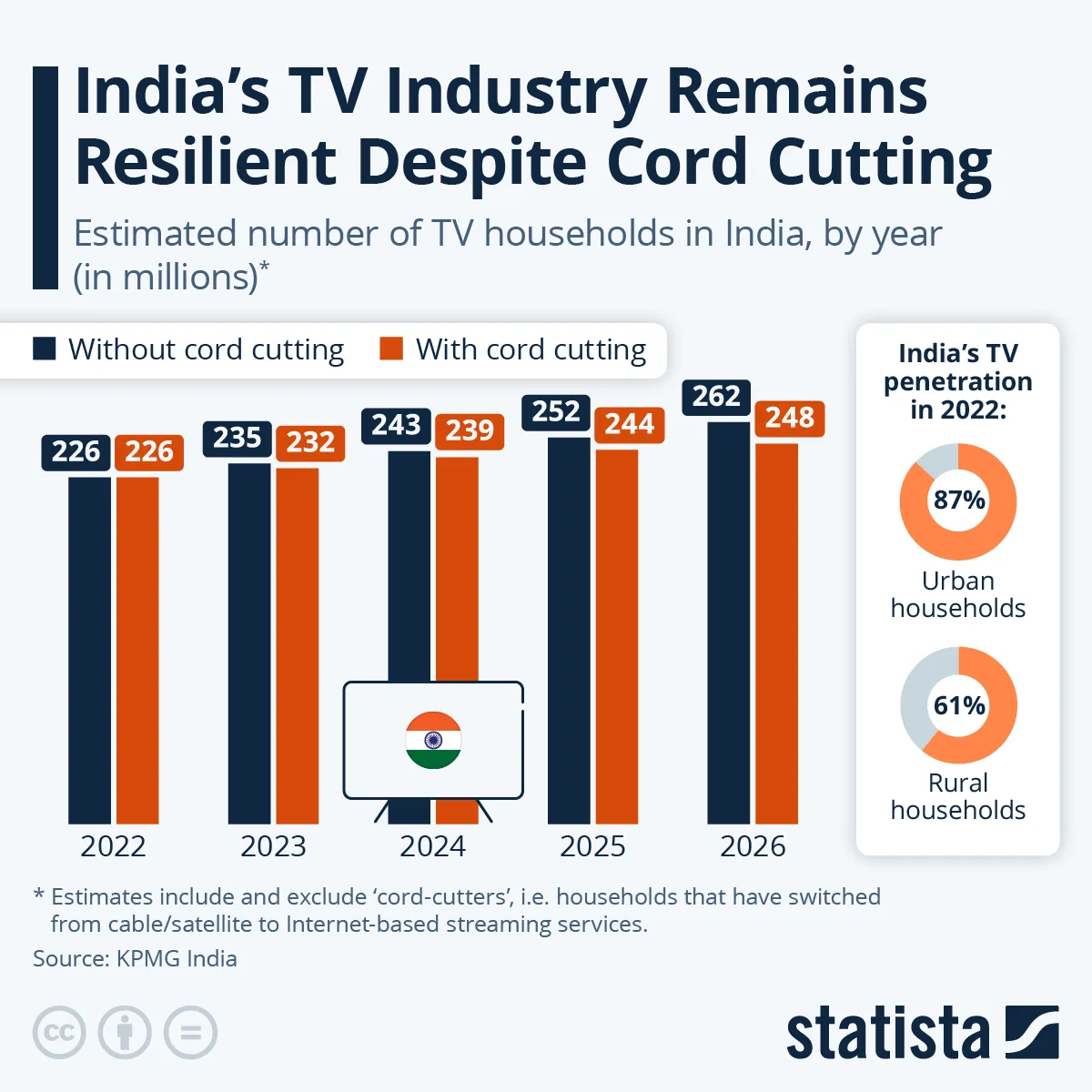
    India’s TV Households Expected to Rise from 226M to 248M by 2026

    The Resilience of India’s TV Industry in the Age of Streaming

    The Indian television landscape is undergoing significant transformations, yet it remains a robust sector amid the global trend of cord-cutting. Despite predictions of decline in traditional TV viewership, India’s unique market dynamics showcase its ongoing relevance and potential for growth.

    Current Landscape of TV Ownership in India

    India boasts a vibrant and rapidly expanding television market. According to the 2022 KPMG India report titled "Sports Broadcasting on TV: A Match Made in Heaven," there are compelling statistics on TV ownership that reveal the country’s evolving media consumption habits. In 2022, India had approximately 314 million households, of which 226 million owned a TV. These numbers are projected to grow, with expectations of reaching 248 million TV households by 2026, despite the backdrop of increasing streaming service subscriptions.

    Impact of Cord Cutting on Traditional TV in India

    Cord cutting—where viewers abandon traditional cable or satellite TV in favor of internet-based streaming services—is a global trend. However, its impact in India is more tempered compared to markets like the United States or the United Kingdom. Indian households are increasingly adopting streaming platforms such as Netflix and Amazon Prime Video; however, these trends coexist with continued engagement with linear TV.

    One major factor contributing to this phenomenon is the diversity in viewing preferences across different demographics and regions. While urban areas may lean towards modern streaming options due to better internet access and availability of diverse content, rural areas still heavily rely on traditional TV for entertainment and news.

    Growth Potential in Rural Markets

    The rural market in India presents a unique opportunity for the TV industry. Despite only a 61 percent penetration rate of TV households in rural regions, the growing availability of affordable television sets and satellite connection options is set to drive substantial growth. As infrastructure improves, more rural households are likely to invest in TV, fuelling both ownership and viewership statistics.

    Moreover, the allure of sports broadcasting plays a pivotal role in captivating audiences. Events such as cricket, which hold cultural significance in India, have the potential to attract viewers and reinforce traditional TV’s importance. The right mix of local programming and accessible sports content could bridge the gap between urban and rural viewership practices, sustaining the relevance of traditional TV.

    The Future of Television Consumption in India

    The imminent future foresees a television landscape that is not merely a battlefield between traditional and streaming platforms but rather an ecosystem where both can thrive. Factors such as socio-economic variations, regional preferences, and the allure of premium content are likely to keep TV alive and well in many households.

    As content providers adapt to this multifaceted environment, the potential for hybrid consumption models emerges. It is conceivable that viewers may oscillate between streaming and traditional TV, depending on their context—family viewing events, live sports, or binge-watching sessions.

    Conclusion

    The Indian television industry exemplifies resilience in the face of changing consumer behaviors. With growth prospects particularly strong in rural areas and a deep-rooted penchant for local content, traditional TV is likely to maintain a significant presence for years to come—even as viewers experiment with new digital offerings.