الوسم: military aid

  • Trump: US to Increase Weapons Aid to Ukraine

    Trump: US to Increase Weapons Aid to Ukraine

    US President Donald Trump discusses matters while signing documents in the Oval Office at the White House in Washington, DC, on February 4, 2025. — Reuters

    • Kyiv has confirmed a drone strike on a Russian ammunition factory.
    • Russia claims to have taken control of the village of Dachne in Dnipropetrovsk.
    • Kyiv is concerned about a potential reduction in US support following Trump’s return to the White House.

    KYIV: President Donald Trump announced on Monday that the United States will provide additional military aid to Ukraine, responding to recent advances made by Russia in its ongoing conflict with the country.

    This announcement came after Washington disclosed last week that it would pause certain arms shipments to Kyiv, leaving Ukrainian officials in a state of uncertainty.

    This halt could pose a significant challenge for Ukraine, which is facing some of the heaviest missile and drone offensives from Russia during the more than three-year conflict.

    “We will be sending more defensive weapons,” Trump told reporters at the White House. “They are under intense attack,” he said of Ukraine, while also expressing discontent with Russian President Vladimir Putin.

    Putin initiated a full-scale invasion of Ukraine in 2022 and has shown little interest in ceasing hostilities despite pressure from Trump.

    Trump’s commitment to delivering more military equipment to Ukraine follows Russia’s claim of having captured its first village in the Dnipropetrovsk region after months of advances.

    Prior to the announcement, Russia launched another wave of drone and missile strikes, targeting Ukraine’s military recruitment centers.

    Ukraine also reported a drone strike on a Russian munitions factory located in the Moscow area.

    Challenging Conditions

    Russia stated that its forces had taken over the village of Dachne in the Dnipropetrovsk region, an area crucial for its industrial mining that has been subjected to increasing air assaults from Russia.

    Last month, Moscow claimed its troops had breached the border into the Dnipropetrovsk region for the first time in their campaign.

    In recent months, Russian forces appear to regard crossing into this region as a strategic priority, and deeper incursions could lead to logistical and economic difficulties for Ukraine.

    So far, Kyiv has denied the presence of any Russian troops in Dnipropetrovsk.

    The Ukrainian military reported earlier on Monday that its forces had “repelled” assaults in Dnipropetrovsk, including near Dachne.

    Dnipropetrovsk is not one of the five Ukrainian territories—Donetsk, Kherson, Lugansk, Zaporizhzhia, and Crimea—that Moscow has publicly annexed.

    Describing the situation in Dnipropetrovsk as “challenging,” military analyst Oleksiy Kopytko noted that Russia seems poised to establish a buffer zone in the area. “Our troops are holding their positions fairly well,” he informed AFP.

    Relying on Allies

    Last week, the White House indicated it was suspending certain significant arms supplies to Ukraine that had been established under Trump’s predecessor, Joe Biden, without specifying which programs would be impacted.

    This decision was made following a review of America’s defense needs and its military assistance to other countries.

    Kyiv has long feared interruptions to US support since Trump’s return to office in January, particularly given his criticisms of the significant financial and military aid provided by Biden.

    During Biden’s presidency, the US committed over $65 billion in military assistance to Ukraine.

    Since resuming his term, Trump has not announced any new military aid packages for Kyiv. Instead, he has advocated for initiating peace talks between the two parties, including phone conversations with Putin. Nevertheless, the Russian leader has dismissed requests for a ceasefire, insisting that Ukraine must concede more territory to conclude the conflict.

    Before Trump’s comments on Monday, Ukrainian President Volodymyr Zelensky emphasized that air defense remained the “highest priority for saving lives,” urging partners to fulfill their commitments.

    Explosions were reported overnight on Tuesday in the southern Ukrainian city of Mykolaiv, as Mayor Oleksandr Senkevych mentioned on Telegram that the “danger of drone attacks” persists.

    Mykolaiv’s regional governor, Vitaliy Kim, reported a fire outbreak in the outskirts of the city due to shelling, which resulted in injuries to a 51-year-old man.

  • Ukrainian F-16 Pilot Dies in Major Russian Strike; Zelensky Seeks US Aid

    Ukrainian F-16 Pilot Dies in Major Russian Strike; Zelensky Seeks US Aid

    A powerful explosion illuminates the sky over Kyiv during a Russian drone strike amid ongoing hostilities in Ukraine on June 29, 2025.

    On Sunday, Ukrainian authorities reported that an F-16 pilot died in a crash while defending against a massive Russian air assault involving hundreds of drones and missiles. This incident occurred as Moscow ramps up its nighttime bombardments, marking the fourth year of the conflict with Ukraine.

    President Volodymyr Zelensky honored the fallen pilot, Maksym Ustymenko, by posthumously awarding him the title of Hero of Ukraine, the nation’s highest honor.

    In the wake of the attack, which caused damage to homes and infrastructure and injured at least 12 individuals, Zelensky urged the United States and other Western allies to provide enhanced support to strengthen Ukraine’s air defense systems.

    As warnings of air raids blared, families sought refuge in metro stations across Kyiv. Gunfire and explosions echoed through the capital, as well as in Lviv, a city less frequently targeted by such assaults.

    The governor of Lviv, situated near the Polish border, confirmed that the raid aimed at critical infrastructure.

    Since acquiring the U.S.-made F-16s last year, Ukraine has now lost three of these aircraft. While Kyiv has not disclosed the total number of F-16s in its fleet, they have become a vital component of its defense strategy.

    The Ukrainian Air Force reported that the pilot maneuvered the damaged jet away from populated areas but did not have time to eject before the plane went down.

    “The pilot deployed all onboard weapons and successfully shot down seven enemy targets. However, while targeting the last one, his aircraft sustained damage and began to descend,” the Air Force communicated via Telegram.

    Military expert Roman Svitan noted earlier this month that while the F-16 is a powerful aircraft, it is not particularly designed for all tasks, especially in countering the drone swarms that are common in urban areas, where higher-speed targets are more effectively engaged.

    In his nightly video address, Zelensky highlighted that Ustymenko had been involved in missions dating back to 2014, during the conflict with Russian-backed separatists in eastern Ukraine.

    “He was proficient in flying four types of aircraft and achieved significant results in defending our nation,” Zelensky remarked. “Losing such talented individuals is truly painful.”

    Russia’s overnight assault included a total of 477 drones and 60 missiles; Ukraine’s defense efforts successfully intercepted 211 drones and 38 missiles, with 225 additional drones either lost to electronic warfare measures or identified as decoys.

    On social media, Zelensky stated: “Moscow will not relent as long as it can execute massive strikes,” revealing that Russia launched about 114 missiles, 1,270 drones, and 1,100 glide bombs within the past week alone.

    Russia’s RIA Novosti news agency reported one fatality caused by a Ukrainian drone in the Luhansk region, which is under Russian control. Both Ukraine and Russia maintain that they do not target civilians.

    Political Context

    Ukraine insists that these recent attacks underscore the urgent need for further assistance from Washington, especially considering that under President Trump, new military support has not been confirmed.

    Trump stated he is contemplating Ukraine’s request for additional Patriot missiles and batteries following his meeting with Zelensky at a NATO summit last Wednesday.

    “This conflict must come to a close. We need to apply pressure on the aggressor while ensuring our protection,” Zelensky stated in a post. “Enhancing our air defense systems is crucial for saving lives.”

    He expressed Ukraine’s readiness to purchase American air defense systems and emphasized the need for “leadership, political will, and support from the U.S., Europe, and all our partners.”

    In recent weeks, Russia has conducted extensive strikes on Ukrainian cities every few days, resulting in widespread devastation, civilian casualties, and numerous injuries.

    During the latest round of attacks, explosions were reported in Kyiv, Lviv, Poltava, Mykolaiv, Dnipropetrovsk, Cherkasy, and the Ivano-Frankivsk regions, according to witnesses and local officials. The Ukrainian military confirmed air strikes in six areas.

    In Cherkasy, eleven people were hurt, including two children, while regional authorities reported damage to three apartment buildings and a college. One female resident was injured in Ivano-Frankivsk.

    Emergency responders worked to evacuate residents from apartment buildings in Cherkasy with burnt walls and shattered windows.

  • EU Contributes 39% of Military Aid to Ukraine Amid U.S. Doubts

    EU Contributes 39% of Military Aid to Ukraine Amid U.S. Doubts

    Military Aid to Ukraine: The Role of the United States and Europe

    As the conflict in Ukraine continues to evolve, the dynamics of military aid and support have come under intense scrutiny. The interplay between the United States and European nations is critical, especially against the backdrop of shifting political attitudes in America. An infographic highlighting the U.S.’s role in military aid to Ukraine underscores the importance of transatlantic cooperation.

    Current Landscape of Military Aid to Ukraine

    With rising concerns regarding the future of American support for Ukraine, European leaders are stepping up their initiatives to assure commitment to Ukraine’s defense. A recent special meeting of the European Council sparked significant discussions about Europe’s strategic security and its role in bolstering Ukraine’s defense against Russian aggression.

    Europe’s Reassurance to Ukraine

    Ursula von der Leyen, the president of the European Commission, articulated the urgency of the situation, emphasizing that “Europe faces a clear and present danger.” The assessment reflects a broader understanding among European leaders that Europe needs to enhance its defense capabilities independent of American influence. This sentiment is underpinned by a desire for "peace through strength," a concept that highlights the necessity for Europe to fortify its military aid to Ukraine.

    Financial Contributions from European Nations

    According to the IfW Kiel’s Ukraine Support Tracker, European Union member states have collectively allocated approximately $53.8 billion in military assistance to Ukraine from January 2022 to the end of 2024. This figure represents about 39 percent of the total military aid given to Ukraine during this time frame. Notably, the amount falls roughly $15 billion short of the contributions made by the U.S., contrasting the two regions’ financial commitments to Ukraine’s defense.

    Contributions from Non-EU Countries

    The financial landscape alters when accounting for contributions from European non-EU nations such as Norway and the UK. When included, these nations’ contributions place Europe’s military support on par with that of the U.S. This scenario reinforces the urgency for European countries to prepare for the possible permanence of a withdrawal of U.S. military support.

    The Implications of U.S. Withdrawal

    The stakes are particularly high, as some political discourse in the U.S. has hinted at a potential reduction in support. For Europe to maintain its military assistance comparably to that of the U.S., it would need to significantly increase its investments in Ukraine’s defense capabilities. Such a reassessment of financial support is critical in a scenario where unilateral American actions could abruptly change.

    Conditions for Future Peace Negotiations

    In a joint statement issued by 26 of the 27 EU member states, the European Council stated its conditions for future peace talks. This includes the essential participation of both Ukraine and Europe in negotiations. There is a strong emphasis that any resulting peace agreement must honor Ukraine’s sovereignty and territorial integrity, themes that may be contentious given that some political figures in the U.S. have suggested compromises that may involve territorial concessions from Ukraine.

    Conclusion

    The course of military aid and political support for Ukraine is in a state of flux, especially with the U.S.’s role increasingly subject to debate. As European leaders reaffirm their commitment, the challenge lies in balancing national security interests, financial commitments, and the necessity of a sovereign Ukraine.

  • 20% of U.S. Adults Support Increasing Aid to Ukraine

    20% of U.S. Adults Support Increasing Aid to Ukraine

    Understanding American Perspectives on Military Aid to Ukraine

    In the context of ongoing geopolitical tensions following Russia’s invasion of Ukraine, American public opinion on military aid to the Eastern European nation has become increasingly relevant. A recent survey conducted by YouGov sheds light on how U.S. adults view military support for Ukraine, revealing sharp divisions based on political affiliation and differing perspectives on the conflict’s potential outcomes.

    Current Opinions on Military Aid

    Survey Insights

    According to the YouGov survey, only 20% of U.S. adults believe that the United States should increase its military aid to Ukraine. This figure suggests a notable hesitation among the broader population about escalating involvement in the conflict. In contrast, a significant 30% of respondents advocate for a decrease in aid, highlighting a substantial faction that believes the U.S. should reconsider its current level of commitment to Ukraine.

    Political Party Affiliation and Its Impact

    Democratic Views

    The responses to military aid become even more pronounced when broken down by party affiliation. Among Democrats, a considerable 74% express support for either maintaining or increasing U.S. military aid to Ukraine. This strong consensus reflects a party aligned with internationalist policies and a tendency to support Ukraine’s sovereignty against aggression.

    Republican Perspectives

    On the other end of the spectrum, Republican respondents present a starkly different view. While 35% support maintaining aid, a striking 45% believe that the U.S. ought to scale down its military assistance. The division within the Republican base underscores a growing isolationist sentiment that resonates with a significant portion of conservative voters. This divergence in opinions raises questions about the future of U.S. foreign policy and the potential for bipartisan support in times of crisis.

    War Outcomes According to U.S. Citizens

    Perceptions of Victory

    The survey also sought to gauge public sentiment regarding the likely victor of the ongoing conflict. Interestingly, 29% of respondents predict that Russia will emerge victorious, while only 13% hold the belief that Ukraine will achieve victory. These statistics reveal a pessimistic outlook among the public regarding Ukraine’s prospects, particularly in light of the sustained military and economic support they have received thus far.

    Uncertainty and Equal Likelihoods

    Further complicating the public opinion landscape, 19% of survey participants feel that both nations stand an equal chance of winning the war. Additionally, a significant 39% of respondents admitted they did not know which side would secure victory. This uncertainty may stem from the complex nature of the conflict, which has seen irregular shifts in momentum and ongoing negotiations that leave the outcome shrouded in ambiguity.

    Summary of Key Findings

    • 20% of Americans advocate for an increase in military aid to Ukraine.
    • 30% believe the U.S. should decrease its support.
    • 74% of Democrats favor maintaining or increasing aid, contrasted with only 10% of Republicans.
    • 29% predict a Russian victory, while only 13% foresee a Ukrainian win.
    • A significant number remain uncertain regarding the war’s outcome, highlighting the complexity and evolving nature of the situation.

    Through these findings, it becomes increasingly clear that public opinion on military aid to Ukraine is heavily influenced by political affiliation and perceptions of the conflict’s viability. The landscape of American support for Ukraine is complex, with a range of opinions that could potentially shift as the situation on the ground evolves.

  • Ukraine Aid Projections: Up to $119B or Down $59B by 2025?

    Ukraine Aid Projections: Up to $119B or Down $59B by 2025?

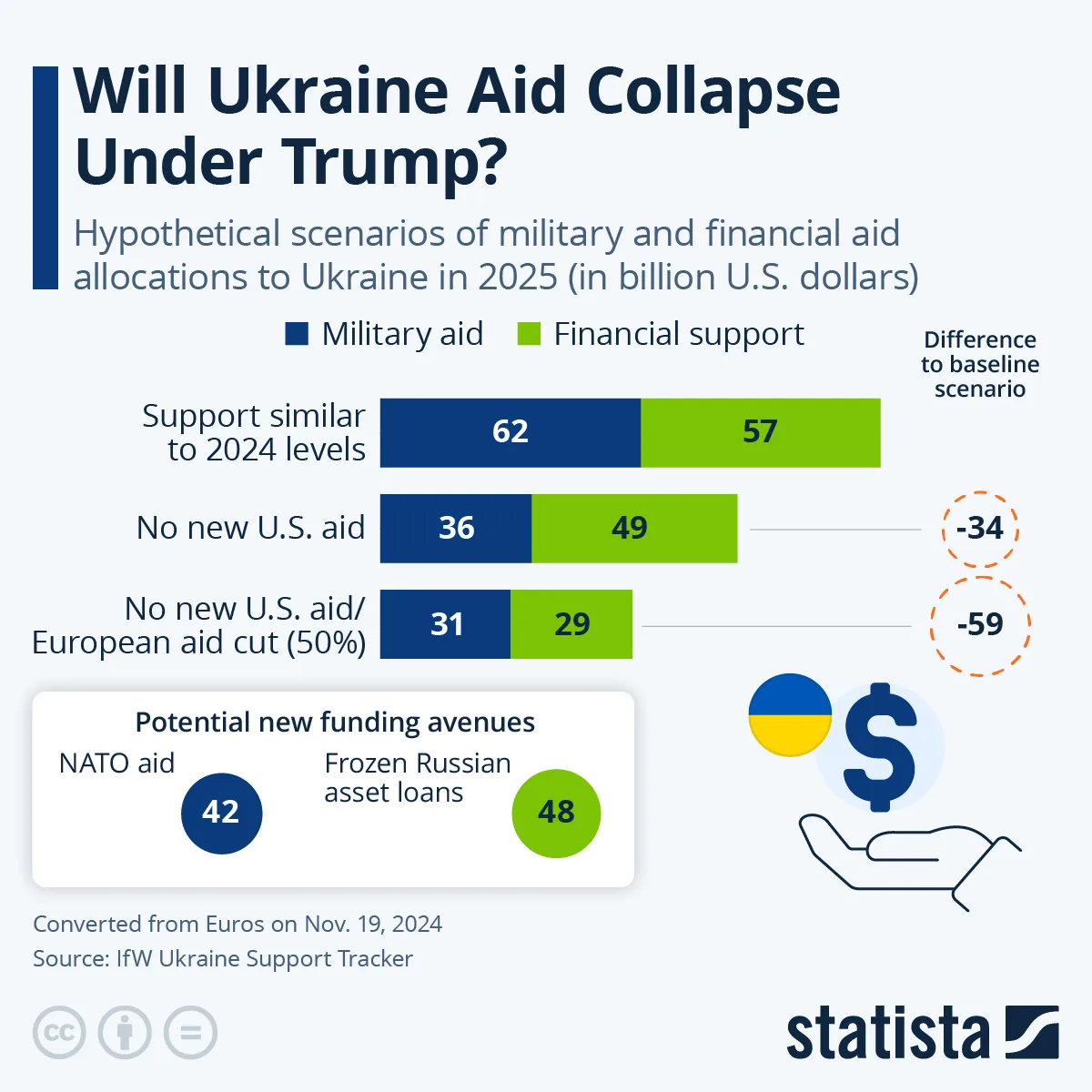
    Will Ukraine Aid Collapse Under Trump? Understanding the Political Implications for 2025

    The ongoing conflict in Ukraine has necessitated significant international support, primarily from the United States and its allies. As the 2024 presidential election in the U.S. approaches, concerns about the future of aid to Ukraine have risen, particularly with Donald Trump’s candidacy and his past rhetoric regarding U.S. military commitments abroad. This blog delves into the implications of potential shifts in Ukraine aid under a Trump presidency and contemplates different funding scenarios for 2025.

    The Context of U.S. Aid to Ukraine

    Since the onset of the Ukrainian conflict, which escalated markedly in 2022, the United States has emerged as one of Ukraine’s main allies, providing substantial military and financial assistance. This aid aligns with the Biden administration’s strategy to support democratic nations against authoritarian aggression. However, Trump’s previous criticisms of overseas military engagements raise questions about whether this support can be sustained or will take a different form if he regains presidency.

    Hypothetical Scenarios for Ukraine Aid in 2025

    Researchers at the Kiel Institute for the World Economy have presented several hypothetical scenarios for what Ukraine might expect in terms of aid by the year 2025, assuming Trump returns to office. These scenarios are crucial for understanding the possible trajectories of international support.

    Continued Aid Trends

    The baseline scenario posits that if aid levels continue on their current trajectory through 2024, Ukraine could receive around $119 billion in 2025. This scenario assumes steady commitments from both the U.S. and European allies, creating a stable support framework for Ukraine.

    A Complete Cut of U.S. Aid

    On the other hand, a scenario where Trump cuts all U.S. aid could lead to a drastic reduction in funding, dropping it down to approximately $85 billion in 2025. This represents a staggering shortfall of $34 billion relative to the baseline scenario. Such a cut would not only impact military operations but also Ukraine’s broader economic recovery efforts.

    The Ripple Effect: European Aid in Flux

    Moreover, if the U.S. aid were to be significantly reduced or completely halted, European nations might follow suit, contingent upon their reliance on U.S. leadership for foreign policy direction. The Kiel Institute researchers have explored the implications of this potential scenario, suggesting that European aid could drop by 50 percent, resulting in an estimated gap of $59 billion compared to levels established in 2024.

    Emerging Funding Solutions for Ukraine

    In light of these uncertain scenarios, it’s also important to consider new funding channels that have been proposed to bolster Ukraine’s efforts and potentially offset any reductions in U.S. support.

    NATO’s Pledges

    NATO has recently committed to coordinated aid totaling $42 billion for Ukraine in 2025. This pledge represents a collective security strategy that not only addresses Ukraine’s immediate needs but also strengthens the alliance’s deterrent capabilities against further aggression.

    G7 Financing Initiatives

    Additionally, the G7 has outlined a plan to provide $48 billion in loans to Ukraine, capitalizing on frozen Russian central bank assets. This initiative showcases an innovative approach to funding, potentially allowing Ukraine to access funds without exacerbating foreign debt levels.

    The Need for Increased Support

    Despite these pledges, experts argue that merely maintaining the current levels of aid may not be sufficient. The situation calls for a strategic shift where support is not only sustained but possibly increased to ensure that Ukraine can achieve a decisive victory against the ongoing threats posed by Russian aggression.

    In a rapidly changing geopolitical landscape, the dynamics surrounding Ukraine aid are intertwined with U.S. domestic politics and international policymaking. As we look toward the future, the fate of Ukraine’s aid and its broader implications will undoubtedly continue to evolve, contingent on the political climate and the strategic decisions made at both domestic and international levels.