Tag: magnetic fields

  • Astronomers Detect Magnetic Clues in the Universe’s Brightest Explosions

    Astronomers Detect Magnetic Clues in the Universe’s Brightest Explosions

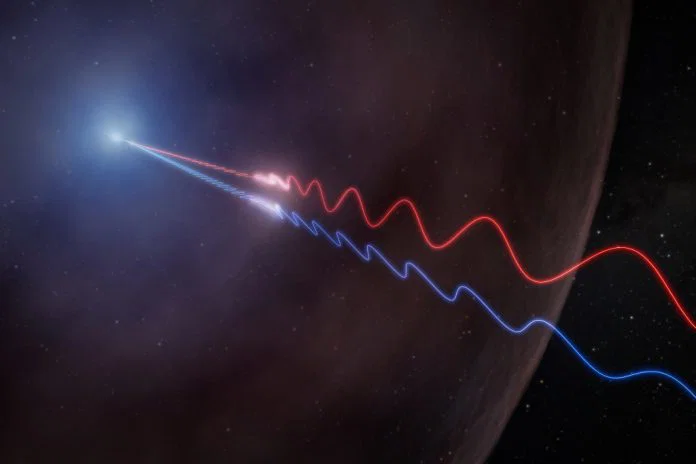
    Astronomers have made a significant breakthrough by detecting a hidden magnetic signal from one of the universe’s most intense explosions. Using the Very Large Array (VLA) radio telescope operated by the U.S. National Science Foundation, researchers observed polarized radio waves from a gamma-ray burst (GRB) for the very first time. They also identified a phenomenon called Faraday rotation within one of these events, providing scientists with a groundbreaking new method to study the powerful magnetic fields surrounding such phenomena.

    Led by scientists from the University of Arizona and the University of Utah, this research sheds new light on the extreme physics behind gamma-ray bursts, or GRBs. These bursts are the universe’s brightest and most energetic explosions, capable of releasing more energy in seconds than the Sun produces over billions of years. Scientists believe they originate when massive stars collapse at the end of their life cycles or during other catastrophic cosmic events, launching narrow, high-speed jets of particles traveling close to the speed of light. These jets often produce radio afterglows that can be visible for months following the initial explosion.

    While gamma-ray bursts have been studied for decades, measuring the magnetic fields around them proved challenging. Such magnetic fields are thought to play a crucial role in the formation and sustenance of the jets, but they have largely remained hidden until now. The burst studied, known as GRB 260310A, was relatively close to Earth compared to other cosmic events. Its radio afterglow was among the brightest observed in recent decades, offering a rare chance for detailed examination.

    When the VLA was pointed at the fading explosion, scientists discovered the radio waves were polarized, meaning the vibrations of the light waves primarily oscillated in a single direction—similar to how polarized sunglasses reduce glare by filtering polarized light reflecting off water. The significance increased when they observed that the polarization changed depending on the radio wavelength. This phenomenon, called Faraday rotation, occurs when polarized light passes through a cloud of charged particles threaded with magnetic fields, twisting the light’s polarization as it travels. This twisting provides valuable clues about the strength and structure of the magnetic fields along its path.

    Measurements indicated magnetic fields thousands of times stronger than what could be explained by the Milky Way or intergalactic space, pointing instead to a densely magnetized cloud of gas surrounding the star before it exploded. The researchers believe this was an HII region—a large bubble of ionized hydrogen created by intense ultraviolet radiation and stellar winds from young, massive stars. The presence of the burst within such an environment supports the idea that many gamma-ray bursts originate when the universe’s most massive stars reach the end of their lives.

    Previous efforts to detect polarization in gamma-ray bursts mostly focused on shorter radio wavelengths and had to be conducted very soon after the explosion before the afterglow faded. The new observations, however, demonstrate that longer radio wavelengths can also provide significant insights, including the first direct detection of Faraday rotation in a gamma-ray burst. Scientists anticipate that future observations using the VLA and other radio telescopes will enable detailed tracking of how magnetic fields around these bursts evolve over time.

    This advancement promises to deepen our understanding of how these colossal explosions generate energetic jets, disperse enormous amounts of energy, and influence some of the universe’s most extreme environments.

    Source: National Radio Astronomy Observatory.
  • Scientists Unveil Tiny ‘Drift’ Signaling Star Formation

    Scientists Unveil Tiny ‘Drift’ Signaling Star Formation

    A new star’s birth begins deep within cold, dense clouds of gas and dust, known as prestellar cores. Researchers have long been curious about the processes leading to star formation, and recent observations are shedding light on one of the earliest stages.

    A study published in Astronomy & Astrophysics reports a groundbreaking discovery by scientists from Kyushu University in Japan and the Max Planck Institute in Germany. They observed, for the first time, a phenomenon called ambipolar diffusion inside a prestellar core—a dense, cold cloud that has yet to ignite as a star.

    Stars like our Sun emerge from these cores. Gravity constantly pulls the gas and dust inward, striving to create a new star. But magnetic forces also play a crucial role, threading through the cloud and opposing gravity’s pull. These magnetic fields can slow or even halt the collapse, preventing immediate star formation. For years, scientists have believed that weakening of these magnetic fields is necessary for a star to form, but actually observing this process has been extremely challenging.

    The team focused their study on a prestellar core named L1544, located in the Taurus Molecular Cloud—one of Earth’s closest star-forming regions. They utilized the powerful 30-meter IRAM radio telescope to gather data. Since these cores are extremely cold, many molecules freeze onto dust grains, making detection tricky. Instead, they targeted two specific molecules that stay in the gas phase: diazenylium-d1 (N₂D⁺), a charged molecule, and para-monodeuterated ammonia (para-NH₂D), a neutral molecule.

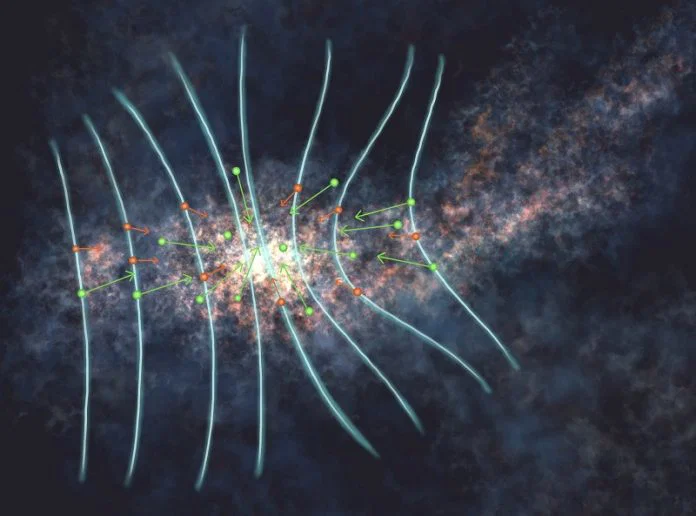
    By analyzing the radio waves emitted by both molecules, the scientists measured their movements. They discovered that the neutral molecules moved approximately 0.05 kilometers per second faster than the charged ones—a tiny but significant difference. This difference served as clear evidence of ambipolar diffusion at work.

    The explanation lies in how these particles interact with magnetic fields. Charged molecules remain tied to magnetic lines, while neutral molecules are not as constrained. As the cloud becomes denser, fewer charged particles linger, weakening magnetic support. Consequently, gravity pulls the neutral particles inward more freely, while the charged particles continue to follow magnetic lines, resulting in a gradual drift between the two groups.

    Over time, this drift diminishes the magnetic field’s hold, allowing gravity to dominate. When gravity overpowers the magnetic resistance, the cloud collapses, and a protostar—an embryonic star—begins to form.

    This discovery contributes a vital piece to understanding how stars originate. The researchers plan to observe additional prestellar cores with even more sensitive instruments to verify if ambipolar diffusion is a common step throughout our galaxy.

    Understanding star formation is essential because stars are the factories of planets and the raw materials for life. By capturing this tiny cosmic drift, scientists have taken a significant step toward unraveling the cosmic story of how stars like our Sun, and countless others across the universe, come into existence.

  • Scientists Reveal Hidden Magnetic Fields on the Sun’s Far Side

    Scientists Reveal Hidden Magnetic Fields on the Sun’s Far Side

    From Earth’s vantage point, we can only observe half of the sun at any given time. The other half—the far side—remains hidden from view, yet what happens there is still significant. Active solar phenomena developing on the far side can eventually rotate toward Earth, potentially sparking solar storms that could impact satellites, communication networks, and power grids.

    Scientists have now devised an innovative approach to better understand what occurs on the sun’s unseen side. In a study published in Scientific Reports, researchers led by Amr Hamada demonstrated how to map not only the locations of active regions on the sun’s far side but also their magnetic structures.

    For years, helioseismology has been the primary technique used to study the sun’s hidden hemisphere. This method involves “listening” to sound waves that travel through the sun’s interior. These waves bounce within the sun’s layers, carrying clues about what lies beneath the surface. By analyzing these wave patterns, scientists can detect large areas of activity, like sunspots, even when they are not directly visible.

    However, until recently, helioseismology couldn’t reveal an essential detail—magnetic polarity, which indicates the direction of magnetic fields. This information is crucial because magnetic polarity influences how solar activity unfolds. Different magnetic configurations can lead to either intense eruptions or relatively minor events, affecting how we predict solar behavior.

    The breakthrough came from examining minute variations in the sound waves, known as phase shifts. The research team utilized data from the Global Oscillation Network Group, a global network of solar observatories that continuously monitor the sun. By studying these tiny changes, they gathered clues about the arrangement of magnetic fields in regions hidden from view.

    This enabled them to estimate the magnetic polarity and orientation of active regions on the sun’s far side. Essentially, they created magnetic maps of areas that are normally beyond our visual reach—advancing our goal of developing a more comprehensive picture of the sun’s magnetic environment.

    This progress has tangible benefits for space weather forecasting. Since the sun completes a rotation roughly every 27 days, regions on the far side can rotate into view and influence Earth shortly afterward. The earlier scientists can identify and analyze these active regions, the better they can predict space weather events and issue warnings.

    Such warnings are increasingly critical in our tech-dependent world. Solar storms can damage satellites, disrupt GPS signals, interfere with communications, and even affect terrestrial power systems. Gaining a more complete understanding of the sun’s magnetic behavior could help mitigate these risks and protect our infrastructure.

    Although we can’t directly observe the far side with telescopes, this research demonstrates that it’s not beyond reach. By analyzing the sun’s internal vibrations, scientists are uncovering hidden magnetic patterns that drive its most powerful activities. With ongoing advancements, this approach might eventually enable a continuous, full-map view of the sun’s magnetic field, including parts we can never directly see.