Tag: lithium

  • Astronomers find Sun-like star that probably consumed a planet

    Astronomers find Sun-like star that probably consumed a planet

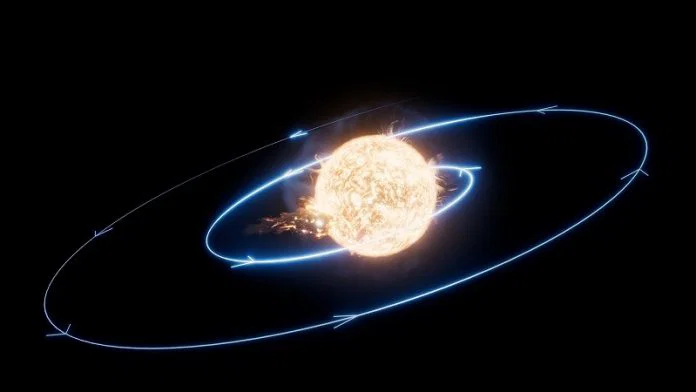
    A team of astronomers has gathered compelling evidence suggesting that a star similar to our Sun might have consumed one of its own planets.

    This star, identified as TOI-5882, is approximately 1,300 light-years away from Earth.

    Scientists found that TOI-5882 contains an unusually high level of lithium, a chemical element that could indicate a significant event in the star’s history.

    The idea that “you are what you eat” applies to stars as well. While stars naturally contain small amounts of lithium, planets tend to be much richer in this element.

    When a star engulfs a planet, it can absorb a large dose of lithium, leaving behind a chemical signature. This process, known as “planetary engulfment,” occurs very rapidly on cosmic timescales—sometimes within days or weeks.

    Because such events happen so quickly, astronomers rarely have the chance to observe a star swallowing a planet in real-time. Instead, they must piece together clues left behind long after the event.

    Lead researcher Brooke Kotten from the University of Michigan explains that this investigative work is what makes the field so engaging. Since they can’t observe the “crime” directly, scientists analyze data to reconstruct what likely happened.

    Studying these occurrences helps us understand how often stars consume planets and the various mechanisms behind it.

    In the distant future, our own solar system might experience a similar fate. In about five billion years, the Sun is expected to swell into a red giant, potentially swallowing Mercury and Venus, and possibly even Earth.

    However, TOI-5882 hasn’t expanded enough for that explanation to fit. Instead, scientists suspect that another object—the brown dwarf orbiting the star—may have played a role.

    This brown dwarf is a massive object, over 20 times the mass of Jupiter, larger than planets but too small to become a true star. Researchers believe it might have disrupted the orbit of a nearby planet, eventually causing it to spiral into the star.

    The scientists estimate that the planet likely had a mass somewhere between a few Earth masses and Neptune.

    They used a technique called spectroscopy to study the light emitted by TOI-5882. Since different elements leave unique patterns in starlight, spectroscopy helps identify the chemical makeup of stars from great distances.

    To confirm that TOI-5882’s lithium level was truly exceptional, the team compared it with 62 similar stars matching in age, size, and temperature. In all cases, TOI-5882 stood out—containing more lithium than at least 97% of the comparison stars.

    Interestingly, a few other stars also showed higher-than-normal lithium levels, hinting that there may be additional ways for stars to become enriched with this element. While one mystery is solved, many new questions have arisen for astronomers to explore.

  • New MIT Technique Halves Lithium Costs with Near-Zero Waste

    New MIT Technique Halves Lithium Costs with Near-Zero Waste

    Lithium has become an essential mineral worldwide because it’s a crucial component in rechargeable batteries powering electric vehicles, smartphones, laptops, and energy storage systems.

    With the rising demand for batteries, the need for lithium continues to grow. Although countries like the U.S. and Australia possess significant lithium resources, much of the refining still occurs in China.

    One reason is that extracting lithium from hard rock is currently costly, requires a lot of energy, and produces substantial waste.

    Now, researchers at MIT and their partners have created a new method that could significantly transform lithium production. Their process extracts lithium from hard rock at low temperatures, almost eliminates waste, and could reduce costs by approximately 50% compared to traditional methods. This research was published in the journal Science.

    Traditionally, extracting lithium from hard rock involves heating the rock above 1,000°C and then using chemicals to separate the lithium. This process consumes significant energy, and the leftover rock waste is typically discarded.

    In contrast, the new approach uses a liquid mixture of water and ammonium fluoride to dissolve the rock at room temperature. This allows for the separation of the valuable minerals without high heat. The main lithium mineral, spodumene, mainly consists of lithium, aluminum, and silica. The researchers found ways to recover each component in useful forms: lithium as battery-grade lithium carbonate and lithium hydroxide, aluminum as smelter-grade material, and silica for cement production.

    Since every major component is recovered and sold, waste is minimized. Interestingly, the idea for this process stemmed from a discovery made roughly 25 years ago. MIT professor Yet-Ming Chiang noticed that a glass-etching cream containing ammonium fluoride could dissolve glass. Because glass and spodumene both contain high silica content, he wondered if the same chemistry could break down lithium-bearing rock, leading to this innovative method.

    The team further developed a way to recover and reuse the ammonium fluoride and water used in the process, establishing a closed-loop system that recycles key chemicals rather than discarding them.

    They tested the method on 17 different spodumene samples from around the world, indicating broad applicability. Besides environmental advantages, this technology could bolster lithium production domestically in countries like the U.S. and Australia. Given the expected surge in demand over the coming decades, more efficient extraction techniques will be vital.

    To commercialize their innovation, the researchers launched a startup called Rock Zero. They are now working to scale up the process and believe it could become one of the most affordable and sustainable methods for producing lithium for future batteries.

    Source: KSR.