الوسم: Latest

  • iRobot Risks, Meta Privacy Threats & Nintendo’s Lego Game Boy

    iRobot Risks, Meta Privacy Threats & Nintendo’s Lego Game Boy

    iRobot’s founder wouldn’t go near today’s robots with a 10-foot pole

    Source: x.com/cb_doge

    Rodney Brooks describes the billions invested in creating bipedal humanoid robots as nothing more than an “expensive pipe dream.” He argues that designing robots in our shape is inherently unsafe because larger bipedal machines could turn into bigger walking hazards. Imagine a 10-foot-tall metal-and-polymer giant slipping and falling on you—that’s not far-fetched. Plus, the current energy systems powering these robots can lead to unpredictable behavior, making them dangerous to be around.

    More critically, they lack dexterity. Companies like Tesla and others rely solely on visual data to train their robots, while humans learn from multiple senses—touch, sound, sight, and more. Unless we can equip robots’ fingertips with as many sensors as human nerve endings, they’ll never match our level of fine motor skills.

    We need to rethink robot design, leaning toward models like Wall-E—a small, wheeled box. Rodney suggests future robots shouldn’t mimic human appearance but instead feature wheels (like Wall-E!), multiple limbs (not like Wall-E), and specialized sensors that don’t function exactly like human eyes or ears.

    In other words, we should aim for robots more like Wall-E in the future.

    Meta: “Yes, we’ll use your data. No, you can’t opt out.”

    Photo: ReutersPhoto: Reuters

    I find it frustrating when big companies keep shifting the boundaries of user privacy.

    Meta announced that starting December 16th, what you say to their AI will be used to “personalize content and ad recommendations.” And the kicker? You can’t opt out.

    If this sounds like a move to push the limits of data collection and privacy, it’s because it is.

    Meta claims they won’t use highly sensitive information—like religious beliefs or sexual orientation—for ad targeting. However, numerous reports show that people tend to overshare with AI, and there have been incidents where ChatGPT and Meta’s systems have posted private conversations publicly or had them appear in Google search results.

    This isn’t limited to the Meta app. It extends to any Meta product: smart glasses can record your surroundings, capture your voice, and use that data to push targeted ads or content.

    And let’s be honest, we’ve known they’re always listening and recording. Their direct admission is a new level of audacity that should raise alarms for everyone.

    Bringing Lego to life (think Game Boys)

    Source: x.com/natalie_thenerdSource: x.com/natalie_thenerd

    The Lego Game Boy was released on Wednesday, and when X user @natalie_thenerd saw it, she said it was like flipping a switch inside her mind, as if a sleeper agent had been activated.

    Within less than a day, she managed to convert the Lego version into a mostly working Game Boy. By designing a custom printed circuit board that fits behind the screen using a tiny CPU with its own RAM, she’s not just emulating games—she’s using actual original chips. The entire circuit fits inside a space smaller than a Dot-Matrix Game Boy cartridge.

    It’s “mostly functional” because, although the buttons can be pressed, they don’t send inputs yet. No footage of gameplay exists so far, but based on what she’s created, it’s only a matter of time before a fully operational version appears.

  • Sleep Issues, Better Gums, and Trendy Water Bottles

    Sleep Issues, Better Gums, and Trendy Water Bottles

    Protecting Your Gums, One Plant at a Time

    Source: REUTERS

    Good news for parents: you can now use a new approach to encourage kids to eat their apples and figs—especially their peels—by tackling something unexpected: gum disease.

    Yes, it’s true. A research team from São Paulo State University studied morin, a natural compound found in plants like those pictured, and found it effective against various bacteria. It exhibits anti-inflammatory, antioxidant, and antimicrobial properties targeting bacteria responsible for gum disease.

    However, simply eating foods containing morin won’t unlock its benefits—because it needs to be processed first. Researchers are working on ways to optimize its delivery so that it stays in contact with teeth and gums long enough to be effective, since saliva tends to wash away anything that doesn’t adhere.

    Luciana Sales has created a solution designed to overcome this challenge and is now testing it with morin.

    Naturally, it’ll be some time before these innovations become widely available.

    A Breakthrough for Water Lovers

    Source: REUTERSSource: REUTERS

    One Water, a premium bottled water company, introduced its innovative interlocking bottle design at the World Economic Forum in Davos earlier this year, in January.

    While the technology itself isn’t new, some media outlets are revisiting the story now, over the past few months, likely to draw more attention to their bottles.

    If the goal was publicity, it certainly succeeded. But it’s a bit concerning that they keep rehashing the same story instead of providing new updates.

    They claim to source their pristine spring water directly from the Canadian Rocky Mountains. They also aim to unite the world’s top water sources under one label, which sounds a lot like a move toward monopolizing a basic necessity.

    That said, their bottles do stack neatly, making transportation easier. They say this design helps cut packaging waste and reduce carbon emissions from shipping by 35%.

    If you’re into water, maybe their bottles are worth a try. Personally, I might stick with Pakola’s water, though.

    Small Homes, Long Commutes, and No Rest

    Source: REUTERSSource: REUTERS

    Modern workers often seem to be at a disadvantage. Recent surveys from Japan reveal that small living spaces, lengthy commutes, and extended working hours are linked to insomnia.

    Between 30% and 40% of adults report experiencing some form of sleep disturbance. Japan has the shortest average sleep duration among OECD countries, falling about an hour below the average.

    Longer commutes correlate with both tiredness during the day and insomnia, while smaller homes are mainly associated with sleep issues.

    So, the obvious solution? Larger homes closer to workplaces. I wonder why this isn’t already standard practice. It seems like a no-brainer that improving living conditions would be a priority.

    Apparently, the real answer is simple—better housing and better locations could make all the difference.

  • AI Rapid Rise & Micro Gear Breakthrough Threatened by Solar Flare

    [gpt3] rewrite this content in American English and make it unique and human written and plagiarism free and do not include any introductions or extra text and only return the rewritten content

    Nanomachines, son!


    Photo Illustration: Google Gemini

    I confess, the title is misleading, and I apologize for that, but we are inching ever closer to making microbots and one day, nanomachines.

    Scientists at the University of Gothenburg have made light-powered gears that can fit inside a human hair. For reference, a human hair can range from 0.017 to 0.186 millimeters (mm) in diameter. If you tried to straighten out your hair and examine it head-on, you likely wouldn’t be able to see anything. A singular microgear is a mere 0.016 mm in diameter.

    Researchers had initially only been able to manufacture gears as small as 0.1mm in size, but by using lithography, scientists manufactured gears with light-sensitive materials, so when a laser is shone on it, the gear wheel spins. The gear’s speed can be adjusted with the strength of the laser, and direction can be controlled by the polarization of light.

    What’s more, these gears can be fitted directly onto silicone chips, opening the door for a plethora of uses, such as building microscopic devices that work on larger individual cells in the human body, autonomously.

    Maybe life will have a chance to recreate art in the future, and we’ll get a real life Senator Armstrong fight from Metal Gear Rising: Revengeance.

    A solar awakening


    Source: REUTERS

    NASA’s saying that our Sun has been much more active over the recent decade than they had expected.

    Solar events typically follow an 11-year cycle, and at our point in this cycle, there should have been historically low activity. But solar activity has been increasing ever since 2008, leaving scientists scratching their heads.

    Solar flares and coronal mass ejections (ejections of plasma from the Sun’s corona into the heliosphere) can disrupt our communication systems by damaging satellites, causing radio blackouts, and even making power grids fail.

    If the Sun’s ‘waking up’ as they say, we may have to prepare for the time when we get hit by a flare so massive that it nukes most or all of our electronic systems. At least my mother won’t be able to blame that ‘damn phone’ whenever I complain about a headache anymore.

    “AI’s moving too fast!”, says AI company CEO


    Source: REUTERS

    You’ve heard your friends say it. You’ve heard your co-workers say it. You’ve most probably heard your parents say it, or even your children at this point.

    But now you’ve heard it from the horse’s mouth: Dario Amodei, CEO of Anthropic, warns that at the pace at which AI is going, it may soon cause mass unemployment despite the many limitations of current technology, and is already replacing jobs.

    Alarmist? Perhaps. AI is currently unable to replace many of the jobs that were projected to be replaced, like programming. Software developers and programmers are still very much needed, and while AI may augment their work, it cannot replace their work entirely. Even ‘vibecoding’, while it has potential, cannot replicate the quality and precision that a real person can provide.

    On the flipside, Dario does point out that while people say that AI can’t do certain complex human-centric tasks, the fact that it can still do intermediate tasks that are relatively complex (like being a surgery assistant) shows that anything can be possible. And the improbable is fast becoming the probable.

    We’d really only know for sure when we all get replaced, or if that solar flare hits us.

    [/gpt3]

  • Wild Weeds, AI Earthquake Warnings, and Big Tech’s Greed

    [gpt3] rewrite this content in American English and make it unique and human written and plagiarism free and do not include any introductions or extra text and only return the rewritten content

    Seas of weeds


    Source: REUTERS

    Something wicked this way comes, in the form of brown seaweed (well really it’s a type of algae).

    Sargassum was once presumed to only exist in the nutrient-poor waters of the Sargasso Sea. However, recent research reveals the journey of sargassum from nutrient-rich coastal areas to the open ocean via oceanic currents, such as the Loop Current and the Gulf Stream.

    ‘Nutrient loading’ from rivers on ocean processes, like from agricultural runoff, wastewate discharge and atmospheric deposition, fuels the massive growth of sargassum on coasts.

    This sargassum then travels from the sea towards areas in the open ocean, namely the North Atlantic. Nutrient recycling within sargassum populations sustains the blooms, which explains why we have the Great Atlantic Sargassum Belt: the enormous seasonal bloom spans West Africa to the Gulf of Mexico.

    The belt has formed each year since 2011 (excluding 2013), and in May this year reached a record biomass of 37.5 million tons. These massive growth events result in costly beach cleanups and even in the emergency shutdown of a Florida nuclear power plant in 1991.

    Left unchecked, these massive blooms will affect fisheries and tourism, pose health risks, and ruin marine ecosystems. If it keeps growing, we may even manage to take pictures of it from space.

    AI saw what researchers didn’t


    Photo Illustration: Google Gemini

    AI just gave scientists X-ray vision for earthquakes in Italy. Using a Stanford-built model to comb through thousands of seismic data points, researchers discovered that the restless Campi Flegrei volcanic field near Naples has been hiding four times more quakes than previously thought.

    The revelation is a double-edged warning: while the main short-term risk isn’t a volcanic eruption but moderate shallow quakes, the region has already clocked five magnitude-4 tremors this year alone.

    The hope is that sharper, AI-driven detection will give authorities and residents a crucial head start in preparing for whatever the ground decides to throw at them next.

    Tech companies want more power. Shocker.


    Source: REUTERS

    It brings me some small comfort whenever I hear about load shedding in countries other than Pakistan, knowing that there are people around the world that I can relate to. However, the problem for Mexico may go deeper than that, and data centers are the main culprit.

    Microsoft’s data center in Colón ran on gas generators for a part of 2024, and plans to plug into the grid by 2027. This is all government-approved, but the pollution and harm to the environment this will cause should raise eyebrows everywhere.

    Google opened a data center site here in 2024, and Amazon opened a campus in January of this year, and you can only imagine the energy they already consume and will continue to consume when they’re all plugged in.

    And don’t get me started on the water usage. Microsoft’s data center in Central Mexico used 40 million liters of water in 2024, the same year that the area experienced the worst drought in a century. The data center craze might bring more people greater access to the digital world, but at increasing costs to lives and livelihoods.

    We might be on track to Big Tech seeking ‘alternative’ energy solutions, like plugging people into the Matrix. Once they perfect androids, they might just.

    [/gpt3]

  • Google Introduces Groundbreaking Innovations in AI Technology

    Google Introduces Groundbreaking Innovations in AI Technology

    An illustration featuring the Google logo alongside the words 'Artificial Intelligence,' captured on May 4, 2023 — Reuters
    An illustration featuring the Google logo alongside the words ‘Artificial Intelligence,’ captured on May 4, 2023 — Reuters

    On Wednesday, Google announced its latest breakthroughs in artificial intelligence, aiming to develop AI that is smarter, more agent-like, and tailored to individuals.

    “We are making more intelligence available to everyone, everywhere. This progress signifies a new era in AI, where decades of research are coming to life for individuals, businesses, and communities,” stated Sundar Pichai, CEO of Google.

    The significant updates illustrate the transformative impact of AI on various Google products. These include enhancements to Gemini 2.5, an upgraded Google Search experience, new generative AI media tools, updates to the Gemini app, and applications within Google Workspace.

    For starters, the Gemini 2.5 update has introduced features like Deep Think, an advanced reasoning mode tailored for tackling complex tasks such as coding and mathematics. Additionally, this model can now generate audio natively.

    The revamped Google Search has evolved into a smart search engine powered by Gemini, offering an interactive interface that allows users to delve deeper into topics. It now provides AI-generated overviews in over 200 countries and supports more than 40 languages, transforming search into a more intelligent engine with new functionalities like video comprehension and screen sharing.

    Moreover, new generative AI media tools aim to empower the next generation of creators, featuring Imagen 4 for high-quality image generation, Veo 3 for cinematic video production, and Lyria 2 for AI-composed music. These tools are accessible via Flow, Google’s innovative platform for AI-driven filmmaking, which streamlines storyboarding, directing, and producing short videos using natural language prompts and media references.

    The Gemini app has also received significant updates, allowing for a more intuitive user experience. With this revamp, Gemini understands the user’s context better and anticipates their needs, thanks to integration with camera functionality, screen sharing, and world modeling from Project Astra. This integration facilitates a variety of tasks including problem-solving, content creation, and digital navigation.

    Furthermore, Gemini has been integrated into Google Workspace, enhancing its utility. In Gmail, it offers personalized smart replies, while in Google Meet, it can translate spoken language. Additionally, it assists users in improving their writing by providing research and suggestions. The newly launched Vids app allows users to create short videos using slides, voice input, and AI-driven editing features.

  • Sajal Aly Sizzles in Her Latest Photo Shoot

    Sajal Aly Sizzles in Her Latest Photo Shoot

    KARACHI – Sajal Aly stands out as one of Pakistan’s most skilled and stunning actresses, making a significant impact in the entertainment sector in a relatively short time.

    She has gathered a massive following on social media, amassing 10.6 million followers on Instagram, where her presence is vibrant and engaging.

    Recently, Sajal captured attention with her remarkable performance in the drama series “Zard Patton Ka Bunn.” She often shares her photoshoots on Instagram to stay connected with her audience.

    In her latest post, she shared a series of photos that undoubtedly caught the eye of her fans.

    Sajal looks captivating as she poses beautifully in a chic coat, perfect for the upcoming winter season.

    One fan commented, “Can’t get over how pretty you look,” expressing admiration for her striking beauty.

  • Nvidia Overtakes Apple as the World’s Top Valued Company

    Nvidia Overtakes Apple as the World’s Top Valued Company

    On October 25, Nvidia briefly surpassed Apple to claim the title of the world’s most valuable company, a significant achievement for the semiconductor leader. Nvidia’s value soared to $3.53 trillion, with its stock peaking at $144.13, edging ahead of Apple’s valuation, which stood at $3.52 trillion.

    During midday trading, both tech giants were nearly tied, each hovering around the $3.52 trillion mark in market value.

    This remarkable rise illustrates Nvidia’s extraordinary journey since late 2022, particularly spurred by the launch of ChatGPT by OpenAI, which sparked a surge in demand for Nvidia’s AI-driven GPUs.

    Over the past two years, Nvidia’s stock has skyrocketed over 740%, adding an impressive $3.1 trillion to its market capitalization, fueled by the widespread integration of AI across various sectors.

    As a primary provider of graphics processing units (GPUs) crucial for artificial intelligence, Nvidia has effectively harnessed a technological revolution that is transforming industries such as cloud computing, healthcare, and finance.

    Analysts predict further growth for Nvidia, with expectations that the company might soon reach a $4 trillion valuation due to rising demand for AI technologies.

    Bank of America recently updated its price target for Nvidia to $190, highlighting the “once-in-a-generation opportunity” that AI presents for Nvidia to dominate the market.

    CFRA Research has also adjusted its target, raising it to $160, pointing out an ongoing “AI race” among major cloud services and the significant impact of Nvidia’s upcoming “Blackwell” GPU lineup on major players like Amazon and Google.

    Nvidia’s achievements reflect a broader tech boom driven by advancements in AI, an area also being aggressively pursued by competitors like Apple and Microsoft.

    After reclaiming its title from Microsoft as the most valuable company in June 2024, Apple is also making strides in AI. The company has announced plans to integrate ChatGPT into Siri, incorporating AI functionalities into iPhones. This initiative has helped Apple maintain a robust position during the AI surge.

    Nonetheless, Nvidia’s rapid success indicates that its lead in the AI hardware market is growing more rapidly than expected.

    Nvidia’s GPUs are widely recognized as essential for AI processing, providing the company with a distinct advantage as the preferred supplier for AI infrastructure.

    Numerous tech giants are hastily moving to incorporate or bolster AI within their ecosystems, creating a favorable environment for Nvidia’s offerings.

    The battle for market supremacy is intensifying, with Nvidia, Apple, and Microsoft standing as the key players in the evolving AI landscape.

    Investor sentiment remains optimistic regarding Nvidia’s future, with confidence that the company’s hardware will play a critical role in the advancements of AI in the years to come.

    Nvidia’s overall market performance will be closely watched in November when it releases its third-quarter earnings report and shares more about its long-term strategy.

    This recent shift underscores the volatility and potential for growth within the tech sector, as companies strive to leverage AI in their products and services.

  • SpaceX Marks 99th Mission in 2024, Launching 20 Starlink Satellites

    SpaceX Marks 99th Mission in 2024, Launching 20 Starlink Satellites

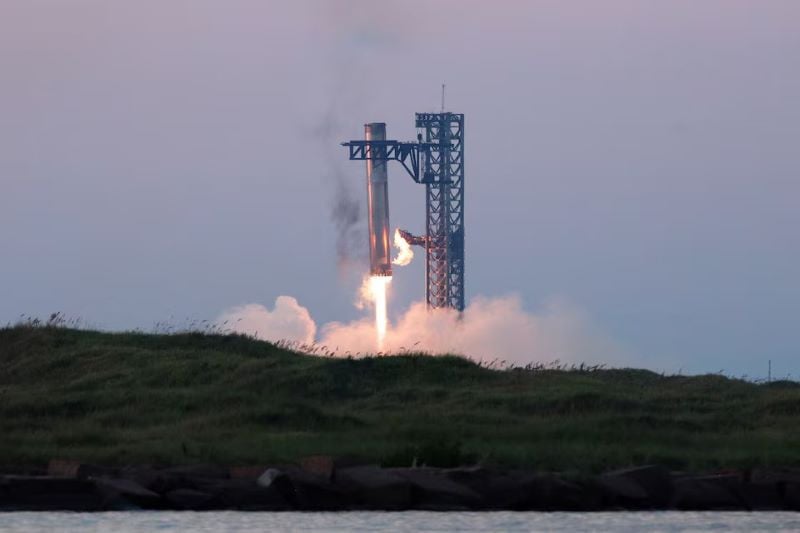
    SpaceX has successfully completed its 99th mission of the year, launching 20 Starlink satellites into orbit from Cape Canaveral, Florida, on Friday night.

    The Falcon 9 rocket took off at 7:31 PM ET from Space Launch Complex 40, marking the 17th flight for this particular booster, which was later recovered by the “Just Read the Instructions” droneship in the Atlantic Ocean.

    This launch is a significant milestone for SpaceX as the company approaches a new annual record for the number of launches. With 71 missions conducted from Florida alone, SpaceX is just one launch away from tying its previous record of 72 launches from the Space Coast achieved in 2023.

    Most of the launches have been handled by SpaceX, with only five conducted by the United Launch Alliance. This latest mission also contributes to the rapid growth of SpaceX’s Starlink constellation, bringing the total number of satellites launched since 2019 to over 7,100.

    Of special note, 13 of the satellites included in this mission feature direct-to-cell capabilities, reflecting SpaceX’s ongoing efforts to expand global internet access. To date, SpaceX has performed 97 Falcon 9 missions in 2024, including this one, along with two Falcon Heavy missions.

    Additionally, the company has conducted three test flights of its Starship rocket, which is still in development, from the Starbase facility in Texas. The most recent Starship launch occurred on October 13, when SpaceX achieved a remarkable milestone by successfully capturing the Super Heavy booster mid-air using mechanical arms known as “Mechazilla.”

    This achievement represents a key advancement in SpaceX’s ambition for rapid rocket reusability, a cornerstone of the company’s strategy to lower the costs of space travel and facilitate missions to Mars.

    However, the Starship program has encountered various regulatory challenges this year. In early October, SpaceX received Federal Aviation Administration (FAA) approval for its fifth uncrewed Starship test flight, overcoming delays related to environmental and safety concerns.

    Elon Musk, CEO of SpaceX, had previously voiced criticism of the FAA’s handling of the situation, arguing it amounted to regulatory overreach. The FAA, in turn, cited issues with reports of sonic booms and compliance with Texas water usage regulations.

    Despite these challenges, SpaceX’s launch rate in 2024 has been impressive. The company initially aimed for up to 144 launches this year, though weather and technical issues have caused several delays, resulting in a total of 99 operational missions to date.

    So far in October, SpaceX has conducted six launches, while previous months varied with 13 launches in May and 11 in August. The majority of these missions have focused on Starlink, the company’s ambitious satellite internet project. With 67 Starlink-specific missions planned for 2024 alone, SpaceX is aggressively expanding its satellite network, which now boasts over 6,400 active satellites, according to satellite tracker Jon McDowell.

    These efforts have solidified SpaceX’s leading position in the satellite launch market and laid the groundwork for future growth in both commercial and experimental space missions. As the company approaches its 100th mission of 2024, it continues to push the boundaries of rocket reusability and satellite deployment while making strides in space exploration technology. The next Falcon 9 launch is anticipated shortly, keeping SpaceX on track for a record-setting year in spaceflight.

  • Volta Space Technologies Reveals Lunar Power Satellite Network Plans

    Volta Space Technologies Reveals Lunar Power Satellite Network Plans

    Volta Space Technologies, a Montreal-based startup with a presence in the US, has revealed an ambitious plan to establish a satellite network around the moon aimed at supplying power to lunar spacecraft.

    Announced on October 10, the network, dubbed “LightGrid,” will harness solar energy collected by satellites in orbit around the moon and transmit it via lasers. This innovative technology will allow lunar landers and rovers to function during the fortnight-long lunar night or even within permanently shadowed craters.

    The LightGrid system is designed to offer a dependable energy source for lunar exploration missions when solar power is not available. Satellites will orbit the moon, gathering solar energy and beaming it down to receivers mounted on various spacecraft and rovers.

    Co-founder and Chief Technology Officer Paolo Pino explained that this system could eventually be extended to power additional lunar infrastructure, including sensors and resource extraction facilities. Meanwhile, co-founder and CEO Justin Zipkin shared that the inspiration for Volta stemmed from a project at the International Space University, which led the team to participate in NASA’s Watts on the Moon competition.

    The startup has attracted considerable interest, with potential contracts estimated at over $250 million. Volta has already developed laser power transmission technology, successfully conducting tests over distances of up to 850 meters. The next significant milestone involves testing the system in Earth’s orbit, which is scheduled for 2026.

    Initially, the LightGrid network is expected to comprise three small satellites placed in low lunar orbit, providing comprehensive power services to clients on the lunar surface. According to Pino, these satellites can be scaled up by incorporating additional units into the network, which provides an advantage over traditional power infrastructure on the moon.

    Paul Damphousse, the company’s Chief Operating Officer, emphasized the benefits of operating from lunar orbit. He noted that this approach allows for global coverage right from the outset and simplifies operations compared to landing equipment directly on the lunar surface.

    Volta has secured initial seed funding from investors, including MaC Venture Capital and Industrious Ventures, and has also received grants and awards from NASA, the Department of Defense, the European Space Agency, and the Canadian Space Agency.

    As Volta prepares for a Series A funding round, it anticipates the need for a subsequent Series B round to implement the first phase of the LightGrid network by 2028. The company is also exploring further applications for its technology, such as enabling power transmission between space platforms, sending energy from space to Earth, and supporting emergency services like power and communication during disaster relief efforts.

    Damphousse pointed out that Volta is also investigating potential uses of its technology for aerial and maritime applications. The team at Volta Space Technologies recognizes the strong connections between lunar operations and Earth applications, with plans to adapt their innovations for various other fields in the future.

    The vision laid out by Volta is set to play a crucial role in influencing future lunar missions and the broader framework of space infrastructure.

  • TikTok Cuts Hundreds of Jobs Amid AI-Driven Content Shift

    TikTok Cuts Hundreds of Jobs Amid AI-Driven Content Shift

    TikTok, a subsidiary of ByteDance, has recently announced significant layoffs impacting hundreds of employees across the globe, including approximately 500 in Malaysia. This workforce reduction is part of the company’s strategic pivot towards enhancing content moderation through artificial intelligence.

    The layoffs were officially communicated to employees via email, aligning with TikTok’s broader initiative to streamline its global content management processes. According to a spokesperson for TikTok, this move is focused on boosting efficiency in content moderation by integrating AI alongside human oversight.

    Globally, TikTok has committed $2 billion towards ensuring trust and safety on its platform, with artificial intelligence now responsible for removing 80% of harmful content. As AI technology continues to develop, it increasingly handles violations related to nudity, violence, and other policy infractions, gradually replacing human moderators who have been subjected to challenging working conditions, including low wages and exposure to distressing material.

    Even with the burgeoning role of AI, TikTok still relies on human reviewers for handling cases that are appealed. The company has faced scrutiny regarding the mental health impact of this work on human moderators, leading TikTok to assert its commitment to providing support for its employees.

    These layoffs occur in the context of rising regulatory scrutiny in areas like Malaysia, where the government is urging social media companies to enhance their content moderation efforts to address cybercrime. Additionally, TikTok has found itself embroiled in legal disputes in the United States, with several states alleging that the platform’s addictive features adversely affect teenagers’ mental health.

    This transition towards AI-driven content moderation is part of a broader trend in the technology sector, where automation is increasingly being adopted to enhance operational efficiency and reduce costs.

  • Brazil’s Supreme Court Reinstates X After Musk Meets Court Requirements

    Brazil’s Supreme Court Reinstates X After Musk Meets Court Requirements

    Brazil’s Supreme Court has given the green light for the social media platform X (formerly known as Twitter) to resume operations in the country, effectively ending a prolonged conflict between Elon Musk, the platform’s owner, and Brazilian officials.

    The platform was initially suspended in late August after Musk declined to follow court orders designed to tackle misinformation and anti-democratic narratives.

    Justice Alexandre de Moraes, who has been at the forefront of enforcing Brazilian regulations, authorized X to restart its services on Tuesday, following the company’s fulfillment of several legal conditions.

    These conditions included paying hefty fines, designating a local legal representative, and blocking accounts identified as promoting harmful content.

    X’s adherence to these requirements marks a notable change for Musk, who had criticized these actions as censorship and referred to Moraes as a “dictator.”

    The decision to reinstate X was welcomed by numerous Brazilian officials as a triumph for the rule of law. Communication Minister Juscelino Filho expressed that this situation highlighted the necessity for even large multinational corporations to adhere to Brazilian laws.

    “We have shown the world that our laws must be followed, no matter who you are,” Filho remarked.

    With over 21 million users, Brazil ranks as X’s sixth-largest market globally and has become a critical battleground in the fight against online misinformation.

    The Supreme Court’s suspension of X was triggered by Musk’s failure to appoint a local representative and address outstanding fines, along with the company’s resistance to a series of court rulings aimed at mitigating the spread of far-right misinformation.

    These legal measures were deemed essential for upholding democracy, especially in the wake of the January 2023 riots in Brasília, which many experts attributed, in part, to provocative content circulating on social media.

    Musk initially pushed back against the suspension, arguing it violated free speech and subsequently withdrew X’s legal representation from Brazil. He even likened Moraes to the fictional villain Voldemort in a social media post.

    However, in the weeks leading up to the recent ruling, Musk appeared to soften his position.

    X appointed Brazilian attorney Rachel de Oliveira Conceicao as its local representative and complied with the court’s directives by blocking nine accounts tied to misinformation efforts.

    Justice Moraes ordered Brazil’s telecommunications regulatory body, Anatel, to restore X’s services within 24 hours. While users were still unable to access the platform as of Tuesday evening, it was anticipated that X would be back online shortly.

    In reaction to the ruling, X’s Global Affairs account expressed that the platform was “proud to return to Brazil” and reaffirmed its dedication to free speech while adhering to local regulations.

    Musk’s decision to comply with Brazilian court rulings is perceived as a strategic choice, especially given the public backing for Moraes’ actions among the Brazilian populace.

    With municipal elections taking place, X’s return comes at a pivotal time, although many users had already shifted to alternative platforms such as Bluesky and Threads during the suspension.

    Pro-democracy advocates celebrated the outcome as a victory for Brazilian independence and democratic principles.

    “This wasn’t about censorship,” remarked political analyst Gerson Camarotti on GloboNews. “It was about honoring judicial rulings.”

    As X gears up for its online comeback, this incident highlights the complexities Musk confronts in balancing global regulations with his commitment to free speech.

  • SpaceX Embarks on Mission to Save Stranded Astronauts

    SpaceX Embarks on Mission to Save Stranded Astronauts

    SpaceX has successfully completed a mission to rescue two astronauts who have been stuck on the International Space Station (ISS) since June.

    The Dragon capsule, which carried supplies along with two vacant seats for astronauts Butch Wilmore and Suni Williams, took off from Cape Canaveral, Florida, on September 28.

    Wilmore and Williams were initially scheduled to remain on the ISS for about eight days. However, a problem was discovered with the Boeing Starliner spacecraft, prompting a crewless return to Earth for safety reasons.

    NASA astronaut Nick Hague and Russian cosmonaut Alexander Gorbunov are aboard the Dragon capsule to deliver fresh supplies to Wilmore and Williams, who are expected to return to Earth in February.

    The launch had been planned for Thursday but was delayed due to the impacts of Hurricane Helene, which caused significant damage throughout Florida and various southern states.

    Founded by Elon Musk, SpaceX has established a routine schedule for transporting crews to and from the ISS every six months.

    The Dragon capsule is projected to dock with the ISS on Sunday at around 9:30 PM GMT.

    In a separate development, SpaceX is contemplating a $15 billion investment in Vietnam to expand its Starlink satellite internet service.

    This announcement followed a meeting between SpaceX Senior Vice President Tim Hughes and Vietnam’s Communist Party General Secretary To Lam during his recent visit to the US for the United Nations General Assembly.

    The potential investment represents a significant move by SpaceX to provide satellite internet services to Vietnam, a nation facing challenges in improving connectivity due to outdated infrastructure and complex terrain.

    This initiative could play a vital role in reducing the digital divide and improving internet access for many living in the area.

    These recent developments underscore SpaceX’s dedication to advancing space exploration and improving global communication networks through cutting-edge technology.

  • Pakistan Achieves Premier Cybersecurity Recognition

    Pakistan Achieves Premier Cybersecurity Recognition

    ISLAMABAD:

    On Friday, Shaza Fatima Khawaja, the State Minister for Information Technology and Telecommunication, celebrated Pakistan’s achievement in securing a spot in the highest category of a global cybersecurity index.

    The country was recognized in Tier 1 of the International Telecommunication Union’s Global Cybersecurity Index 2024 report. This top tier, labeled as "role-modeling," includes nations that scored between 95 and 100, with a total of 46 countries making the cut. In the previous report, Pakistan had placed at 79.

    During a press conference in Islamabad, Khawaja emphasized that the findings reflect Pakistan’s significant advancements in legal frameworks, technical capacity, skill development, and organizational growth, positioning the nation as a benchmark.

    "The Global Cybersecurity Index 2024 highlights the remarkable progress of countries that have enacted vital legal measures, strategic plans, capacity-building initiatives, and collaborative frameworks, particularly in enhancing their incident response capabilities," Khawaja stated.

    "Pakistan has excelled in the latest rankings, joining the ranks of countries like the United States, Japan, Singapore, Australia, Saudi Arabia, and Malaysia in Tier 1," she added.