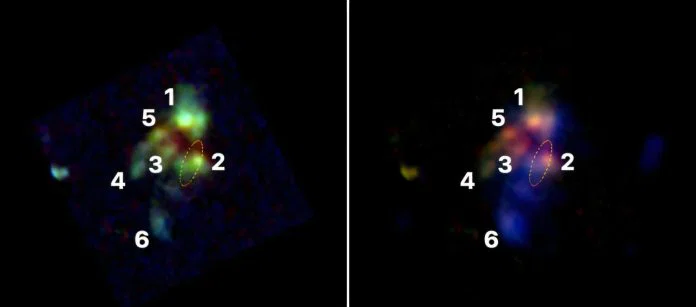
Images from the James Webb Space Telescope show the distant galaxy complex TGSSJ1530+1049. The left image depicts at least six galaxies tightly packed in the early universe. The right image highlights fast-moving gas, shown in blue. Scientists believe these galaxies will eventually merge into a single, massive galaxy. The area inside the ellipse marks the source of intense radio emissions that prompted this study; it likely contains a growing supermassive black hole. Credit: NASA/ESA/CSA.
Astronomers have used the Webb to observe one of the most extraordinary events ever seen from the early universe—a massive galaxy in the process of formation. Instead of a single new galaxy, researchers found a dense cluster of at least six galaxies apparently merging into one large galaxy. At the core of this cluster is a rapidly growing supermassive black hole.
This discovery was made by an international team led by scientists from Leiden University in the Netherlands and the University of Oxford in the UK. Their research offers a rare glimpse into how some of today’s biggest galaxies might have formed billions of years ago.
Located more than 12 billion light-years away, the system, called TGSSJ1530+1049, shows us the universe as it appeared around 1.5 billion years after the Big Bang. Since light takes time to travel, astronomers are viewing this region as it was billions of years ago. Essentially, the Webb acts like a time machine, allowing scientists to peer into the distant past.
The team initially aimed the telescope here because earlier radio observations indicated an active supermassive black hole was feeding in the area. But the new images revealed a more dynamic scene—rather than a single galaxy, there’s a close-knit neighborhood of at least six galaxies.
Four of these galaxies are already extremely massive, collectively containing hundreds of billions of stars. Even more remarkable, all of them are packed into a relatively small space, making this one of the densest early collections of large galaxies ever observed.
Scientists believe these galaxies are still in the early stages of merging. Over the next few million years, they’re expected to combine into a single giant galaxy. Such systems are called protoclusters, representing the early building blocks of the massive galaxy clusters found throughout the universe today.
At the heart of this developing system lies a young supermassive black hole—one with millions or even billions of times the Sun’s mass. As gas and dust spiral into the black hole, they heat up and release powerful energy, including radio waves.
Using a network of radio telescopes, researchers have created a detailed image of the black hole’s activity. Observations show material falling into the black hole while some of it is ejected at extremely high speeds, indicating the black hole is still actively growing.
What makes this discovery especially significant is that astronomers are witnessing two major cosmic events simultaneously: the formation of a giant galaxy through the merging of smaller ones, and the rapid growth of its central supermassive black hole.
The Webb continues to uncover parts of the universe that were previously hidden, providing some of the clearest images yet of how the largest galaxies and their black holes formed over 12 billion years ago.