Tag: Institutions

  • Accelerate Your Integration in EU5 by Completing Institutions and Solving Challenges

    Accelerate Your Integration in EU5 by Completing Institutions and Solving Challenges

    In Europa Universalis 5, institutions like the Renaissance or Printing Press are the most crucial factors for your country’s progress. These historical milestones unlock new technology levels, making them essential for staying competitive. Institutions start in specific areas and spread across your territory based on how close they are to locations that already have them. Your nation’s growth rate also influences how quickly the spread occurs.

    To succeed, you need to actively control this spread instead of just waiting for it to happen naturally. This guide highlights the important advances and cabinet actions you should focus on in your research plan to help your provinces adopt these cultural shifts quickly. Doing so will secure your position among the world’s powerful nations.


    How Does Institution Spread Work?

    Institutions begin in particular places; for example, during the Renaissance, they often start in Italy. Once they spawn, their spread to nearby regions depends on how far they are from the closest area that already has the institution. Your nation’s Institution Growth modifier also affects this process.

    Because embracing institutions unlocks new research options, it’s vital to get your country to adopt them as fast as possible. When at least 20% of your territories have embraced an institution, you can spend money and stability to adopt it nationwide more quickly. The cost decreases as more of your country embraces the institution, so it’s worth investing early.

    To see where an institution can first appear, hover over its name in the Advances menu (in the Ages section). Then, check the percentage shown in the tooltip for the institution’s spawning chance each month. This indicates what makes a location eligible for a new institution to spawn there. Keep in mind, this only applies to institutions that haven’t already emerged.

    A historical game rule can also be enabled so each institution spawns in historically linked locations—like Mainz for the Printing Press or Paris for the Enlightenment.


    How to Improve Institution Growth

    Beyond waiting for institutions to spawn naturally, you can take strategic steps to speed up their spread. Certain advances in your research plan directly boost your overall Institution Growth, helping your country embrace new milestones faster and unlock related advances sooner.

    The table below shows key advances that increase your general institution growth:

    Age Advance Prerequisites
    Age of Traditions Classic Scholasticism Organized Religion
    Age of Renaissance Print Culture Printing Press Institution and one other prerequisite advance
    Age of Reformation Scientific Experimentation Global Trade Institution and five other prerequisite advances

    A particularly important advance is Share of Knowledge. You should research this as soon as your country adopts the Printing Press in the Age of Discovery. It unlocks the Promote Institution cabinet action, which lets you target specific institutions for faster spread. This is especially useful when you need to focus on certain cultural shifts without other urgent priorities.
  • Trust in U.S. Institutions: Only 8% Trust Big Tech & 12% Gov.

    Trust in U.S. Institutions: Only 8% Trust Big Tech & 12% Gov.

    The Erosion of Trust in American Institutions: A Closer Look

    Understanding the Landscape of Distrust

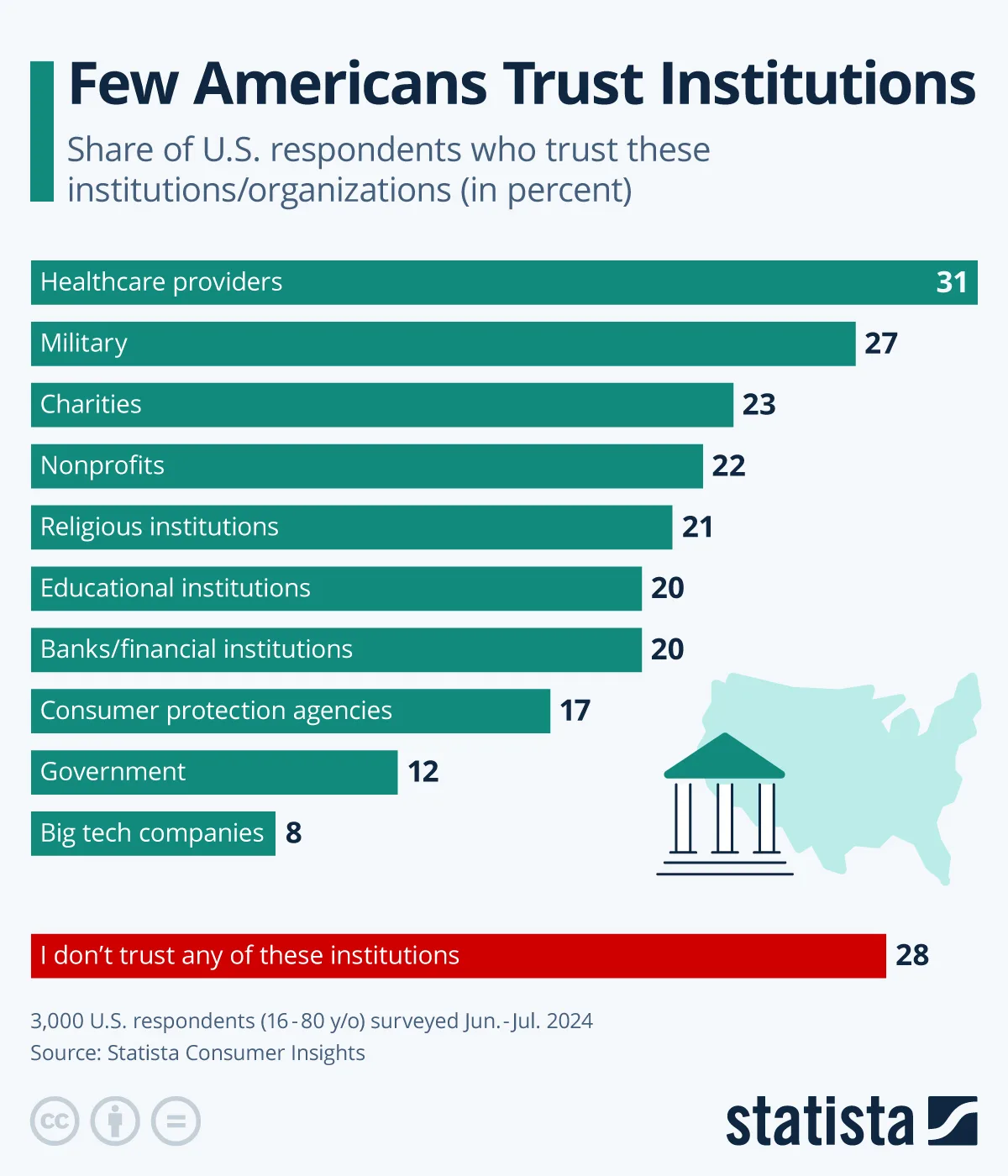
    In recent years, trust in American institutions has seen a significant decline, reflecting a growing skepticism among the populace. Various entities, from government to big tech, have been scrutinized by the public, raising questions about accountability and reliability. According to a survey conducted by Statista Consumer Insights, these concerns are not unfounded, as many Americans report an alarming lack of confidence in the organizations intended to serve them.

    Key Statistics from the Survey

    Distrust in Big Tech and Government

    The survey results reveal a stark reality regarding trust in a couple of significant sectors. Only 8% of Americans expressed trust in big tech companies, while just 12% placed their faith in government institutions. This profound distrust points to larger issues of privacy, surveillance, and the role of these entities in daily life. As technology evolves and becomes more integrated into our lives, the public’s discomfort surrounding data privacy and corporate responsibility grows correspondingly.

    Financial and Educational Institutions Under Fire

    Further compounding the issue of trust is the perceived integrity of financial and educational institutions. The survey noted that only 20% of respondents trusted financial organizations—a telling reflection of the fallout from financial crises and scandals that have marred the reputation of banks and similar entities. Similarly, educational institutions fared poorly, with only 20% expressing trust. The skepticism towards these institutions may also stem from rising tuition costs, student loan crises, and questions surrounding the value of degrees in today’s job market.

    The Role of Religious Institutions

    Evaluation of Faith-Based Organizations

    Interestingly, religious institutions garnered a modest trust level of 21%. This figure prompts deeper inquiry into how religious organizations are perceived today in comparison to eras with higher faith engagement. The decline may also reflect societal shifts towards secularism and increased public discourse surrounding accountability and moral integrity within these organizations.

    Trust in Consumer Protection Agencies

    Why Are Consumer Agencies Viewed with Distrust?

    Even consumer protection agencies, designed to safeguard the interests of everyday Americans, only managed to achieve 17% trust among survey participants. This alarming statistic may hint at a perceived ineffectiveness or lack of enforcement in protecting consumer rights, leading to frustration and further mistrust.

    Healthcare Providers and Military: A Slightly Brighter Outlook

    Comparison of Trust Levels

    Despite the general trend of distrust, healthcare providers and military institutions are viewed comparatively more favorably. Trust levels here are slightly higher, ranging from 27% to 31%. This relative confidence may be tied to their roles during crises, such as the COVID-19 pandemic, showcasing their importance in public health and safety.

    Nonprofits, Charities, and Community Trust

    Levels of Confidence in Charitable Organizations

    In the realm of charities and nonprofits, the trust rate hovers around 22-23%. While these organizations often work to uplift communities and help those in need, the sustainability and transparency of their operations have come under scrutiny. This disconnect may deter individuals from fully embracing these entities despite their noble missions.

    A Significant Percentage Lacking Trust

    The Widespread Distrust Phenomenon

    Most concerning is the revelation that 28% of Americans reported not trusting any of the listed institutions. This significant figure demonstrates a widespread sentiment of disillusionment and a pervasive belief that institutions fail to meet their commitments to the public.

    Implications for Energy, Retail, and the Media

    A Look at Other Misgivings

    The survey also touched on trust in energy and utility companies, media outlets, brands, and large retail chains, all of which are viewed with suspicion by the American public. As individuals navigate an increasingly complex societal landscape, the lack of trust in these critical areas raises fundamental questions about engagement, transparency, and the purpose of these institutions in modern America.

    The Consequences of Distrust

    Broader Societal Effects

    The consequences of this erosion of trust can ripple throughout society, affecting everything from political engagement to community cohesion. As Americans grapple with a lack of faith in the institutions meant to safeguard their interests, they face growing challenges in forming alliances and building trust within communities.

    In an era where reliable information and accountability are paramount, addressing these trends will require concerted efforts from leaders across all sectors to rebuild faith in our institutions and foster a sense of shared purpose amongst the populace.