الوسم: independence

  • Trump celebrates US, condemns ‘communists’ in 250th anniversary speech

    Trump celebrates US, condemns ‘communists’ in 250th anniversary speech

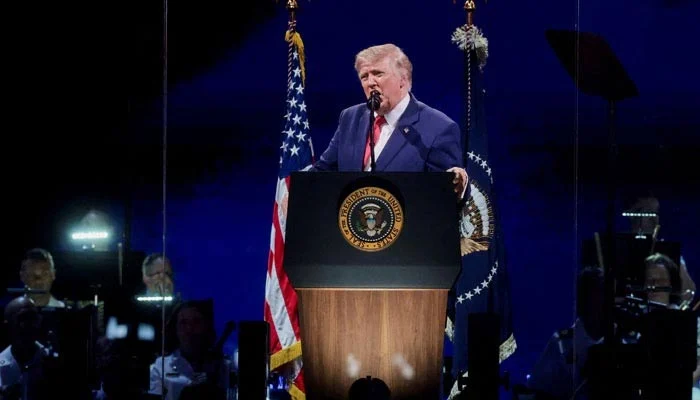
    US President Donald Trump speaks at a Fourth of July rally, commemorating 250 years of American independence on the National Mall in Washington, DC, July 4, 2026.— Reuters

    • Trump praises veterans from WWII, Korea, and Vietnam conflicts.
    • US president claims Washington “decimated” Tehran’s military forces.
    • Disorder erupts as crowds resist leaving the event venue.

    On Saturday, President Donald Trump celebrated America’s 250th birthday as the greatest achievement in human history, while also using the occasion to criticize domestic opponents he accused of being communists.

    The speech, delayed hours due to storm evacuations in Washington, saw Trump proclaim that under his leadership, the nation has become “more proud than ever.” Although he anticipated a massive rally to mark the holiday, the 80-year-old Republican mostly delivered a traditional patriotic message.

    “For over two and a half centuries, our American republic has stood as humanity’s pinnacle,” Trump told tens of thousands on the National Mall.

    He paid tribute to WWII veterans, along with those who fought in Korea and Vietnam.

    However, he also linked Korea and Vietnam veterans to the fight against “communists,” echoing his speech from the previous evening at Mount Rushmore.

    “Our soldiers fought against communism around the world, only to see that threat re-emerge here at home. We won’t allow that to happen,” he stated.

    Expressing American Pride

    In recent weeks, Trump has emphasized themes of patriotism, especially as midterm elections approach and Democratic primaries swing leftward with victories. He described the situation as a “cancer” that needs to be excised.

    The speech also featured boasts about recent military actions against Iran and Venezuela, claiming the U.S. has “eliminated” Tehran’s military.

    Despite these claims, his address lasted only around 45 minutes, shorter than usual for him.

    “We love Trump. We loved his speech,” said Richard Sullivan, 70, from Virginia, wearing a Freedom 250 T-shirt with his wife Nancy. “He highlighted our rich history and spoke directly to our veterans. He makes us proud to be American.”

    A spectacular fireworks show followed his speech, with Trump asserting it would break records as the largest in the world.

    Across the East Coast, Americans faced record-breaking heat, with temperatures reaching 103°F (39.4°C) in the nation’s capital—an all-time high for July 4. Nearly 160 million Americans were under extreme weather warnings, according to the National Weather Service.

    Weather conditions delayed fireworks displays in New York and caused evacuations at events in Philadelphia and in Boston along the Charles River.

    The Spirit of the Country

    Blistering heat also threatened the event’s schedule. Hours before his speech, tens of thousands were asked to vacate the National Mall due to approaching thunderstorms. Some fans left quietly, while others refused or tried to re-enter, sparking chaos with shouts of “Charge!” and “Trump! Trump!” as AFP reporters observed.

    Trump assured supporters he would proceed with his speech, telling Fox News that if WWII D-Day veterans endured harsh weather, he could stand through the storm too.

    “Dealing with some heat is a small price compared to what so many have sacrificed for our freedom,” said Randy Cole, 62, a retired civil servant attending the festivities in Washington.

    Nevertheless, Trump’s focus on promoting his political image during the centennial celebrations accentuated the country’s deep divisions. On Capitol Hill, masked groups—some waving Confederate flags, others displaying white supremacist Patriot Front symbols—shouted slogans like “Reclaim America.”

    The 250th anniversary serves as a chance for Americans to reflect and celebrate. A Quinnipiac University poll revealed that 61% of citizens feel the U.S. isn’t fully living up to the ideals outlined in the Declaration of Independence.

  • Daily Foods That Could Help Seniors Stay Strong Longer

    Daily Foods That Could Help Seniors Stay Strong Longer

    Age doesn’t mean you have to lose your independence. Many individuals stay active into their seventies, eighties, and beyond, continuing to travel, exercise, care for loved ones, and pursue hobbies.

    Scientists have long sought to understand why some people retain their physical strength while others experience a rapid decline in mobility and muscle function.

    A recent study published in the journal Nutrients offers a potential answer: consistent intake of protein. The research indicates that older adults who regularly consume lower amounts of protein-rich foods tend to develop muscle weakness and have trouble with everyday activities.

    Led by Dr. Rizwan Qaisar from the University of Sharjah, an international team of researchers from Denmark, Finland, Pakistan, Saudi Arabia, and Austria analyzed data from over 38,000 adults aged 50 and above across 27 European countries. This information came from the Survey of Health, Ageing and Retirement in Europe, which tracks older adults over several years, enabling researchers to examine how diet impacts future physical health.

    Protein, often called the body’s building block, is vital for growth, repair, and maintenance of all cells, especially muscles. As people age, their bodies naturally break down muscle tissue more quickly than they can rebuild it, leading to muscle decline. This can cause weakness, balance problems, slower walking speeds, and an increased risk of falling.

    The study found that lower protein consumption was linked to greater difficulty in performing various daily tasks—including walking short distances, climbing stairs, bending down, kneeling, reaching overhead, and shopping. Additionally, reduced protein intake correlated with weaker handgrip strength, a common marker of overall health and physical resilience in older adults.

    Handgrip strength might seem simple, but it offers meaningful insights: stronger grip strength is associated with better health outcomes and greater independence in later years.

    Importantly, the study focused on food sources rather than dietary supplements. Researchers looked at how often participants consumed foods like milk, yogurt, eggs, fish, poultry, beans, and lentils—foods rich in protein that support muscle maintenance over the lifespan.

    These findings suggest that everyday food choices can have long-term effects. Small, consistent dietary habits made over many years may influence whether an individual remains active and independent or develops physical limitations.

    The research also identified gender differences. Men showed a stronger link between low protein intake and decreased handgrip strength, while women were more prone to mobility and activity challenges when their protein consumption was insufficient.

    As the global population ages, preserving physical function is a public health priority. Loss of mobility affects not only individuals but also families and healthcare systems, as decreased strength increases the risk of falls, medical complications, and dependency.

    Since diet is modifiable, these findings hold practical significance. Healthcare providers could identify older adults with low protein intake and offer simple nutritional guidance to help prevent or delay significant physical decline.

    If you’re interested in nutrition, consider exploring studies on the benefits of beetroot juice or the potential risks associated with combining medications with supplements.

    For more health insights, look into recent research on increasing iron intake naturally to combat anemia or how vitamin K might reduce heart disease risk by about a third.

    Source: University of Sharjah.

  • Trump to Open 250th Anniversary Fair After Performers Cancel

    Trump to Open 250th Anniversary Fair After Performers Cancel

    Next month, President Donald Trump will be the featured speaker at an event celebrating the United States’ 250th anniversary on the National Mall, organizers announced Saturday. Several musical acts initially set to perform withdrew over concerns linking the event to him.

    The performances were part of the opening celebration for the Great American State Fair, a 16-day festival scheduled from June 25 to July 10, 2026. The event, organized by the Freedom 250 group, plans to extend along the National Mall from the Capitol to the Washington Monument, featuring concert stages, state pavilions, exhibits, rides, and various attractions.

    However, the lineup has experienced multiple cancellations. On Friday, Bret Michaels, lead singer of Poison, became the fifth performer to pull out, citing his belief that the event no longer represents a neutral celebration. Despite this, Freedom 250 announced that Trump will now “personally kick off this historic celebration,” sharing the news on social media.

    The reasons behind the performer withdrawals remain undisclosed, prompting questions about whether the event can proceed as originally planned. The organizers have yet to comment to Reuters.

    Earlier on Saturday, Trump posted on Truth Social implying that the concert series might be unnecessary if performers continue to drop out. He suggested he might instead deliver a speech on the National Mall, asserting himself as a more prominent draw than any musical act.

    “Many consider me the top attraction worldwide,” Trump wrote. He claimed he attracts larger audiences than Elvis during his peak, all without playing a guitar. The president also directed his team to evaluate the feasibility of hosting a “America Is Back” rally.

    Freedom 250 is a public-private partnership created by the White House to coordinate festivities commemorating the nation’s 250th anniversary in collaboration with federal agencies.

  • Trump plans to include his image in US passports

    A photo of Donald Trump will soon be featured in certain U.S. passports, government officials announced Tuesday, marking a break from normal protocol as the president seeks to imprint his personal influence on national institutions.

    Few democracies worldwide—or elsewhere—have included images of sitting leaders in passports, and Trump would be the first sitting U.S. president to appear on American travel documents.

    The State Department stated it plans to issue this special edition passport to commemorate this year’s 250th anniversary of the Declaration of Independence.

    Historically, the department—which has maintained a stance of neutrality in U.S. politics—shared a preview on social media of the passport. The image shows a stern-faced Trump overlaid on the July 4, 1776, Declaration of Independence, with his gold signature beneath.

    A second limited edition features a historic painting of the U.S. Founding Fathers.

    “As the U.S. celebrates its 250th anniversary in July, the State Department is preparing to release a limited batch of specially designed passports to honor this historic milestone,” said spokesperson Tommy Pigott.

    An unnamed official said these Trump-themed passports will only be available during in-person visits in Washington and only as long as supplies last. The official also added there will be no extra charge.

    It remains unclear if applicants can opt-out of having their passport display Trump’s image. Since most Americans apply for passports via local post offices—these offices might not supply the special edition.

    Critics from the Democratic Party have voiced strong disapproval of the initiative. For instance, House Foreign Affairs Democrats criticized Secretary of State Marco Rubio, urging him to focus on diplomatic issues like ending conflicts rather than “wasting tax dollars on boosting Trump’s vanity.”

    Worldwide, passports with artwork usually showcase historical scenes or natural landscapes. Even North Korea, which prominently displays images of leader Kim Jong Un and demands loyalty, does not feature him in their passport; instead, they show Mount Paektu, a sacred mountain.

    Currently, U.S. passports highlight historic moments and iconic sites such as the Moon landing and the Statue of Liberty. Since his return last year, Trump has prominently styled government buildings and institutions with his name and images—banners in the capital, and his name added to venues like the Kennedy Center and the former U.S. Institute of Peace.

    Recently, the Treasury Department announced Trump’s signature will soon begin appearing on dollar bills, another unprecedented move.

    In contrast, countries like Britain and other members of the Commonwealth feature their monarch, King Charles III, on currency. King Charles, as a constitutional monarch, does not directly engage in politics. He met with Trump during his official visit to Washington on Tuesday.

    Currently, only about half the U.S. population holds valid passports—a lower ratio than many Western nations. Surveys suggest residents of states that leaned toward Trump are less inclined to travel internationally.

  • Greenland Prime Minister Supports Strengthening Denmark Relations Over US

    Greenland Prime Minister Supports Strengthening Denmark Relations Over US

    Greenland’s capital city, Nuuk, sees widespread support among residents for maintaining its status within Denmark, with many calling for a pause on independence talks before key meetings in Washington this week. This comes as U.S. President Donald Trump ramps up his focus on the Arctic region.

    Greenlandic and Danish foreign officials are scheduled to meet U.S. Vice President JD Vance and Secretary of State Marco Rubio in Washington on Wednesday, amid renewed threats of US controlling Greenland, which is an autonomous Danish territory.

    Greenland’s Prime Minister Jens-Frederik Nielsen reaffirmed Greenland’s loyalty to Denmark, rejecting any notion of becoming a US territory. “We’re facing a geopolitical crisis, and if we must choose right now between the US and Denmark, we choose Denmark,” Nielsen told reporters in Copenhagen on Tuesday, standing alongside Danish Prime Minister Mette Frederiksen. “We stand united within the Kingdom of Denmark.”

    Political shifts seem to point toward discussions of long-term independence rather than immediate autonomy. Finn Meinel, a lawyer based in Nuuk, expressed that staying under Denmark’s wing and NATO’s security umbrella is a prudent move for the future.

    Many residents are uneasy about potential US intervention. Charlotte Heilmann, a retired resident of Nuuk, said, “I can’t picture myself as an American. We belong to Denmark and NATO, so I don’t understand why the US keeps insisting on taking our land.”

    Casper Frank Moller, a tour operator, noted how recent US threats have actually strengthened Greenlanders’ sense of unity. “Last year, some people still focused on quick independence, but the recent threats have brought us together. We’re standing against possible annexation, and I hope tomorrow’s diplomatic talks can resolve this peacefully.”

    For many Greenlanders, the land is more than just territory — it’s home. Since 1979, Greenland has been progressively gaining self-governance. Naaja Nathanielsen, responsible for business, energy, and minerals, emphasized there’s no urgency for full independence. “To others, it might be just land, but for us, it’s home,” she said from London. She added that Greenlanders are comfortable being part of Denmark and see their country as allies of the U.S., not as Americans themselves.

    U.S. officials have repeatedly highlighted Greenland’s strategic importance for national security. There are discussions about how to bring Greenland under U.S. control, including potential military use and payments to Greenlanders to encourage secession from Denmark.

    The upcoming meeting in Washington is seen as critical. Danish Foreign Minister Lars Lokke Rasmussen and Greenlandic Foreign Minister Vivian Motzfeldt requested it, emphasizing diplomacy. Rasmussen said, “We want to sit face-to-face and work things out.”

    Denmark, which has overseen Greenland for centuries, is under increasing pressure to strengthen defenses in the Arctic amidst rising geopolitical tensions. Danish Defense Minister Troels Lund Poulsen is set to meet NATO Secretary General Mark Rutte in Brussels next week, with plans for multinational NATO exercises in Greenland by 2026.

    Prime Minister Frederiksen acknowledged the difficulty of standing up to the U.S., calling them their most important ally, but warned that the hardest challenges may lie ahead.

  • Trump Admin Considers Payments to Influence Greenland Support

    Trump Admin Considers Payments to Influence Greenland Support

    Greenland’s national flag waves over Nuuk on February 5, 2025. — Reuters

    – Greenland and Denmark assert they are not for sale.
    – European leaders support Copenhagen and Nuuk in their stance.
    – Recent days have seen increased discussions at the White House regarding Greenland.

    U.S. officials reportedly debated offering lump sums to Greenlanders to persuade them to break away from Denmark and possibly join the United States. Four sources with knowledge of the matter indicate conversations ranged from $10,000 to $100,000 per individual, though specific figures and logistical details remain uncertain and are kept confidential.

    Paying residents directly could be perceived as an attempt to “buy” Greenland, a territory of Denmark with a population of about 57,000, despite official denials from Copenhagen and Nuuk that Greenland is for sale. This idea is one among several strategies being considered by the White House, which might also include military action. However, offering monetary incentives risks being viewed as overly transactional and disrespectful to a community where independence aspirations and economic ties to Denmark are ongoing debates.

    Greenland’s Prime Minister Jens-Frederik Nielsen dismissed such notions, stating on Facebook that “enough is enough” and rejecting any fantasies of annexation following comments from President Donald Trump about acquiring the island.

    European reactions have been strongly opposed to the idea. Leaders from France, Germany, Italy, Poland, Spain, the UK, and Denmark issued a joint statement emphasizing that only Greenland and Denmark can decide their future relations. The White House referred inquiries about potential purchase plans and payments to statements made by Press Secretary Karoline Leavitt and Secretary of State Marco Rubio. Rubio announced an upcoming meeting with Denmark’s foreign minister to discuss Greenland.

    The conversation around acquiring Greenland has been ongoing, with Trump advocating for it primarily due to its abundant mineral resources vital for military technology and its strategic geopolitical importance in the Western Hemisphere. Internal discussions intensified after U.S. forces captured Venezuelan leader Nicolás Maduro, fueling ideas to leverage Greenland’s strategic value.

    While payment discussions are not new, they have gained momentum recently, with some aides considering a figure as high as $100,000 per person—a sum nearing $6 billion total. The specifics of how such payments would be administered or what would be expected from Greenlanders remain unclear. The White House has floated the possibility of military intervention but prefers diplomatic solutions like purchase or other means of acquisition.

    One alternative being explored is establishing a Compact of Free Association (COFA) with Greenland, similar to agreements the U.S. has with Micronesia, the Marshall Islands, and Palau. This would involve the U.S. providing essential services, military protection, and duty-free trade in exchange for strategic military access. Greenland would need to pursue independence from Denmark for such a treaty. Polls show broad support for independence among Greenlanders, but many hesitate due to economic concerns and a reluctance to join the U.S.

    The future of Greenland remains a subject of intense international debate and internal deliberation, with multiple avenues and strategies under consideration.

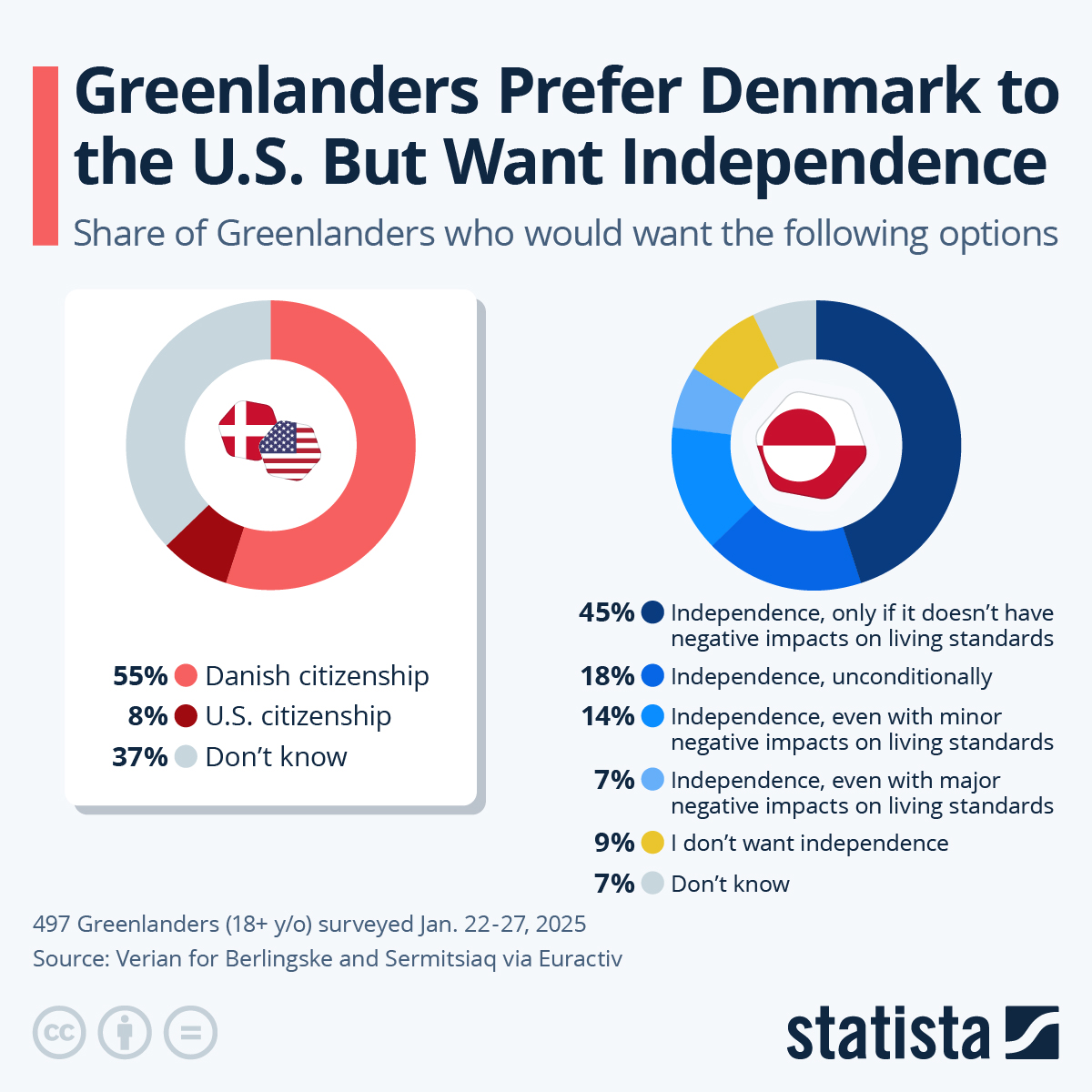
  • 55% of Greenlanders Prefer Danish Passport Over U.S. Citizenship

    55% of Greenlanders Prefer Danish Passport Over U.S. Citizenship

    Greenland’s Political Identity: Preference for Denmark Over the U.S.

    Greenland, a territory within the Kingdom of Denmark, has recently found itself at the intersection of geopolitical interests, particularly with the U.S. showing keen interest in the Arctic region. A notable recent event was the backlash experienced by the U.S. delegation visiting Greenland, perceived as a provocative move by the local leaders. This visit followed remarks made by former U.S. President Donald Trump about wanting to purchase the island. However, public sentiment among Greenlanders tells a different story regarding their national identity and future aspirations.

    The Survey Insights: Greenlanders on U.S. Citizenship

    A survey conducted by Verian for the Danish newspaper Berlingske and Greenlandic media outlet Sermitsiaq revealed some startling figures about Greenlandic sentiment towards American citizenship. Only eight percent of respondents expressed a desire to obtain U.S. citizenship. This indicates a strong inclination towards retaining their unique identity rather than aligning themselves with a nation that has historically shown interest in acquiring their land.

    Preference for Danish Citizenship

    In stark contrast to the minimal interest in U.S. citizenship, the survey disclosed that 55 percent of respondents favored Danish citizenship. This preference points towards a deeper connection with Denmark, reflective of a historical relationship that encompasses culture, governance, and economic support. The significance of maintaining ties with Denmark is indicative of Greenlanders valuing their social, political, and economic frameworks more than the prospect of American governance.

    Independence: A Double-Edged Sword

    Independence remains a pivotal topic in Greenlandic discourse. The poll revealed that while many are in favor of pursuing independence, their opinions hinge on the condition of maintaining or improving their quality of life. A substantial majority expressed a desire for independence if it does not lead to a decrease in living standards. This presents a nuanced perspective on independence: it is not merely about sovereignty but also about the practical implications such a move might entail.

    Economic Considerations: The Role of Danish Funding

    One of the critical aspects of the independence debate revolves around Greenland’s financial relationship with Denmark. Approximately 20 percent of Greenland’s GDP is underpinned by an annual block grant from the Danish government. Should independence be pursued, the loss of this financial support poses a significant threat to the quality of life for many Greenlanders. This economic dependency complicates the desire for self-determination, as many are cautious about potential economic repercussions.

    The Spectrum of Voices on Independence

    The survey also highlighted the diversity of opinions among Greenlanders regarding independence. While the sentiment toward self-governance is prominent, it varies across different demographics and communities within the territory. The complexity of opinions illustrates that independence is a nuanced subject, deeply intertwined with the lived experiences and expectations of the Greenlandic populace.

    Conclusion: Navigating the Future of Greenland

    As Greenland continues to weigh its options between maintaining ties with Denmark and pursuing independence, it is essential to understand the perspectives expressed in the recent survey. With a strong preference for Danish citizenship, concerns about economic stability, and varied opinions on independence, the political landscape in Greenland is as multifaceted as the territory itself. The actions of external nations, particularly the U.S., will undoubtedly influence these discussions, making it crucial for Greenlanders to navigate their identity and future carefully.