الوسم: image

  • Experts Warn Sydney Sweeney’s Euphoria Role Could Impact Her Image

    Experts Warn Sydney Sweeney’s Euphoria Role Could Impact Her Image

    Digital Phablet – Sydney Sweeney’s Success in Euphoria Sparks Conversation About Her Image

    Sydney Sweeney’s compelling and courageous performance in Euphoria has quickly placed her among Hollywood’s emerging stars. Yet, industry experts now express concerns that the intense focus on the show’s provocative content might threaten her public image if discussions shift away from her acting abilities.

    Analysts warn that some scenes from Sweeney’s role in Euphoria could potentially impact her career prospects. Since the third season’s debut on April 12, Sweeney has been a prominent topic online. While branding specialists believe her current visibility benefits her, they also caution that if her portrayals are overshadowed by viral clips and controversies, Hollywood’s perception of her may change. Dave Quast, the founder of EDQ Strategies, explains that her breakout success stems partly from her fans perceiving her as a bold and daring actress on screen.

    “Euphoria has clearly established Sydney Sweeney as a fearless performer, both physically and emotionally,” Quast states. “That’s a key reason she has broken through the ranks. However, the danger lies in public discussions simplifying her complex performances into mere sensational images. If conversations focus more on the sexual elements than her acting craft, it could narrow her brand’s boundaries,” he warns.

    Sexuality in film and television, according to Quast, doesn’t necessarily undermine an actor’s credibility. The bigger concern, he suggests, is when audiences begin to associate an actor solely with a specific image or stereotype. “The challenge isn’t her performing in sexualized roles,” he emphasizes. “It’s making sure those moments are viewed as deliberate character choices and not the entirety of her professional identity.”

    Despite these concerns, industry experts agree that Sweeney’s high profile remains a significant asset in today’s entertainment world. “Visibility is power,” Quast remarks. “She’s one of the few young actresses consistently able to generate conversations across a broad spectrum of topics. That kind of recognition has substantial commercial value.”

    Sydney Sweeney in "Euphoria" Season 3

    In summary, while Sweeney’s bold roles and public perception continue to place her squarely in the spotlight, industry observers advise that managing her brand carefully is crucial. Balancing her daring performances with strategic public relations can help ensure her continued success in Hollywood’s competitive landscape.

  • Trump’s AI Jesus Image Sparks Feud with Pope Leo

    Trump’s AI Jesus Image Sparks Feud with Pope Leo

    On Sunday, former President Donald Trump shared an AI-generated image of himself resembling Jesus, which sparked considerable backlash, even among some religious conservatives who usually support him. The post was swiftly taken down the following day.

    The image on Trump’s Truth Social platform showed him in a white robe, with a hand placed on a man’s head who appeared to be unwell. Trump later claimed that the picture was meant to depict him as a doctor, emphasizing that he makes people better. However, critics pointed out the photo’s religious symbolism, noting the divine light emanating from Trump and the way he is portrayed holding a luminous orb and touching a patient’s forehead, reminiscent of Christian imagery of healing.

    The controversy arose amid Trump’s ongoing dispute with Pope Leo, who has publicly condemned the inhumane aspects of the US-Israel conflict in Iran, a war that Trump has been critical of. Prior to the post, Trump launched a lengthy attack on Leo, criticizing him as “weak on crime” and disastrous for foreign policy. In response, Leo—who is the first U.S.-born pope—asserted that he fears no American administration and plans to continue speaking out, condemning the violation of international law by global powers in a speech from Algerian grounds.

    The imagery of Trump in the white robe, with a seemingly healing gesture toward the sick man, risks alienating some of his key religious supporters, who are vital for his political base. The background features symbols such as the Statue of Liberty, fireworks, a fighter jet, and eagles, adding to the dramatic, almost messianic tone.

    Trump denied that the image was meant to portray him as Jesus; he insisted it was simply him as a doctor making people better. Art critics and political figures, however, raised doubts. Brendan McMahon, an art history professor at the University of Michigan, noted the religious symbolism, pointing out that the image aligns with centuries-old Christian art traditions portraying Christ as a healer, with divine light streaming from his figure and hands.

    Some critics, like Brilyn Hollyhand, former co-chair of the Republican National Committee Youth Advisory Council, harshly condemned the image as blasphemous, arguing that faith should not be used as a prop and that Trump’s record should speak for itself. Riley Gaines, a former college swimmer and vocal critic of transgender athletes, questioned Trump’s judgment, suggesting that a bit more humility would be beneficial and warning that mocking God is dangerous.

    Religious voters, particularly Catholics, are a crucial demographic for Trump. Despite his irregular church attendance, he demonstrated strong support among Christian voters in the previous election, including Catholics. After narrowly surviving an assassination attempt in July 2024, some evangelical supporters viewed it as divine favor.

    This discord with Pope Leo may influence Catholic voters’ loyalty, sparking debate among analysts. David Gibson of Fordham University highlighted the uncertainty about whether this dispute crosses a line that will cause Catholics to reconsider their support. Bishop Robert Barron, who serves on a religious liberty commission established by Trump, urged the president to apologize for his social media remarks, yet also acknowledged Trump’s outreach to Catholic communities.

    Recently, Leo has been vocal about his opposition to the Iran war, emphasizing that Jesus’s teachings oppose conflict and violence—a stance in direct contrast to some U.S. officials like Defense Secretary Pete Hegseth, who has justified aggressive actions with biblical references. The Pope has also criticized the use of Jesus to justify war, saying God rejects those who incite strife.

    The tensions extend beyond rhetoric; Trump’s criticisms of Leo have escalated considerably beyond previous disagreements with Pope Francis, who publicly opposed Trump’s deportation policies. Last year, after Francis passed away, Trump posted an image of himself as the pope, which drew significant outrage from many Catholics.

    Over 8 members of Trump’s cabinet are Catholic, including Vice President JD Vance and Secretary of State Marco Rubio. Vance downplayed the religious imagery as a joke and suggested that the Vatican should focus on moral issues rather than political spectacle. Meanwhile, the ongoing disagreement exemplifies the complex relationship between Trump’s political maneuvers and the religious sentiments that have historically influenced American politics.

  • Former Colleague Unveils Indian Roots of Bondi Attacker Naveed Akram

    Former Colleague Unveils Indian Roots of Bondi Attacker Naveed Akram

    Former colleague of attacker Naveed Akram can be seen in this image. — Screengrab via A Current Affair

    A former coworker of one of the Bondi Beach attackers shared with an international media outlet that Naveed Akram’s ethnicity is Indian.

    In an interview with A Current Affair, Lachie, a former colleague, said he recognized Akram immediately when he saw his photo online.

    Discussing Akram’s personal background, the former coworker explained: “Yeah, his background is Indian and Italian… his mom’s Italian, and his dad’s Indian.”

    A father and son opened fire during a Jewish festival at Australia’s most popular beach on Sunday evening, resulting in 15 fatalities, including a child, and injuring 42 others.

    The former coworker stated he was scrolling through social media when he saw the image. “Shock, disbelief — genuine shock,” he recalled. “I couldn’t believe that someone I spent time with every workday could commit such cruelty.”

    He emphasized that regardless of the motive, the attack was unjustifiable. “Whatever the reasons behind it, it’s just wrong. And for what?” he questioned.

    The ex-colleague said he worked with Akram intermittently for about five years in construction. “Probably on and off for about five years, mostly as a bricklayer,” he added.

    He noted that Akram’s behavior showed no signs of potential violence. “You wouldn’t think it. But that’s him,” he remarked.

    Officials have condemned the attack as terror-related, though they haven’t officially identified the shooters—one who was killed on scene and the other hospitalized.

    However, Australia’s national broadcaster ABC stated that the alleged attacker was Naveed Akram from Bonnyrigg, a suburb in western Sydney, citing an unnamed official. Local media also reported police raids at his residence.

    According to reports, Naveed was detained at the scene and transported to the hospital, where he remains under police supervision in critical but stable condition. His father, Sajid, reportedly owned a fruit shop and died at the scene.

    Home Affairs Minister Tony Burke confirmed Sajid arrived in Australia in 1998 on a student visa, which was later converted to a partner visa in 2001. He also holds a resident return visa. Burke added that Naveed, born in 2001, is an Australian citizen.

    Family members had initially told relatives they were heading to the South Coast for fishing, with Verena, Naveed’s mother, saying he had gone to Jervis Bay with his dad for the weekend and last contacted them Sunday morning.

    ‘Terrified’ Sydney man misidentified as Bondi gunman

    A Sydney resident, wrongly identified as the gunman, recounted receiving death threats and feeling too afraid to leave his home on Monday after his photo circulated widely online.

    Images of a smiling man in a green Pakistan cricket jersey spread across social media platforms.

    Many of these posts were shared thousands of times, accompanied by hostile comments.

    The photo was taken from a Facebook profile belonging to a different Naveed Akram, who issued a video appeal on Monday through the Pakistan Consulate in Sydney, urging people to stop spreading misinformation.

    “According to media reports, one of the shooters is named Naveed Akram, but my name is also Naveed Akram,” he stated in the video.

    “That’s not me. I have no connection to the incident or the individual involved,” he added, condemning the “horrible” Bondi Beach attack.

    “I need everyone’s help to stop this false information,” he urged, asking users to report accounts that misuse his photo, which he shared on Facebook in 2019.

    ‘Life-threatening’

    The 30-year-old, residing in a northwest Sydney suburb, told AFP he first learned around 9:30 p.m. on Sunday that he had been falsely linked to the shooting.

    “I couldn’t even sleep last night,” Akram admitted, saying he deleted numerous hateful messages he received.

    “I’m terrified. I can’t go outside; it feels life-threatening. I don’t want to take any risks… my family is worried as well, so this has been a tough time for us.”

    He asked the Pakistan Consulate to release his video, as relatives in Punjab, Pakistan, also received numerous phone calls.

    “It was damaging my reputation and my family’s reputation,” he explained.

    “People were calling them. They were worried, and they even contacted police back home.”

    Originally from Pakistan, he moved to Australia in 2018 to study at Central Queensland University, later completing a master’s at Sydney’s Holmes Institute.

    Today, he owns a car rental business and expressed his love for Australia.

    “I really enjoy living here. I’ve never felt unsafe—everyone is so friendly,” Akram said.

    “It’s just this incident that’s caused me so much trauma.”

  • NASA Rover Shows Gloomy Photo of Mars Moon Deimos

    NASA Rover Shows Gloomy Photo of Mars Moon Deimos

    Sometimes, you may glance up and find yourself captivated by the impressive sight of the moon, its surface beautifully illuminated by the sun. But have you ever considered what other moons might appear as seen from the surface of different planets in our solar system?

    The Perseverance rover, managed by NASA and exploring Mars since its dramatic landing in 2021, has just released a stunning image of Deimos, one of Mars’ two moons.

    “Wishing upon a… moon?” the Perseverance team based in California posted on the rover’s X account, adding, “That bright ‘star’ is actually Mars’ moon Deimos.”

    Wishing upon a… moon?

    That bright “star” is actually Mars’ moon Deimos. In the hours before dawn, I snapped this long-exposure image with my left Navcam and caught Deimos as well as two stars from the constellation Leo in the sky.

    It’s definitely a mood, as they say. pic.twitter.com/WTSppIAQID

    — NASA’s Perseverance Mars Rover (@NASAPersevere) May 15, 2025

    Captured in March during the hours just before dawn, Perseverance used its left navigation camera to take a long-exposure shot that also features two stars from the constellation Leo: Regulus and Algieba, which NASA has kindly pointed out.

    Deimos boasts a diameter of 7.7 miles (12.4 kilometers) and is believed to be a captured asteroid, significantly smaller than Earth’s moon, which has a diameter of 2,159 miles (3,474 kilometers).

    While Deimos orbits Mars at a distance of 14,577 miles (23,460 kilometers), Earth’s moon hangs much farther away at about 238,855 miles (384,400 kilometers).

    Another distinguishing factor is the shape; our moon is spherical, whereas Deimos has an irregular, “potato-like” form, as portrayed by NASA.

    This captivating image provides a refreshing change from the rover’s usual exploration of Martian terrain in search of ancient microbial life, offering a moment to appreciate the grander cosmic significance of its mission.

    In many ways, this striking photograph is not only a technical achievement but also a source of reflection as the rover continues its epic journey to uncover knowledge beyond our home planet.

  • AI Image Generation Tutorial

    AI Image Generation Tutorial

    A Comprehensive Guide to AI Image Generation

    In recent years, artificial intelligence has made significant strides in the realm of image generation. AI image generators use complex algorithms and neural networks to create stunning visuals that often mimic human creativity. This tutorial will walk you through the basics of AI image generation, its applications, and how you can start generating your own images.

    Understanding AI Image Generation

    AI image generation involves the use of deep learning models to synthesize images based on input data. These models learn from vast datasets of existing images, making them capable of generating new images that can resemble real-world objects, scenes, or entirely fictional concepts.

    Key Technologies Behind AI Image Generation

    1. Generative Adversarial Networks (GANs):

      • Composed of two networks—a generator and a discriminator—that work against each other.
      • The generator creates images, while the discriminator evaluates their authenticity.
      • This process continues until the generated images are indistinguishable from real ones.

    2. Variational Autoencoders (VAEs):

      • These models encode input images into a compressed representation and then decode them back into images.
      • VAEs are effective for generating variations of existing images.

    3. Diffusion Models:

      • A newer approach that gradually adds noise to an image and then learns to reverse that process to recover the original.
      • Known for producing high-quality images with intricate details.

    Getting Started with AI Image Generation

    Embarking on an AI image generation project requires both the right tools and a bit of knowledge about how to use them. Here’s how you can get started:

    1. Selecting the Right Tools

    Numerous platforms and libraries are available for producing AI-generated images. Here are some popular options:

    • DALL-E 2: Developed by OpenAI, this model allows users to create images from textual descriptions.
    • BigGAN: Known for generating high-resolution images, BigGAN is accessible through TensorFlow and PyTorch.
    • Artbreeder: A user-friendly online tool that allows users to blend images and create variations easily.

    2. Setting Up Your Environment

    To work with AI models locally, you’ll need:

    • A suitable programming language: Python is the most commonly used language in AI.
    • Frameworks: Install TensorFlow or PyTorch.
    • Jupyter Notebook: A great tool for developing and visualizing your models.

    3. Basic Steps to Generate Images

    Follow these steps for a basic image generation project:

    1. Install Required Libraries:

      • Use pip to install necessary libraries:
        pip install torch torchvision matplotlib

    2. Load a Pre-trained Model:

      • Utilize pre-trained models to ease the learning curve. For example, you can load a GAN model as follows:

        import torch
        from torchvision.models import gan

        model = gan(pretrained=True)

    3. Generate an Image:

      • Once the model is loaded, you can start generating images:
        noise = torch.randn(1, 100)  # Random noise vector
        generated_image = model(noise)

    4. Visualize the Output:

      • Use matplotlib to display the generated image:
        import matplotlib.pyplot as plt
        plt.imshow(generated_image.permute(1, 2, 0).detach().numpy())
        plt.show()

    Tips for Effective Image Generation

    • Experiment with Parameters: Tweak parameters such as learning rate, input noise vectors, and model architecture to see how they affect the output.
    • Utilize Datasets: Investigate different datasets to influence what your AI generates; datasets such as COCO or ImageNet are excellent for training.
    • Iterate and Improve: Image generation is often about iteration. Assess the outputs and refine your approach based on what you observe.

    Common Applications of AI-Generated Images

    AI-generated images find applications across various fields, including:

    • Art and Design: Artists use AI to create novel pieces or as tools to brainstorm ideas.
    • Gaming and Animation: Game developers can automatically generate backgrounds or character designs, enhancing creativity and efficiency.
    • Advertising: Marketers leverage AI to produce unique visuals tailored for campaigns.
    • Fashion: AI can generate clothing designs or help visualize new fashion trends.

    Ethical Considerations

    While the capabilities of AI image generation are exciting, ethical considerations must be taken into account:

    • Copyright Issues: Generated images may resemble existing works, leading to potential copyright conflicts.
    • Deepfakes: The technology could be misused to create misleading images or content, raising concerns about misinformation.
    • Bias: AI models can reflect biases present in their training data, resulting in the generation of problematic or insensitive images.

    By following this guide, you can dive into the intriguing world of AI image generation, unlock new creative possibilities, and contribute to the ongoing evolution of technology in art and design.

  • James Webb Takes Stunning Photo Of A Cosmic Tornado

    James Webb Takes Stunning Photo Of A Cosmic Tornado

    The James Webb Space Telescope has unveiled another breathtaking image of the cosmos, this time depicting the fascinating environment surrounding a nascent star. In their early stages, stars often emit intense jets of hot gas, and when these jets interact with surrounding dust and gas, they create remarkable structures known as Herbig-Haro objects.

    This latest image focuses on Herbig-Haro 49/50, which is situated relatively close to Earth, about 630 light-years away, in the constellation Chamaeleon. Scientists had previously examined this object with the Spitzer Space Telescope, dubbing it the “Cosmic Tornado” due to its tornado-like appearance. To illustrate the enhanced capabilities of the James Webb Telescope in capturing such objects with extraordinary detail, you can explore the comparison between the 2006 Spitzer image and the latest Webb capture.

    Upon examining the complete image in all its intricacies, you might notice an object positioned at the tip of the tornado in the upper left. Initially, when researchers surveyed this area using Spitzer, they observed a fuzzy formation at the tip and speculated about its nature, but the resolution at that time was insufficient for clarity. Now, thanks to Webb’s advanced imaging capabilities, it is evident that this formation is, in fact, a spiral galaxy located in the background, perfectly aligned with the Herbig-Haro object from our viewpoint on Earth.

    The NASA/ESA/CSA James Webb Space Telescope observed Herbig-Haro 49/50, an outflow from a nearby still-forming star, in high-resolution near- and mid-infrared light with the NIRCam and MIRI instruments. The intricate features of the outflow, represented in reddish-orange color, provide detailed clues about how young stars form and how their jet activity affects the environment around them. A chance  in this direction of the sky provides a beautiful juxtaposition of this nearby Herbig-Haro object (located within our Milky Way) with a more distant, face-on spiral galaxy in the background.
    NASA, ESA, CSA, STScI

    The observations were made using Webb’s NIRCam (Near-Infrared Camera) and MIRI (Mid-Infrared Instrument), which analyze different segments of the infrared spectrum to create a comprehensive view of the target. These instruments detect the glowing hot molecules of hydrogen, carbon dioxide, and dust, which appear in shades of red and orange.

    The jets from a protostar, known as Cederblad 110 IRS4, energize these gases and dust grains. While this particular protostar isn’t visible in the Webb image, it is located just outside the lower right corner.

    This protostar is still in its infancy, estimated to be anywhere from tens of thousands to one million years old—quite young compared to our Sun, which is approximately 4.5 billion years old. Nevertheless, the clouds of dust in this region, known as the Chamaeleon I Cloud complex, resemble the material from which our Sun likely formed. Images like this one provide valuable insights into the tumultuous early stages of star formation.

  • Stunning Hubble Image Reveals Colors Of The Veil Nebula

    Stunning Hubble Image Reveals Colors Of The Veil Nebula

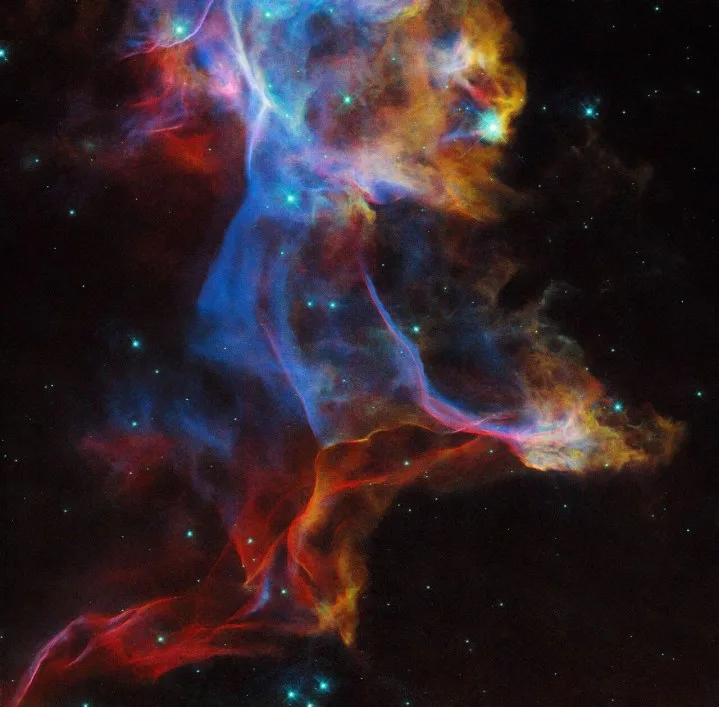
    A breathtaking cosmic spectacle reveals its vibrant hues in this recent capture by the Hubble Space Telescope. The Veil Nebula, remnants of a colossal star that detonated in a supernova approximately 10,000 years ago, showcases a stunning array of dust and gas, elegantly shaped, which inspired its name.

    The progenitor star of the nebula was a behemoth, boasting a mass 20 times that of our sun. Its explosion was so brilliant that it would have outshone Venus in Earth’s sky, despite being situated 2,400 light-years away. Over the millennia, the remnants of that eruption have dispersed, forming the intricate structure we observe today.

    Hubble has previously photographed the Veil Nebula, with the last instance occurring in 2015. However, this latest image zooms in on a specific region of the nebula, providing an intricate view. The various colors depicted correspond to different elements found within the nebula, enabling scientists to analyze the unique chemical composition of this area.

    The image is displayed in its entirety below:

    In this NASA/ESA Hubble Space Telescope image, Hubble once again lifts the veil on a famous — and frequently photographed — supernova remnant: the Veil Nebula.
    In this NASA/ESA Hubble Space Telescope image, Hubble once again unveils the captivating — and often photographed — supernova remnant: the Veil Nebula. ESA/Hubble & NASA, R. Sankrit

    “This image is a composite created from data collected through three different filters by Hubble’s Wide Field Camera 3, emphasizing emissions from hydrogen, sulfur, and oxygen atoms. This snapshot reveals only a small segment of the Veil Nebula; had you the visibility of the entire nebula without telescopic aid, it would span the width of six full moons aligned side by side,” Hubble scientists explain.

    “While this image captures a singular moment in the life of the Veil Nebula, it aids researchers in understanding the evolution of the supernova remnants over decades. When combined with Hubble observations from 1994, scientists can track the movement of individual gas knots and filaments over time, deepening our comprehension of this remarkable nebula.”

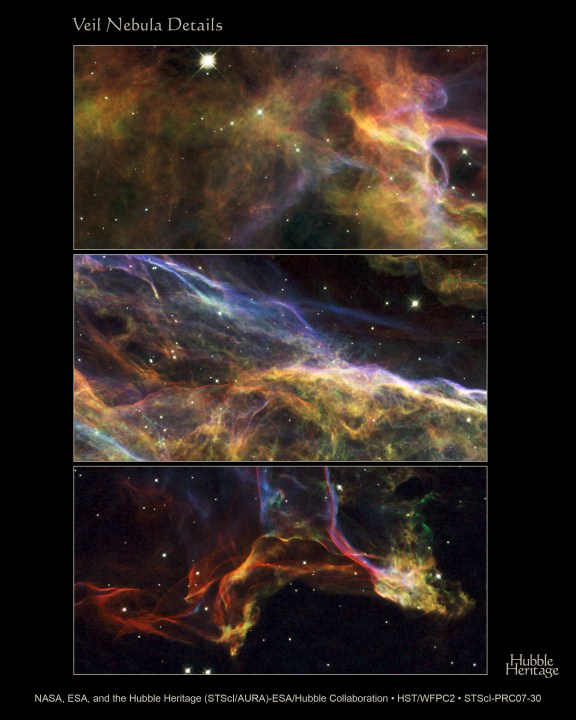
    Additionally, comparisons can be made with original Hubble images taken in 1994 and 1997. These images exhibit different aspects of the nebula:

    NASA's Hubble Space Telescope photographed three magnificent sections of the Veil Nebula – the shattered remains of a supernova that exploded thousands of years ago. This series of images provides beautifully detailed views of the delicate, wispy structure resulting from this cosmic explosion.
    NASA’s Hubble Space Telescope captured three stunning sections of the Veil Nebula – the shattered remnants of a supernova that occurred millennia ago. This collection of images showcases intricate details of the ethereal, wispy structure born from this cosmic explosion. NASA, ESA, and the Hubble Heritage (STScI/AURA)-ESA/Hubble Collaboration; Acknowledgment: J. Hester (Arizona State University)

    With over 30 years separating some of these images, scientists can witness the structural transformation over time — showcasing how Hubble continues to deliver mesmerizing imagery of the cosmos as it nears its 35th anniversary since its launch.

  • U.S. Takes A Stand On AI Image Copyright Enforcement

    U.S. Takes A Stand On AI Image Copyright Enforcement

    Théâtre D'opéra Spatial, an award-winning AI-generated image
    Midjourney

    While AI-generated art can be showcased in competitions, it doesn’t benefit from copyright protections in the United States, as outlined in recent guidance from the U.S. Copyright Office (USCO).

    This report provides clarity on the copyright potential of AI-generated media such as videos, images, and text. It reveals that, despite the novelty of generative AI, the existing copyright framework remains applicable, implying that no new legislation is necessary. Unfortunately for creators using AI, the available protections are minimal.

    As established in a previous ruling, AI itself cannot claim copyright ownership. The Supreme Court’s decision in the 1989 case Cmty. for Creative Non-Violence v. Reid emphasized that “the author [of a copyrighted work] is . . . the person [emphasis added] who translates an idea into a fixed, tangible expression entitled to copyright protection.”

    The USCO’s latest guidance asserts that prompts given to AI lack enough user’s control over the generative process to confer authorship to the users, regardless of how intricate and detailed the prompts may be.

    The report indicates, “No matter how many times a prompt is revised and resubmitted, the final output reflects the user’s acceptance of the AI system’s interpretation, rather than authorship of the expression it contains.” Essentially, it’s about the level of human involvement, not the predictability of the output.

    However, there are exceptions to the lack of protection. For instance, the upcoming 2024 film “Here,” which showcases digitally enhanced performances by Tom Hanks and Robin Wright, has received copyright despite utilizing generative technology. This is attributed to the AI being employed as a tool rather than acting as a creator in its own right. Similarly, films incorporating AI-generated effects and visuals can still be copyrighted, even if those individual components cannot.

    Artists using AI to enhance or alter their pre-existing work might also find some protections. While the AI-generated portions may not be copyrightable, the overall artistic creation, showcasing “perceptible human expression,” would still enjoy copyright coverage.

    The ongoing debate surrounding authorship is longstanding. Since the emergence of computers in the 1960s, the USCO has grappled with whether digital content is the result of human effort or merely produced by machines.

    As noted by then-Register of Copyrights Abraham Kaminstein in 1965, “The crucial question appears to be whether the ‘work’ is basically one of human authorship, with the computer merely being an assisting instrument or whether the traditional elements of authorship in the work (literary, artistic, or musical expression or elements of selection, arrangement, etc.) were actually conceived and executed not by man but by a machine.”

    Moving forward, the USCO acknowledges that its stances may evolve as generative technology continues to develop. They propose a hypothetical scenario where future AI tools could enable users to exert substantial control over the output, thereby leading to a reevaluation of copyright considerations. Yet, current AI functionalities have not reached such a level of user control.