الوسم: Hubble

  • How to Open the Puzzle Chest in Hubble Castle Using Completing and Solving in DQ7 Reimagined

    How to Open the Puzzle Chest in Hubble Castle Using Completing and Solving in DQ7 Reimagined

    “Dragon Quest 7 Reimagined” features complex puzzles, and one of the trickiest is the statue crossing puzzle found in the Grand Conjuratorium. This puzzle has confused many players since the game’s original release on PlayStation, but it’s actually quite straightforward once you understand the pattern.

    The key to solving this puzzle lies in walking through doorways in a specific sequence to reveal hidden platforms, which in turn unlock treasures. Interestingly, this same puzzle appears twice in the game: once in the Conjuratorium itself and again in Hubble Castle’s Water Tower. In both locations, following the same pattern will unlock a hidden chest or access a new area containing valuable items.

    If you’ve been struggling to figure out this riddle, here’s how to solve it:

    How to Solve the Statue Puzzle

    The only clue you get comes from a woman in a previous version of the game’s region. You’ll find her on the second floor of the Water Tower (located east once you enter the castle).

    Here’s a simple step-by-step guide:

    1. Stand underneath the statue on the left side of the room.
    2. Walk straight through the center of the room and exit through the east wall.
    3. Move around to the top outside of the room.
    4. Walk through the center again and exit through the bottom wall.

    By following this pattern in the Water Tower, you will open the chest in the middle of the room. When performed in the Grand Conjuratorium’s entrance hall, this same steps will lift a walkway to the stairs, granting access to a new area filled with more treasure.

    Extra Tip

    The secret area in the Grand Conjuratorium contains a tablet fragment and a statue. Speaking to the statue will grant you a more powerful version of The Great Leveller—an upgrade that becomes especially useful after completing the story events at Hubble, making the trip well worth it.

  • Gorgeous Cotton Candy Clouds Reveal Hubble’s Image Processing

    Gorgeous Cotton Candy Clouds Reveal Hubble’s Image Processing

    The latest breathtaking photograph captured by the Hubble Space Telescope might remind you of cotton candy, but it’s actually a glimpse into a nebula found in the neighboring Large Magellanic Cloud. This satellite galaxy of the Milky Way lies approximately 160,000 light-years away. The nebula features a vibrant array of dust and gas that emits various colors, reflecting the different physical processes occurring within it.

    To understand how Hubble achieves its striking and colorful imagery, it’s important to know how its cameras operate. Unlike your smartphone camera, which takes a quick snapshot, Hubble’s instruments, like the Wide Field Camera 3, perform multiple observations of the same object while utilizing different filters.

    Each of these filters allows the camera to isolate specific wavelengths of light. In this instance, five distinct filters were employed, targeting not only visible light but also portions of the ultraviolet and infrared spectrum.

    This technique enables Hubble to collect multiple black-and-white images of the same celestial object at different wavelengths. When these images are combined, they form a single, vibrant colored photograph, which you can admire in detail below.

    “When image-processing experts combine raw data from these filters into a colorful composite, they assign colors to each filter,” Hubble scientists state. “Visible-light data corresponds to the color that the filter permits, while shorter wavelengths, like ultraviolet, are usually represented as blue or purple. In contrast, longer wavelengths like infrared tend to be shown in red.” This coloring method provides a clearer understanding of phenomena happening in wavelengths outside of human visibility.

    The process of creating these images is akin to the techniques used by the James Webb Space Telescope, utilizing filters and composite methods to produce incredible representations of hidden cosmic entities. This work demands a blend of scientific acumen and a touch of artistic sensibility from the image processors.

  • Hubble Sees Rogue Black Hole Consuming A Star

    Hubble Sees Rogue Black Hole Consuming A Star

    Black holes are the voracious giants of the universe; incredibly dense entities capable of drawing in everything that comes too close, ultimately leading to its consumption. Recently, astronomers utilizing the Hubble Space Telescope witnessed a black hole actively consuming a star, tearing it apart and emitting a massive burst of radiation.

    This radiation release, known as a tidal disruption event (TDE), enabled the scientists to pinpoint the black hole. The TDE designated AT2024tvd was especially intriguing for a unique reason: while most supermassive black holes reside at the centers of galaxies, this one is a nomadic outlier.

    “Typically, one anticipates locating massive black holes at the core of galaxies, like Sagittarius A* in the Milky Way,” noted lead researcher Yuhan Yao from UC Berkeley. “That’s where tidal disruption events are usually sought. However, this black hole is not at the center; it’s located approximately 2,600 light years away. This marks the first optically identified off-nuclear TDE.”

    In addition to Hubble, researchers employed various instruments, including NASA’s Chandra X-Ray Observatory and the NRAO Very Large Array telescope, to study the TDE depicted above.

    The black hole often starts as a discreet figure in the cosmos, but when a star ventures too close, it succumbs to the black hole’s gravitational pull and becomes extended, or “spaghettified,” into a long shape. This results in a disk-like formation of debris around the black hole, which rapidly spirals in, generating a burst of radiation detectable from Earth — indicating that the black hole defies typical central placement within galaxies.

    Interestingly, this galaxy houses not just one, but two supermassive black holes: one at the core and another wandering nearby. This phenomenon is believed to arise when two smaller galaxies collide and amalgamate, forming a larger galaxy.

    “Massive black holes are generally positioned at the centers of galaxies, but galaxies do merge — this is a fundamental process in their growth. When two galaxies merge, they can host multiple black holes,” said co-author Ryan Chornock, also from UC Berkeley. “What happens next? While we anticipate they will eventually merge, theorists have postulated a population of black holes that roam within galaxies.”

    The researchers speculate that these two supermassive black holes may eventually combine, resulting in a cataclysmic event powerful enough to produce gravitational waves that could be detected from our planet.

    The study will be published in The Astrophysical Journal Letters.

  • Hubble Captures Two Spiral Galaxies: One Perfect, One Odd

    Hubble Captures Two Spiral Galaxies: One Perfect, One Odd

    Galaxies come in a variety of shapes, and they are categorized accordingly. Elliptical galaxies appear as smooth, featureless blobs of light, while irregular galaxies exhibit bizarre forms due to gravitational interactions with other galaxies. The spiral galaxies, such as our Milky Way, are well-known for their elongated arms that radiate from a central core, creating a remarkable structure.

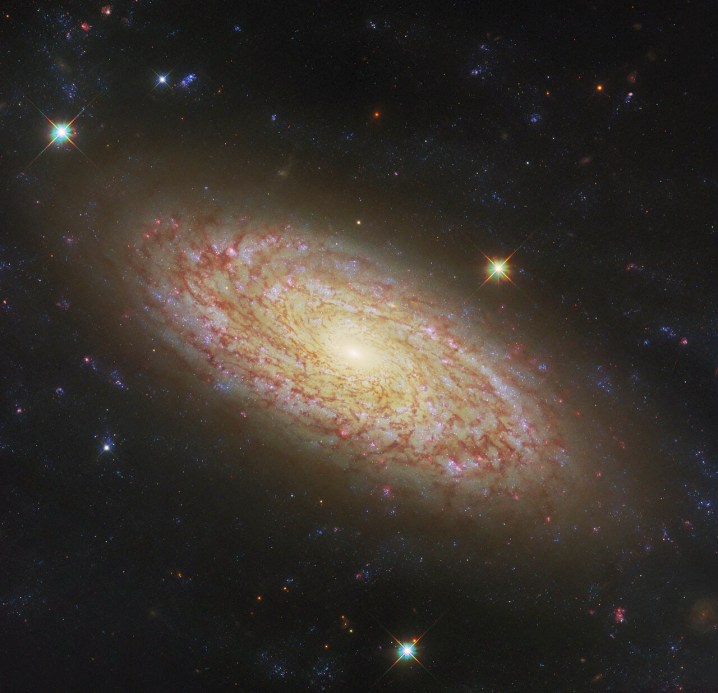
    Recent images captured by the Hubble Space Telescope illustrate the diversity among spiral galaxies. The first image features NGC 3596, which showcases a clean and orderly spiral structure. In contrast, the second image presents galaxy Arp 184 (also referred to as NGC 1961), classified as a peculiar spiral galaxy.

    A striking difference between the two galaxies is their appearance from our vantage point on Earth: NGC 3596 is viewed head-on, presenting a uniform shape. Meanwhile, Arp 184 is observed at an angle, revealing its asymmetrical design. This galaxy’s skewed appearance prevents it from fitting perfectly into the spiral classification, leading to its classification as “peculiar” in the whimsical Atlas of Peculiar Galaxies, created by Halton Arp in 1966.

    The prominent spiral arm in Arp 184 is broad and noteworthy, yet the opposite side lacks a similarly large arm, highlighting its asymmetry. In contrast, NGC 3596 is characterized by evenly sized spiral arms that glow pink in this image, indicating regions rich in star formation. This raises intriguing questions: why do some galaxies develop spiral arms while others do not, and how do they vary so widely in form? Astronomers are actively exploring these questions, with findings suggesting that the density of stars in specific areas of a galaxy plays a vital role.

    According to Hubble scientists, “Spiral arms represent a pattern of varying densities rather than a solid structure. As stars, gas, and dust orbit within a galaxy, they ebb and flow in and out of the spiral arms. Similar to cars navigating a traffic jam, these elements slow down and cluster as they enter a spiral arm before continuing along their galactic journey.”

  • Hubble Marks 35 Years With Four Stunning New Images

    Hubble Marks 35 Years With Four Stunning New Images

    This week marks a momentous occasion for one of the planet’s most cherished astronomical instruments: the Hubble Space Telescope is turning 35. Since its launch on April 24, 1990, Hubble has transformed our comprehension of cosmology, shedding light on the universe’s expansion, and it continues to gather priceless scientific data along with stunning images today.

    To commemorate its 35 years in orbit around Earth, the Hubble team has unveiled a collection of four remarkable images highlighting the diverse types of celestial objects that Hubble can study, including planets, nebulae, and galaxies. The telescope has benefited from multiple servicing missions over the years, resulting in significant instrument upgrades, enabling it to remain at the forefront of astronomical research even as technology evolves.

    According to the European Space Agency, Hubble has made an astonishing 1.7 million observations of 55,000 targets, leading to the publication of 22,000 scientific papers and the accumulation of over 400 terabytes of data. Even now, time on Hubble is a precious commodity, with six times as many science projects vying for access to the telescope’s resources as can be accommodated.

    This breathtaking image showcases a planetary nebula, formed by powerful stellar winds emanating from a vibrant white dwarf at its center. With temperatures soaring to nearly 22,000 degrees Celsius, the core of this dying star emits enough radiation to mold the surrounding dust and gas into exquisite structures.

    This eye-catching galaxy resembles our Milky Way with its spiral arms and luminous central bar of stars. However, while our galaxy exhibits distinct spiral arms, NGC 5335’s arms are more spread out, with patches of brightness in some areas due to star formation, while other zones appear less populated. A significant portion of the star formation activity within this galaxy occurs in the central bar, which appears particularly bright.


  • Hubble Captures Stunning Images of the Eagle Nebula Again

    Hubble Captures Stunning Images of the Eagle Nebula Again

    The stunning Eagle Nebula, often called the Pillars of Creation, is one of the universe’s most recognizable features. A renowned photograph captured by the Hubble Space Telescope showcases these majestic pillars, and to mark its 35th anniversary, Hubble has revisited the nebula to capture new imagery.

    The image displayed below reveals an impressive formation of gas and dust, an intricate part of the Eagle Nebula. Towering at 9.5 light-years in height, this structure is composed of cold hydrogen gas, within which new stars are forming amid the nebula’s cloud-like formations.

    As Hubble scientists describe, “The core of the nebula, which lies beyond the view of this image, is home to a cluster of youthful stars. These stars have carved out a vast cavity at the nebula’s center, resulting in the creation of pillars and globules of dusty gas. One distinct feature of this area extends like a finger pointing towards the center, where the active young star cluster resides.”

    This stellar activity contributes to the nebula’s sculpted appearance. Young stars shine brightly and give off significant amounts of radiation, along with a flow of particles known as stellar wind. This stellar wind shapes the surrounding clouds of dust and gas, leading to the remarkable formations seen in the image. Some of the gas becomes ionized due to the stars’ radiation, causing it to emit a radiant glow. Conversely, where dust is densely packed, it appears opaque, creating the dark silhouettes captured in the photograph.

    The various hues present in the image represent different elemental compositions within the nebula. The blue tones primarily stem from ionized oxygen, while the red tones emerge from hydrogen. However, this dark structure is not eternal; over time, the radiation from young stars will gradually erode the pillars.

  • Stunning Hubble Image Reveals Colors Of The Veil Nebula

    Stunning Hubble Image Reveals Colors Of The Veil Nebula

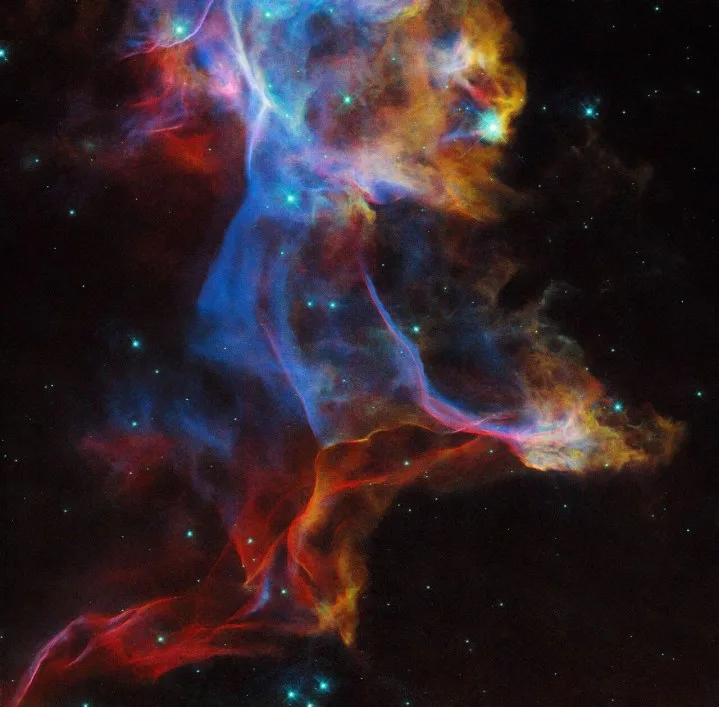
    A breathtaking cosmic spectacle reveals its vibrant hues in this recent capture by the Hubble Space Telescope. The Veil Nebula, remnants of a colossal star that detonated in a supernova approximately 10,000 years ago, showcases a stunning array of dust and gas, elegantly shaped, which inspired its name.

    The progenitor star of the nebula was a behemoth, boasting a mass 20 times that of our sun. Its explosion was so brilliant that it would have outshone Venus in Earth’s sky, despite being situated 2,400 light-years away. Over the millennia, the remnants of that eruption have dispersed, forming the intricate structure we observe today.

    Hubble has previously photographed the Veil Nebula, with the last instance occurring in 2015. However, this latest image zooms in on a specific region of the nebula, providing an intricate view. The various colors depicted correspond to different elements found within the nebula, enabling scientists to analyze the unique chemical composition of this area.

    The image is displayed in its entirety below:

    In this NASA/ESA Hubble Space Telescope image, Hubble once again lifts the veil on a famous — and frequently photographed — supernova remnant: the Veil Nebula.
    In this NASA/ESA Hubble Space Telescope image, Hubble once again unveils the captivating — and often photographed — supernova remnant: the Veil Nebula. ESA/Hubble & NASA, R. Sankrit

    “This image is a composite created from data collected through three different filters by Hubble’s Wide Field Camera 3, emphasizing emissions from hydrogen, sulfur, and oxygen atoms. This snapshot reveals only a small segment of the Veil Nebula; had you the visibility of the entire nebula without telescopic aid, it would span the width of six full moons aligned side by side,” Hubble scientists explain.

    “While this image captures a singular moment in the life of the Veil Nebula, it aids researchers in understanding the evolution of the supernova remnants over decades. When combined with Hubble observations from 1994, scientists can track the movement of individual gas knots and filaments over time, deepening our comprehension of this remarkable nebula.”

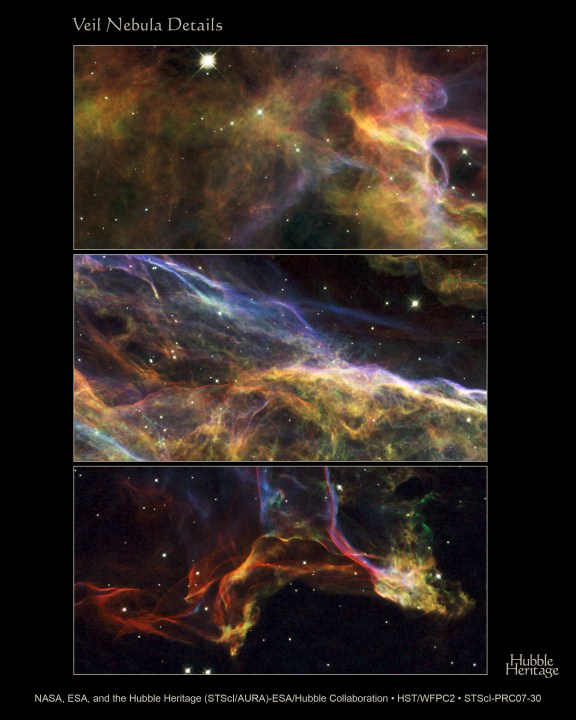
    Additionally, comparisons can be made with original Hubble images taken in 1994 and 1997. These images exhibit different aspects of the nebula:

    NASA's Hubble Space Telescope photographed three magnificent sections of the Veil Nebula – the shattered remains of a supernova that exploded thousands of years ago. This series of images provides beautifully detailed views of the delicate, wispy structure resulting from this cosmic explosion.
    NASA’s Hubble Space Telescope captured three stunning sections of the Veil Nebula – the shattered remnants of a supernova that occurred millennia ago. This collection of images showcases intricate details of the ethereal, wispy structure born from this cosmic explosion. NASA, ESA, and the Hubble Heritage (STScI/AURA)-ESA/Hubble Collaboration; Acknowledgment: J. Hester (Arizona State University)

    With over 30 years separating some of these images, scientists can witness the structural transformation over time — showcasing how Hubble continues to deliver mesmerizing imagery of the cosmos as it nears its 35th anniversary since its launch.

  • Hubble Captures Stunning Image Of The Tarantula Nebula

    Hubble Captures Stunning Image Of The Tarantula Nebula

    The Hubble Space Telescope has recently captured a stunning image of the vibrant star-forming region known as the Tarantula Nebula. This nebula, named for its intricate, web-like structure, resides in the Large Magellanic Cloud, a satellite galaxy of the Milky Way. It is a focal point for astronomers studying the dynamics of star formation and evolution.

    The latest image showcases the periphery of the nebula rather than its dense center. While the core is home to massive stars up to 200 times our sun’s mass, the outer edges present a more tranquil scene.

    According to the Hubble scientists, “The area depicted in this image is characterized by soft blue gas, patches of brownish-orange dust, and a scattering of multicolored stars.” They elaborate that the stars obscured by the dust appear redder due to the dust’s tendency to absorb and scatter blue light more effectively than red light. As a result, the red light reaches our observations more readily. The image integrates various wavelengths, including ultraviolet, infrared, and visible light.

    “By examining dusty nebulae in the Large Magellanic Cloud and other galaxies through Hubble’s observations, scientists can study distant cosmic dust grains, enhancing our understanding of their role in the birth of new stars and planets,” they add.

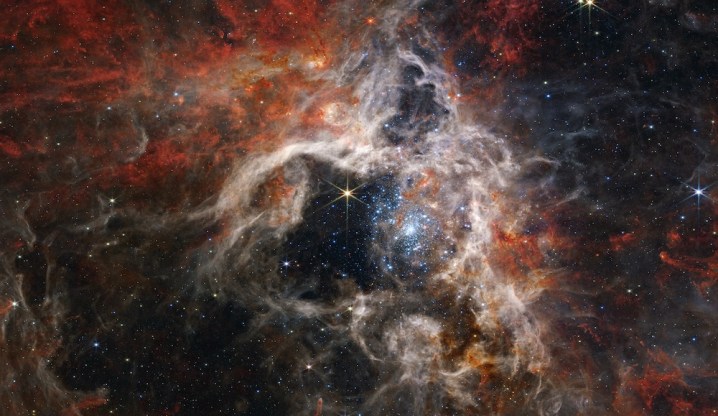
    Hubble has previously photographed the Tarantula Nebula, with notable images released in 2023 and 2020. This nebula gained further recognition when the James Webb Space Telescope selected it as a significant target, producing a breathtaking image in 2022 that highlighted its rich details.

    The Tarantula Nebula captured by the James Webb Space Telescope.
    NASA reports: This mosaic spans 340 light-years and shows the Tarantula Nebula’s star-forming region in unprecedented detail, revealing tens of thousands of young stars previously hidden by cosmic dust, with the most active regions glowing in pale blue. NASA, ESA, CSA, STScI, Webb ERO Production Team

    Young stars emit significant amounts of radiation and shine brightly, often surpassing older stars like our sun. Star formation occurs when dense clusters of dust and gas form, gradually attracting more material through gravity, which leads to the creation of protostars.

    While there is some debate about the exact rate of star formation in the Milky Way, it is generally accepted that our galaxy produces many more stars than the nearby Andromeda galaxy. The Large Magellanic Cloud, being a smaller galaxy, has a surprisingly high rate of star formation and is conveniently nearby, making it a prime location for studying how stars come to be. Telescopes like Hubble and James Webb are continuously unveiling new insights into star formation in this dynamic galactic neighbor.

  • Webb And Hubble Capture Two Views Of One Galaxy

    Webb And Hubble Capture Two Views Of One Galaxy

    The James Webb Space Telescope has captured the public’s attention over the past few years, but we must not overlook the venerable Hubble Space Telescope. While Webb boasts advanced technology and enhances our view of the cosmos, it is by no means a substitute for Hubble. New comparisons of images from both observatories highlight their unique strengths, showcasing the benefits of having both instruments working together for scientific exploration.

    The spiral galaxy NGC 2090, featured in Webb’s image above, was captured using the MIRI and NIRCam instruments. These tools operate within the mid-infrared and near-infrared sections of the electromagnetic spectrum, resulting in the galaxy’s arms appearing bright red. This impressive display originates from swirling gas and dust, containing compounds known as polycyclic aromatic hydrocarbons that emit an infrared glow. Meanwhile, the blue center indicates a region filled with young, hot stars.

    Hubble's image of NGC 2090, a spiral galaxy located in the constellation Columba.
    This captivating image from NASA/ESA Hubble Space Telescope showcases the spiral galaxy NGC 2090 in the constellation Columba.
    ESA/Hubble & NASA, D. Thilker

    In contrast, Hubble’s view of the same galaxy, captured in visible light, reveals a different perspective. Here, the spiral arms are less prominent, but patchy areas of dust forming the galaxy’s disc become more evident.

    NGC 2090 is a dynamic galaxy characterized by ongoing star formation across various stages of star development. The diverse ages of stars present offer valuable insights for researchers studying stellar evolution, allowing them to observe the life cycles of stars in differing stages. This galaxy was chosen for Webb’s observation as part of a broader project focused on understanding stellar evolution in nearby galaxies that are still in the process of star formation.

    Hubble’s observations of NGC 2090 also contribute to research on star formation and were utilized in an initiative called the Extragalactic Distance Scale Key Project. This project centers around a specific type of star, known as Cepheid variable stars, which play a crucial role in determining the universe’s expansion rate.