الوسم: Hindu

  • India investigates embezzlement at temple built on Babri mosque site

    India investigates embezzlement at temple built on Babri mosque site

    Indian authorities are probing allegations of financial misappropriation at a temple in northern India, a site closely associated with Prime Minister Narendra Modi’s Hindu-centric political stance, according to a senior government official on Friday.

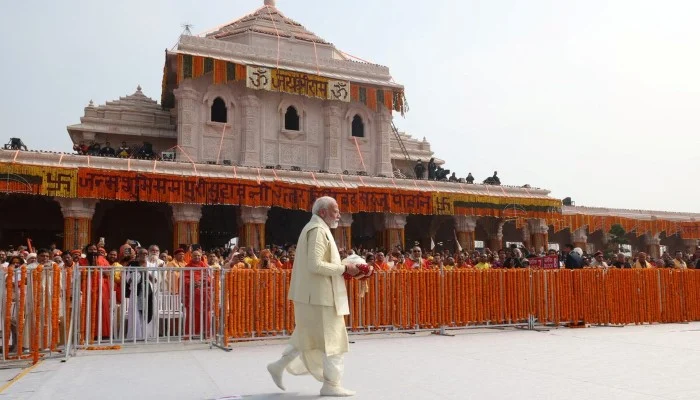
    The Ram Mandir temple in Uttar Pradesh—built on the site where a mosque stood for centuries before being dismantled by Hindu nationalists—was officially opened in 2024 with significant ceremony led by Modi himself.

    Uttar Pradesh’s Chief Minister Yogi Adityanath stated that a special investigation team (SIT) has been formed to examine claims of illegal diversion of donations from devotees.

    “We have initiated an SIT inquiry based on the recommendations of the trust overseeing the temple,” Adityanath, a prominent Hindu monk, announced during a public event.

    He urged anyone with documentary evidence related to the allegations to submit it to the SIT.

    The extent of the alleged financial misconduct remains uncertain, but opposition parties and local media report that the amount could exceed $20 million.

    Construction costs for the temple were approximately $240 million, entirely funded by public donations, according to the project organizers.

    Reports from The Indian Express indicate that daily donations typically average around $10,000, with peak days seeing contributions up to $60,000.

    Believers hold that Lord Ram was born in Ayodhya—home to the temple—more than 7,000 years ago, though it is also believed that the Babri mosque was constructed on his birthplace by a Muslim ruler in the 16th century.

    The Bharatiya Janata Party (BJP), the current ruling party, was instrumental in the campaign that led to the mosque’s demolition in 1992. The incident propelled the party and Modi to national prominence, helping them overtake the secularist Indian National Congress, which had dominated Indian politics since independence.

  • India State Elections Highlight Growing Hindu-Muslim Divide

    Supporters of India’s ruling Bharatiya Janata Party (BJP) celebrate outside the party’s regional office in Kolkata, India, on May 4, 2026, as the party leads in the West Bengal state assembly elections. — Reuters

    In the recent elections across four states, the Congress party has gained increased Muslim voter support, while the BJP has solidified its base among Hindus, according to analysts. Adhikari describes the BJP’s victories in Assam and West Bengal as a triumph of Hindutva.

    PM Modi’s BJP opted not to run Muslim candidates in key regions, instead relying on strong Hindu voter backing for their wins. Data from the elections shows a clear trend: Muslim voters have increasingly supported the Congress party, while Hindu voters predominantly favored Modi’s BJP. This pattern underscores escalating religious polarization within the country’s secular framework, reflecting a persistent ideological divide between the two major parties.

    Since coming to power in 2014, Modi has championed a pro-Hindu agenda, with the BJP aligning with Hindutva—a Hindu-centric ideology. This voter split benefits the BJP, as Hindus make up nearly 80% of India’s 1.42 billion population, with Muslims constituting about 14%.

    Political analyst Rasheed Kidwai notes, “The rise of the BJP has prompted Muslim voters to consolidate behind so-called secular parties, especially Congress—what we’re witnessing is a form of reverse polarization.” Muslim leaders indicate that their communities are increasingly turning to Congress or regional parties over smaller parties that focus on Muslim issues but rarely enter government.

    The latest election results, announced this week, reveal Congress’s poor performance overall. The party gained control of just one state, while BJP-led coalitions overtook three others, and a regional group won the remaining contest. In Assam, where BJP maintains power, 18 of the 19 newly elected lawmakers are Muslim—up from about 16 in the last assembly. The BJP fielded 20 Muslim candidates out of 126 seats and won 82 seats overall. Meanwhile, the All India United Democratic Front (AIUDF), which primarily relies on Muslim support, saw its seats drop from 16 five years ago to just two.

    In West Bengal, which the BJP secured for the first time with 207 seats out of 294, the two Congress legislators elected were Muslim. Neither Assam nor West Bengal saw Muslim candidates from the BJP—support for the party was attributed by leaders, including Bengal’s prospective chief minister Suvendu Adhikari, to Hindu voters. “It was a victory for Hindutva,” Adhikari stated.

    Looking ahead, political columnist Radhika Ramaseshan suggests, “Depending on regional dynamics, Muslim voters might continue to consolidate behind Congress, prompting Hindu voters to rally more strongly around the BJP.” Congress has capitalized on fears among Muslim voters who feel marginalized under BJP rule and question their citizenship, argues Badruddin Ajmal, head of AIUDF.

    He adds, “The narrative is that only a party capable of challenging the BJP at the national level can address these concerns. While this isn’t entirely accurate, voters are scared.” In response, the BJP accuses Congress of becoming a “new Muslim League,” though Congress asserts Muslims constitute about 12% of its 664 state legislators nationwide, with Hindus making up approximately 78%, consistent with India’s demographics.

    Congress spokesperson Pawan Khera expressed discomfort over discussions of religion, emphasizing that the party has broad, inclusive support. “We’ve historically stood for the oppressed and vulnerable, regardless of their religion or caste, and we will continue to do so,” he affirmed.

    While the BJP has also sought Muslim outreach, it did not nominate Muslim candidates in the 2024 general elections. Modi has consistently denied using religion to win votes, asserting, “If I start talking about Hindus and Muslims in politics, I’ll lose my ability to serve the public. That’s my commitment.”

    However, Ramaseshan notes that religious rhetoric, particularly around election time, has sharply increased under Modi compared to earlier BJP leadership. “The BJP and its ideological parent, the Sangh, are shaping a new vision of India as a ‘Hindu Rashtra,’ and that narrative is increasingly influencing the national consciousness. This could lead to a fundamental shift in how India’s identity is perceived in the future,” she warns.
  • Sikh Activists and BJP Supporters Clash Outside UK Embassy in London

    Sikh Activists and BJP Supporters Clash Outside UK Embassy in London

    Sikh activist and Hindu groups protest outside Bangladesh Embassy in London, UK on December 28, 2025. — Geo News

    • Hindu groups’ protest was met with pro-Khalistan activists.
    • Police respond to the scuffle, intervene, and restore calm.
    • A Sikh leader accuses India of persecuting Sikhs, Muslims, and Christians.

    London: Tensions escalated outside the Bangladesh Embassy when a clash erupted between pro-Khalistan Sikh activists affiliated with Sikhs For Justice (SFJ) and a group of British Indian Hindus aligned with India’s ruling Bharatiya Janata Party (BJP) during a demonstration over the alleged persecution of Hindus in Bangladesh.

    The protest aimed to show solidarity with minority communities but was met with anti-India chants from the Khalistani protesters, who also displayed Khalistani flags.

    Veteran Khalistani figure Paramjeet Singh Pamma, a coordinator of the Khalistan Referendum campaign, confronted the Hindu protestors gathered outside the embassy grounds.

    A physical altercation broke out between Pamma and supporters of Hindutva, prompting rapid response from Metropolitan Police officers present at the scene who separated the groups and reinstated order.

    Pro-Khalistan Sikh activists formed a protective barrier around the embassy, shouting slogans accusing India of responsibility for killings linked to Sikh activism, including chants like “Who Killed Hadi — Modi” and “Who Killed Nijjar — Modi, Modi, India.”

    Pamma is listed as a “most wanted terrorist” by India, a designation used by Indian security agencies against various Khalistan supporters. However, Pamma’s legal status in the UK differs from India’s view.

    Addressing Indian allegations, Pamma stated, “I live openly in the UK; no UK court has convicted me of terrorism; no extradition request from India has led to my removal, and UK authorities have not validated India’s accusations.”

    “Today, we’re here to reveal India’s true face. India is engaged in persecuting Sikhs, Muslims, and Christians at home; it cannot blame Bangladesh for human rights violations. We are preparing for the next phase of the Khalistan Referendum to expose the full extent of India’s atrocities against Sikhs,” Pamma declared.

    The incident occurs amid strained relations between India and Bangladesh, especially since Bangladesh’s former Prime Minister Sheikh Hasina, now residing in India, and following violent incidents including the killing of student leader Sharif Osman Hadi and a lynching of a Hindu worker in Dhaka.


  • Bangladesh Calls Indian Envoy Amid Protest in New Delhi

    Bangladesh Calls Indian Envoy Amid Protest in New Delhi

    Bangladesh summoned the senior Indian diplomat on Tuesday amid fresh protests outside its high commission in New Delhi, triggered by the mob lynching of a Hindu worker in Dhaka.

    The garment worker was accused of blasphemy and killed on December 18, as anti-India feelings rise in the predominantly Muslim country next door. Authorities have detained seven individuals in connection with the murder.

    That day, hundreds gathered near Bangladesh’s High Commission in New Delhi, waving saffron flags and banners, including one that read: “Stop Killing Hindus in Bangladesh.”

    A protester and member of the right-wing Vishva Hindu Parishad (VHP), Puneet Gautam, 37, said, “Hindus are warning Bangladesh that it’s headed down the wrong path.”

    Clashes erupted outside Dhaka’s diplomatic outpost when the crowd pushed past yellow barricades approximately 300 meters from the embassy, with VHP members and security forces involved.

    Earlier, Bangladesh’s foreign ministry summoned Indian High Commissioner Pranay Verma to voice serious concern over previous protests outside its visa centers, which they labeled as “regrettable incidents” of vandalism last week in New Delhi and Siliguri. India rejected these claims as “misleading propaganda.”

    Relations have strained since ex-Prime Minister Sheikh Hasina fled the pro-democracy movement last year and sought refuge in India. India is still considering Bangladesh’s requests to extradite Hasina, who was sentenced to death in absentia for allegedly leading a brutal crackdown during the uprising.

    Bangladesh’s political landscape remains volatile, with violence surfacing ahead of upcoming elections. Recently, controversial parliamentary candidate Sharif Osman Hadi was shot in Dhaka; reports suggest his alleged attackers may have escaped across the border into India.

    In response to recent unrest, protests, and violence—including attacks on media outlets supportive of India, arson at key buildings, and stone-throwing at the Indian High Commission in Chattogram—Bangladesh temporarily halted visa services in Dhaka last Monday, with India suspending its visa operations earlier.

    Russia has called on both nations to repair their relationship promptly. Alexander G Khozin, Moscow’s ambassador to Bangladesh, emphasized that “the sooner, the better,” in comments reported by the Dhaka Tribune.

  • US VP Vance defends desire for wife to convert to Christianity

    US VP Vance defends desire for wife to convert to Christianity

    US Vice President JD Vance and his wife attended a White House ceremony on October 14, 2025, where President Donald Trump posthumously awarded the Medal of Freedom to Charlie Kirk. The event took place in Washington, DC, and was covered by Reuters.

    Vance, a staunch Catholic who himself converted in 2019, defended his recent comments about his wife Usha, who was raised Hindu, expressing his hope that she might convert to Christianity. He stated that he’s optimistic about her spiritual journey but respects her free will, citing religious freedom as fundamental.

    During a Turning Point USA event honoring the late conservative activist Charlie Kirk at the University of Mississippi, Vance was asked about raising their three children in an interfaith marriage. He responded, “Do I hope she eventually shares my faith? Absolutely. But if she doesn’t, that’s okay. God grants everyone free will, and I accept that.”

    Vance, considered a potential candidate for the 2028 U.S. presidential election, responded on social media to criticism. He dismissed an accusation that he was undermining his wife’s religion to appease political conservatives, calling it a “disgusting comment.” He clarified that Usha has no plans to convert but hopes she might see the world as he does someday.

    Usha Vance was born in San Diego to parents who migrated from India. She shared with Fox News in 2024 that her Hindu upbringing helped shape her into a “really good person.” Vance grew up in a chaotic, sometimes impoverished environment, which he detailed in his memoir “Hillbilly Elegy.” The couple met at Yale Law School and tied the knot in 2014. Since his conversion to Catholicism five years later, Vance has often spoken about how his faith has influenced his conservative politics.

  • India’s Hindu Leader Calls for Three-Child Families Amid Declining Fertility

    India’s Hindu Leader Calls for Three-Child Families Amid Declining Fertility

    Mohan Bhagwat, leader of the Rashtriya Swayamsevak Sangh (RSS), the prominent Hindu nationalist organization, gestured as he addressed a press conference in New Delhi on November 9, 2019. — Reuters

    – Declining birth rates present demographic challenges.
    – Bhagwat urges for a population balance that is “controlled, yet sufficient.”
    – The RSS leader encourages Muslims to overcome fears and foster mutual trust.

    —

    NEW DELHI: The leader of India’s influential Hindu nationalist group, the Rashtriya Swayamsevak Sangh (RSS), emphasized that Indian families should aim for three children each, warning about the potential long-term risks associated with decreasing birth rates. Currently, with a population of 1.46 billion, India remains the world’s most populous country. However, according to the UN Population Fund’s 2025 report, the fertility rate has fallen below two children per woman, even as the economy continues to grow.

    Bhagwat, who heads the RSS—the ideological backbone of Prime Minister Narendra Modi’s Bharatiya Janata Party—stressed the importance of maintaining a “controlled, yet sufficient” population. Speaking during a lecture commemorating the RSS’s 100th anniversary, he suggested that “for the nation’s interest, every family should have three children and limit themselves accordingly.” His appeal for larger families underscores concerns among nationalist leaders and regional politicians about the country’s demographic stability, national capacity, and cultural preservation.

    For years, hardline Hindu groups have pointed to higher birth rates among minority communities like Muslims as a concern, although data indicates that Indian Muslim populations are also experiencing fewer children than in the past. Bhagwat acknowledged that birth rates are declining across religious groups.

    While the RSS officially promotes itself as a cultural organization dedicated to Hindu values, it wields significant influence through an extensive network of affiliates and millions of grassroots volunteers. Many senior ministers in Modi’s cabinet, including the prime minister himself, are long-time RSS members. Analysts note that BJP’s policy stances—from cultural and educational reforms to citizenship laws—often echo the views held by the RSS, making it one of the most powerful civil society organizations globally.

    Bhagwat dismissed accusations that the RSS harbors anti-Muslim intentions. He stated that the organization views all minorities as integral parts of India. “Our ancestors and our culture are one. While worship practices may differ, our identity remains united. Changing religion does not alter one’s community,” he explained. “Mutual trust must be built on all sides. Muslims need to overcome their fears and realize that working together does not threaten their religion.”

  • Hindu Pilgrimage Kicks Off in IIOJK

    Hindu Pilgrimage Kicks Off in IIOJK

    Annual Amarnath Pilgrimage Commences Amid Security Concerns

    Pahalgam – Hindu devotees kicked off a significant month-long pilgrimage in the Indian-occupied region of Jammu and Kashmir on Thursday. Many began their journey from areas near where a tragic attack occurred in April, resulting in the deaths of 26 tourists, primarily Hindus.

    • Last year, approximately half a million pilgrims took part in the Amarnath pilgrimage, which leads to a revered ice formation situated in a cave within the majestic Himalayan hills near Pahalgam.
    • Security measures have been intensified, with 45,000 troops deployed and high-tech surveillance tools implemented along the challenging trek to the holy site dedicated to Lord Shiva.

    Security Measures Heightened

    Following the attack on April 22, which New Delhi claims was orchestrated by gunmen supported by Pakistan—a claim Islamabad disputes—diplomatic tensions between the two nations have escalated. This incident led to a four-day conflict, marking the gravest standoff between the nuclear-armed countries since 1999.

    Despite recent unrest, some pilgrims, like Muneshwar Das Shashtri from Uttar Pradesh, expressed a sense of security. “I have no fear,” he told AFP.

    Authorities have fortified Pahalgam, transforming the base camp into a heavily secured area protected by barbed wire. Soldiers monitor the area from newly stationed armored vehicles and sandbagged positions, enhanced by facial recognition technology.

    Manoj Sinha, the Indian-appointed administrator for the region, stated, “We’ve installed high-quality surveillance cameras at all major points along the pilgrimage route.” All participants must register and travel in canopied convoys protected by security personnel until they begin walking.

    Camouflaged bunkers have been established in the wooded areas along the path, where makeshift kitchens offer free meals to the pilgrims. Electronic tracking cards are provided to help ensure the safety of those on the pilgrimage.

    Ujwal Yadav, a first-time pilgrim from Uttar Pradesh, declared, “Whatever attacks may have occurred here, I am undeterred. I’ve come to witness the sacred formation.”

    Despite claims from officials that “public confidence is returning,” the number of registrations has dropped by 10% this year.

    A Growing Tradition

    Originally a modest event attended by local devotees, the Amarnath pilgrimage has expanded since an armed insurgency began in 1989. The Indian government has since actively promoted the event, which will continue until August 9.

    Although advocates for freedom in the region have stated that the pilgrimage is not a target, they warn that any attempts to use it to assert Hindu dominance could lead to conflict. In 2017, an attack on a pilgrimage bus resulted in the loss of 11 lives.

    The individual responsible for the April 22 incident remains at large, despite extensive manhunts by security forces in the region. On June 22, India’s National Investigation Agency reported the arrest of two men in the Pahalgam area accused of providing logistical support to the attackers.

    As the pilgrimage unfolds, the combination of faith and heightened security shapes what has become an enduring and complex tradition in this historically charged region.

  • Six Killed in Stampede at Indian Temple Tragedy

    Six Killed in Stampede at Indian Temple Tragedy

    Here’s a rewritten and unique version of your content in American English:

    —

    Hindu devotees pulling a chariot during a religious procession at the chariot festival. —AFP/ File

    • Goa’s Chief Minister expresses sorrow over tragic stampede at Lairai Devi temple.
    • Five individuals critically injured and on ventilator support, according to the health minister.
    • Lairai Zatra, a significant Hindu event, features a fire-walking ritual.

    NEW DELHI: Six people lost their lives at a Hindu temple in Goa, India, after a stampede occurred during a widely attended fire-walking ceremony, officials reported on Saturday.

    Chief Minister Pramod Sawant stated that he was “deeply saddened by the tragic stampede” that took place at the Lairai Devi temple in Shirgao village early Saturday morning.

    “Six individuals died even before reaching the hospital,” Sawant informed reporters.

    He visited the hospital and assured that “all possible assistance” would be provided to the families of both the deceased and the injured.

    Vishwajit Rane, Goa’s health minister, mentioned that around 80 individuals sustained injuries.

    “Five of them are in critical condition and require ventilator support, while others are being treated in an emergency ward,” he noted.

    Prime Minister Narendra Modi’s office sent condolences to all those who have lost loved ones.

    The Lairai Zatra is an important celebration for Hindus in Goa, notable for its fire-walking tradition.

    Stampedes during religious festivals are unfortunately common in India. Earlier this year, at least 30 people perished in a similar incident at the Kumbh Mela, a major Hindu festival held in Prayagraj, in the northern part of the country.

    —

    This version maintains the essence of the original content while ensuring it is articulated in a fresh and unique manner.