Tag: gravitational waves

  • Ancient Dark Stars’ Gravitational Waves Could Hold Hidden Secrets

    Ancient Dark Stars’ Gravitational Waves Could Hold Hidden Secrets

    Mysterious Gravitational Waves May Be Echoes of Ancient Dark Stars
    Credit: Unsplash+.

    A faint gravitational-wave signal drifting through the cosmos might hold secrets about enigmatic stars that existed over 13 billion years ago, new research suggests.

    Scientists from Colgate University have explored whether some of the earliest supermassive black holes could be responsible for much of the ultra-low-frequency gravitational-wave background we observe today.

    Their research raises an intriguing possibility: some of these ancient black holes might have originated from objects known as Dark Stars.


    Gravitational waves are ripples in spacetime caused by massive objects in motion. Researchers can detect extremely slow gravitational waves by observing pulsars—rapidly spinning neutron stars that emit regular radio signals toward Earth.

    Because pulsars send out signals with incredible precision, they act like cosmic clocks. When a gravitational wave passes between a pulsar and our planet, it can cause a slight variation in the arrival time of those pulses. By monitoring numerous pulsars over years, scientists have detected a faint “hum” of gravitational waves permeating the universe.

    The leading theory is that this background signal mainly results from pairs of supermassive black holes gradually orbiting each other before merging. Black hole pairs with combined masses exceeding about a billion times the Sun are thought to contribute most significantly.

    This leads to another question: how did these black holes grow so massive?

    Astronomers using advanced observatories, including the James Webb Space Telescope, have found surprisingly large black holes in the early universe. They’re now trying to understand how the initial “seed” black holes formed and grew so rapidly.

    Researchers Sohan Ghodla and Cosmin Ilie studied two potential origins for these initial black hole seeds: direct-collapse black holes and black holes stemming from collapsing supermassive Dark Stars.

    Dark Stars are hypothetical stars that might have existed shortly after the Big Bang. Unlike traditional stars like our Sun, which generate energy through nuclear fusion, Dark Stars could have been powered mainly by heat produced by dark matter.

    Some theories propose that these unusual stars could have remained relatively cool and enormous while continuing to accumulate material. Over time, some might have grown to over a million times the Sun’s mass before collapsing into massive black holes.

    The researchers modeled how these black holes could grow within their galaxy environments, form pairs, and eventually produce gravitational waves.

    Their simulations suggest that if supermassive Dark Stars were common in the early universe, the black holes they left behind could account for a large—or even dominant—portion of the gravitational-wave background we detect today.

    In contrast, direct-collapse black holes, which were considered in their models, were predicted to be rarer, leading to a weaker gravitational-wave signal.

    This work also offers a new way for scientists to test theories about the early cosmos. If too many massive black-hole seeds formed, their descendants would generate more gravitational waves than current observations show. So, existing measurements help set limits on how common such objects could have been.

    The study doesn’t claim that Dark Stars definitely existed, but it shows that modern gravitational-wave data could help evaluate their possible role in cosmic history.

    As pulsar timing improves, the faint gravitational-wave background surrounding us might reveal extraordinary clues: remnants of objects born during the universe’s earliest moments, preserved over more than 13 billion years of cosmic evolution.


  • Astronomers Discover Hidden Black Hole Amid 10 Million Stars

    Astronomers Discover Hidden Black Hole Amid 10 Million Stars

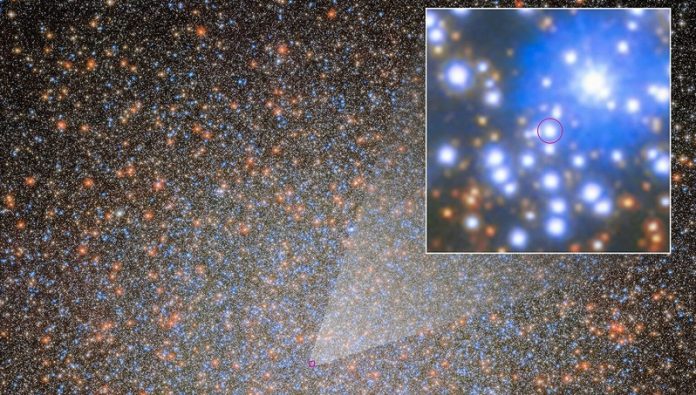
    Astronomers have identified the first stellar-mass black hole concealed within the massive star cluster Omega Centauri, helping to resolve a long-standing mystery among scientists. Situated roughly 18,000 light-years from Earth, Omega Centauri is the largest globular star cluster in the Milky Way, housing approximately 10 million stars tightly packed together.

    For years, scientists believed the cluster should also include thousands of black holes remaining from the remnants of massive stars that ended their lives in supernova explosions. Despite extensive searches, very few of these black holes had been detected—until now.

    Using over two decades of data from NASA’s Hubble Space Telescope combined with recent observations from the James Webb Space Telescope, researchers successfully identified this elusive black hole. Their work has been published in The Astrophysical Journal Letters.

    Previous studies suggested Omega Centauri hosts a large intermediate-mass black hole at its core. Furthermore, computer simulations predicted around 10,000 smaller black holes, each about the mass of a few suns, spread throughout the cluster. However, traditional detection methods—such as monitoring for radio or X-ray signals, or tracking stellar motion deviations caused by unseen companions—failed to reveal these black holes.

    Instead, the team employed astrometry, a method that precisely measures stars’ tiny motions across the sky. Tracking the movement of a specific star over 20 years revealed that it was orbiting an invisible object whose mass was too significant to be anything but a black hole.

    This newfound black hole, named oMEGACat BH-2, weighs approximately 4.5 times the Sun’s mass. While its mass confirms it as a black hole, it is surprisingly lighter than expected for a black hole formed in Omega Centauri’s metal-poor environment.

    The discovery also overturned previous assumptions that the unseen object was a neutron star. By combining Hubble’s observations from 2002 to 2023 with highly precise infrared data from Webb, scientists calculated its mass more accurately. At 4.46 solar masses, it’s simply too heavy to be a neutron star.

    This black hole exists in one of the most unusual binary systems ever observed. Its companion star orbits it approximately once every 94 years, making it the longest-period black hole binary known to date. Such a wide orbit suggests the pair was not born together but likely became companions through gravitational interactions within the crowded star cluster.

    Scientists estimate this pairing will likely break apart within less than a billion years, as close encounters with other stars eventually separate the two. Although a billion years may sound long, it is relatively brief compared to Omega Centauri’s estimated age of about 12 billion years.

    This discovery provides critical insights into how black holes form and behave within dense star environments. It also offers valuable information for understanding how black hole pairs can eventually collide, generating the gravitational waves detected by observatories on Earth.

    Researchers believe this is just the beginning. By continuing to leverage the combined capabilities of Hubble, Webb, and future missions like NASA’s Nancy Grace Roman Space Telescope, astronomers aim to uncover many more hidden black holes within globular clusters, filling in key gaps in our understanding of these mysterious cosmic objects.

  • Black Hole “Gold Rush” Unveils Countless Hidden Space Collisions

    Black Hole “Gold Rush” Unveils Countless Hidden Space Collisions

    Credit: University of Glasgow.


    Scientists have released the largest catalog of gravitational wave detections to date, marking a significant milestone in understanding black holes and the universe’s workings.

    The new compilation, called GWTC-5, includes 161 confirmed signals from merging black holes detected between April 2024 and January 2025.

    This breakthrough was achieved by the international LVK collaboration, which manages advanced gravitational wave observatories—LIGO in the U.S., Virgo in Italy, and KAGRA in Japan.

    With these latest additions, the total count of detected gravitational wave signals now stands at 390.

    Gravitational waves are minuscule ripples in spacetime caused by catastrophic cosmic events like black hole collisions.

    Detecting these waves is extraordinary challenging because they shift space by less than an atom’s width. Researchers rely on highly sensitive instruments to observe these tiny disturbances.

    For decades, researchers at the University of Glasgow have been pioneers in gravitational wave science.

    They contributed to developing essential technology for LIGO, including the ultra-sensitive mirror suspension systems that enable detection of these faint signals.

    Since the first confirmed detection in 2015, the number of discoveries has surged as the detectors have become more refined. Currently, scientists identify around three to four signals weekly.

    The latest catalog features several record-setting events. One, known as GW240615, provided the most precise localization of a gravitational wave source ever achieved, narrowing down its origin to just six square degrees in the sky—an extraordinary feat for such measurements.

    This event involved the collapse of two black holes, roughly 26 and 30 times the mass of the sun, merging more than 3 billion light-years away.

    The updated catalog is also playing a key role in addressing one of cosmology’s biggest mysteries: the universe’s expansion rate, expressed by the Hubble constant.

    Gravitational wave data offers a new approach to measuring cosmic distances. By estimating how far away these black hole mergers happen—and sometimes identifying their host galaxies—scientists can refine calculations of the universe’s expansion rate.

    The return of Virgo during this observing period significantly enhanced the ability to pinpoint signal origins. Additionally, researchers utilized 236 gravitational wave events in their analyses, nearly doubling the data used previously.

    Another notable event, GW250114, stands out as the clearest gravitational wave detection to date, with an exceptionally high signal-to-noise ratio, allowing for precise analysis.

    This merger involved two nearly identical black holes, about 32 and 34 solar masses, merging over a billion light-years away.

    Thanks to the clarity of this signal, scientists performed some of the most rigorous tests of Einstein’s theory of general relativity to date. The data also supported Stephen Hawking’s black hole area theorem, which suggests the surface area of black holes should increase after a merger.

    Evidence continues to grow for the existence of “second-generation” black holes—those formed from previous black hole mergers rather than direct collapse from a star.

    In late 2024, two events revealed strong signs of this process, indicating these repeated mergers likely happen within dense star clusters where black holes frequently interact and collide.

    By studying hundreds of these events, scientists are beginning to identify patterns in black hole masses, spins, and formation pathways. The expanding catalog is revealing that these phenomena are not isolated incidents but part of a larger structure within the universe’s black hole population.

    Source: University of Glasgow.


  • New research shows atoms can detect ripples in spacetime

    New research shows atoms can detect ripples in spacetime

    Gravitational waves are minute disturbances in spacetime caused by some of the universe’s most explosive events, like the collision of two black holes. Since their first detection in 2015, scientists have used massive instruments capable of measuring incredibly tiny changes in distance—smaller than a proton’s width—to identify these ripples.

    However, a new theoretical study suggests an entirely different, potentially more subtle method of detection: examining how atoms emit light. Researchers from Stockholm University, Nordita, and the University of Tübingen propose that gravitational waves could subtly influence the light emitted by atoms.

    This study, published in Physical Review Letters, doesn’t yet include experimental verification, but it introduces an exciting new avenue for detecting gravitational waves in the future.

    Understanding this idea starts with how atoms normally behave. When atoms absorb energy, they enter an excited state. They don’t stay excited for long; instead, they quickly release that energy as light at a specific frequency—a process called spontaneous emission, fundamental to quantum physics.

    The scientists suggest that gravitational waves can slightly disrupt the quantum fields surrounding atoms. When this occurs, the light emitted by the atoms isn’t perfectly uniform in every direction. Instead, the frequency of the emitted light may vary depending on its direction of travel.

    Imagine a music player that always plays the same steady note. A gravitational wave wouldn’t change the volume of the note, but it might subtly alter its tone depending on where you’re listening from. This minor variation could encode information about the gravitational wave’s properties and direction.

    One reason this effect hasn’t been observed before is because the total amount of light emitted remains unchanged; only the tiny details—such as the light’s frequency in different directions—are affected. Detecting these slight variations would require highly sensitive instruments.

    The researchers believe that existing atomic clock technologies could help test this concept. These systems depend on extremely stable light signals, making them capable of detecting tiny shifts. Particularly, cold atoms—atoms cooled to near absolute zero—could be used to observe these effects over longer durations.

    If viable, this approach could pave the way for a new class of gravitational wave detectors that are much more compact than current giant observatories. Instead of sprawling facilities spanning kilometers, future detectors might be small enough to fit on a tabletop or even within millimeter-sized devices.

    While more research is necessary to address practical challenges like background noise, the initial findings are promising. This work suggests that even the tiniest particles—atoms—could someday help us “listen” to the faint ripples of spacetime in an entirely new way.

  • NASA Reveals Innovative LISA Prototype for Gravitational Wave Detection

    NASA Reveals Innovative LISA Prototype for Gravitational Wave Detection

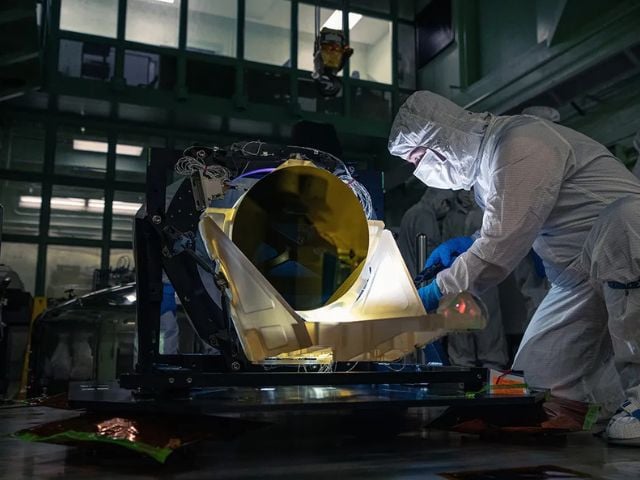
    NASA has introduced an exciting preview of a full-sized prototype for a series of six telescopes that will facilitate the detection of gravitational waves from space in the coming decade. This initiative, called the Laser Interferometer Space Antenna (LISA), represents a partnership with the European Space Agency (ESA).

    Gravitational waves are distortions in the fabric of space-time, triggered by dramatic cosmic events like the merging of black holes. LISA’s mission is to identify these waves by employing lasers to measure minute changes in distance—precisely down to picometers, which are one-trillionth of a meter—between three spacecraft arranged in a triangular setup. Each side of this extensive arrangement will stretch nearly 1.6 million miles (or about 2.5 million kilometers).

    According to Ryan DeRosa, a researcher at NASA’s Goddard Space Flight Center, “Each spacecraft will host twin telescopes that will both send and receive infrared laser beams to monitor their counterparts.” NASA is responsible for providing all six telescopes for the LISA mission.

    The prototype, referred to as the Engineering Development Unit Telescope, will play a crucial role in the development of the flight hardware. It was subjected to a thorough inspection after delivery in a darkened clean room at NASA Goddard in May. The telescope is crafted from a unique amber-colored glass-ceramic that retains its shape across a wide range of temperatures, and its mirror is coated with gold.

    This innovative design not only enhances the reflection of infrared lasers but also minimizes heat loss in the frigid environment of space, allowing the telescope to function effectively at temperatures close to that of a typical room. Produced by L3Harris Technologies in Rochester, New York, the Engineering Development Unit Telescope exemplifies significant advances in material technology.

    Its primary mirror is composed of Zerodur, another amber-hued glass-ceramic renowned for its stability and precision. The LISA mission is expected to launch in the mid-2030s, paving the way for revolutionary discoveries in the field of astrophysics.