الوسم: graphene

  • Scientists Develop Smart Battery Material to Prevent Energy Loss

    Scientists Develop Smart Battery Material to Prevent Energy Loss

    Lithium-sulfur batteries have long been considered one of the most promising innovations for future energy storage solutions. They can hold significantly more energy compared to current lithium-ion batteries and utilize sulfur, an abundant and cost-effective material.

    However, a major obstacle has hindered their widespread adoption.

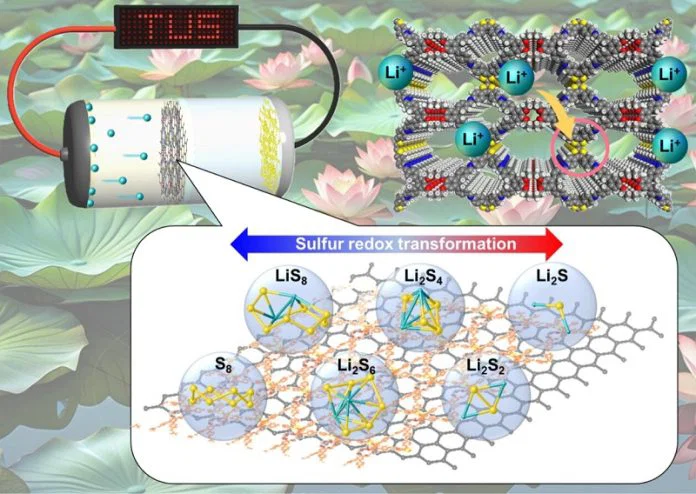
    Researchers from Tohoku University have now developed a new material designed to address this challenge, bringing lithium-sulfur batteries closer to mainstream use. Their study, published in the journal Small, features a specially engineered layer composed of a covalent organic framework (COF) combined with graphene.

    This innovative layer enhances the battery’s efficiency and longevity. Lithium-sulfur batteries generate power through a sequence of chemical reactions. During operation, sulfur transforms into various forms before reverting during charge cycles. This process enables these batteries to store much more energy than most smartphones, laptops, and electric vehicles.

    Unfortunately, one of the sulfur compounds produced—lithium polysulfides—can dissolve into the battery’s liquid electrolyte. These particles tend to drift to other regions within the battery, causing unwanted side reactions, reducing the amount of available sulfur, lowering capacity, and shortening lifespan. This issue, known as the “polysulfide shuttle,” has been a significant barrier to developing practical lithium-sulfur batteries.

    Rather than trying to merely block these particles, the research team designed a material capable of capturing, guiding, and facilitating the normal chemical reactions of these sulfur compounds within the battery.

    The new material integrates two advanced components. The first is a covalent organic framework, or COF—a lightweight, highly ordered structure made from precisely arranged molecules with tiny, uniform pores. Its controlled architecture allows it to selectively interact with specific chemicals inside the battery. The second is graphene, a form of carbon renowned for its exceptional electrical conductivity. When combined, these materials form a thin layer that traps problematic sulfur compounds while still enabling rapid electron flow.

    Laboratory tests yielded promising results. Batteries incorporating this layer demonstrated high energy storage capabilities, maintained performance during rapid charging and discharging, and remained reliable after over 1,000 cycles. The team also assembled a larger pouch-style battery using the same technology, proving its potential for real-world applications.

    Each component of the new material performs a vital role. Some sections attract lithium ions, others facilitate their movement, and certain areas accelerate the key chemical reactions during charging and discharging. Rather than functioning as a mere filter, this layer actively manages and optimizes the battery’s internal chemistry.

    The scientists emphasize that their work exemplifies how molecular-level material design can significantly enhance battery performance. If ongoing testing continues to show favorable results, this approach could lead to lighter, longer-lasting batteries with much higher energy capacities.

    Such advancements might enable electric vehicles to travel farther on a single charge, extend the runtime of portable electronics, and improve the efficiency of renewable energy storage systems.

  • A Basic Shake Might Revolutionize Graphene Manufacturing

    A Basic Shake Might Revolutionize Graphene Manufacturing

    Scientists have discovered a new way to produce ultra-thin materials like graphene using simple vibrations at room temperature. This approach could greatly speed up production, reduce costs, and lessen environmental impact, paving the way for broader applications in electronics, energy systems, and cutting-edge technologies.

    Led by Jason Stafford at the University of Birmingham, the research, published in Small, aims to improve the manufacturing process for two-dimensional (2D) materials—extremely thin sheets made from just a few layers of atoms. These materials, such as graphene, are valued for their unique properties that are not found in traditional materials. They are highly conductive, incredibly strong, and ideal for next-generation devices including flexible electronics, sensors, and energy storage solutions. Other notable 2D materials include hexagonal boron nitride, which acts as an insulator, and molybdenum disulfide and tungsten disulfide, which are used in advanced optical and electronic applications.

    Although scientists have known how to create these materials in labs for years, scaling up production for industrial use has remained a major challenge. Conventional techniques often involve intense mechanical forces, lengthy processing times, and large quantities of chemical solvents—methods that are slow, expensive, environmentally damaging, and can compromise material quality by causing defects or contamination.

    This innovative method shifts away from harsh mechanical or chemical processes. Instead, researchers apply high-frequency vibrations to gently separate layers from bulk materials within a liquid environment. The process takes place at room temperature, using water and a natural compound called tannic acid, which is affordable and eco-friendly. When vibrated in this medium, particles bend and fold at their edges, eventually splitting into thinner layers and peeling off into nanosheets only a few atoms thick. Remarkably, visible changes occur within minutes.

    Using advanced imaging techniques and computer models, the team confirmed the mechanism behind this process. They observed that vibration enhances the yield, producing larger quantities of material at higher concentrations compared to traditional methods. Importantly, the quality of the nanosheets remains high, free from defects commonly introduced by more aggressive procedures.

    This breakthrough addresses one of the biggest hurdles in the field: producing graphene and similar materials on a scale large enough for real-world applications. Existing production methods are costly and inconsistent, limiting industrial uptake. The new vibration-based approach offers a faster, cleaner, and more scalable alternative, enabling easier integration of 2D materials into products like electronics, advanced coatings, and catalysts.

    The research team plans to collaborate with industry partners to further refine and scale up the technology. If successful, this simple vibration method could be crucial in transitioning advanced materials from the lab to everyday devices, shaping the future of technology and manufacturing.