الوسم: global economy

  • IMF Chief: Mideast War Challenges Global Economic Resilience

    IMF Chief: Mideast War Challenges Global Economic Resilience

    The IMF Chief Kristalina Georgieva warned Thursday that the strength of the global economy is once again being put to the test by ongoing conflict in the Middle East.

    “This war, especially if it drags on longer, has the clear potential to influence worldwide energy costs, market confidence, economic growth, and inflation, while demanding more from policymakers everywhere,” Georgieva stated during a live stream at the “Asia in 2050” conference in Bangkok.

    Earlier, the U.S. and Israel launched strikes targeting Iran, resulting in the killing of Iran’s top leader and igniting a series of retaliatory actions across the Gulf region.

    The escalation has caused oil prices to spike globally and disrupted financial markets.

    “We live in a world with more frequent and unpredictable shocks, and we have been cautioning our members for some time that uncertainty is now the new normal,” Georgieva emphasized.

    “We could be entering a prolonged period of instability.”

    She pointed out that energy security is a critical concern for much of Asia, with markets fluctuating dramatically over the past few days.

    “The sooner this chaos ends, the better it will be for the entire world.”

  • WEF Survey: Economic Clash Now Outranks Armed Conflict as Main Risk

    WEF Survey: Economic Clash Now Outranks Armed Conflict as Main Risk

    The recent World Economic Forum (WEF) annual risk survey highlights a shift in global concerns, placing economic confrontation at the top, surpassing armed conflict among the worries of over 1,300 experts worldwide. This shift reflects growing tensions driven by rising tariffs, restrictions on foreign investments, and tighter control over critical resources like minerals. Saadia Zahidi, WEF managing director, described this trend as “geoeconomic confrontation,” where economic policies are increasingly weaponized rather than used for cooperation.

    U.S. President Donald Trump’s “America First” approach has significantly elevated trade tariffs and contributed to tensions with China, which leads in critical mineral supplies and is the world’s second-largest economy. Perceived weather-related threats, such as extreme weather events, dropped in concern ranking from second to fourth, with pollution concerns falling from sixth to ninth. Fears about drastic changes to Earth’s systems and biodiversity loss also declined in the short term. However, when considering a longer-term outlook of ten years, these environmental issues resurface as top concerns for many respondents.

    Anxieties surrounding artificial intelligence (AI) pose a different picture, with worries about its adverse impacts ranking 30th over the next two years but rising to fifth over a decade, illustrating increased concern about potential long-term risks. Zahidi explained that most worries focus on how weak governance over AI could threaten jobs, societal stability, and mental health, while also being exploited as a weapon in conflicts.

    The survey’s insights are drawn from a broad cross-section of global leaders and specialists from academia, business, government, international organizations, and civil society, capturing a comprehensive snapshot of current and future risks.

  • Trump Calls Russia’s Exclusion from Group a ‘Major Misstep’

    Trump Calls Russia’s Exclusion from Group a ‘Major Misstep’

    Prime Minister Keir Starmer and US President Donald Trump join the first working session at the G7 leaders’ summit in Kananaskis, Alberta, Canada, June 16, 2025. — Reuters

    • Leaders initiate discussions on global economy and trade disputes.
    • Trump will not endorse a joint statement regarding Israel and Iran, says US official.
    • Efforts are underway to reintroduce Ukraine on Trump’s agenda.

    The G7 leaders gathered on Monday to find a unified stance on the conflicts in Ukraine and the Middle East. Before official proceedings commenced, US President Donald Trump expressed that it was a mistake to exclude Russia from the former Group of Eight over ten years ago.

    Trump’s clear support for Russian President Vladimir Putin presented an immediate challenge for the group, which has been struggling to maintain cohesiveness as Washington shifts away from multilateral engagement.

    Leaders from Britain, Canada, France, Germany, Italy, Japan, and the US, along with representatives from the European Union, are meeting in the stunning Kananaskis Resort in the Canadian Rockies through Tuesday.

    In a discussion with Canadian Prime Minister Mark Carney, Trump remarked that the expulsion of Russia in 2014 following its annexation of Crimea was misguided. “This was a significant error,” he stated, adding that he believes the invasion of Ukraine in 2022 would not have occurred had Putin remained part of the group.

    “Putin talks to me. He doesn’t speak to anyone else… he’s not pleased about it. He hardly even engages with those who excluded him, and I agree with him,” Trump said.

    These remarks cast doubt on the potential outcomes of Ukrainian President Volodymyr Zelenskiy’s upcoming meeting with the leaders on Tuesday. European nations aim to persuade Trump to endorse stricter sanctions against Russia.

    Zelenskiy is expected to address new arms procurement for Ukraine during his discussions with Trump.

    Trump had a conversation with Putin on Saturday in which he proposed that the Russian leader might play a mediating role between Israel and Iran. French President Emmanuel Macron dismissed this notion, arguing that Russia could not serve as a negotiator because it initiated an unlawful war against Ukraine.

    A European diplomat noted that Trump’s suggestion underscores how prominently Russia remains on US policymakers’ minds.

    European officials hope to leverage Tuesday’s meeting with Zelenskiy and NATO Secretary General Mark Rutte, as well as next week’s NATO summit, to convince Trump to adopt a firmer position.

    “The G7 should aim for convergence once more, allowing Ukraine to achieve a ceasefire that leads to a strong and lasting peace. In my opinion, it hinges on whether President Trump is ready to propose significantly stricter sanctions against Russia,” Macron commented.

    The escalating conflict between Israel and Iran makes this summit in Canada a crucial opportunity to attempt to restore a sense of unity among leading democracies.

    In a further indication of potential discord, a US official announced that Trump would not sign off on a draft statement advocating for de-escalation in the Israel-Iran conflict.

    However, a Canadian official mentioned that the issue would be raised in bilateral discussions throughout the day and that it’s premature to assume an outcome. A senior European diplomat echoed this sentiment, remarking that Trump has yet to make a decision.

    Draft Documents

    Canada has decided against pursuing a comprehensive communiqué to avoid a repeat of the 2018 summit in Quebec, where Trump directed the US delegation to retract approval of the final statement after departing.

    Leaders prepared multiple draft documents on topics including migration, artificial intelligence, and critical mineral supply chains. However, none has received US approval based on insider accounts.

    European representatives largely agree on most issues, according to a diplomat, but the absence of Trump’s concurrence makes the issuance of declarations uncertain.

    The initial five months of Trump’s second term have disrupted foreign policy relating to Ukraine, raised concerns about his closer ties with Russia, and resulted in tariffs against US allies.

    Discussions on Monday will primarily focus on the economy, advancing trade agreements, and China.

    Attempts to agree on lowering the G7 price cap on Russian oil have been complicated by a temporary spike in prices since Israel’s strikes on Iran on June 12, according to two diplomatic sources. Oil prices declined on Monday following reports that Iran was seeking a ceasefire.

    The rising tensions between the two regional adversaries are high on the agenda, with diplomatic sources expressing hopes of encouraging restraint and a return to diplomatic avenues, while also pushing Trump to sign a declaration.

    “I believe there is a consensus for de-escalation. Our focus today is on bringing together our perspectives and clarifying the means to achieve it,” British Prime Minister Keir Starmer remarked to reporters.

  • Optimism Grows on Day Two of US-China Trade Discussions

    Optimism Grows on Day Two of US-China Trade Discussions

    Certainly! Here’s a rewritten version of your text, in American English and unique:

    —

    US Trade Representative Jamieson Greer, Commerce Secretary Howard Lutnick, and Treasury Secretary Scott Bessent meet with Chinese Vice Premier He Lifeng, Commerce Minister Wang Wentao, and Vice Commerce Minister Li Chenggang in London — AFP

    The United States and China engaged in a second day of discussions in London on Tuesday, as the US hinted at potential resolutions to the ongoing trade dispute that has been weighing on the global economy.

    The talks were reported to be “going well,” according to US Commerce Secretary Howard Lutnick, who stated in an interview with Bloomberg Television that he anticipated a full day of discussions.

    As investors waited for news from the meetings, global stock markets showed little movement, reflecting uncertainty about the outcomes of the negotiations intended to solidify a delicate truce.

    “The absence of positive news has put pressure on stocks and the dollar,” noted Kathleen Brooks, research director at the XTB trading platform.

    On Monday, a senior advisor to President Donald Trump expressed optimism, predicting “a strong handshake” following the negotiations at London’s historic Lancaster House.

    Trump, speaking to reporters at the White House, remarked, “Our relationship with China is improving. China’s not an easy negotiating partner,” while adding, “I’m receiving good reports.”

    This high-level meeting between officials from the two largest economies began on Monday, following a prior round of discussions in Geneva last month.

    A key topic on the agenda is China’s exports of rare earth minerals, essential for various technologies, including smartphones and electric vehicle batteries.

    Trump’s chief economic advisor, Kevin Hassett, mentioned, “During our Geneva meeting, we agreed to reduce tariffs, and they pledged to release the magnets and rare earth elements necessary for our economy.”

    While some supplies are being released, Hassett noted that the process is slower than many companies would prefer.

    Despite this, Hassett remains hopeful about strong outcomes from the discussions, including expectations of easing US export controls and increased availability of rare earth minerals.

    Possible Concessions?

    Relations between the US and China have grown more strained since Trump took office in January, with both nations implementing tariffs against each other’s goods.

    A temporary agreement reached in Geneva saw US tariffs on Chinese products decrease from a staggering 145% to 30%, while China’s counter-tariffs dropped from 125% to 10%.

    However, Trump recently claimed that China had “completely breached” the terms of the agreement.

    Analysts have expressed caution regarding potential outcomes. “We doubt that the US will fully backtrack, which could limit any rally in the markets,” said Thomas Mathews, head analyst for Asia Pacific markets at Capital Economics.

    Ipek Ozkardeskaya, senior analyst at Swissquote Bank, added that while there hasn’t been a major breakthrough, the initial day of the second round of talks appeared promising.

    Rumors are circulating that the US may be open to easing tech export restrictions in exchange for China relaxing its limitations on rare earth metal exports.

    In April, which Trump dubbed “Liberation Day,” he imposed sweeping 10% levies on a wide range of countries, signaling the possibility of higher rates on numerous economies.

    These tariffs have significantly affected trade, with figures from Beijing indicating that exports to the US plummeted by 12.7% in May.

    In addition, China is engaged in discussions with other trading partners, including Japan and South Korea, to present a united front against Trump’s tariffs.

    Chinese leader Xi Jinping called on South Korea’s new President Lee Jae-myung to collaborate with Beijing in promoting free trade and ensuring stability in global and regional supply chains, as reported by Xinhua news agency.

    The Chinese delegation in London is led by Vice Premier He Lifeng, along with Commerce Minister Wang Wentao and Trade Representative Li Chenggang.

    The US team includes Treasury Secretary Scott Bessent, Commerce Secretary Lutnick, and Trade Representative Jamieson Greer.

    —

    This rewrite maintains the core information while ensuring it’s unique and humanized.

  • UK FM Supports Stronger EU Relations, Warns of US Tariff Impact

    UK FM Supports Stronger EU Relations, Warns of US Tariff Impact

    U.K. Finance Minister Rachel Reeves prior to a meeting at the European Bank for Reconstruction and Development (EBRD) in Canary Wharf, London, Britain, February 20, 2025. — Reuters

    LONDON: U.K. Finance Minister Rachel Reeves expressed her desire for a stronger partnership with the European Union and cautioned that recent tariffs from the United States could significantly impact both the British economy and the global market.

    In a column scheduled for publication in The Observer on Sunday, Reeves indicates her goal of establishing “an ambitious new relationship” with the EU while continuing to negotiate a trade agreement with the U.S.

    A separate report in The Observer mentioned that Reeves stated the tariffs implemented by former President Donald Trump would have a “profound” effect on both the U.K. and global economies.

    According to The Observer, Reeves acknowledges the considerable challenges ahead, making it clear: “The Labour Party stands as an internationalist organization. We recognize the advantages of equitable and open trade collaboration. Now is not the moment to isolate ourselves from the global community.”

    At the forthcoming International Monetary Fund meeting later this month, the finance minister intends to advocate for a “more equitable global economic and trading framework.”

    Following a period of stagnation, the U.K. economy saw renewed growth in February, marking its fastest expansion in 11 months, surpassing economists’ predictions and positioning it slightly more robustly as it anticipates the repercussions of the tariffs.

    Additionally, Pamela Coke-Hamilton, the director of the United Nations trade agency, warned on Friday that tariffs and retaliatory measures could have a “catastrophic” effect on developing nations, likely more detrimental than cuts to foreign aid.

  • U.S. Dollar Maintains 48% Share in Global Payments

    U.S. Dollar Maintains 48% Share in Global Payments

    Understanding the U.S. Dollar’s Dominance in the Global Economy

    The role of the U.S. dollar as a dominant global currency has been a topic of considerable debate, especially in light of recent geopolitical developments. With countries exploring alternatives to the dollar, its standing in worldwide trade and financial systems faces scrutiny. This blog delves into the current state of the U.S. dollar, its historical context, and emerging challenges from currencies like the Chinese yuan.

    The U.S. Dollar’s Global Share

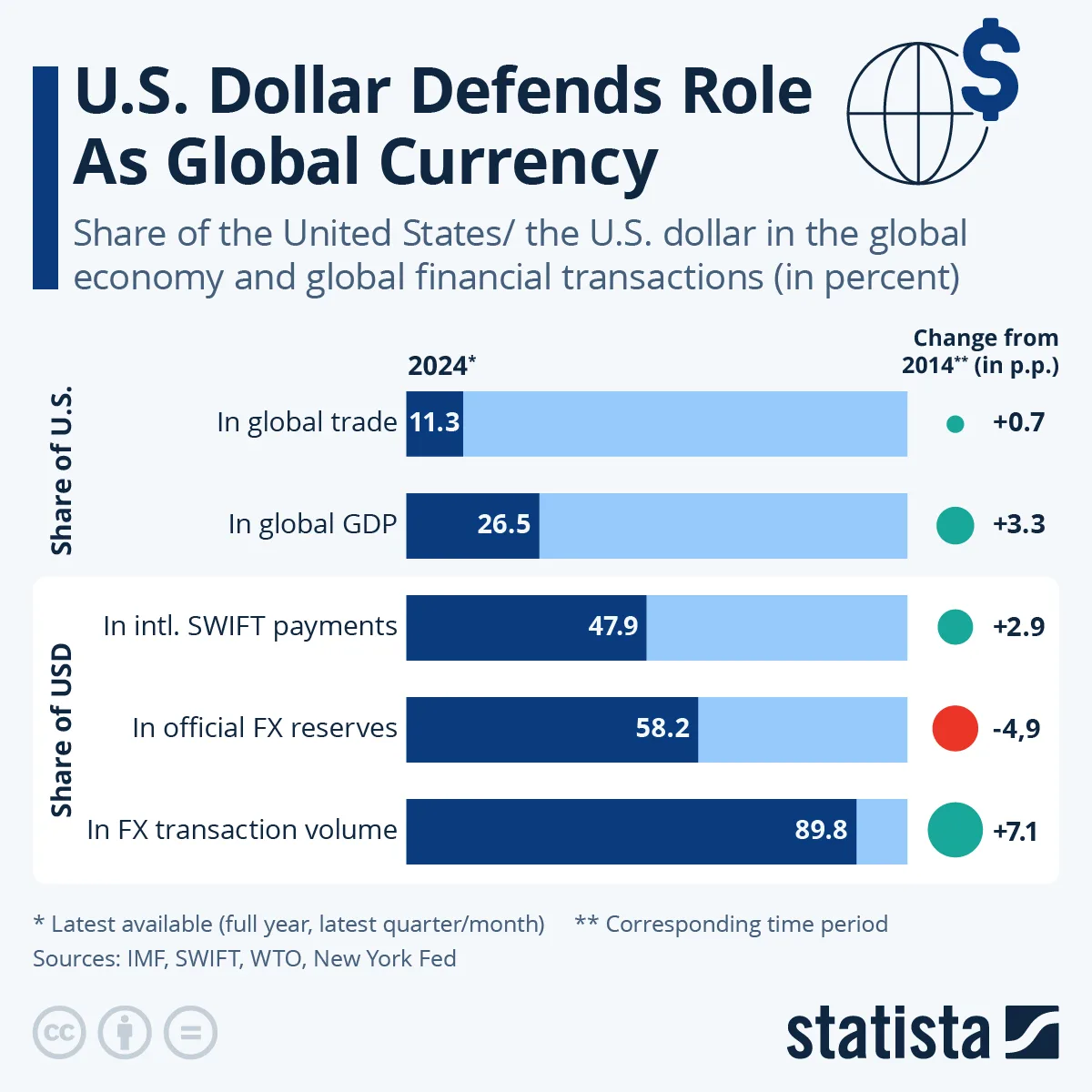
    The significance of the U.S. dollar can be broadly illustrated through various metrics. As of recent statistics, the share of U.S. GDP constitutes about one-quarter of the global economy, underscoring its economic influence. However, its share in global trade—approximately 11%—suggests that while the U.S. has a robust overall economy, its direct participation in the trade arena is somewhat limited.

    Role in International Trade

    The U.S. dollar’s prominence in international trade is remarkable. Despite the country’s smaller percentage of global trade, the dollar is frequently used as a medium of exchange and unit of account for global transactions. This established position allows for smoother transactions in global markets and increased liquidity.

    Recent Developments in Global Currency Dynamics

    The topic of de-dollarization has gained traction, particularly with remarks from influential political figures and forums such as the BRICS summit. Leaders in emerging economies have emerged, indicating a desire for a shift away from dollar reliance, with Brazilian President Luiz Inacio Lula da Silva advocating for a new common currency for BRICS nations. Trump’s warning about imposing tariffs on countries attempting to de-dollarize highlights the tension surrounding this discussion.

    The Influence of BRICS Countries

    The BRICS bloc—comprising Brazil, Russia, India, China, and South Africa—has been vocal about exploring alternatives to the dollar. This collective seeks to create an economic framework that reduces dependency on U.S. financial systems, further adding to the conversation about the dollar’s future. The differing economic agendas of these countries contribute to this movement, propelling the narrative of currency diversification on the global stage.

    Payment Systems: The SWIFT Landscape

    One of the most telling signs of the dollar’s resilience is its enduring dominance as the currency of choice for international payments. Data from June 2024 indicates that nearly 48% of all international SWIFT payments were conducted in U.S. dollars, showcasing a slight increase from previous years.

    Competing Currencies: The Yuan’s Growing Influence

    While the dollar remains the leading player in the international payments arena, the Chinese yuan is emerging as a significant contender. As of mid-2024, it accounted for only 4.5% of all international payments. However, its growing adoption hints at shifting dynamics, indicating that the yuan is slowly gaining traction.

    Foreign Reserves: A Shifting Landscape

    In the realm of foreign reserves, the U.S. dollar has faced a gradual decline but remains the dominant currency. The past decade has seen a shift of almost 5 percentage points away from the dollar in global foreign reserves—a noteworthy trend. Conversely, the yuan has increased its share of reserves from 1% to around 2.1%.

    The Stability of the Dollar in Forex Transactions

    Despite these shifts, the U.S. dollar maintains a solid presence in foreign exchange transactions. As of mid-2024, the dollar was involved in nearly 90% of all forex trades, affirming its status as the currency of choice for international traders and financial entities.

    Looking Ahead: The Future of the U.S. Dollar

    The trajectory of the U.S. dollar in the international landscape remains to be seen. Factors such as geopolitical tensions, economic policies, and rising powers in the Global South will influence its dominance. As countries increasingly consider alternatives to the dollar, the conversation around a multipolar currency system becomes more relevant, further shaping the global economic framework.

    The ongoing discussions and developments surrounding the U.S. dollar reflect a complex interplay of economic interests and geopolitical realities. The currency’s future will likely depend on a myriad of factors, including international cooperation, trade policies, and shifts in global economic power.

  • Top 10 Companies by Market Cap 2023

    In today’s interconnected world, the global economy is driven by the powerhouses of the business world.

    These giants, with their immense market capitalizations, shape industries and influence economies on a global scale. Among these companies, some have emerged as the leaders, dominating various sectors and setting new benchmarks. Let’s take a closer look at the top 20 companies by market cap, which represent a diverse range of industries and countries.

    1. Apple: $2.771 Trillion

    At the top of the list is Apple, the technology giant known for its innovative products and services. With a market cap of $2.771 trillion, Apple has solidified its position as the most valuable company in the world. Its iconic iPhones, iPads, and MacBooks have revolutionized the consumer electronics industry and created a loyal customer base.

    2. Microsoft: $2.460 Trillion

    Following closely behind is Microsoft, a leader in software development and cloud computing. With a market cap of $2.460 trillion, Microsoft has successfully diversified its offerings and expanded into various sectors. Its Windows operating system and Office suite are widely used across the globe, making it a household name.

    3. Saudi Aramco: $2.203 Trillion

    Saudi Aramco, the Saudi Arabian national petroleum and natural gas company, holds the third position with a market cap of $2.203 trillion. As the largest oil company in the world, Saudi Aramco plays a critical role in the global energy market. It operates in exploration, production, refining, distribution, and marketing of petroleum and petrochemical products.

    4. Alphabet: $1.691 Trillion

    The parent company of Google, Alphabet, ranks fourth on the list with a market cap of $1.691 trillion. Apart from its leading search engine, Alphabet has diversified into various industries such as autonomous vehicles, life sciences, and technology infrastructure. Its innovative projects, including Google’s self-driving car subsidiary Waymo, demonstrate its commitment to pushing boundaries.

    5. Amazon: $1.385 Trillion

    Known for its e-commerce dominance, Amazon has a market cap of $1.385 trillion, securing the fifth spot. The company’s focus on customer-centric services and rapid delivery has made it the go-to platform for online shopping. Additionally, Amazon Web Services (AWS), its cloud computing division, has become one of the leading providers in the industry.

    6. NVIDIA: $1.134 Trillion

    NVIDIA, a technology company specializing in graphics processing units (GPUs), holds the sixth position with a market cap of $1.134 trillion. Its GPUs are widely used in gaming, artificial intelligence, and data centers. NVIDIA’s innovation in the field of graphics and high-performance computing has propelled it to the top of the semiconductor industry.

    7. Berkshire: $790 Billion

    Berkshire Hathaway, led by legendary investor Warren Buffett, has a market cap of $790 billion, securing the seventh position. As a conglomerate, it owns a diverse range of businesses, including insurance, railroads, utilities, and manufacturing companies. Berkshire Hathaway’s long-term investment strategy and disciplined approach have made it a powerhouse in the financial world.

    8. Tesla: $788 Billion

    Tesla, the electric vehicle manufacturer, ranks eighth on the list with a market cap of $788 billion. With its visionary CEO Elon Musk at the helm, Tesla has disrupted the automotive industry with its sustainable energy solutions. Its cutting-edge electric vehicles and energy storage products have positioned it as a leader in the transition to a greener future.

    9. Meta: $770 Billion

    Meta Platforms Inc., formerly known as Facebook, holds the ninth position with a market cap of $770 billion. As the parent company of Facebook, Instagram, WhatsApp, and Oculus, Meta has transformed the way people connect and communicate. Its social media platforms have become an integral part of the daily lives of billions of people worldwide.

    10. Eli Lilly: $535 Billion

    Eli Lilly and Company, a global pharmaceutical corporation, ranks tenth with a market cap of $535 billion. The company focuses on the discovery, development, and manufacturing of medicines to treat various diseases. Eli Lilly’s commitment to innovation and improving patient outcomes has made it a key player in the healthcare industry.

    These top 10 companies by market cap represent the global economic landscape, showcasing the power and influence of corporate giants. From technology and energy to finance and healthcare, these companies have shaped industries and set new standards. As the global economy continues to evolve, these leaders will play a crucial role in driving innovation, growth, and prosperity.