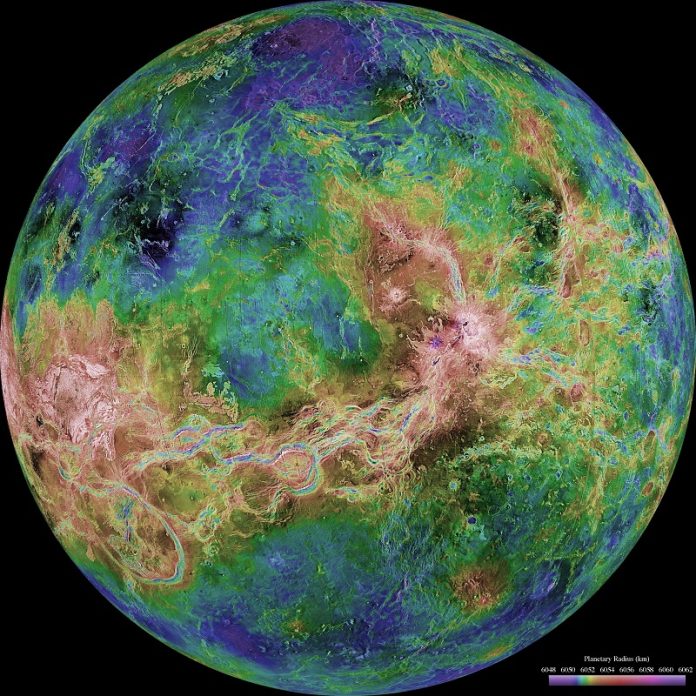
Many years ago, scientists thought Venus was a quiet, geologically dormant planet where major surface changes had long since ceased. However, recent research challenges that belief, indicating that Earth’s closest neighbor might still be tectonically active, with large rift valleys that formed relatively recently.
This new study, led by researchers at ETH Zurich and published in Nature Geoscience, presents compelling evidence that Venus’s interior may still be dynamic, continually reshaping parts of its surface. Although often called Earth’s “sister planet” due to similarities in size and composition, Venus is vastly different. Its surface temperatures are hot enough to melt lead, its atmosphere is thick and mostly carbon dioxide, and the surface experiences immense pressure. Unlike Earth, Venus lacks oceans and plate tectonics—the moving continents that drive geological changes here.
Yet, Venus displays prominent rift valleys—vast cracks in its crust that resemble Earth’s African Rift Valley, where the crust gradually pulls apart. Some of these rift systems extend up to 10,000 kilometers, making them among the planet’s largest geological features. Previously, most scientists believed these rifts formed over 100 million years ago and have remained unchanged since, leading to the assumption that Venus was largely inactive.
To reevaluate that idea, the ETH Zurich team employed advanced computer simulations. Led by Professor Taras Gerya and graduate student Xi Yang, they developed detailed three-dimensional models that are far more accurate than earlier two-dimensional simulations, which relied on simplified assumptions about rock behavior. These newer models allowed scientists to understand better how rift valleys form and evolve over time.
The simulations suggest that young, active rift valleys often develop steep, narrow mountain ridges—called rift flanks—along their edges. These features are most prominent when the rift is still opening or has only recently ceased moving. The team also discovered that these rifts might expand faster than previously thought, growing by roughly 3 to 10 centimeters each year. After movement stops, these ridges gradually flatten as the crust relaxes.
Unlike Earth, where erosion from wind, rain, rivers, and ice continually reshapes landscapes, Venus lacks liquid water, so its surface modifications primarily result from slow crustal sinking and settling under the planet’s own weight.
To verify their models, the researchers compared their simulation results with images from NASA’s Magellan spacecraft, which mapped most of Venus during its 1990s mission. They observed that several Venusian rift valleys still display big, steep flanks, consistent with features of relatively young geological age. This correlation suggests that many of these giant cracks could have formed far more recently than once believed, supporting the idea that Venus’s interior is still active.
With ongoing interest in Venus, NASA and the European Space Agency (ESA) are preparing new missions for the upcoming decade to explore the planet in greater detail. ESA’s EnVision, scheduled for launch in the early 2030s, will carry instruments developed with help from ETH Zurich researchers, aiming to study everything from surface features to internal processes and atmospheric conditions.
These discoveries could help scientists identify the most geologically active regions for future exploration. Beyond helping us better understand Venus, this research offers insights into how rocky planets evolve across the universe, including Earth-like worlds orbiting distant stars.