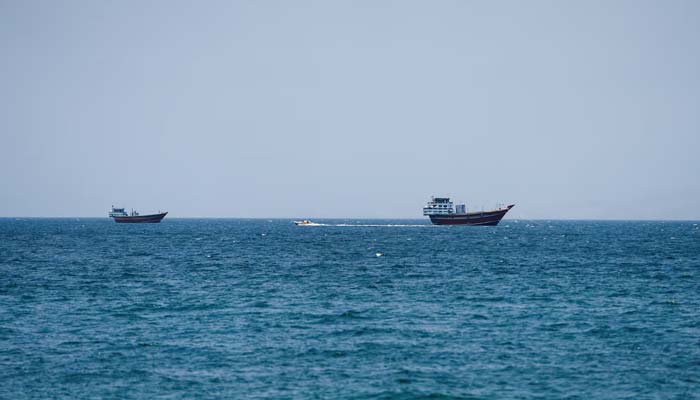
Oman’s suggestion would make the fees for crossing the Strait of Hormuz voluntary.
Trump warns that U.S. airstrikes could resume if negotiations don’t succeed.
Oil prices continue to decline after Trump halted the airstrikes.
Oman has gained support from Gulf nations for a plan allowing Tehran to collect voluntary fees for using the Strait of Hormuz, a Gulf source told Reuters on Tuesday. This approach could help end the disruption to oil shipments caused by the ongoing US-Israeli conflict with Iran.
President Donald Trump, who unexpectedly stopped a two-week bombing campaign over the weekend in his latest strategic shift, said there are “positive talks” happening with Iran but warned that strikes could restart if negotiations fail. Iran denies actively seeking new talks with the U.S.
Earlier this month, the U.S. renewed its bombing efforts to weaken Iran’s control of the strait, which previously facilitated about 20% of the world’s oil and liquefied natural gas trade prior to the conflict.
Iran effectively shut down the strait to ships other than its own after the U.S. and Israel launched strikes on February 28. A partial reopening was achieved last month through a U.S.-Iran agreement, but that deal fell apart in early July after Iran fired upon ships in a channel it disapproves of.
Iran has expressed interest in jointly managing the strait with Oman, which controls the opposite side, and levying service fees on ships passing through. The U.S. aims to restore the free passage past before the conflict, considering mandatory fees illegal.
According to a source, the Omani proposal would prevent Iran from exercising exclusive control and would introduce voluntary payments, similar to the system used in Southeast Asia’s Strait of Malacca, where Indonesia, Malaysia, and Singapore solicit voluntary contributions for navigation, environmental efforts, and rescue services.
Iranian Foreign Minister Abbas Araqchi discussed the Strait of Hormuz with his Omani and Saudi counterparts on Monday, emphasizing the importance of regional cooperation, according to Iran’s Foreign Ministry.
Trump warns of further strikes
Trump called off his latest bombardment after military advisors advised that the strategy had reached its limit. The 13 nights of renewed U.S. airstrikes resulted in multiple casualties in Iran and targeted infrastructure like bridges and tunnels across the south, in addition to military targets.
Iran responded with attacks on U.S. bases in neighboring countries, killing four service members, and struck civilian infrastructure in Gulf states as retaliation for U.S. attacks on civilian sites.
Iran has stated it will hold fire as long as the U.S. does. However, reports indicate drone attacks in Jordan, Saudi Arabia, and northern Iran on Monday, with Jordan also reporting another drone downed on Tuesday.
On Monday, Trump expressed cautious optimism about reaching a deal to end the five-month conflict but warned that U.S. strikes could restart if negotiations fail.
“I think there’s a good chance something could happen, and if it does, great. If not, we’ll just go back to what we were doing two days ago.”
Iran maintains it has not initiated new negotiations with the U.S., accusing Washington of violating last month’s agreement on framework talks to end the hostilities.
U.S. President Trump is scheduled to meet Israeli Prime Minister Benjamin Netanyahu in Washington on Tuesday. Although involved initially in the bombing campaign, Israel has not participated in subsequent peace negotiations, and tension has recently increased between the leaders.
Trump has also had to restrain Israeli efforts to attack Hezbollah in Lebanon in an attempt to weaken Iran-backed groups, complicating efforts to secure peace with Iran.
The end of U.S. bombing over the weekend caused oil prices to drop sharply, around 8%, and prices kept falling on Tuesday. Brent crude futures fell more than 2.5%, trading around $86 a barrel by mid-morning.
In June, Washington and Tehran agreed on a framework for talks aimed at addressing key issues, including Iran’s nuclear program, with plans to hold discussions by the end of August.
Disputes over the interpretation of the agreement’s language about the strait have arisen, with the U.S. insisting it ensures free passage, while Iran claims it authorizes Iran to oversee transit.