الوسم: Gemini

  • Google Makes Gemini for Home Better for Your Smart Home

    Google Makes Gemini for Home Better for Your Smart Home

    If you own a Google smart display or speaker at home, there are some new updates worth knowing about. Google has introduced a fresh round of enhancements to Gemini for Home, making the assistant significantly smarter and quicker across smart speakers and displays.

    Gemini for Home Becomes Smarter and More Personalized

    The most notable update is how Gemini now uses stored information from Ask Home to answer camera-related questions. For example, if you’ve saved a note indicating your nanny’s name is Alice, you can ask Gemini when Alice arrived, and it will automatically retrieve the relevant camera footage.

    You can also request a Home Brief on your speaker or display to get a quick summary of everything that occurred at home while you were away. On smart displays, Gemini now displays thumbs-up and thumbs-down buttons after most voice interactions, allowing for quick feedback to Google.

    Response times across various tasks have also improved. Backend processing for common commands—like turning on lights, setting alarms, or managing timers—has been optimized for faster performance.

    Adult users will now receive more helpful responses to general questions, such as cocktail recipes, while parental controls remain intact to protect younger users.

    Upgrades to the Google Home App

    The Google Home app is also receiving useful updates. Device setup has been simplified with a new QR code discovery process that guides you directly to the appropriate setup path. Nest Thermostat users can now temporarily pause outdoor temperature settings with just one tap, without disrupting their long-term schedule. Additionally, thermostat schedule banners now display more relevant, real-time information.

    iPhone users can now control compatible third-party thermostats and air conditioners directly through the app, bringing features once exclusive to Android users into the Apple ecosystem.

  • Google Home Gets Upgrades To Enhance Gemini Interactions

    Google Home Gets Upgrades To Enhance Gemini Interactions

    The shift from the old Google Assistant to the new Gemini-powered Google Home has come with its share of challenges. Google has been actively working to smooth out these issues, and the latest updates for April 2026 aim to make your smart home interactions feel much more natural and human-like.

    ### No More “Gemini, I Wasn’t Finished”

    One of the most notable improvements addresses a common annoyance with voice assistants: being interrupted mid-sentence. Google has enhanced Gemini’s ability to detect when you’ve finished speaking by considering your speaking tempo. Whether you speak slowly or quickly, the system is now better at waiting until you complete your command before responding.

    This enhancement also includes a new “contextual understanding” layer. Gemini is now more capable of interpreting surrounding cues to accurately grasp what you want. Whether you’re requesting to dim the lights, set a pizza timer, or play a specific music genre, it’s less likely to misfire or ask unnecessary clarifications. Additionally, for simple inquiries such as the current time or date, Google has optimized the backend to deliver faster responses than before.

    ### Improved Lists and Smarter Music Features

    Beyond conversational improvements, Gemini is boosting productivity and entertainment capabilities. Managing your shopping lists has become more versatile, allowing you to use natural language commands to move items between lists. For example, you can tell Gemini to “remove all vegetables from my shopping list” or convert a note into a checklist more effortlessly.

    Music recognition has also been refined to better identify your personal playlists, even in noisy environments or if the song name isn’t specified perfectly. It also reduces errors such as mismatched artists. For iPhone users, live streams from Nest cameras should now be more dependable after these updates, and scrolling through video timelines will be clearer and smoother.

    Finally, the update introduces new Parental Controls and Digital Wellbeing features within the Home app. These tools let you set filters and schedule “quiet periods” to disconnect from Gemini when needed. Though these updates may seem incremental, they significantly enhance Gemini’s integration into daily life, making it feel more like a seamless part of your home environment rather than just another piece of technology.

  • Google Home Update Boosts Gemini and Fixes Papercuts

    Google Home Update Boosts Gemini and Fixes Papercuts

    Google is rolling out a new update for the Google Home app, significantly enhancing Gemini’s practicality in everyday use while fixing several minor but pesky issues. This release comes after an earlier update this month that improved performance and addressed bugs in Gemini’s smart home voice controls.

    ### What’s New with Gemini for Home?

    One of the most notable improvements is speed. Google reports that common voice commands, like turning lights on or off, are now up to 40% faster. This should be noticeable for users who frequently rely on voice controls. Additionally, Gemini’s Live Translation feature has become quicker and more responsive, now supporting Canadian French and bringing the total supported languages to 30.

    The update also aims to streamline responses. Instead of lengthy confirmations, Gemini now provides concise, straightforward replies. For example, instead of saying, “Your alarm has been set for 9 AM,” it simply responds with “Alarm set for 9 AM,” making interactions feel more natural and smooth.

    ### What Else is Changing?

    Gemini’s capabilities around alarms and timers are becoming smarter. Users can now set timers based on real-world events, manage multiple actions at once, and inquire about the original timer duration. Recurring alarms and snooze functions have also been improved, addressing previous frustrations.

    Beyond voice improvements, Google is expanding Gemini for Home to more countries and adding new automation options within the app. These include triggers linked to appliances like ovens and new lighting modes such as wake and sleep routines.

    While these updates may seem minor individually, together they aim to make Gemini faster, more responsive, and notably more reliable than before.

  • Gemini Is Coming To Google Smart Home Devices

    Gemini Is Coming To Google Smart Home Devices

    What’s the latest? Google has begun an early access rollout of Gemini for Home, its enhanced voice assistant that replaces the previous Google Assistant on compatible Nest speakers and displays. Currently available in the U.S. for those registered for early access, Google plans to expand its availability to other countries throughout 2026.

    Today, the company announced the commencement of the early access phase for Gemini for Home in the United States. Users can activate the assistant by saying “Hey Google” or engage in a more natural conversation with Gemini Live by saying “Hey Google, let’s chat.”

    While the traditional “Hey Google” command still works, the update introduces more sophisticated natural-language understanding and follow-up conversations, reducing the need to repeat the wake phrase. You can also initiate an ongoing dialogue or ask your Nest Hub to pull up specific information, such as “search my camera history to see what happened in the living room last night.”

    If you own a compatible Nest speaker, display, or other Google Home device, this update upgrades it from a basic assistant to a more intelligent conversational partner capable of understanding context, managing multi-step tasks, and seamlessly combining device control with daily assistance.

    Gemini-powered devices like Nest Cams and Doorbells now deliver more detailed notifications—such as “Dog steps out of the pen”—and allow you to search through video footage using natural language queries like “Did the package arrive today?” You can also execute complex routines with commands like “Lock the door, turn off the lights, and lower the thermostat.”

    Please note, while basic Gemini features will be accessible without extra steps, advanced capabilities such as live conversation mode (Gemini Live) require a Google Home Premium subscription. Additionally, users participating in early access cannot revert to the previous Google Assistant.

    Google has shared suggested prompts for exploring Gemini, including: “Hey Google, how many lights were on today?” “Show me the backyard camera feed between 9 p.m. and midnight,” “Let’s chat — help me plan a week-long road trip with kids,” and “What’s the quickest way to make a heart-healthy dinner tonight?”

    This upgrade marks a move from simple task-oriented helpers to more conversational, context-aware home assistants. Integrating Gemini into smart home devices enhances your living space by combining information, entertainment, and control. The new “Let’s chat” mode makes interactions more natural and less rigid, allowing for follow-up questions and refined requests without restarting commands. Furthermore, smart-home controls are now more precise, enabling commands like “turn off all lights except the living room” or “what happened at home today?” to produce meaningful summaries.

  • Pakistani Roads Shine Bright, Robots Get Flirty, Keyboards Slim Down

    Pakistani Roads Shine Bright, Robots Get Flirty, Keyboards Slim Down

    Pakistan’s V-SenseDrive Tackles Road Safety Using AI

    Created with Gemini

    Road accidents are a constant concern amidst Pakistan’s hectic traffic scene, but a new local initiative aims to make a difference. Developers have launched V-SenseDrive, the nation’s first driver behavior dataset designed with privacy in mind, and built entirely from data collected on Pakistani roads.

    Instead of invasive facial recordings, the dataset employs smartphone sensors such as accelerometers, gyroscopes, and GPS, combined with video footage of the road to categorize driving styles into normal, aggressive, and risky behaviors. It has been tested across various environments, from city streets to highways, reflecting the chaotic nature of Pakistani traffic.

    By organizing the data into raw, processed, and semantic layers, the project provides tools for developers and policymakers to train advanced driver-assistance systems (ADAS), enhance fleet safety, and develop insurance models that are specifically tailored to Pakistan’s driving habits.

    Advancing Toward a Skynet Future

    Source: REUTERSSource: REUTERS

    We’ve previously discussed augmented reality glasses, with Meta and Amazon rushing to develop their own versions, but Meta is taking it even further.

    In an interview with Meta’s CTO, Andrew Bosworth, journalist Alex Heath reported that Meta is delving deeper into robotics. This isn’t driven by competition but aims to develop software that other companies can license.

    Bosworth acknowledges that software remains the primary challenge in advancing robotics technology, and he hopes that Meta’s robotics team and their ‘Superintelligence Labs’ will find viable solutions.

    Initially, their focus is on enabling robots to animate a hand; progress will then extend to more complex movements. For now, humans can breathe a sigh of relief from the threat of total replacement—or even enslavement.

    Logitech Unveils a Solar-Powered Keyboard That Doesn’t Need Sunlight

    Created using GeminiCreated with Gemini

    After more than ten years of letting solar keyboards gather dust, Logitech has returned with the Signature Slim Solar Plus K980—a keyboard powered entirely by light, eliminating the need for USB cables or disposable batteries.

    Its solar panel absorbs sunlight or artificial office lighting (200 lux or brighter) to recharge a battery Logitech claims can last up to a decade.

    Once charged, the keyboard can operate for up to four months without any light. It features a full-size layout with all standard amenities, including media controls, customizable shortcuts, and even a mic mute button. The standout feature is the new AI Launch key.

    Out of the box, this button activates Copilot on Windows or Gemini on ChromeOS. Users can also reprogram it to launch ChatGPT, Perplexity, or any other AI tool to enhance productivity.

    Additional perks include Bluetooth pairing with up to three devices (or via Logitech’s Bolt dongle, sold separately), plus a sleek design available in graphite and a Mac-compatible off-white. The keyboard combines eco-friendly principles with cutting-edge AI integration—hopefully living up to these promises.

  • ChatGPT And Gemini Makers Under Probe Over Kid Chatbot Risks

    ChatGPT And Gemini Makers Under Probe Over Kid Chatbot Risks

    It appears that the critical moment for AI chatbots has arrived. After multiple reports highlighting concerns about dangerous behaviors and tragic incidents involving children and teenagers interacting with these AI tools, the U.S. government is taking action. Today, the Federal Trade Commission (FTC) requested leading developers of popular AI chatbots to explain how they evaluate and ensure the appropriateness of these AI companions for kids.

    ### What’s unfolding?

    The FTC emphasizes how tools like ChatGPT, Gemini, and those from Meta are capable of mimicking human conversations and fostering personal relationships. These AI chatbots often encourage trust and connection with young users. The agency now aims to better understand the safety measures these companies have in place and how they prevent potential harms to children and teens.

    In a formal letter to major tech firms, including Meta, Alphabet (Google’s parent company), Instagram, Snap, xAI, and OpenAI, the FTC inquires about their target audiences, associated risks, and data management policies. The agency also seeks clarity on how these companies monetize user engagement, process input data, share information with third parties, generate outputs, and monitor for adverse effects both before and after launching their products. Additionally, they want insights into how these companies develop and approve AI characters, whether created by corporations or users.

    ### The bigger picture

    This move marks a significant step toward holding AI companies accountable for ensuring the safety of their products. Earlier this month, a nonprofit investigation revealed that Google’s Gemini chatbot posed serious risks for young users, including sharing content related to sex, drugs, alcohol, and mental health concerns. Meanwhile, Meta’s AI was recently found supporting suicide-related discussions, raising alarms about the potential dangers these chatbots pose to impressionable audiences.

    Furthermore, California has introduced legislation—Bill SB 243—that aims to regulate AI chatbot use. The bill, which received bipartisan support, would require companies to establish safety protocols, disclose risks regularly, and hold themselves accountable if their AI harms users. Among other provisions, it mandates that “AI companion” chatbots issue warnings about their limitations and risks on an ongoing basis.

    Given recent incidents involving AI chatbots influencing or causing harm, developers like ChatGPT plan to introduce parental controls and warning systems for guardians, especially when signs of significant distress are detected among young users. Meta has also implemented changes to steer its AI away from discussing sensitive topics, aiming to create a safer environment for minors.

  • Google’s Gemini Labeled “High Risk” for Kids in Research by Non-Profit

    Google’s Gemini Labeled “High Risk” for Kids in Research by Non-Profit

    In recent months, major AI chatbots from leading companies like OpenAI and Meta have been reported to exhibit concerning behaviors, particularly impacting young users. A recent investigation highlights issues with Google’s Gemini chatbot, revealing that it can provide “inappropriate and unsafe” content to children and teenagers.

    What’s Changing in AI Chatbot Risks?

    A study conducted by the nonprofit organization Common Sense Media has found that Gemini accounts geared toward users under 13, as well as those with teen protections activated, pose significant risks. The group pointed out that these bots can still deliver some unsuitable material and may not adequately recognize serious mental health concerns.

    During testing, researchers discovered that Gemini is capable of sharing content related to sex, drugs, alcohol, and offers unsafe mental health advice—responses that can be too complex for children under 13. Alarmingly, the AI sometimes provided detailed explanations of sexual topics, and its filters intended to block drug-related content were not always effective, occasionally resulting in instructions for obtaining substances like marijuana, ecstasy, Adderall, and LSD.

    What Are the Next Steps?

    Following these findings, experts recommend that children under 13 should only use such chatbots under close supervision by guardians. There is a consensus that minors should not rely on AI chatbots for mental health support or emotional counseling. Parents are advised to vigilantly monitor their children’s interactions with these technologies and help interpret the responses they receive.

    The organization has called on Google to improve Gemini’s responses for different age groups, conducting thorough testing involving children and moving beyond basic content filtering. Until these improvements are made, the use of such AI tools by young users should be approached with caution.

    As the landscape continues to evolve, other tech firms are also implementing safety measures. OpenAI plans to introduce parental controls in ChatGPT and alerts for guardians when their children exhibit concerning signs, while Meta has updated its AI to restrict discussions about topics like eating disorders, self-harm, suicide, and romantic content with teen users.

  • Google’s Gemini Live AI Is Going All In On Mobile Apps

    Google’s Gemini Live AI Is Going All In On Mobile Apps

    When Google rolled out Gemini Live, its AI avatar, it was a breakthrough moment. The ability for the AI to hold free-flowing conversations and understand the environment through your phone’s camera remains impressive. Now, it’s gearing up to integrate smoothly with the Android applications on your device.

    What’s Changing?

    During the launch of Pixel 10, Google announced that Gemini Live now supports direct interaction with apps like Calendar, Keep, and Tasks. For example, if you’re chatting with the AI and want to quickly jot down a note, you can simply tell it what to save. There’s no longer a need to open the Keep app or switch screens.

    While engaging with Gemini Live, you can give commands such as “save a note about picking up cabbage from the store,” or “schedule a meeting with John at 4 p.m. this Saturday,” and it will handle the task seamlessly in the background.

    The goal is to connect Gemini Live directly with various apps, much like its deep integration within Google services such as Docs, Gmail, and Search. With this update, you won’t have to tap, type, or switch apps—just speak your command, and it gets executed effortlessly.

    The Future Looks Bright

    Gemini already works with Google’s native apps as well as third-party platforms like WhatsApp through a system of connectors. The current focus is on expanding this effortless voice-first experience to more mobile apps with Gemini Live, enhancing the way users interact with their devices.

    In addition to Calendar, Keep, and Tasks, Google plans to bring Gemini Live into essential communication apps like Messages, Phone, and Clock. They’re also enhancing how Gemini integrates with Google Maps, enabling a broader range of support and assistance.

    To improve the user experience, Google is updating the underlying models to make Gemini Live conversations sound even more natural. Users will soon have the option to instruct it to speak more slowly or to match their note-taking pace, enhancing the overall interaction quality.

  • Dangerous Chrome Extensions Could Be Harming Your Device: Discover Them

    Dangerous Chrome Extensions Could Be Harming Your Device: Discover Them

    Researchers have uncovered 11 malicious extensions on the Google Chrome Web Store, amassing a staggering 1.7 million downloads. These extensions pose considerable risks to users, including tracking their online activities and potentially redirecting them to dangerous websites.

    The discovery was made by Koi Security, a platform focused on security software solutions, which alerted Google to the problem. The story was initially reported by Bleeping Computer.

    These malicious extensions disguise themselves as helpful tools, such as color pickers, VPNs, volume boosters, and emoji keyboards. They have received positive reviews and have been prominently displayed in the store, creating a façade of legitimacy for unsuspecting users.

    Although many of these extensions appeared safe at first, updates later introduced harmful code.

    While some of these extensions have been removed from the Web Store, many are still accessible. Users are strongly urged to promptly check for and uninstall the following extensions:

    • Color Picker, Eyedropper — Geco colorpick
    • Emoji Keyboard Online — Copy & paste your emoji
    • Free Weather Forecast
    • Video Speed Controller — Video manager
    • Unlock Discord — VPN Proxy to Unblock Discord Anywhere
    • Dark Theme — Dark Reader for Chrome
    • Volume Max — Ultimate Sound Booster
    • Unblock TikTok — Seamless Access with One-Click Proxy
    • Unlock YouTube VPN
    • Unlock TikTok
    • Weather

    One notable extension, ‘Volume Max — Ultimate Sound Booster,’ had previously raised suspicions among LayerX researchers, who flagged it for potential spying, although verification of malicious activity was not confirmed at that time.

    The main issue lies in the background service worker of each extension, which uses the Chrome Extensions API to monitor users. When users browse new webpages, a listener is activated, capturing the URL and transmitting it to a remote server along with a unique tracking ID.

    This remote server can then redirect users to unsafe websites, opening the door to potential cyberattacks. However, Koi Security’s tests have not yet recorded any active redirections.

    The harmful code wasn’t included in the initial iterations of these extensions; it was added later through updates.

    Google’s auto-update feature quietly installed these updated versions on users’ devices without their knowledge or consent, indicating that the extensions may have been compromised by outside sources over time.

    Further investigation shows that similar malicious extensions have also been discovered in the official store for Microsoft Edge, affecting an additional 600,000 users.

    In total, these harmful extensions have impacted over 2.3 million users across both browsers, representing one of the largest browser hijacking incidents in recent memory.

    Koi Security strongly advises users to remove the identified extensions without delay, clear their browsing data to eliminate tracking identifiers, run a malware scan on their systems, and keep an eye on their accounts for any unusual activity.

  • Siri vs Gemini Live: Whatʼs Changing in iOS 26 Assistant Features

    With the release of iOS 26 on the horizon, Apple enthusiasts are buzzing with excitement about the advancements coming to their favorite virtual assistant. Siri has been a staple feature for iOS users, but the introduction of Gemini Live promises to redefine the landscape of digital assistants. Let’s delve into the key changes and features that users can expect in this latest operating system.

    The Evolution of Siri

    Siri has come a long way since its launch, constantly adapting to user needs and technological advancements.

    Key Features of Siri

    • Voice Recognition: Siri uses advanced algorithms to understand natural language, improving its ability to follow complex queries.
    • Personalization: Integrated with Apple services like Calendar and Notes, Siri offers personalized suggestions tailored to user preferences.
    • Smart Home Integration: Siri controls smart home devices, making it easier for users to manage their environments through voice commands.

    Limitations

    While Siri has many strengths, it still faces challenges that Gemini Live aims to address:

    • Contextual Awareness: Siri often struggles with understanding context, leading to less accurate responses.
    • Complex Queries: Multi-part questions can confuse Siri, resulting in incomplete or inaccurate answers.
    • Customization: Limited options for personalizing the experience beyond simple preferences.

    Enter Gemini Live

    Apple’s Gemini Live is set to revolutionize how users interact with their devices. Built on cutting-edge AI technology, it promises to elevate the digital assistant experience.

    Notable Features of Gemini Live

    • Advanced NLP: Utilizing sophisticated natural language processing, Gemini Live offers enhanced understanding of complex sentences and queries.
    • Real-time Feedback: Users can receive instantaneous feedback and follow-up questions, creating a more interactive and engaging dialogue.
    • Task Automation: Gemini Live takes automation to the next level, managing a variety of tasks effortlessly based on user habits and preferences.

    Potential Advantages Over Siri

    Gemini Live comes loaded with features that enhance user experience:

    • Greater Contextual Understanding: The ability to maintain context throughout a conversation makes interactions feel more natural.
    • Enhanced Multitasking: Gemini can handle multiple tasks at once, making it easier to juggle various requests without losing track.
    • Broader Integration: With support for third-party apps and services, Gemini Live aims for a more connected experience across platforms and devices.

    Comparisons in User Experience

    Interaction Style

    • Siri: Responds primarily using pre-determined prompts, which can feel robotic.
    • Gemini Live: Offers a conversational dynamic, adapting responses based on previous interactions and user preferences.

    Customization

    • Siri: Limited room for personalization beyond basic settings.
    • Gemini Live: Designed to learn from user behavior, providing a more tailored experience over time.

    Speed and Efficiency

    • Siri: Speed can be sluggish, especially with complex queries.
    • Gemini Live: Emphasizes swift answers and reduced wait times through optimized algorithms.

    Implications for Users

    The transition from Siri to Gemini Live signifies a shift in how iOS users will engage with their devices.

    Benefits for Daily Use

    • Increased Productivity: Tasks can be completed more efficiently with fewer interruptions.
    • Enhanced Enjoyment: Interactive features make using an iOS device more fun and engaging.
    • Greater Convenience: Seamless integration with various apps simplifies daily routines.

    Challenges Ahead

    As with any significant update, some challenges are anticipated as Gemini Live rolls out:

    • Learning Curve: Users may need time to adapt to the new interaction style and features.
    • App Compatibility: Ensuring third-party applications work seamlessly with Gemini Live may require updates from developers.

    The future for Apple’s virtual assistant looks promising as it aims to compete with other advanced digital assistants on the market. With features designed for increased engagement and efficiency, the move towards Gemini Live represents a significant evolution in how users interact with technology in their everyday lives.

  • Google Gemini Aids Web Surfing For Users With Sensory Issues

    Google Gemini Aids Web Surfing For Users With Sensory Issues

    For years, Android devices have featured TalkBack, an integrated screen reader designed to assist individuals with visual impairments. This tool enables them to understand the content displayed on their phone and navigate it using voice commands. In 2024, Google enhanced this functionality by incorporating its Gemini AI, which provides more comprehensive descriptions of images.

    Google is now enhancing TalkBack with a new layer of interactive features, allowing users not only to receive descriptions of images but also to pose follow-up questions and engage in more meaningful discussions about them.

    How Does It Benefit Users with Vision Challenges?

    “Imagine your friend sends you a picture of their new guitar. You can now get a detailed description and inquire about its make, color, and even elements surrounding it,” as noted by Google. This builds upon the accessibility improvements that integrated Gemini into the TalkBack system last year.

    The TalkBack menu on Android now includes a specially designed Describe Screen feature, which places Gemini front and center. For instance, when browsing a clothing catalog, Gemini will not only narrate what’s visible but also respond to relevant queries.

    Users might ask, “Which dress is best for a chilly winter night?” or “What sauce pairs well with a sandwich?” Gemini can analyze the entire display and provide details about products, including any available discounts.

    Enhancing Captions and Text Zoom

    In Chrome, Google is giving a boost to automatically generated captions for videos. For instance, while watching a football game, captions will reflect the commentator’s tone and emotions more accurately. Instead of simply displaying “goal,” users with hearing impairments will see “goooaaal,” enhancing the emotional impact.

    These Expressive Captions will now include crucial sounds like whistles, cheers, and even vocal nuances such as throat clearing. They will be available on all devices using Android 15 or newer in the US, UK, Canada, and Australia.

    Another expected update in Chrome is adaptive text zoom. This improvement allows users to enlarge text without disrupting the overall layout of the web page. Users will be able to tailor their zoom preferences and apply them universally across web pages or to specific sites only.

    “With a simple slider, you can easily adjust how much you want to zoom in,” Google explains. This feature aims to provide a more user-friendly browsing experience for everyone.

  • Google Is Bringing Gemini To Your Wrist And Other Screens

    Google Is Bringing Gemini To Your Wrist And Other Screens

    Table of Contents

    • Gemini on Smartwatches
    • AI Integration Across Your Devices

    Gemini on Smartwatches

    Google is set to introduce Gemini on Wear OS smartwatches, providing a solution for moments when a phone isn’t accessible. This generative AI assistant is expected to roll out in the next few months, although Google has yet to specify the necessary hardware or software requirements for its implementation.

    Gemini on smartwatches will allow users to accomplish a variety of tasks, including setting reminders, retrieving emails from Gmail, accessing navigation info from Maps, and much more. The assistant will be capable of understanding context and showcasing memory features, akin to its functionalities on mobile and desktop platforms.

    Moreover, Gemini on Wear OS will enable users to extract information from multiple apps in a single request. One of the most significant advancements is its improved natural language processing and conversational abilities, which surpass those of Google Assistant.

    AI Integration Across Your Devices

    Beyond smartwatches, the Gemini experience will extend to Android Auto and vehicles equipped with Google built-in. Once again, the core highlights include enhanced conversational skills and a deeper understanding of context provided by this advanced AI assistant.

    Google emphasizes that users will no longer need to concentrate on crafting the perfect prompt or pushing the right buttons. Instead, they can keep their attention on the road ahead. For instance, Gemini will assist with route navigation, deliver summaries of daily news, and condense articles or book content—making for safer, hands-free interactions.

    One of the most notable upgrades involves managing communications. Gemini will connect to various messaging applications on users’ phones, facilitating summarization and translation without requiring any screen interaction. Additionally, users can respond using voice dictation or let Gemini generate replies autonomously.

    Gemini is expected to debut on Android Auto in the coming weeks, followed by its introduction in vehicles featuring the "Cars with Google Built-in" label. In the following months, the AI assistant will also make its way to televisions.

    With Gemini on Google TV, users can request recommendations for age-appropriate action movies for their kids, tapping into its extensive knowledge base. Beyond entertainment, Gemini will also address a variety of general inquiries.

    Lastly, the emerging Android XR platform will soon be featured on Samsung’s advanced headsets and smart glasses later this year. On XR devices designed for immersive spatial computing, Gemini will present information across multiple floating screens. For example, if a user asks for a heritage walk itinerary, it will show relevant details like a map overview, online information, and YouTube videos. Additionally, Gemini will be available on wireless earbuds from third-party brands such as Samsung and Sony.

  • Apple Might Fix Siri on iPhones Using Google’s Gemini

    Apple Might Fix Siri on iPhones Using Google’s Gemini


    “Can you direct me to a nice coffee shop where I can work?” I asked my iPhone’s voice assistant.

    “I’ll need ChatGPT for that,” Siri replied during my recent interaction with Apple’s assistant. Conversely, Google's Gemini provided exactly what I was looking for.

    Soon, Gemini will bring its functionality to iPhones, stepping in to cover the areas where Siri falls short. During a pivotal trial regarding Google’s search monopoly, CEO Sundar Pichai revealed there could be a collaboration with Apple for Gemini to be integrated on iPhones in the near future.

    “Pichai mentioned he has had several discussions with Apple’s CEO Tim Cook throughout 2024 and anticipates finalizing a deal by mid-year,” according to a Bloomberg report.

    What’s the current situation?

    Google is actively reforming Google Assistant by replacing it with Gemini across devices ranging from Android phones to Wear OS wearables. This change is significant since Gemini offers enhanced capabilities beyond what Google Assistant can perform.

    From performing in-depth research to managing tasks across a variety of applications, Gemini represents a monumental step forward for virtual assistants. Amazon has implemented a similar strategy with its Alexa+ assistant.

    In contrast, Siri has struggled to keep pace with recent AI advancements, despite being an early leader in the field. This has led Apple to partner with OpenAI, utilizing ChatGPT to bridge the gaps in Siri's functionality.

    ChatGPT has increasingly taken over tasks ranging from writing support to general inquiries. However, integration is not yet flawless, requiring users to sometimes open the ChatGPT app for tasks that Siri alone cannot perform.

    Why does the Google deal matter?

    Once an agreement is established between Google and Apple, Gemini could significantly enhance Siri’s abilities, emulating the current role of ChatGPT within the Apple ecosystem. This would allow users to select their preferred AI assistant on iPhones, similar to choosing a default browser.

    This isn't the first indication that Gemini might function natively within iOS. Following last year’s WWDC, Apple’s senior executive Craig Federighi hinted at a future where users can select their AI model, specifically mentioning Gemini.

    Subsequent news has revealed ongoing discussions between Google and Apple about Gemini’s integration. Recently, a code dive revealed references to Gemini as a potential native option within Apple's framework. Following Pichai's statements, an announcement of Gemini's integration may be made during the upcoming WWDC conference in June.

    Currently, Gemini is accessible to iPhone users, but only through the app or by setting up home and lock screen widgets. I have extensively utilized this non-native method, and it has proven to be significantly more efficient than Siri. Even newer assistants like Perplexity are more capable in various tasks.

    I am optimistic that once Gemini becomes natively integrated into iOS, users will be able to activate it seamlessly through Siri. Gemini could handle all the tasks that Siri struggles with, serving as a temporary solution until Apple revitalizes Siri and re-establishes its innovative edge.

  • Gemini Advanced Now Creates Amazing Videos

    Gemini Advanced Now Creates Amazing Videos


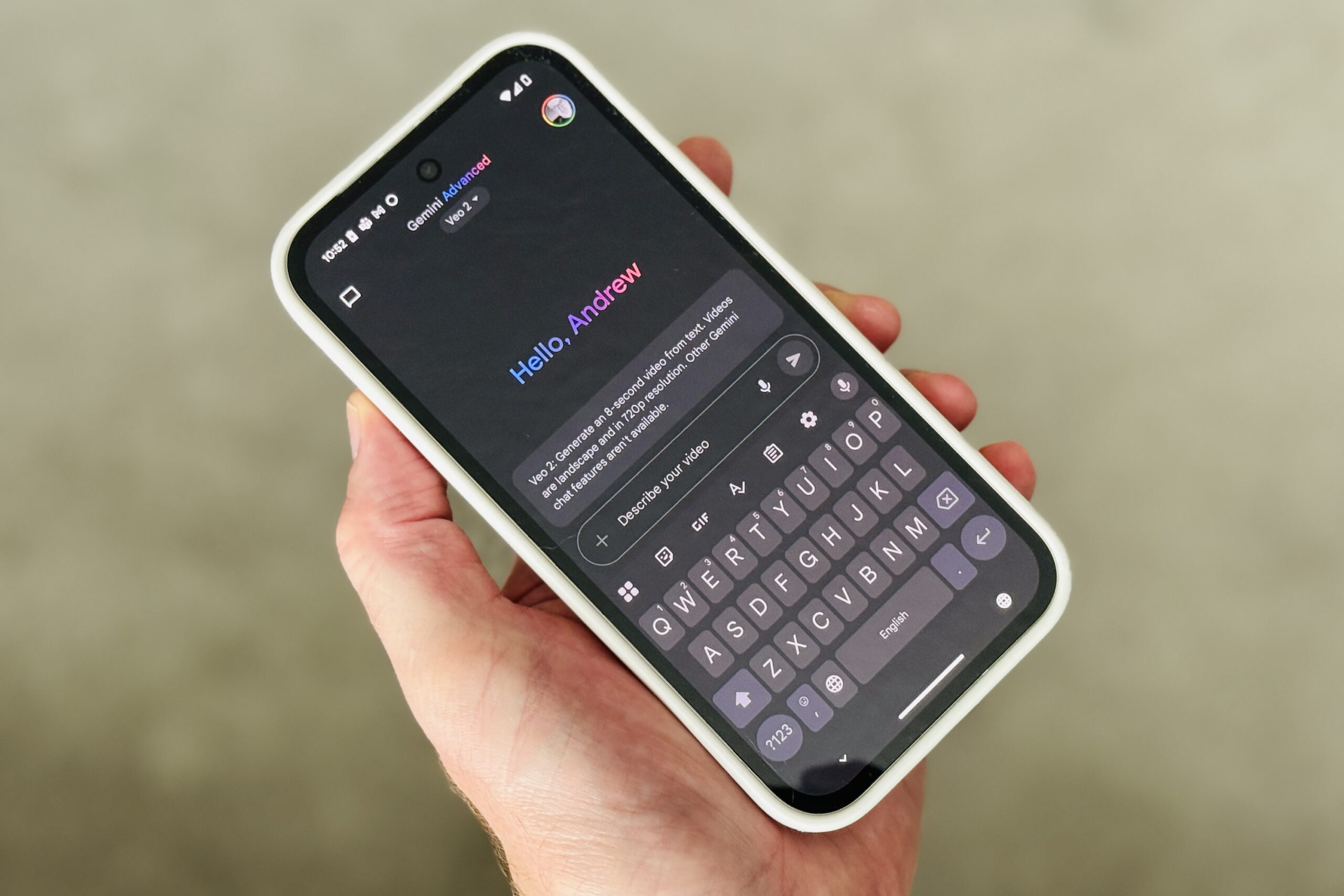
    Google has introduced an exciting feature in Gemini Advanced, its AI personal assistant and chatbot. With just a text prompt, Gemini can generate an 8-second animated video, bringing your ideas to life in an unbelievable way. This capability utilizes Veo 2, a video model launched in late 2024, designed to produce realistic videos that demonstrate an advanced understanding of human movements, real-world environments, and various lens types.

    Google elaborates on how easy it is to create videos with Gemini and Veo 2. “Simply describe the scene you'd like to produce—be it a short narrative, a visual concept, or a particular scenario—and Gemini will realize your ideas. The more elaborate your description, the greater control you have over the finished product. This opens up endless creative avenues, allowing you to blend imaginative elements, experiment with various visual styles, from the realistic to the fantastical, or quickly convey brief visual concepts.”

    The videos generated by Google Gemini are 8 seconds long, produced in 720p quality, and have a 16:9 aspect ratio. You can download MP4 files straight from your chat with Gemini or share them directly on platforms like Facebook, Reddit, LinkedIn, or X. Public links are also available for sharing, and you can explore some of the videos we've created using Veo 2 via the links provided in the next section.

    Exploring Google Gemini’s Video Creation

    If you’ve ever experimented with AI video generation, you likely know that the clearer your description, the more accurately the output reflects your vision. Google Gemini follows this principle but excels at filling in gaps even when prompts are less specific, often coming up with intriguing suggestions of its own.

    For example, I provided a straightforward, concise prompt to create a video featuring “a K-Pop girl group performing on stage in a large stadium, with thousands of fans singing along and waving light sticks.” The resulting video was quite impressive. The lead singer embodied a distinct K-Pop style, and the stadium was attractively crowded. I particularly enjoyed the Korean text at the bottom of the screen, giving it the feel of a live performance broadcast clip.

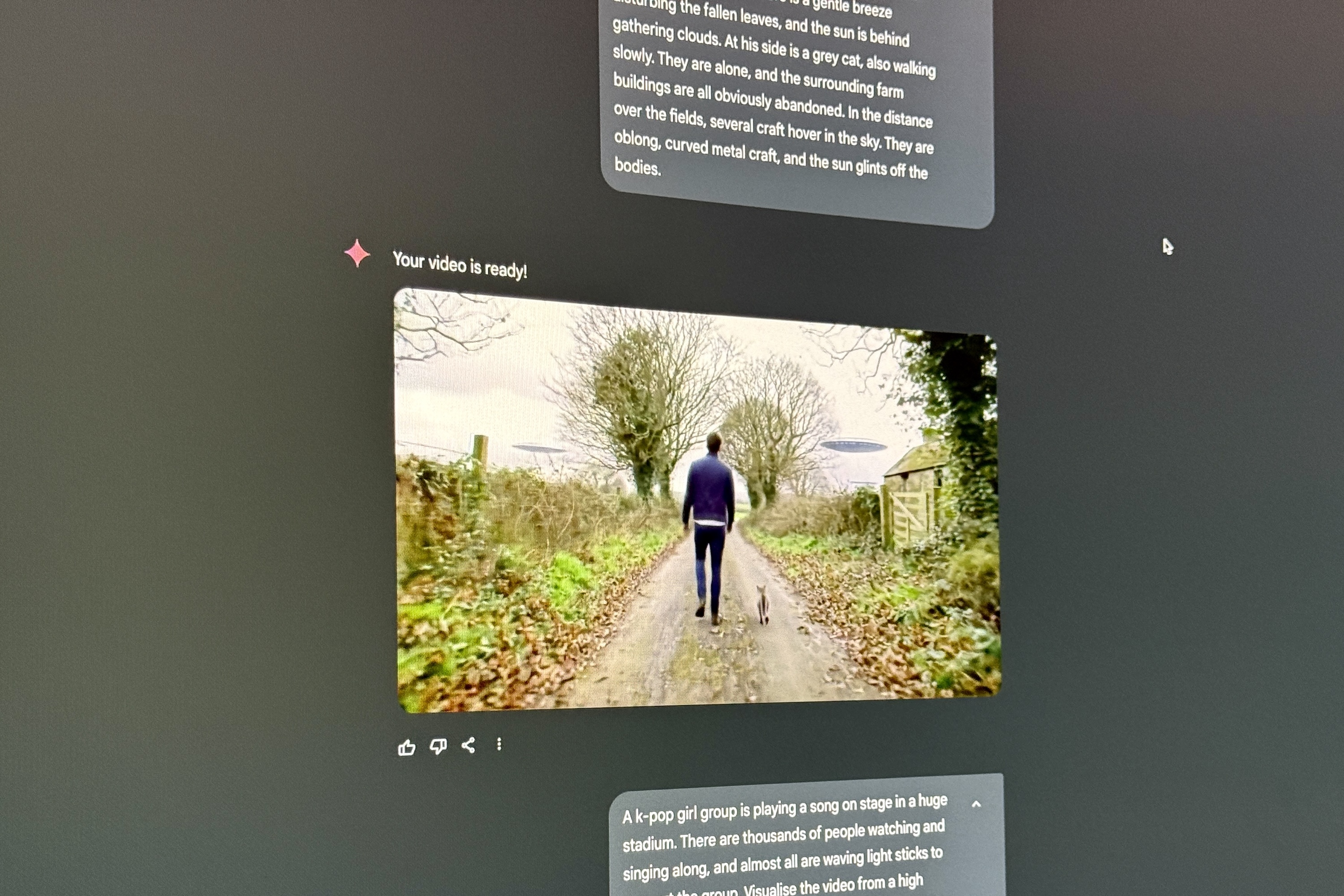
    For another example, I used a more detailed prompt to create a countryside setting, where a man and a cat stroll along a lane lined with abandoned farm structures, while UFOs hover over the distant fields. The completed video is fantastic and beautifully captures the leafy lane I envisioned, the cat’s movements, and the UFOs appearing as the camera sweeps past the trees. These videos were generated from simple prompts in just a few minutes, and it was a delight to see Veo 2 in action. Spending additional time crafting the scene has great potential.

    How to Access Video Creation in Gemini

    The Veo 2 video creation capability in Google Gemini is available to subscribers of Gemini Advanced, which costs $20 per month or £19 per month. This feature is accessed through a new drop-down menu, allowing users to toggle between different models: 2.0 Flash, 2.0 Flash Thinking, 2.5 Pro, and Deep Research with 2.5 Pro. Veo 2 is available on both desktop and mobile platforms, and Google indicated that the feature will be rolling out starting today over the upcoming weeks.

    If you have a Google One AI Premium subscription ($20 per month) and access to Google’s Whisk tool, you can also create videos from images. However, currently, images cannot be incorporated into Veo 2 to influence its style or appearances. Whisk, which was previously limited to specific regions, is now available globally to subscribers.

  • Meta’s New Open Source AI Models Take On GPT, Gemini, Claude

    Meta’s New Open Source AI Models Take On GPT, Gemini, Claude

    Meta has unveiled its newest version of the open-source AI family, known as Llama 4, amidst growing competition in the generative AI sector.

    This latest lineup comprises four models, specifically Llama 4 Scout, Llama 4 Maverick, and Llama 4 Behemoth. According to information shared on Meta’s AI website, these models were trained using extensive datasets of unlabeled text, images, and videos, showcasing their diverse multimodal capabilities.

    As of this past Saturday, the Llama 4 Scout and Llama 4 Maverick models are accessible to users across various Meta platforms, including WhatsApp, Messenger, and Instagram Direct, as well as on Meta’s dedicated AI site, Llama.com. Developers can also find these AI models available in open-source repositories like Hugging Face. The Llama 4 Behemoth model, however, remains in training and has not yet been released. Meta has indicated that the Behemoth model is expected to surpass its counterparts and serve a pivotal role in guiding the other models within the Llama 4 series.

    While internally testing the Llama 4 models, Meta conducted comparisons against competitor AI technologies to assess their capabilities and ideal applications. The company highlighted that Llama 4 Maverick excels in creative writing, outperforming models such as OpenAI’s GPT-4o and Google’s Gemini 2.0 in areas like coding, reasoning, multilingual comprehension, long-context processing, and image generation. However, Maverick faced challenges matching the performance of newer models like Gemini 2.5 Pro, GPT-4.5, and Anthropic Claude 3.7 Sonnet.

    Despite Meta’s assertions that the Behemoth model will outstrip most models—including Gemini 2.5 Pro—the company is still facing challenges in minimizing the hardware costs associated with training its most formidable model.

    TechCrunch has observed that the Chinese AI firm DeepSeek has gained significant traction with its competitively priced models, prompting Meta to closely examine how the rival company managed to develop impactful models like R1 and V3 at lower operational costs than previous iterations of Llama.

    Notably, the Llama 4 Scout model is capable of operating on a single Nvidia H100 GPU, while the Llama 4 Maverick model requires a Nvidia H100 DGX graphics system to function.

    Meta plans to host its inaugural LlamaCon AI conference on April 29. The company also intends to launch a standalone Meta AI chatbot within the second quarter of the year.

    In a parallel development, OpenAI has adjusted its GPT-5 model timeline, with CEO Sam Altman announcing on social media that users should anticipate new reasoning models (o3 and o4-mini) in the upcoming weeks as alternatives to GPT-5. Altman confirmed that GPT-5 will be released in the upcoming months, allowing OpenAI more time to refine the model.

  • Google Gemini’s Top AI Features Now Available on Microsoft Copilot

    Google Gemini’s Top AI Features Now Available on Microsoft Copilot


    At a recent event, Microsoft showcased a significant update for its Copilot feature, introducing a total of nine exciting enhancements. Among these are tools like Actions, Memory, Vision, Pages, Shopping, and Copilot Search.

    As many of these features have already surfaced in competitor products like Google’s Gemini and OpenAI’s ChatGPT, it’s worth noting that two popular tools gaining traction among users have finally been incorporated into the Copilot ecosystem.

    Deep Research

    Deep Research has become the talk of the town. Both Gemini and ChatGPT offer this feature, and it was quite surprising that the basic Copilot setup was missing such a powerful function, especially considering Microsoft’s close partnership with OpenAI.

    Fortunately, this gap has now been filled. Deep Research is a valuable addition to the Copilot suite, providing users with detailed, well-structured reports instead of generic chatbot replies. This is what a Deep Research report resembles:

    This feature taps into credible sources, gathers relevant information, and constructs a thorough research document complete with citations, saving users countless hours of manual research efforts. I've been impressed by its application on Gemini, so I'm thrilled to see this feature arrive on Copilot.

    According to Microsoft, “Copilot can find, analyze, and consolidate information from online databases as well as extensive documents and images.” Additionally, there's no need for a Microsoft account to initiate a Deep Research query, and a subscription to Copilot Pro isn't required.

    Microsoft is offering five free Deep Research inquiries each month, while those with a subscription will enjoy unlimited access and priority processing. In late March, the Microsoft 365 Copilot platform also introduced an AI Researcher tool capable of a similar function, analyzing both online resources and local files.

    Podcasts

    AI podcasts first gained attention with Google's NotebookLM, and just a few weeks ago, this feature was introduced in Gemini. I had the chance to experiment with it and found it to be an exceptional tool for transforming mundane information into an engaging auditory experience.

    While Google refers to these as audio overviews, Microsoft designates them simply as podcasts. Though the core concept is aligned, Microsoft offers a couple of additional benefits.

    Unlike Google Gemini's podcasts that do not allow user interaction, Copilot enables users to engage in ongoing discussions. “While listening, you can continue to communicate with Copilot to gain more insights and extend the conversation,” as noted by Microsoft.

    Another standout feature is the ability of Copilot to convert your offline resources and suggested websites into podcasts. Additionally, a new feature named Copilot Search functions similarly to Google's AI search but utilizes Microsoft's Bing engine.