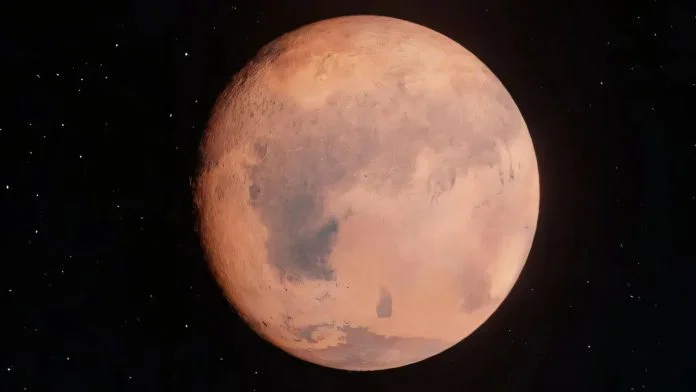
Scientists have uncovered a brand-new type of rock from Mars and have, for the first time, identified the mineral garnet in a Martian sample. This discovery provides a fascinating insight into the ancient history of the Red Planet and could improve our understanding of how Mars has changed over the past 4.5 billion years.
The breakthrough was made by an international research team, which includes Professor James Darling, a geoscientist from the University of Portsmouth in the UK.
On Earth, garnet is best known as a deep red gemstone often used in jewelry and recognized as the birthstone for January. However, for geologists, garnet is far more significant than its beauty. It can serve as a recorder of the conditions—such as temperature, pressure, and geological events—that affected rocks in the distant past.
This newly discovered garnet-bearing rock could act as a “time capsule” from ancient Mars. By analyzing it, scientists hope to gain clues about the geological processes that shaped the planet billions of years ago.
The research was led by Professor Tanya Kizovski from Brock University in Canada. She explained that this discovery broadens what scientists believe about the types of geological activity that may have occurred on Mars.
The team initially found the garnet while studying a small piece of a Martian meteorite known as NWA 8171, which is housed at the Royal Ontario Museum in Canada. At first glance, they thought the fragment contained pyroxene—a common mineral found in many rocks. But chemical tests revealed something unusual.
“This tiny section of the meteorite looked quite interesting, and its chemistry was a bit strange,” Kizovski said. “We initially assumed it was pyroxene, but decided to take a closer look.”
Using high-powered microscopes and specialized laser tools, the researchers soon discovered that the fragment contained garnet, a mineral never before identified in a Martian sample.
This discovery prompted scientists to explore how the garnet might have formed. On Earth, garnet is typically found in metamorphic rocks—those that form when existing rocks are transformed by intense heat, high pressure, or hot fluids. Similar conditions could have occurred on Mars.
The team suggests that the heat and pressure necessary for garnet formation could have resulted from a large meteorite impact, volcanic activity, or a combination of both. However, they have yet to confirm if the garnet formed on Mars itself.
There’s also a possibility that the rock originally came from another planetary body and was later cast onto Mars via a meteorite impact.
To determine its true origin, scientists would need to analyze the oxygen isotopes in the rock, which can reveal where it initially formed. Unfortunately, such tests would require destroying part of the sample.
Since this may be the only garnet-bearing Martian rock available for study, researchers are proceeding carefully. They hope that future investigations, along with data from Mars rovers and orbiting spacecraft, will ultimately clarify the origin and history of this extraordinary piece of the Red Planet.