الوسم: Firefly Aerospace

  • Firefly Aerospace Makes History With Thrilling Lunar Landing

    Firefly Aerospace Makes History With Thrilling Lunar Landing

    Firefly Aerospace has achieved a significant milestone by becoming the first private firm to successfully land on the moon. At 3:34 a.m. ET on Sunday, March 2, the Blue Ghost lander made a soft landing on the lunar surface, arriving safely and standing upright with its payload of scientific experiments and technology tests intact.

    The moon’s cratered landscape posed challenges for the landing process, described by team members as “frankly terrifying.” The entire descent was conducted autonomously; the lander utilized a downward-facing camera and terrain relative navigation software to adjust its path and identify a safe landing site. This technology allowed the onboard computer to assess its velocity and position accurately while detecting potential landing hazards like boulders and craters.

    The Firefly team experienced anxiety right up to the final moments before touchdown. With the landing successfully completed, their attention swiftly shifts to the next challenge. “The fretting never goes away,” explained Kevin Scholtes, Future Systems Architect at Firefly. “We’re always planning for the next big adventure. The goal is to leave the future brighter than we found it, which involves consistently concerning ourselves with the details.”

    The control room in Austin, Texas erupted in cheers when the lander safely reached the lunar surface. Nicky Fox, NASA’s Associate Administrator for the Science Mission Directorate, joyfully declared, “We’re on the moon!” during a celebratory event attended by many.

    Touching down in the Mare Crisium region, the lander will commence data collection over the next two weeks. Its payload includes experiments developed by NASA, which supported the mission through its Commercial Lunar Payload Services program, aimed at utilizing private companies for lunar supply transport.

    The onboard experiments feature a drill and sample collection system, a test of dust-repellent technology needed to counter the sharp glass-like dust covering the lunar terrain, and instruments designed to analyze how solar winds interact with Earth’s magnetic field.

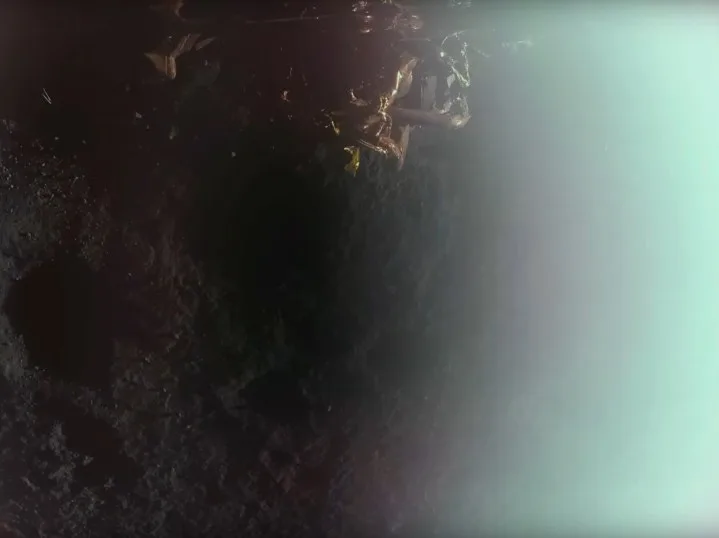
    Firefly has also shared the first image captured by the lander, showcasing part of the lunar surface:

    First image taken by the Blue Ghost lander on the surface of the moon.
    First image taken by the Blue Ghost lander on the surface of the moon.
    Firefly Aerospace

    This initial image, while low in quality, captures a portion of the lander against the backdrop of the moon. Higher-resolution images are expected to be released soon as Firefly tests its onboard instruments and begins operational tasks.

    “Firefly is literally and figuratively over the Moon,” remarked Jason Kim, CEO of Firefly Aerospace. He stated, “Our Blue Ghost lander now has a permanent presence on the lunar surface, carrying 10 NASA payloads and a plaque featuring the names of all Firefly employees. This remarkable team has demonstrated our capability to provide reliable, cost-effective access to the Moon, and we aim to continue advancing our lunar missions. We are paving the way for a sustained lunar presence that will facilitate access to the greater solar system for the United States, our partners, and the global community.”


  • Firefly Aerospace Launches Blue Ghost Mission To The Moon

    Firefly Aerospace Launches Blue Ghost Mission To The Moon

    This morning, Firefly Aerospace successfully launched a moon lander equipped with a range of NASA science instruments and technology demonstrations. The mission, known as Blue Ghost, lifted off aboard a SpaceX Falcon 9 rocket from NASA’s Kennedy Space Center in Florida at precisely 1:11 a.m. ET on Wednesday, January 15.

    The primary goal of this mission is to achieve a soft landing on the lunar surface. If accomplished, it will mark only the second successful moon landing by a private company, following the Odyssey landing by Intuitive Machines last year. Both missions are integral to NASA’s Commercial Lunar Payload Services program, which aims to have commercial partners deliver scientific payloads to the moon in preparation for the upcoming Artemis human exploration missions.

    “This mission embodies the bold spirit of NASA’s Artemis campaign – a campaign driven by scientific exploration and discovery,” remarked NASA Deputy Administrator Pam Melroy. “Every flight we participate in is a crucial step towards establishing a sustainable human presence on the moon, Mars, and beyond. Each scientific instrument and technology demonstration takes us closer to making our vision a reality. Congratulations to the teams at NASA, Firefly, and SpaceX for this successful launch.”

    Following launch vehicle separation, Firefly’s Blue Ghost lunar lander acquired signal and completed on-orbit commissioning.
    After separating from the launch vehicle, Firefly’s Blue Ghost lunar lander established communication and completed its on-orbit commissioning.
    Firefly Aerospace

    Following the launch, the spacecraft successfully separated from its rocket at 2:17 a.m. ET and made contact with ground control. The team carried out checks to verify the spacecraft’s condition and status, confirming that all systems were operational and data transfer was functioning correctly.

    The Blue Ghost will remain in Earth orbit for approximately 25 days before embarking on its four-day journey to the moon, where it will spend 16 days orbiting the lunar surface. The mission aims to execute a landing on Sunday, March 2, in the Mare Crisium basin—a 300-mile-wide crater located on the moon’s near side—followed by conducting experiments related to lunar drilling and sample collection.

    “On behalf of Firefly, I want to extend our gratitude to SpaceX for their precise deployment into our target orbit,” stated Jason Kim, CEO of Firefly Aerospace. “The mission is now in the capable hands of the dedicated Firefly team. Having completed extensive testing and mission simulations, we are focused on executing our planned operations, achieving a successful soft landing on the lunar surface, and paving the way for humanity’s return to the moon.”