Air filters are essential for keeping the air we breathe free of contaminants.
They are commonly used in homes, offices, hospitals, factories, vehicles, and various other settings to trap dust, pollen, smoke, and harmful airborne particles.
Nevertheless, even the most effective filters have their limitations. While they can capture tiny pollutants, some of these particles can become dislodged over time and re-enter the air.
Researchers have now developed an easy-to-apply spray coating that could address this persistent problem.
This new material significantly improves a filter’s ability to retain trapped particles, enhancing overall performance and nearly doubling the lifespan before replacement is needed.
The study was led by Sanghyuk Wooh from Chung-Ang University and Chae Bin Kim from Pusan National University in South Korea, with findings published in Advanced Materials.
Traditional filters mainly rely on weak physical forces to hold particles in place. As air flows through, some dust and pollutants can loosen and escape, reducing the filter’s efficiency and shortening its service life.
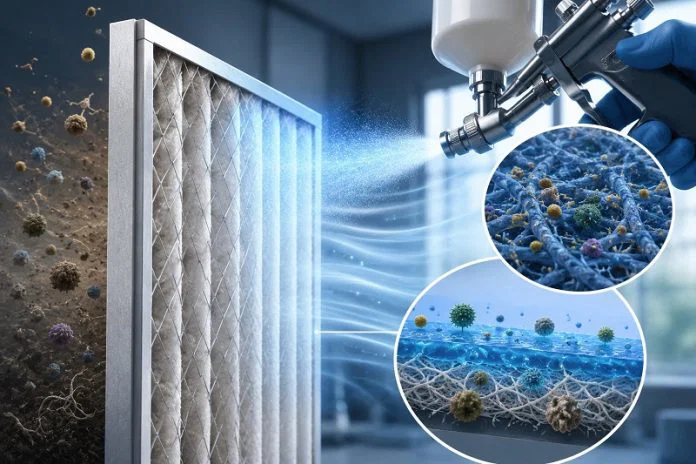
To overcome this, the researchers created a special coating called Dynamic Imine Bond Adhesive (DIBA). Unlike typical adhesives, this coating continually refreshes its surface, acting like a blend of solid and liquid. This allows particles to settle into the coating while exposing new sticky surfaces to trap additional pollutants.
The coating can be applied using a straightforward spray method, making it easy to upgrade existing commercial filters without altering their manufacturing process.
Laboratory tests assessed the coating’s chemical makeup, strength, and ability to hold particles under different scenarios. They also examined how well the coated filters performed at various airflow speeds and how long they remained effective.
The results were remarkable. The coating increased the force to retain trapped particles by nearly 70 times compared to uncoated filters, greatly reducing the likelihood of pollutants escaping back into the environment.
Additionally, overall filtration efficiency improved by 10% to 30% across multiple types of commercial filters. This upgrade moved the filters from a MERV 6 rating to MERV 11, a substantial boost in their ability to eliminate airborne particles.
Crucially, the coating did not impede airflow, an important factor since increased resistance can lead to higher energy use by fans. The researchers confirmed that filtration performance improved without causing additional pressure drops.
Durability was another key benefit. Since particles get embedded into the sticky coating rather than clogging the pores quickly, the coated filters experienced slower clogging and lasted nearly twice as long as standard filters before needing replacement.
The team believes this technology could be beneficial in a variety of settings, including HVAC systems, home air purifiers, medical ventilation, industrial dust collection, cleanrooms, vehicle cabin filters, and even face masks.
Beyond air filtration, the same self-renewing adhesive technology might enhance water purification, environmental remediation, and specialized manufacturing processes where controlling tiny particles is crucial.
This research demonstrates how a relatively simple materials innovation can make everyday air filters more effective, longer-lasting, and environmentally friendly, helping to provide cleaner air while reducing waste and maintenance costs.