Digital Phablet – Recently, Portuguese football star Cristiano Ronaldo stirred controversy by reportedly liking an Instagram post accusing FIFA of corruption. The post alleged that the organization and its president, Gianni Infantino, assisted Argentina in reaching the 2026 World Cup final.
Ronaldo’s online activity quickly made waves across social media platforms, though he has not publicly addressed his stance. Beyond his personal opinion, Argentina’s national team has faced repeated accusations of favoritism, with many fans pointing fingers at FIFA and fueling conspiracy theories online.
His action of liking the post has reignited a long-standing rivalry between him and Argentina’s Lionel Messi.
Ronaldo Likes Video Accusing FIFA of Bias Favoring Argentina
In a tweet, Mario Nawfal shared, “🇵🇹🇦🇷 Cristiano Ronaldo liked a video claiming FIFA is outright corrupt, helping Argentina get to the final. Targeting Infantino and the entire setup for Messi. The rivalry never ends. CR7 throwing shade from the sidelines.”
— Mario Nawfal, July 21, 2026
A social media user on X (formerly Twitter) commented, “That’s why he’s the GOAT — he’s the only one brave enough to stand up to corruption and has been exposing FIFA for years. Why act surprised now? He did it during the Argentina scandal.”
Another user wrote, “Everyone saw the corruption with their own eyes. Well done, Ronaldo. Respect for him has only grown after this World Cup.”
Following Argentina’s dramatic 3-2 victory over Egypt in the round of 16, claims of FIFA favoritism intensified. Egypt led 2-0 before Argentina mounted a comeback, scoring three goals in the second half. The refereeing decisions drew scrutiny, with questionable VAR calls—including a disallowed goal and denied penalty for Egypt.
Egyptian coach Hossam Hassan accused French referee François Letexier of bias, suggesting the match was “rigged” to favor Argentina. Hassan stated, “Maybe they wanted to keep the reigning champions in the tournament. Maybe they wanted Messi to stay in the hunt.”
Additionally, Mostafa Ziko, whose goal was disallowed, told reporters post-match, “The referee was unfair and undermined the efforts of an entire nation. The trophy is going to Argentina.” Since then, fans have jokingly dubbed Argentina “VARgentina” in reference to the controversial officiating.
Digital Phablet – Tiffany Haddish targeted Trump during her guest-host debut on Jimmy Kimmel Live.
Donald Trump’s phone call regarding the World Cup has sparked a late-night roasting. During her first appearance as guest host, Haddish delivered sharp humor about the president’s controversial involvement with FIFA, among other topics.
Haddish criticized President Donald Trump for meddling in the World Cup during her appearance on Jimmy Kimmel Live! on Monday. According to the Independent, she kicked off her week-long hosting stint by condemning Trump’s controversial call to FIFA. She is filling in for Kimmel during his usual two-month summer break from the show.
Haddish stated on the show that Trump reinstated a U.S. FIFA player, claiming it was “the first time he ever defended a Black person.” She added, “Of course, no one in the left-wing media will call her out for this wild claim.” (source: @theMRC)
Trump had reached out to FIFA President Gianni Infantino to express his dissatisfaction with U.S. star Folarin Balogun’s red card during the Bosnia-Herzegovina match. Subsequently, FIFA announced that the red card had been suspended, allowing him to participate in the knockout stage against Belgium. On Monday, Trump told reporters in the Oval Office that he “asked for a review by FIFA” but denied any involvement in the decision.
Haddish addressed the situation directly on the show. “One of our star players was supposed to be suspended from tonight’s game, but President Trump personally called FIFA to get him reinstated,” she claimed. She then remarked, “Which is surprising because Trump doesn’t know anything about soccer, and it’s the first time he’s ever defended a Black person!”
Despite his efforts, the U.S. men’s soccer team lost 4-1 to Belgium on Monday. Trump responded on Truth Social, saying, “Thank you to FIFA for doing what was right and reversing a great injustice.” The incident continues to be the subject of ridicule worldwide.
Haddish also took aim at Trump’s Great American State Fair, which saw low attendance due to extreme heat and canceled performances. “Trump claimed the event would be, and I quote, ‘packed to the brim,’” she said. “Honestly, there were more people at my bar mitzvah.” Starting July 13, actor Anthony Anderson will take over the guest hosting duties.
During a surprising turn on Sunday, FIFA announced it would lift the one-match suspension imposed on U.S. forward Florian Balogun’s red card, enabling him to play in the upcoming World Cup Round of 16 game against Belgium on Monday.
Balogun isn’t alone in receiving a red card during this tournament. Data from Northeastern University’s NetSI Sport research group shows that the number of red cards handed out has more than tripled compared to the previous two World Cups.
So far this year, 13 players have been shown red cards. In 2018 and 2022, only four players received red cards in each tournament, according to the data.
In soccer, players can be shown either yellow or red cards in response to unsportsmanlike conduct. A yellow card acts as a caution, signaling an official warning for infractions like illegal tackles, arguing with referees, or pretending to be injured.
A red card, however, signifies a more serious offense such as reckless fouls, violent behavior, insulting language, spitting, or intentionally preventing a clear scoring chance, known as DOGSO. Players shown a red card are immediately sent off and cannot return to the game; in the World Cup, they’re also banned from starting the following match. Receiving two yellow cards in a single game also results in a red card.
Balogun was sent off during the U.S. team’s Round of 32 match against Bosnia and Herzegovina after stepping on an opponent’s ankle while trying to regain control of the ball in the second half.
While some defenders argue that Balogun may not have deserved a red card, critics—including UEFA, the Union of European Football Associations—say FIFA’s decision to suspend his ban undermines the tournament’s fairness. On Monday, FIFA rejected Belgium’s appeal challenging Balogun’s eligibility to play.
What explains the increase in red cards this year? According to NetSI Sport, several factors are at play, including improvements in video assistant referee (VAR) technology, which now provides faster and more detailed slow-motion replays.
For instance, three of this year’s red cards were initially considered yellow-card offenses but were upgraded after VAR reviews. These included Qatar’s Homam Ahmed’s last-man foul on Canada’s Tajon Buchanan on June 18; Qatar’s Assim Madibo’s dangerous tackle on Canada’s Ismaël Koné during the same match; and Iraq’s Rebin Sulaka’s DOGSO on Senegal’s Sadio Mané on June 26.
FIFA has also implemented stricter rules to promote safe and fair play. Two of this year’s red cards stemmed from violations of a new FIFA rule prohibiting players from covering their mouths when speaking to opponents. The first was issued to Paraguay’s Miguel Almiron against Turkey on June 19; the second went to Ecuador’s Piero Hincapie in their Round of 32 match against Mexico on June 30.
At the same time, the number of yellow cards and fouls has decreased across the tournament. NetSI attributes this trend to FIFA’s efforts to keep the game flowing smoothly, minimizing stops for minor infractions.
Written by Cesareo Contreras, Northeastern University.
Celebrating Women’s Participation in Soccer: A Global Perspective
Introduction to National Girls and Women in Sports Day
February 5 marks a significant occasion in the United States—National Girls and Women in Sports Day. This annual celebration, organized by the Women’s Sports Foundation, aims to acknowledge the achievements of female athletes and encourage participation in sports amongst girls and women. In 2023, we celebrate the 39th edition of this important event, highlighting the progress and challenges that remain in women’s sports, particularly in soccer.
The Global Landscape of Female Soccer Participation
Soccer, known as football in many parts of the world, is one of the most popular sports globally. Interest and participation levels can vary widely by country, and recent surveys provide interesting insights into how women are engaging with the sport.
Female Participation Rates in Mexico
Mexico stands out for its impressive statistics regarding female soccer players. According to a Statista Consumer Insights survey, 20% of female respondents aged 18-64 indicated that they participate in soccer at least occasionally. This notable figure underscores soccer’s popularity among women in Mexico, where the sport’s cultural significance is profound.
Insights from Brazil: A Soccer Stronghold
Brazil is another nation synonymous with soccer excellence, and its women’s participation rates support this reputation. The same survey indicates that 14% of women in Brazil engage in soccer, either recreationally or competitively. While these figures reveal substantial involvement, it is essential to note that male participation is significantly higher, with approximately 65% of men in Brazil reported to be involved in the sport.
Comparing Women’s Participation in Europe
The soccer landscape across Europe reveals a more nuanced picture. Participation rates for women vary by country, highlighting both opportunities and barriers in different contexts.
The United Kingdom: Leading the Charge
In the United Kingdom, female soccer participation is slightly higher compared to other European nations such as Spain, France, Germany, and Italy. This trend indicates progress in promoting women’s sports within the UK, fueled by initiatives aimed at increasing visibility and opportunities for female soccer players.
Spain, France, Germany, and Italy: A Mixed Picture
In Spain, France, Germany, and Italy, the figures for women’s participation in soccer are reflective of broader societal and cultural attitudes toward women’s sports. While these countries have made strides in promoting soccer for women, the participation rates are still lower than those in the UK. Factors influencing these numbers can include structural support for women’s leagues, media coverage, and social attitudes towards female athletes.
The Male-Female Participation Gap
Analyzing the data highlights a significant male-female participation gap in soccer, particularly in regions like Mexico and Brazil. Even as efforts are made to enhance the visibility of women in soccer, it’s clear that substantial work remains to reach equitable participation levels. The encouraging figures for women’s rising involvement in sports exemplify a growing recognition of female athletes’ contributions and capabilities.
The Role of Societal Attitudes and Infrastructure
Increased participation in soccer by women often hinges on societal attitudes toward female athletes and the presence of supportive infrastructures. Countries like Mexico and Brazil have deep-rooted soccer cultures, which can provide an exciting backdrop for women to engage with the sport. The presence of women’s leagues, school programs, and local clubs can further foster this engagement, offering women the opportunities and resources they need to thrive.
The Importance of Continued Advocacy
As we celebrate National Girls and Women in Sports Day, it is vital to continue advocating for increased participation, visibility, and support for female athletes across all sports, including soccer. Through concerted efforts and societal change, we can hope for a future where women in soccer enjoy the same recognition, resources, and participation levels as their male counterparts.
By analyzing participation rates and understanding the underlying factors contributing to these trends, we contribute to an ongoing conversation about gender equality in sports, making strides toward a more inclusive future for all athletes.
Saudi Arabia’s Bid for the 2038 World Cup: Context and Controversies
In a move that has sparked significant debate and concern, FIFA has officially confirmed Saudi Arabia’s bid to host the 2038 FIFA World Cup. This decision follows the announcement of a joint bid by Spain, Portugal, and Morocco to host the 2030 World Cup. While these developments are monumental in the realm of international football, they are not without a tangle of controversies and ethical dilemmas.
The Process Behind the Bidding
FIFA’s Principle of Confederation Rotation
FIFA operates under a principle of confederation rotation, which aims to ensure that the World Cup is hosted in various regions of the world over time. However, the organization has faced criticism for seemingly circumventing this principle. For the 2030 World Cup, FIFA included Uruguay, Argentina, and Paraguay as hosts to commemorate the 100-year anniversary of the inaugural tournament held in Uruguay. This decision raises questions about the exclusion of South American bids for the 2034 event, and subsequently the tight time frame imposed on other applicants for the 2038 World Cup.
A Tight Timeline for Bids
The deadline set by FIFA for bids for the 2034 World Cup appears to have been strategically established. By only allowing aspirants from Asia and Oceania—and placing a narrow window for submissions—FIFA’s plan effectively cleared the path for Saudi Arabia to claim its ambition of hosting the tournament. This sequence of events coincides with FIFA’s announcement of a multi-year global partnership with Saudi Aramco, the state-owned oil giant, creating an intricate web of political and economic interests intertwined with the World Cup hosting rights.
Human Rights Concerns
The Striking Criticism from Activist Groups
Human rights groups have been vocal in their criticism regarding Saudi Arabia’s bid, expressing grave concerns about the nation’s record concerning migrant workers, women’s rights, and the treatment of LGBTQ individuals. Saudi Arabia’s human rights context has come under scrutiny, which has not deterred FIFA from supporting its bid. Notably, FIFA published a "Bid Evaluation Report" granting the Saudi bid an impressive score of 4.2 out of 5—the highest in the history of World Cup bid evaluations.
A Flawed Evaluation Process
According to FIFA, the inclusion of human rights considerations in its evaluation is intended to assess how effectively bidders plan to mitigate human rights risks associated with hosting a tournament. Critics, including Amnesty International’s Head of Labour Rights and Sport, Steve Cockburn, have dismissed FIFA’s report as a "whitewash" of Saudi Arabia’s troubling human rights history. Concerns have been raised regarding the lack of binding commitments to safeguard the rights of workers, protect residents from eviction, and prevent the imprisonment of activists during the World Cup period.
Current State of Human Rights in Saudi Arabia
Ratings and Indices
As highlighted in various human rights indices, Saudi Arabia typically ranks poorly in terms of governance and human rights conditions. This consistent placement near the bottom of international rankings casts a long shadow over its candidacy for hosting a globally celebrated event like the World Cup. The growing visibility and attention on these issues compel stakeholders, including FIFA, to confront the realities of human rights conditions in countries hosting major international events.
The Broader Implications
The implications of choosing Saudi Arabia as a host for such a significant global event transcends mere logistics and finances; it also reflects on the moral responsibilities of international organizations like FIFA. The ripple effects of hosting the World Cup—economic, cultural, and social—will undoubtedly raise critical questions about the ethical implications of such partnerships.
With the decision regarding the World Cup significantly influenced by economic deals and geopolitical considerations, the eyes of the world will be watching how FIFA navigates this complex terrain as Saudi Arabia moves ahead with its preparations. The unfolding situation underscores the urgent need for a more robust discussion on the intersectionality of sports, human rights, and corporate responsibility in the global arena.
The 2030 FIFA World Cup: A Controversial Decision and Its Implications
When FIFA disclosed that the 2030 World Cup would be hosted in six countries across three continents, reactions ranged from surprise to disbelief. This decision is not merely a logistical feat but also a strategic maneuver that reflects FIFA’s ongoing endeavors to maximize revenue and expand its global reach.
A Historical Context: Celebrating a Century of World Cup Football
The choice to kick off the 2030 World Cup in Argentina, Paraguay, and Uruguay is steeped in historical significance. These countries played pivotal roles in the origins of the FIFA World Cup, as Uruguay hosted the inaugural tournament in 1930. However, the symbolic gesture of honoring the tournament’s centenary contrasts sharply with the practicalities of modern international sports.
Logistical Challenges Ahead
One of the most glaring issues with this decision is the significant logistical challenge it poses for players and fans alike. The vast geographic spread of the tournament means that athletes will experience drastically different climates within a short span of time. Transitioning from the South American winter to the European and North African summer poses not only physical challenges for athletes but also has implications for their performance.
FIFA: "Following the Money"
FIFA’s latest announcement reveals more than just a celebration of history; it’s a calculated financial strategy. With its track record of controversies around corruption and financial management, this decision appears to be a savvy move to cater to profit-driven motives. By allowing the tournament to be held across continents, FIFA positions itself to capitalize on diverse markets and increase its revenue streams.
The Role of Conflicts in Confederation Rotation
FIFA’s constitution includes a principle of confederation rotation, designed to ensure equal hosting opportunities among its six regional confederations. However, this latest decision raises questions about the integrity of this principle. By involving three confederations in one World Cup, FIFA has cleverly sidestepped potential backlash regarding the 2034 tournament bidding process.
Saudi Arabia’s Ambitions and FIFA’s Strategic Maneuvering
Almost immediately after the 2030 hosting decision, the Saudi Arabian Football Federation announced its intent to bid for the 2034 World Cup. The implications here are profound; while the World Cup is historically awarded to nations based on geographical and meritorial considerations, FIFA’s recent moves signal a shift in focus toward maximizing financial inputs.
The Impact of World Cup Revenue
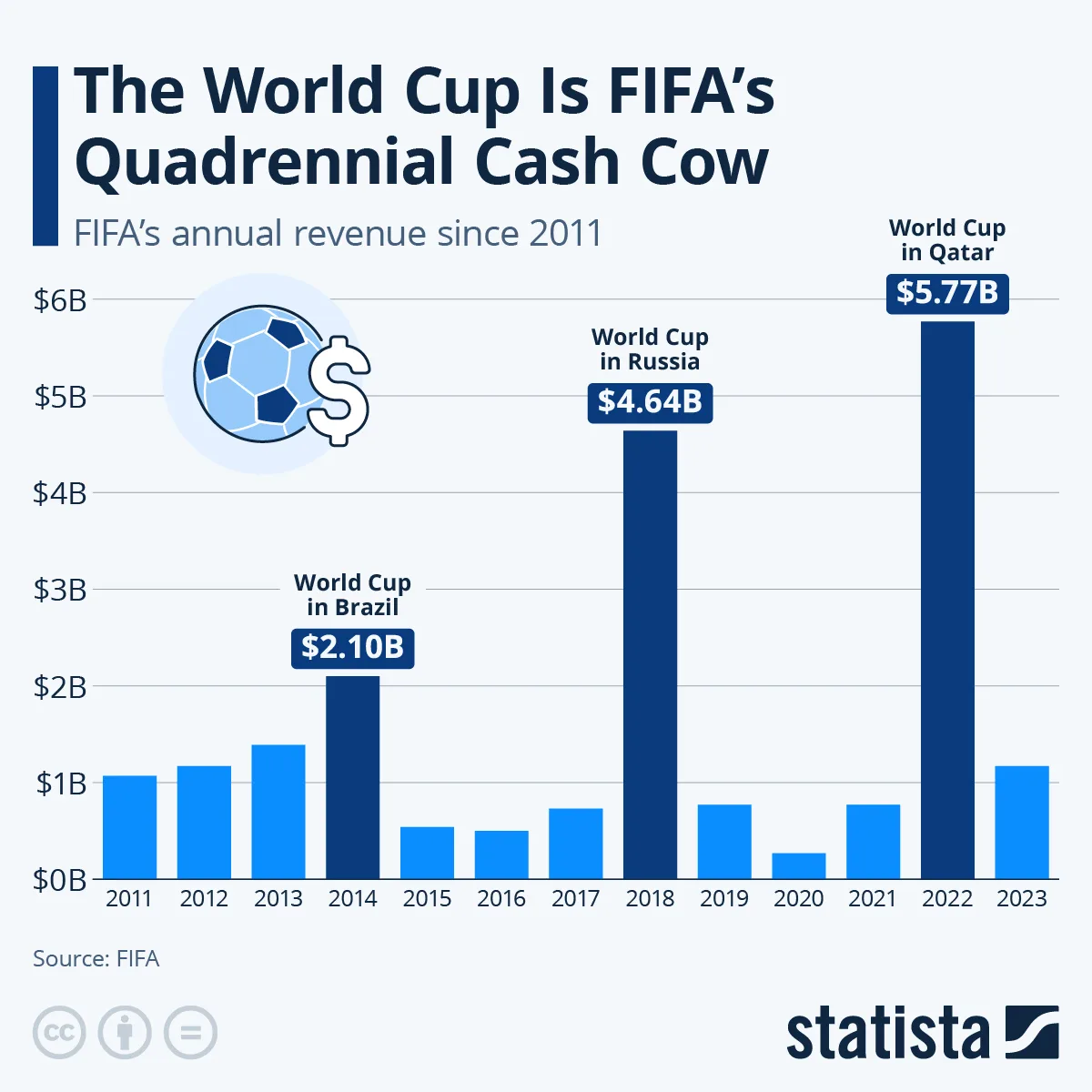
The financial stakes surrounding the World Cup cannot be overstated. For instance, the rights related to the 2022 Qatar World Cup yielded an impressive $6.3 billion in revenue for FIFA from 2019 to 2022, representing a staggering 83% of the organization’s total income during that timeframe. This showcases the World Cup’s significance not just as a sporting event but as a lucrative business venture.
Conclusion
The upcoming FIFA World Cup in 2030 represents a complex blend of historical nostalgia and modern-day pragmatism. As FIFA continues to navigate the intricate landscape of global sports management, the focus on profitability and international appeal remains front and center, raising critical questions about the future of football as both a sport and a business.
Is there anything better than watching a football game in a packed stadium? Watching it on an impressive television set. As the highly anticipated Fifa World Cup approaches, it may be an excellent time to consider upgrading your TV with amazon, which now offers free delivery and installation services for televisions 65 inches and larger.
Consider that the best TV for watching televised sports is not necessarily the same as the best TV for watching general television. There is constant motion on the screen while watching football, tennis, or cricket, and some devices can better capture this motion seamlessly than others. Aside from brightness, it would be best to consider that you might end up watching your reflection rather than the game on the screen.
Now is the time for you to regain control so that you are not distracted by the limitations of your television but, instead, can focus on the beautiful game being played. Before the football season begins, here are our recommendations for the best televisions that you can buy on amazon:
1. LG OLED Evo TV, C2 Series (65-Inch) – (Best Overall)
PROS
Brightness is superior on the screen
Design that is sleek and minimalistic
Four HDMI 2.1 ports are provided
The WebOS operating system is excellent
CONS
Some reviewers have criticized its virtual surround sound
Costly
In terms of clarity, brightness, connectivity, and performance, LG’s C2 Series is unmatched.
Its organic light-emitting diode (OLED) Evo display technology provides superb contrast levels, bright images, vivid colors, and seamless motion for watching sports.
Compared to LG’s older C1 Series, the a9 Gen 5 AI processor increases brightness by 20 percent. A new Dynamic Tone Mapping Pro technology enhances details by creating a sharp, vivid HDR (high dynamic range). This means that highlights are brighter, contrast is greater, and colors are richer and more realistic.
The LG C2 Series is the TV to splurge on if budget is not too much of a concern.
Regardless of the viewing angle, the screen maintains its integrity
The price is fantastic
CONS
There is only one USB port on this device
With Samsung’s AU7000 Smart TV, you can enjoy great quality without spending much money. With Samsung’s Crystal 4K processors, this 75-inch LED television offers solid processing capabilities.
Additionally, it offers 4K UHD (ultra-high definition) with PurColour technology, which enhances the quality of color reproduction and ensures clean images, optimized contrast ratios, and deep, rich colors. Regarding sports, Samsung’s Motion Xcelerator reduces picture shake for smooth, crisp details as fast-moving action sequences occur.
You can enjoy this on a large screen at a price that will not break the bank. If you prefer, you may also be interested in the 65-inch version of this model.
4K Ultra HD resolution provides excellent resolution
Sports mode is included
The VIDAA U5 is an easy-to-use product
There are three HDMI ports and two USB ports for great connectivity
CONS
The brightness may not sufficiently overcome the glare
This 65-inch smart TV from Hisense offers exceptional value with many features, including 4K Ultra HD technology, which provides four times the resolution of a full HD screen. In addition, Dolby Vision HDR brings cinema technology into your living room for more precise and more accurate visuals.
Several apps, including YouTube and Netflix, can be launched using the VIDAA U5 operating system, which is intuitive and smart. Our favorite feature this season is the Sports Mode – the television automatically switches to this mode when it detects a sports signal and adjusts its picture and sound settings to reproduce the experience of being at the stadium live.
4. Hisense 120L5 Laser TV with Smart Screen - (Best Laser TV)
PROS
4K resolution in true 4K
Streaming capabilities built into the VIDAA operating system
Protects the eyes from blue light
There is no need to mount
CONS
Lag may be a problem for gamers
Costly
With this all-in-one entertainment center, you can enjoy the World Cup with your friends and family. Its X-Fusion laser light source produces a 120-inch image just over a foot from the screen, which significantly improves over some other projectors on the market. Consequently, it can be easily mounted on tables – no ceiling mounting is required.
There is no restriction on whether it should be placed horizontally or vertically. A light-rejecting ambient screen is included with the laser TV, so you do not need to purchase additional accessories.
The 120L5 delivers excellent picture quality, thanks to its 4K UHD and HDR technologies, which enhance dark and bright scenes. The MEMC technology is used to create smooth motion, which is vital when watching sports – and the TUV eye protection ensures that you see the same spectacular colors and contrast but with a reduced amount of harmful blue light.
5. evvoli 4K QLED Smart TV (70-Inch) – (Best Value)
PROS
QLED 4K provides exceptional picture quality
It provides a wide field of view
An infinity screen is featured
Android TV with an easy-to-use interface
Several ports (three HDMI and two USB) provide good connectivity
CONS
Some reviewers have criticized the after-sales support as being unsatisfactory
Taking advantage of QLED (quantum dot LED) technology, you can enjoy a large screen at a great price. A 70-inch smart TV from Evvoli features a vivid 4K resolution, a true RGB color spectrum, and HDR for crisp, sharp details, deep blacks, and a wide variety of colors.
Using its Quantum 4K processor, regular content is upscaled to meet the standards of 4K resolution, ensuring the highest quality image onscreen at all times. With its three-sided, bezel-free design, and so thin edges, the screen almost disappears, leaving you with a genuinely immersive infinity display.
It has a wide range of connectivity options, making this television ideal for gaming, so once you have finished watching football, you may be able to play it.
FIFA 2023 is about to take place this year though the fans are tense. The situation that the pandemic has bought to everyone’s life is the worse in the world of sports.