الوسم: federal workers

  • Judge halts Trump’s plan to dismiss thousands of government employees

    Judge halts Trump’s plan to dismiss thousands of government employees

    A man’s shadow stretches as he walks toward the Hubert H. Humphrey Building, which serves as the headquarters for the Department of Health and Human Services (HHS) in Washington, D.C., on April 1, 2025. — Reuters

    – Approximately 4,100 federal employees have been notified of layoffs amid the government shutdown.
    – Two federal employee unions filed a legal challenge against these layoffs.
    – A judge ruled that explicitly political motives behind the job cuts are unlawful under current laws.

  • Trump Administration Promises to Rehire 25,000 Laid-Off Workers

    Trump Administration Promises to Rehire 25,000 Laid-Off Workers

    Content Revised for American English:


    Protests Erupt Over Trump Administration’s Dismissal of Federal Workers

    Protesters gather near the offices of federal lawmakers during a demonstration against a federal workforce reduction campaign led by billionaire Elon Musk, a key advisor to President Donald Trump, on Capitol Hill in Washington, DC, on February 25, 2025. — Reuters


    WASHINGTON: In a significant turn of events, the Trump administration has acknowledged that nearly 25,000 recently hired federal employees were terminated and is now focused on their reinstatement. This acknowledgment comes after a court determined that these mass layoffs were likely illegal.

    Court documents revealed that federal agencies are actively working to reinstate all affected workers following a ruling from a judge suggesting that their dismissals were probably unlawful. Filed late Monday in the federal court based in Baltimore, Maryland, the documents contained statements from officials from 18 agencies, confirming that the workers reinstated from probationary status are currently placed on administrative leave, at least temporarily.

    The mass layoffs, part of Trump’s broader initiative to streamline the federal workforce, have received considerable media attention. However, these court filings mark the administration’s first comprehensive disclosure regarding the terminations.

    Most agencies reported dismissing several hundred workers, with the Treasury Department laying off approximately 7,600, the Department of Agriculture about 5,700, and the Department of Health and Human Services over 3,200, as detailed in the filings.

    On March 13, U.S. District Judge James Bredar ruled that the mass dismissals of probationary workers, which began last month, were unlawful and mandated their reinstatement while further legal discussions continue. Although the ruling does not prevent agencies from terminating employees in the future, it criticized how the large-scale layoffs were executed, indicating that agencies should have adhered to appropriate procedures during such significant workforce reductions.

    Typically, probationary workers have served less than a year in their current roles, though some may have been long-term federal employees.

    In a brief notice released on Tuesday, Judge Bredar remarked that agencies have shown "meaningful progress toward compliance" with his prior ruling. He instructed them to provide an update on their reinstatement efforts by Monday afternoon and expressed his expectations for "substantial compliance."

    This ruling follows a lawsuit initiated by 19 states led by Democrats, along with Washington, D.C. They contended that the mass terminations would lead to a spike in unemployment claims and a greater demand for state-provided social services.

    The Maryland Attorney General’s office, which is spearheading the lawsuit, indicated that it is currently evaluating the court’s filings.

    Furthermore, the Trump administration has appealed Bredar’s ruling while requesting the Richmond, Virginia-based appeals court to suspend the order until the legal process unfolds.

    Several former probationary workers from the Departments of Agriculture, Health and Human Services, the Internal Revenue Service, and the General Services Administration told Reuters that they received notifications about their reinstatement with full pay, although they are currently on administrative leave.

    One reinstated worker from the General Services Administration stated he still expects to be let go eventually, but acknowledged that receiving pay and benefits for now provides some relief. "My family has health insurance, and this gives me a little time to figure out what’s next," he noted.

    Federal Court Decision in San Francisco

    Just hours before Judge Bredar’s March 13 ruling, a federal judge in San Francisco ordered the reinstatement of probationary workers at six agencies, including the five outlined in Bredar’s ruling as well as the U.S. Department of Defense. The administration is also challenging this decision.

    U.S. District Judge William Alsup criticized the choice to place probationary employees on administrative leave instead of reinstating them to work, asserting that this approach failed to restore government services as intended.

    In response, the U.S. Department of Justice contended that placing these workers on administrative leave is merely the first step toward full reinstatement and clarified that "administrative leave is not being used to bypass the requirement for reinstatement."

    According to the filings submitted in Baltimore, agency officials indicated that they had either already reinstated dismissed employees or were in the process of doing so. They recognized the confusion and disruption caused by the large-scale reinstatement.

    These officials cautioned that if an appellate court overturns Judge Bredar’s ruling, it could authorize agencies to terminate these workers again, leading to several changes in their employment status within a short timeframe.

    "The considerable uncertainty surrounding this situation and the associated administrative burdens hinder supervisors from effectively managing their teams," stated Mark Green, Deputy Assistant Secretary at the U.S. Department of the Interior, in one of the filings. "Work schedules and responsibilities are being intricately linked to hearings and briefings set by the courts."

    Judge Bredar has scheduled a hearing for March 26 to decide whether his ruling should remain effective during the ongoing lawsuit, a process that could extend for months or even longer.


    This rendition maintains the essence of the original information while ensuring it is uniquely phrased and compliant with American English standards.

  • Federal Layoffs: 16,000 Workers Affected, 4% Workforce Cut

    Federal Layoffs: 16,000 Workers Affected, 4% Workforce Cut

    Understanding the Federal Layoff Landscape under the Trump Administration

    The recent wave of layoffs among federal employees has drawn significant attention, particularly with the Trump administration’s directive to terminate probationary workers across various government agencies. This comprehensive overview provides insight into the scale and implications of these layoffs, particularly at the Internal Revenue Service (IRS) and other federal departments.

    Layoffs at the Internal Revenue Service

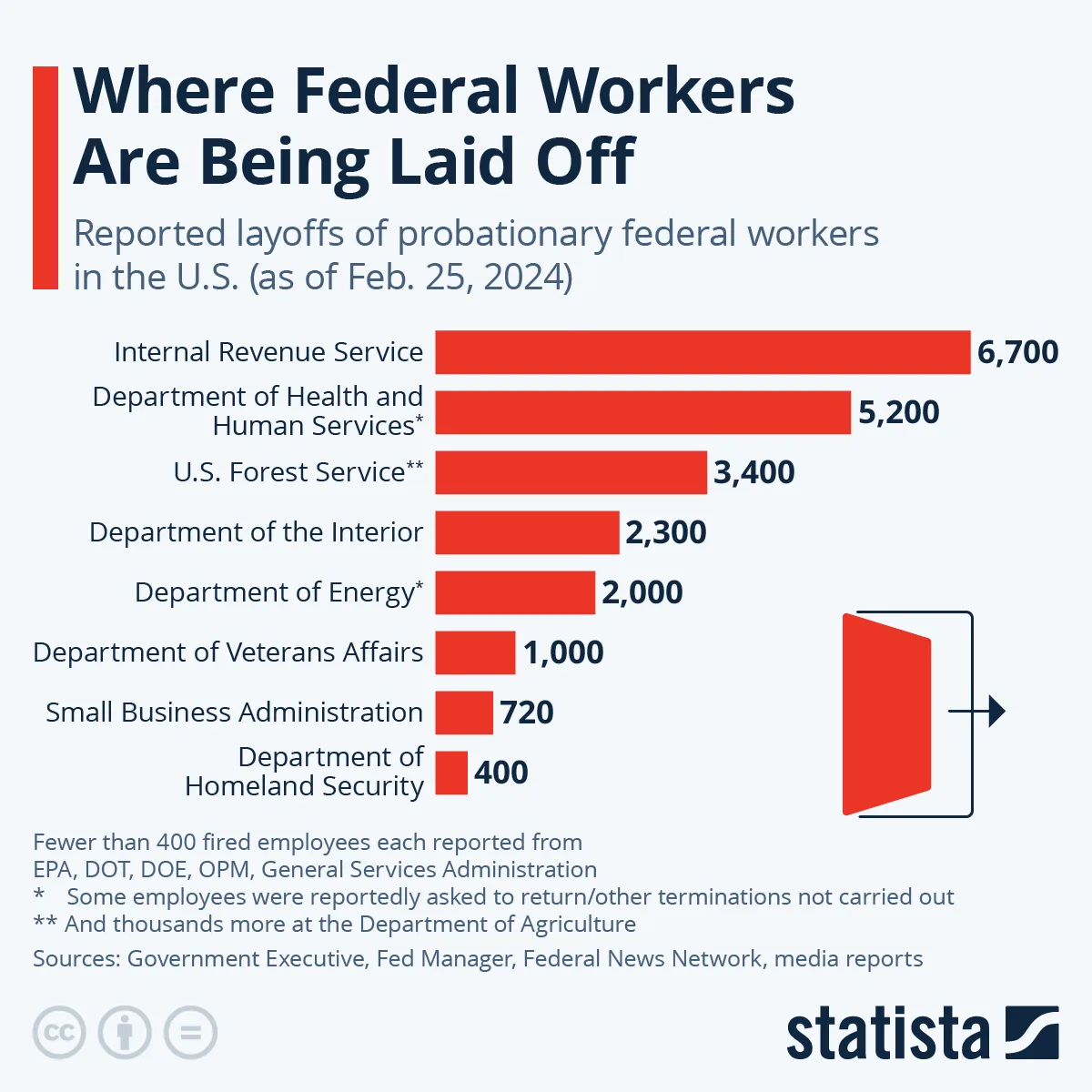
    As part of the government’s cost-cutting measures, the IRS stands out with a staggering report of 6,700 probationary employee layoffs. The Trump administration’s strategy specifically targets employees who lack civil service protections, often due to having less than two years of tenure. The rationale behind this decision is tied closely to budget constraints and a need for efficiency within federal agencies.

    Circumstances Surrounding IRS Layoffs

    The timing of these layoffs is critical, coinciding with the ongoing tax filing season, which traditionally constitutes one of the busiest periods for the IRS. Notably, roles deemed vital to tax processing and customer service during this peak season are exempt from these layoffs. This exemption indicates a strategic approach, avoiding disruption in essential services while still adhering to the broader policy of workforce reduction.

    Broader Layoffs Across Federal Agencies

    Beyond the IRS, the layoffs extend to several other notable agencies as the administration seeks to streamline operations. Here’s a closer look at the numbers and effects in various departments.

    Department of Health and Human Services

    In mid-February, reports indicated that approximately 5,200 employees would receive termination notices from the Department of Health and Human Services (HHS). This plan included substantial cuts at the Centers for Disease Control and Prevention (CDC), where 1,300 jobs—about 10% of the workforce—were at risk. Such cuts raise significant concerns about the agency’s capacity to maintain public health standards amid ongoing health crises.

    National Institutes of Health and FDA

    The National Institutes of Health (NIH) and the Food and Drug Administration (FDA) also faced staff reductions. Reports indicated layoffs impacting many essential healthcare professionals, including nurses. However, the necessity of certain roles for critical product reviews led to a reversal of some FDA cuts, illustrating the delicate balance between workforce reduction and maintaining public safety and health.

    Layoffs in Environmental and National Park Services

    The U.S. Forest Service faced significant staffing challenges, with plans to lay off 3,400 employees, accounting for about 10% of its workforce. This decision has raised alarms about the agency’s ability to manage wildfire risks, particularly given the current climate conditions that exacerbate fire threats across the nation.

    Impact on Local Communities

    The layoffs have broader implications, especially in rural areas that depend heavily on these federal jobs. States like Oregon and Montana, where many federal employees live and work, could see adverse economic impacts from such terminations. Local economies that rely on federal employment may struggle as these layoffs could lead to decreased spending and loss of public services.

    Additional Concerns Across Various Departments

    The Environmental Protection Agency (EPA) is also under scrutiny for potential layoffs, with similar concerns raised regarding the Department of Homeland Security’s U.S. Cybersecurity and Infrastructure Security Agency and the Federal Aviation Administration (FAA). These terminations have sparked worries about the long-term ramifications for national security and environmental protection.

    The Context of Federal Employment Cuts

    Despite the substantial numbers, it’s important to place these layoffs in context. Combined with the nearly 75,000 federal employees who accepted buyouts under the Trump administration, the layoffs represent less than 4% of the total 2.4 million non-military and non-postal federal workforce. Such figures reveal ongoing efforts to reshape the federal landscape, but they also highlight potential pitfalls regarding workforce morale and legal challenges stemming from the terminations.

    The Legal Landscape of Layoffs

    Layoffs of probationary employees can lead to complex legal challenges, especially considering that performance issues have been cited as a reason for many terminations. The potential for appeals against these decisions can complicate the administration’s goals of streamlining government operations. As the administration pushes forward with these layoffs, the impending legal disputes could reshape discussions around federal employment policies moving forward.

    Overall Implications for the Federal Workforce

    The overarching narrative surrounding these layoffs showcases a pivotal moment for the federal workforce in the United States. While the immediate goal may be financial efficiency, the long-term effects on public service delivery, community stability, and employee morale warrant close attention in these uncertain times. As layoffs continue to unfold across various enforcement and service sectors, the implications for American workers and citizens alike will remain profound and far-reaching.