الوسم: federal agencies

  • US Officials Rally Behind Trump in Battle Against the ‘Deep State’

    US Officials Rally Behind Trump in Battle Against the ‘Deep State’

    A collection of government records and a knowledgeable source reveal that dozens of officials from various federal agencies, including U.S. intelligence, have been involved in guiding President Donald Trump’s efforts for retribution against perceived enemies. This group, known as the Interagency Weaponization Working Group, has been meeting since at least May and comprises personnel from the White House, the Office of the Director of National Intelligence, CIA, DOJ, DOD, FBI, DHS, IRS, FCC, and other agencies, according to multiple documents.

    Trump’s executive order on inauguration day directed the attorney general to collaborate with federal agencies to identify and rectify past misconduct related to the weaponization of law enforcement and intelligence agencies. Earlier this year, Attorney General Pam Bondi and DNI Director Tulsi Gabbard announced internal groups aimed at uncovering and addressing alleged misuse of government power against Trump.

    Following a request for comment from Reuters, Fox News reported that Gabbard established this group, with key details previously unreported. Several U.S. officials confirmed to Reuters that the group exists, asserting its primary purpose is to implement Trump’s executive order.

    A White House official, speaking anonymously, stated that the reporting is not new. ODNI spokesperson Olivia Coleman emphasized that “Americans deserve a government dedicated to deweaponization, depoliticization, and safeguarding against the misuse of power.”

    The existence of this interagency effort suggests a broader, more organized push to leverage government authority against those Trump and his allies perceive as opponents—what they refer to as “weaponization.” The term is used to describe unfounded claims that officials from previous administrations abused their authority to target Trump during his impeachments, criminal prosecutions, and the investigation into Russian interference in the 2016 election.

    The group’s mission appears to be centered on targeting what is often called “the Deep State,” a term Trump and supporters use to describe their perceived adversaries within the Obama and Biden administrations, as well as in his first term.

    While the exact scope and actions of the group remain unclear—and there is no evidence that Trump personally directs its operations—many involved are vocal supporters of the former president. Among those in the group are individuals who have publicly amplified false claims of election fraud and opposition to vaccine mandates, aligning with Trump’s narratives.

    Notably, the group discusses high-profile figures such as former FBI Director James Comey, Dr. Anthony Fauci, and military leaders involved in COVID-19 vaccination efforts. There are also allegations of discussions involving Hunter Biden and even former President Joe Biden’s son, though official sources deny these claims.

    Over 20 government records reviewed by Reuters reveal the participation of 39 individuals, including some whose previous roles and public statements strongly support Trump or have propagated election denial claims. These participants include current and former officials from multiple agencies, as well as outspoken opponents of the COVID-19 vaccine mandate.

    An influential figure in the group is Justice Department attorney Ed Martin, who previously failed to secure Senate confirmation as U.S. Attorney for D.C. due to concerns over his support for the Capitol rioters. Martin also oversees Bondi’s DOJ weaponization initiative and acts as the department’s pardon attorney.

    The group appears to have explored issues such as the Russia investigation, the prosecution of January 6 defendants, and potential disciplinary actions against certain officials or entities, including discussions around the Jeffrey Epstein case and security clearance revocations for transgender officials, although official responses deny or downplay some of these activities.

    Many involved have been outspoken Trump supporters, with some amplifying baseless election fraud theories. For instance, Andrew McCoy “Mac” Warner, now with the Justice Department, has claimed that the CIA “stole” the 2020 election from Trump. Several other individuals, including White House aides, Justice Department officials, and former FBI agents, are linked to the group, with some actively promoting conspiracy theories and false narratives.

    The group’s leadership reportedly includes ODNI official Paul McNamara, an aide to Gabbard who oversees the Director’s Initiatives Group. This unit has faced bipartisan scrutiny, with Congress demanding transparency about its members, roles, and security clearances.

    Although the group’s powers and specific activities remain uncertain—whether it acts in a purely advisory capacity or has authority to direct agency actions—its existence signals a systematic effort within the government to scrutinize and potentially target perceived political enemies using federal resources.

  • Trump Urges Supreme Court to Lift Ban on Federal Job Cuts

    Trump Urges Supreme Court to Lift Ban on Federal Job Cuts

    Protesters displaying support outside the Sam Nunn Atlanta Federal Center on April 2, 2025. — Reuters

    On Monday, the Trump administration urged the U.S. Supreme Court to intervene and lift a court ruling that halted widespread layoffs and the restructuring of government agencies. This move is part of President Trump’s initiative to downsize and reorganize the federal government, according to Reuters.

    The appeal from the Justice Department came after U.S. District Judge Susan Illston of San Francisco issued a ruling on May 22, siding with a coalition of unions, non-profit organizations, and local governments that challenged the planned cuts.

    The dispute touches on several federal departments, including Agriculture, Commerce, Health and Human Services, State, Treasury, and Veterans Affairs.

    The Justice Department stated in its filing that managing the workforce of federal agencies is a fundamental aspect of the presidency’s authority. “The Constitution does not create a presumption against the president exercising control over agency personnel, nor does he require special approval from Congress to utilize core Article II powers,” the filing noted, referencing the section of the Constitution that outlines presidential authority.

    The Supreme Court has requested a response from the plaintiffs involved in the case by June 9.

    In February, Trump instructed federal agencies to quickly prepare for significant layoffs as part of his restructuring efforts.

    In her ruling, Judge Illston asserted that Trump exceeded his executive powers in ordering these reductions. “Historically, the president can broadly reorganize federal agencies only if Congress authorizes it,” she wrote.

    Initially, on May 9, Illston restricted approximately 20 agencies from implementing large-scale layoffs for two weeks, and she ordered that employees who had been laid off be reinstated. Most of this relief was maintained in her subsequent ruling on May 22.

    The 9th U.S. Circuit Court of Appeals also rejected the Trump administration’s request to pause Illston’s decision in a 2-1 vote on May 30.

    The 9th Circuit indicated that the administration failed to demonstrate that it would face irreparable harm if the judge’s order remained in effect and noted that the plaintiffs were likely to succeed in their legal challenge.

    “The executive order in question significantly surpasses the president’s supervisory powers under the Constitution,” the 9th Circuit noted, describing the administration’s actions as “an unprecedented attempt to restructure the federal government and its operations.”

    Since returning to office in January, Trump’s administration has sought relief from the Supreme Court in a growing number of cases following lower court decisions that have obstructed various policies.

  • 65% of Americans Oppose Closing Department of Education

    65% of Americans Oppose Closing Department of Education

    Understanding the Push to Dismantle the Department of Education

    In a bold move that resonated across the educational landscape, President Donald Trump signed an executive order aimed at dismantling the Department of Education. This initiative is rooted in his promise to shift educational authority back to parents, states, and local communities. The directive titled “Improving Education Outcomes by Empowering Parents, States, and Communities” directly instructs Education Secretary Linda McMahon to initiate this transition, making it clear that the administration is serious about reshaping America’s educational governance.

    Trump’s Vision for Education

    The executive order reflects a long-held campaign promise by Trump, who envisioned a system where educational power is decentralized. He often expressed a desire to reduce the federal government’s role in education and believed that states and parents should play a more significant role in shaping educational policy. The appointment of Linda McMahon, who was previously the head of the Small Business Administration, was intended to facilitate this vision, with Trump stating she should "put herself out of a job."

    Linda McMahon’s Initial Approach

    Upon her confirmation, McMahon articulated an ambitious “final mission” for the Department of Education. Her speeches resonated with Trump’s core messages, emphasizing the elimination of bureaucratic hurdles, and a return of educational decision-making authority to state and local entities. She consistently referred to the department’s mission as "final," which implied a significant transformation—or even the potential elimination—of the department itself. In her address to the staff, she expressed hope that they could make "American education freer, stronger, and with more hope for the future."

    Response from Legislators

    Opposition to the dismantling of the Department of Education has emerged from various quarters, particularly from Democratic senators. A letter signed by 38 senators highlighted their concerns regarding the implications of such a move. They emphasized that during a time of considerable income and wealth inequality, the actions taken by the Trump administration could undermine access to quality education for students across the country. This sentiment reflects a broader anxiety about the impact of federal education policy changes on vulnerable populations.

    Public Sentiment on Education Policy

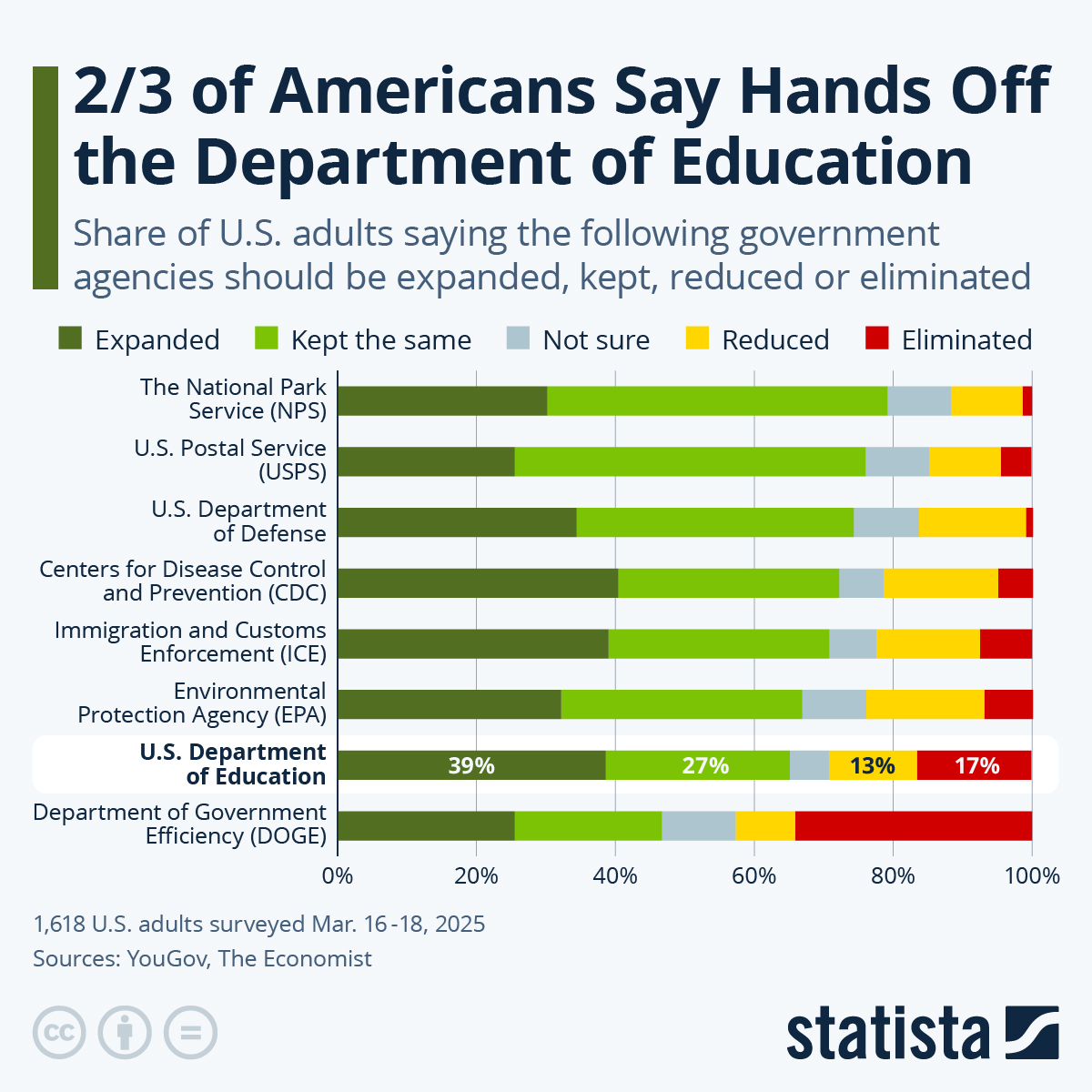
    A survey conducted by YouGov and The Economist reveals significant public sentiment against closing the Department of Education. The majority of Americans expressed a preference for either expanding the department (39 percent) or keeping it as it currently stands (27 percent). In contrast, only 13 percent supported reducing its size, while 17 percent called for its outright elimination. This divergence of opinion underscores a critical tension between the Trump administration’s goals and the general public’s expectations for educational governance.

    Insights from Survey Data

    The survey data further indicates that a notable 46 percent of U.S. adults believe that federal cuts to educational agencies, including the Department of Education, have been excessive. Only a quarter of respondents consider the cuts to be appropriate, while a minority feel that they have not gone far enough. Intriguingly, 34 percent of those surveyed suggested that the newly established Department of Government Efficiency (DOGE) should itself be abolished—a response that reflects skepticism about the administration’s efficiency reforms.

    Implications for the Future of Education

    The ongoing debate surrounding the Department of Education poses significant questions about the future of education policy in the United States. With mixed public opinion and strong opposition in Congress, the outcome of Trump’s plans remains uncertain. The broader implications of dismantling such a pivotal department could affect educational standards, equity, and access across various demographics, particularly for those who rely on federal support for education quality and funding.

    Through these developments, we are witnessing a fundamental clash of ideologies regarding the role of government in education—a debate that promises to have lasting ramifications for the American educational landscape.