Digital Phablet – Sydney Sweeney’s Success in Euphoria Sparks Conversation About Her Image
Sydney Sweeney’s compelling and courageous performance in Euphoria has quickly placed her among Hollywood’s emerging stars. Yet, industry experts now express concerns that the intense focus on the show’s provocative content might threaten her public image if discussions shift away from her acting abilities.
Analysts warn that some scenes from Sweeney’s role in Euphoria could potentially impact her career prospects. Since the third season’s debut on April 12, Sweeney has been a prominent topic online. While branding specialists believe her current visibility benefits her, they also caution that if her portrayals are overshadowed by viral clips and controversies, Hollywood’s perception of her may change. Dave Quast, the founder of EDQ Strategies, explains that her breakout success stems partly from her fans perceiving her as a bold and daring actress on screen.
“Euphoria has clearly established Sydney Sweeney as a fearless performer, both physically and emotionally,” Quast states. “That’s a key reason she has broken through the ranks. However, the danger lies in public discussions simplifying her complex performances into mere sensational images. If conversations focus more on the sexual elements than her acting craft, it could narrow her brand’s boundaries,” he warns.
Sexuality in film and television, according to Quast, doesn’t necessarily undermine an actor’s credibility. The bigger concern, he suggests, is when audiences begin to associate an actor solely with a specific image or stereotype. “The challenge isn’t her performing in sexualized roles,” he emphasizes. “It’s making sure those moments are viewed as deliberate character choices and not the entirety of her professional identity.”
Despite these concerns, industry experts agree that Sweeney’s high profile remains a significant asset in today’s entertainment world. “Visibility is power,” Quast remarks. “She’s one of the few young actresses consistently able to generate conversations across a broad spectrum of topics. That kind of recognition has substantial commercial value.”
In summary, while Sweeney’s bold roles and public perception continue to place her squarely in the spotlight, industry observers advise that managing her brand carefully is crucial. Balancing her daring performances with strategic public relations can help ensure her continued success in Hollywood’s competitive landscape.
“Explaining it to me as if I were a fifth grader.” This phrase, or some variation of it, frequently appears on social media platforms when discussing how AI can help simplify complex topics. It’s a prime example of how artificial intelligence is being used to aid in education. However, experts warn against fully relying on AI tools like ChatGPT to summarize scientific research and academic papers.
What’s the broader perspective?
Academic papers are often filled with technical jargon and complicated language, which can make it challenging for the average person to understand the significance of the discoveries they describe. This is where science journalists come into play, creating concise articles that translate technical findings into language that’s accessible to a broader audience.
The same group has recently explored the idea of using ChatGPT to summarize scientific articles. They conducted a year-long assessment to see if the AI could accurately convey complex scientific information in a simplified manner. The findings revealed that while ChatGPT can generate summaries, it tends to sacrifice accuracy for simplicity and often requires extensive editing. The model also tends to overuse words like “groundbreaking,” leading to overhyping of scientific achievements.
What’s the main takeaway?
During the test, the team used the paid version of ChatGPT to produce three different summaries of two research papers weekly. Human experts then evaluated these summaries. The results showed that although ChatGPT isn’t a complete failure, it struggles with the subtleties essential to scientific communication. The AI often falls short when it comes to conveying nuanced details critical to understanding scientific research accurately.
One researcher pointed out that ChatGPT cannot effectively synthesize or translate scientific findings for non-expert audiences. The chatbot is prone to overhyping findings, struggles to clearly explain its limitations, and has difficulty when discussing multiple research events within a single context.
A human writer shared that relying on ChatGPT for summaries could erode trust. When faced with dense and detailed research, the AI tends to default to jargon and overstate its conclusions, especially when challenged with complex information.
In conclusion:
While AI has promising potential to assist in making science more understandable, current tools like ChatGPT still have significant limitations. They’re useful for quick overviews but aren’t yet reliable enough to replace expert interpretation when accuracy and nuance are crucial, particularly in scientific communication.
Fantasy Finds is the inaugural DLC for Two Point Museum, bringing a brand-new frozen biome for your creative building options, along with the Scorched Earth expedition map. To gather fresh exhibits from this map, you’ll need to recruit Fantasy Experts, or as we like to call them, a team of adventurers!
Fantasy Experts have similarities with other types of specialists, but they also add a unique twist to expeditions. This means enhanced challenges and new strategies during their training, calling for more careful planning. Here’s what you need to know.
How to Recruit Fantasy Experts
Fantasy Experts do not show up in the regular hiring pool. To enlist these adventurers, you will have to specifically advertise for the position, similar to how you would for other expert types. Simply hit the Advertise Job button located at the bottom of the available experts list, and you’ll start seeing candidates in approximately a week.
Tip: Since they’re adventurers at heart, you’ll need to extend a quest for them to show interest!
If you haven’t logged in since the game launched, you might notice that you can now spend more on advertising to attract additional applicants for the role. When looking to hire Fantasy Experts, it’s wise to aim for the full three applicants, as they come in various classes, each focusing on a different specialization. A diverse group of heroes is essential to tackle the challenges posed by the Scorched Earth map, so hiring multiple classes simultaneously is recommended.
Fantasy Experts: Stats and Classes
Fantasy Experts come equipped with four Fantasy Stats that can influence the success of their expeditions: Strength, Dexterity, Intelligence, and Luck. Each of these experts fits into one of four classes, with each class specializing in one of the four Fantasy Stats:
Class
Best Stat
Barbarian
Strength
Rogue
Dexterity
Wizard
Intelligence
Bard
Luck
Additionally, each Fantasy Expert starts with a randomly selected Trait that gives a minor boost to one of the Fantasy Stats that isn’t their primary focus.
Increasing Fantasy Stats
Every time a Fantasy Expert achieves a Rank, they earn one Skill Point that can be used to enhance one of their Fantasy Stats. To do this, select the expert and click the Upgrade button found in their panel’s Class section.
Note: If the expert has no Skill Points available, the Upgrade button will not be visible.
You can use the plus and minus buttons to add Skill Points and then click Confirm to finalize your choices. Bear in mind that once you confirm, the Skill Points cannot be refunded.
Sometimes, while on expeditions, Fantasy Experts may acquire Traits that boost their Fantasy Stats without using any Skill Points, making it worth your while to send them out frequently for potential upgrades.
Utilizing Fantasy Stats on Expeditions
Fantasy Stats have no impact when the expert is at the museum. Their influence is felt only on expeditions, where they can either activate or deactivate events.
The expeditions in Scorched Earth present various events that your team’s abilities can affect. Many of these events depend not only on the overall Rank of team members but primarily on the combined total of a specific Fantasy Stat of the expedition crew.
As an example, you might need a combined Strength of 25 to overcome one challenge and a Dexterity of 40 for another.
While many of the requirements can be quite demanding, you can still utilize cargo items, such as Curse Counters and First Aid Kits, to neutralize certain hazards.
Mixing Fantasy and Non-Fantasy Experts
Certain expeditions in Scorched Earth may require your Fantasy Experts to partner with an expert from another field. However, since only Fantasy Experts possess Fantasy Stats, the “guest” won’t contribute to any events that necessitate these stats.
Conversely, if a Fantasy Expert joins an expedition outside of Scorched Earth, their Fantasy Stats will not be applicable. Nonetheless, in both situations, experts can still utilize Qualifications they’ve earned in the Training Room where relevant.
Understanding the Disconnect: Public Perception of AI
Artificial Intelligence (AI) has become a ubiquitous presence in our daily lives, subtly influencing numerous activities without drawing much attention. However, there exists a notable gap between the understanding of AI among the general public and that of experts in the field.
The Pervasiveness of AI in Daily Life
AI technology has advanced significantly in recent years, seamlessly integrating into various aspects of everyday life. From smartphone cameras that use machine learning algorithms for image enhancement to streaming services like Spotify that curate personalized playlists, AI is omnipresent. Social media platforms likewise employ AI to tailor user experiences, using algorithms that analyze behavior and preferences, often without the user’s conscious awareness.
Differing Perspectives: General Public vs. Experts
A survey conducted by the Pew Research Center highlights a striking contradiction in perceptions regarding AI usage. Only 27% of U.S. adults believe they interact with AI on a frequent basis, whether that be daily or several times a day. In stark contrast, 79% of AI experts—those actively engaged in AI research or application—believe that Americans engage with AI technology much more regularly.
Public Underestimation
Many in the general public tend to view AI primarily through the lens of recognizable applications, such as virtual assistants (e.g., Siri, Alexa) or chatbots like ChatGPT. This narrow view contributes to the underestimation of AI’s role in day-to-day life. For instance, few may realize that many online shopping experiences, customer service interactions, and even healthcare services are increasingly driven by AI technologies that work behind the scenes.
Expert Insights
AI experts, on the other hand, possess a broad understanding of machine learning applications and recognize that AI operates at various levels across numerous sectors. Their perspective encompasses a wide array of technologies, including those used in data analysis, natural language processing, and autonomous systems. This informed viewpoint gives them a much clearer picture of how prevalent AI truly is in everyday functions.
Implications of Misunderstanding AI
The disconnect in perception poses several challenges. As AI continues to evolve, misconceptions may lead to public resistance towards adopting new AI-driven technologies. Additionally, if people do not grasp the full scope of what AI entails, it hampers their ability to make informed choices regarding its use.
The Importance of Education
To bridge this gap, a broader educational effort is required to demystify AI for the general public. Enhancing public understanding of the various applications of AI can empower individuals to navigate this technology more effectively and make conscious decisions regarding its use.
Navigating Risks and Benefits
Understanding AI not only highlights its benefits but also prepares individuals to assess potential risks. By fostering a more accurate awareness of what AI is and how it operates, individuals can better evaluate the implications of AI-powered services and advocate for ethical standards in AI development.
The Future of AI Awareness
As AI technology continues to advance, fostering a more informed public discourse surrounding AI will be crucial. Initiatives aimed at raising awareness of AI applications in daily life can significantly enhance public comprehension, ultimately leading to wiser, more informed engagement with this transformative technology.
“This hurts. I know it wasn’t a real person, but the relationship was still real to me,” laments a Reddit user. “Don’t discourage me; this has been truly fulfilling, and I want it back.”
Clearly, the individual is expressing feelings for ChatGPT. This phenomenon isn’t a new development, and given the nature of chatbots, it’s not entirely surprising.
Imagine a companion that is always ready to listen, doesn’t complain, rarely quarrels, shows sympathy, is rational, and possesses a vast wealth of knowledge amassed from all corners of the internet. It sounds like the ideal partner, doesn't it?
Interestingly, the creators of this technology, a San Francisco-based firm called OpenAI, recently conducted research revealing a correlation between increased chatbot usage and feelings of loneliness.
Voice mode of ChatGPTNadeem Sarwar / Digital Trends
Despite these findings and similar cautions, people continue to turn to AI chatbots for companionship. Some seek comfort, while others claim to find partners they value just as much as their human relationships.
Conversations in platforms like Reddit and Discord can become heated as users express their sentiments under the cloak of anonymity. These debates often remind me of a quote from Martin Wan at DigiEthics: “To view AI as a partner in social interactions is a fundamentally erroneous use of artificial intelligence.”
The Impact is Swift and Real
Four months ago, I met a broadcast veteran who has spent more time behind the camera than I’ve spent in the world. While sharing a late-night espresso in a quiet cafe, she inquired about the current buzz around AI as she considered a role intersecting human rights, authoritarianism, and journalism.
Instead of delving into the technicalities of transformer models, I opted for a live demonstration. I presented her with several research papers discussing the impact of immigration on Europe's linguistic and cultural identity over the last century.
In under a minute, ChatGPT processed the documents, provided an insightful summary of key points, and accurately answered my questions. Transitioning to voice mode, we engaged in a spirited discussion about the folk music traditions of India’s lesser-explored Northeastern states.
Her disbelief was visible as she remarked, “It communicates just like a real person.” Watching her astonishment was delightful. After our extensive chat, she typed with hesitation: “Well, you seem quite charming, but you can't possibly be right about everything.”
Recognizing the moment, I shared an article about the growing trend of individuals forming emotional bonds with AI partners, even going so far as to claim they wish to have children with them. To say she was stunned would be an understatement.
Perhaps it was too much intrigue for one evening, so we parted ways, promising to keep in touch and exchange travel tales.
Meanwhile, the world continues to evolve at an astonishing rate, with AI increasingly at the center of geopolitical changes. Yet, the more intimate undercurrents include those of individuals developing feelings for chatbots.
Calm Beginnings, Dark Progress
Reddit / Digital Trends
Recently, The New York Times featured a story about how users are falling for ChatGPT, an AI chatbot that has made waves in the generative AI space. At its core, ChatGPT facilitates conversation.
When prompted, it can execute tasks like ordering dessert from a local bakery. While it’s not the purpose of most chatbots to make humans susceptible to affection, it has become a reality.
HP Newquist, an accomplished author and technology analyst known for his insights on AI, points out that this trend isn't new. He references ELIZA, one of the first AI programs created in the 1960s.
“Though primitive, users frequently interacted with it as if it were a real person, forming attachments despite its limitations,” he reflects.
Today, our interactions with AI can come across as equally “real,” even when they lack genuine emotion. This creates a complex dilemma.
Chatbots can be enticing, but their inability to exhibit true emotions poses inherent risks.
Reddit / Digital Trends
Chatbots often continue conversations by responding to emotional cues provided by users, or even serving as passive observers. This behavior isn’t much different from social media algorithms.
“These systems mirror the user; as feelings intensify, so do their responses. In times of heightened loneliness, their reassurances become stronger,” notes Jordan Conrad, a clinical psychotherapist who studies mental health and digital interactions.
He cites a concerning 2023 case where a person took their own life after being encouraged by an AI chatbot to do so. “Under certain conditions, these bots can promote alarming behaviors,” he warns.
A Child of the Loneliness Epidemic?
A glance at the community of individuals captivated by AI chatbots reveals a recurring theme. Many are looking to fill a void or alleviate their isolation. Some are so desperate that they're willing to spend substantial sums to maintain their AI friendships.
Expert opinions echo these observations. Dr. Johannes Eichstaedt, a Stanford University professor specializing in computational social science and psychology, highlights the interplay between loneliness and the perceived emotional intelligence of chatbots.
Reddit / Digital Trends
He raises concerns about the deliberately designed nature of human-AI interactions and the unclear long-term consequences. When is it appropriate to halt such unbalanced connections? This is a critical inquiry that experts are grappling with, without established answers.
Komninos Chatzipapas, head of HeraHaven AI, a prominent AI companion platform with over a million users, acknowledges loneliness as a contributing factor. “These tools assist individuals with limited social skills in preparing for real-life interactions,” he explains.
“People often avoid discussing sensitive subjects due to fear of judgment, whether it's personal thoughts or even sexual preferences,” Chatzipapas adds. “AI chatbots provide a safe and private environment to explore these topics.”
Discussions of sexual intimacy are indeed a major attraction of AI chatbots. Since the introduction of image generation features, numerous users have flocked to these platforms—some with restrictions on explicit content, while others permit the creation of provocative visuals for deeper gratification.
Intimacy is Hot, but Further from Love
Over recent years, I've spoken with individuals who engage in flirty exchanges with AI chatbots. Some participants even possess relevant qualifications and have actively contributed to community initiatives from the start.
A 45-year-old woman, who prefers to remain anonymous, shared that AI chatbots serve as excellent platforms to discuss her sexual interests. She expressed that these interactions allow for safe exploration and preparation for real life.
Reddit / Digital Trends
However, not all experts agree with this perspective. Relationship specialist and certified sex therapist Sarah Sloan argues that individuals who develop romantic feelings for a chatbot are essentially creating an idealized version of themselves, since AI evolves based on user input.
“Forming a romantic connection with an AI chatbot might complicate matters for those already struggling with human relationships,” notes Sloan, highlighting that genuine partnerships require mutual negotiation and compromise.
Justin Jacques, a counselor with over two decades of experience, recalls a case where a client’s partner was emotionally and sexually unfaithful to them through an AI chatbot.
Jacques attributes this trend to rising isolation and loneliness, predicting that those with emotional needs will increasingly seek fulfillment in AI relationships. “As AI technology improves, we could see greater emotional connections with these bots,” he warns.
Such unforeseen consequences could distort the perception of intimacy for users. Certified sexologist Kaamna Bhojwani points out that AI chatbots have blurred the lines between human and non-human relationships.
"The concept of having a partner crafted exclusively for your satisfaction is unrealistic in real human interactions,” Bhojwani explains, cautioning that such experiences may exacerbate personal challenges in real life.
Nadeem Sarwar / Digital Trends
Her concerns are not without merit. One person who extensively used ChatGPT for a year articulated a belief that humans are unpredictable and manipulative. "ChatGPT listens to my feelings and allows me to express myself freely,” they expressed.
It’s challenging to overlook the warning signs here. The trend of developing feelings for AI continues to grow. As these systems become capable of conversing in strikingly human-like tones and reasoning, interactions are poised to become even more engaging.
Experts argue that safeguards are essential. However, the question remains: who will implement them, and how? We currently lack a definitive strategy for this challenge.
As the years roll on, CES continues to be a platform for unveiling state-of-the-art medical technology aimed at addressing long-standing health challenges. The year 2025 marked a turning point for regenerative medicine. During a captivating panel discussion at CES 2025, Jason Haider, CEO of Xenco Medical, and Veerle Dhaenens, general manager at Global Therapy Innovations for Terumo BCT, articulated the notion that we are at a significant “inflection point” — a juncture where diverse technological disciplines have converged and can collaborate effectively.
Digital Trends received compensation for considering coverage of these products. The brand had no input on the editorial content and did not influence the coverage.
Haider referenced a “1965 moment” during the discussion, alluding to the year Gordon Moore introduced Moore’s Law. This principle suggested that the number of transistors on computer chips doubles approximately every two years, serving as a metaphor for the rate of technological advancement, which later paved the way for a semiconductor revolution.
Haider believes that regenerative medicine is experiencing a similar pivotal moment. Advances in artificial intelligence, enhanced computer simulations, 3D printing, and a deeper comprehension of medical science—including gene editing and protein folding—have combined to accomplish feats that were once deemed unattainable.
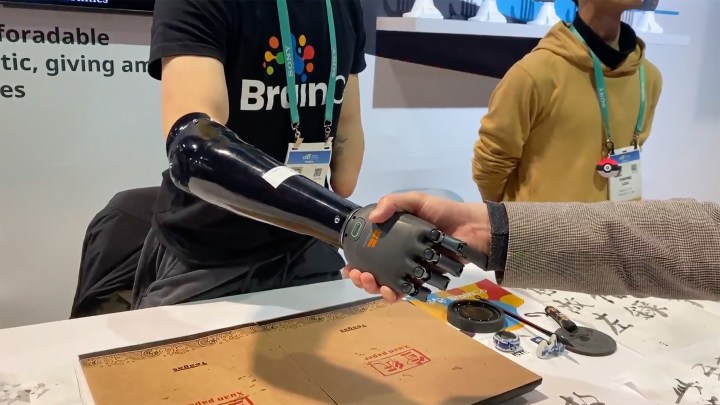
Jeremy Kaplan/Digital Trends / Brainco
Xenco Medical’s goal is to “calibrate” regeneration by carefully providing just the right amount of biomaterials—substances essential for guiding the body back to its natural state. This measured approach aims to minimize potential side effects, such as unintended bone growth.
Moreover, the company aspires to “cascade” regeneration. This strategy will enable the body to exceed its typical healing mechanisms. Xenco plans to equip surgeons with a variety of implants that differ in density and growth factors, ensuring each patient receives the most suitable option for their needs.
These advancements promise two transformative outcomes for the general public: the potential for more cost-effective treatments and enhanced medical accessibility over the next five to ten years, all while boosting the effectiveness of those treatments.
According to Xenco, the rise of in silico trials—computer-based simulations revealing how a drug or illness might impact an individual’s body—is central to the future of medicine. The FDA has indicated in a report that such trials are an inexorable trend, and advancements in AI technology will expedite growth in this arena.
Dhaenens highlighted that artificial intelligence could enhance the success rates of specific procedures dramatically, improving from 47% to 92%—a remarkable increase.
Both experts also discussed the COVID-19 pandemic, noting that while it was a tragic event, the rapid global response has been instrumental in propelling advancements in medical technology.
The rise of AI-driven conversational agents like ChatGPT has seen an explosion in popularity and usage. However, as companies look for monetization strategies, a pressing question arises: will the introduction of advertising impact the performance and user experience of these AI models? Experts are divided on this issue, presenting various viewpoints on the potential consequences.
Understanding ChatGPT’s Functionality
How ChatGPT Works
ChatGPT operates on complex algorithms that analyze and generate human-like text based on input prompts. Its performance relies heavily on:
Natural Language Processing (NLP): This technology enables the model to understand and generate human language effectively.
Training Data: The breadth and quality of data it has been trained on will determine the accuracy and relevance of its responses.
User Interaction: Real-time learning from user interactions allows continuous improvement over time.
Current Usage of ChatGPT
Many users rely on ChatGPT for various applications, including:
Creative writing
Customer support
Educational assistance
Idea generation
The need for an uninterrupted and high-quality experience drives concerns about introducing advertisements.
Perspectives from Experts
Potential Negative Impacts
Some experts caution against the introduction of ads within ChatGPT, citing several potential downsides:
Distraction: Ads may divert user attention from the primary function of the AI, leading to subpar interactions.
Latency Issues: Incorporating ads could slow down response times, affecting user satisfaction.
Compromised Credibility: Users might question the reliability of responses if they perceive ads influencing the content generated by the AI.
Possible Benefits
Conversely, not all experts view ads as detrimental. Some suggest possible benefits that advertising could bring:
Sustainable Revenue: Monetizing the platform through ads could ensure ongoing improvements and support for the AI.
Targeted Experiences: Well-implemented ads could enhance user experience by tailoring recommendations and content to individual user interests.
Increased Functionality: The revenue generated from advertisements might be used to expand features, integrating more advanced functionalities.
Strategies for Incorporating Ads
If advertising is to be implemented, experts propose several strategies to minimize potential drawbacks:
Contextual Relevance
Seamless Integration: Ads should align with user queries or interests, ensuring relevance without overshadowing the primary interaction.
Clear Separation: It’s essential to distinguish between AI-generated content and advertisements. Users should know when they are interacting with promotional material.
User Control
Opt-in Programs: Allowing users to choose whether they want to see ads can foster a more positive experience.
Feedback Mechanisms: Implementing ways for users to provide input on ad relevance can help refine the advertising experience.
Transparent Practices
Clear Guidelines: Communicating how ads will work and their potential impact on user interactions can build trust.
Data Privacy Considerations: Ensuring stringent data privacy measures will alleviate concerns about misuse of user information for advertising purposes.
In navigating the balance between monetization and user experience, the key will be a thoughtful approach that prioritizes user needs while exploring new revenue streams. The ongoing discussion about the role of advertising in platforms like ChatGPT reflects broader trends in technology and consumer expectations, making this a vital area for future exploration.