
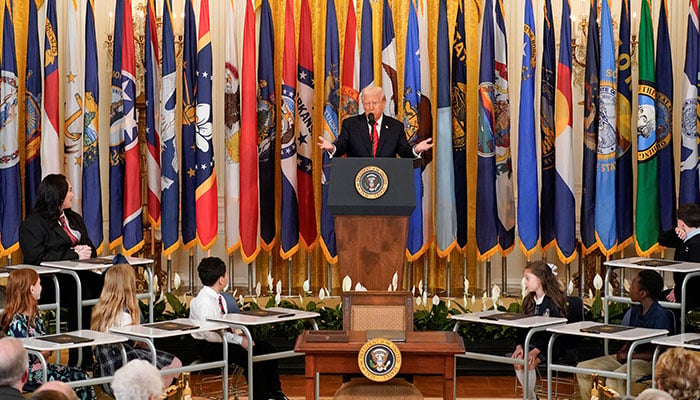
- President Donald Trump signs an executive order to revoke tariffs that were invalidated by the court.
- He announces a new 10% tariff on imports from all nations, effective immediately, layered atop existing tariffs, with certain exemptions like critical minerals, metals, and energy items, as stated by the White House.
- The Supreme Court’s decisive 6-3 ruling challenged the authority Trump and his trade representatives claimed to have used to influence foreign relations and global markets through tariffs.
- The decision briefly boosted U.S. stock markets, which then hovered with slight gains amid ongoing concerns about global market stability and potential future actions by Trump.
- Shortly after the ruling, Trump signed an order to cancel the previously struck-down tariffs and enacted new duties of 10% on most US imports for 150 days, with specific exclusions.
- The ruling raised questions about recent trade agreements negotiated under the threat of high tariffs and the $175 billion collected from US importers, which the court indicated may have been collected unlawfully.
- Trump criticized the court, expressing shame and accusing some justices of being unpatriotic and swayed by foreign interests, claiming they lacked the courage to do what’s right for the country.
- He suggested that, despite the court’s limits on his unilateral powers, there are still other ways to impose tariffs, including invoking emergency powers.
- The court emphasized that, absent a national emergency, the president does not have inherent authority to impose tariffs during peacetime, citing the Constitution’s explicit legislative powers.
- The decision stunned markets, injecting a new wave of uncertainty into trade policy after a tumultuous year of unpredictable tariff statements.
- Analysts predict a return to high tariffs, but with more complexity and less direct control for the presidency, possibly leading to legal challenges in extending tariffs.
- Trump invoked Section 122 of the Trade Act of 1974, allowing tariffs up to 15% for up to 150 days to address international payments issues, though this too could face legal scrutiny.




On Tuesday, President Biden signed an executive order aimed at ensuring that the artificial intelligence industry has ample computing power and electrical resources in the years ahead. The directive specifically opens up federal lands for the development of extensive data centers and clean energy facilities.
This order instructs federal agencies to expedite the approval processes for large-scale AI infrastructure projects on federal properties, increase the availability of federal locations for data centers and energy production, and seamlessly integrate these new infrastructures into local power grids. The Departments of Energy and Defense are each tasked with identifying three sites where private companies can construct AI data centers, followed by “competitive solicitations” for interested builders at those locations.
The executive order goes beyond merely facilitating AI projects; it implements several safeguards and stipulations for how these initiatives can be carried out. Specifically, it requires companies to finance the construction of their facilities and ensure they have sufficient clean energy sources to fully power the data centers upon their completion.
The race to achieve artificial general intelligence, coupled with the ambitious goal of developing larger language models, has ramped up the electricity and cooling demands of AI data centers in recent years. A report from the Department of Energy in December projected that electricity usage by data centers has tripled over the past decade and could potentially triple again by 2028.
Similarly, a report from JLL predicts that power demand for data centers will double by 2029. Additionally, the current trend sees data center infrastructure clustered in specific geographical areas, putting significant strain on local power grids and creating a risk of power delivery issues and increased instances of brownouts.
President Biden remarked in a prepared statement, “AI will have profound implications for national security and the potential to greatly enhance American lives if responsibly managed, from aiding in disease cures to helping communities withstand the effects of climate change.” He emphasized the importance of not taking America’s technological leadership for granted, stating that the nation should not compromise essential environmental standards while striving to remain at the forefront of technology.