الوسم: environmentally friendly

  • Scientists Harness Bacteria to Develop Cooling Material for Electronics & EVs

    Scientists Harness Bacteria to Develop Cooling Material for Electronics & EVs

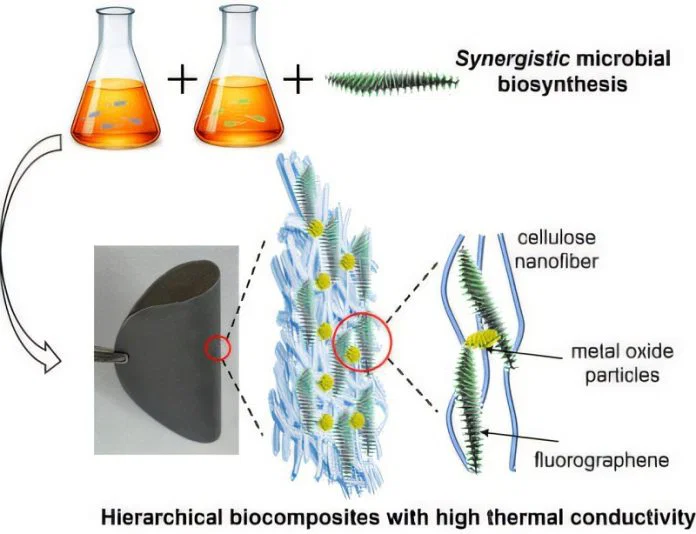
    Graphical abstract. Credit: Matter (2026).


    As electronics like computers, electric vehicles, and advanced gadgets increase in power, they generate more heat.

    Excess heat can slow down devices, diminish performance, shorten their lifespan, and even cause damage to critical components. Improving heat dissipation methods has become one of the main challenges in modern electronic design.

    Now, researchers at the University of Tennessee, Knoxville, have come up with a unique solution: harnessing bacteria to develop high-efficiency cooling materials.

    This innovative approach offers an eco-friendly way to produce thermal interface materials—thin layers placed between electronic components and cooling systems.

    These materials fill microscopic gaps that can trap air, aiding in the transfer of heat from hot electronic parts to cooling devices like heat sinks.

    The study, published in *Matter*, shows that the bacteria-derived material can conduct heat five to ten times better than many traditional thermal interface products.

    Led by Dr. Weinan Xu, an assistant professor in materials science and engineering, the team avoids traditional manufacturing methods that consume large amounts of energy. Instead, they use bacteria to help create the material under much gentler conditions.

    The process begins by feeding certain bacteria sugar, which fuels their growth. Metal ions are also supplied to act as building blocks for the final product.

    As the bacteria multiply, they naturally produce both organic and inorganic substances that combine into a highly effective heat-conducting structure.

    One major benefit of this method is that everything occurs at room temperature in water, unlike conventional techniques that require high heat, harsh chemicals, and significant energy input.

    This bacteria-based process sidesteps many environmental issues associated with traditional manufacturing, while yielding a material with superior cooling performance.

    Effective cooling is especially crucial as modern electronics demand more power.

    Powerful computers, AI systems, electric vehicle batteries, drones, and military gear all generate substantial heat during operation. Improved cooling methods enable these systems to run faster, more reliably, and for longer periods without overheating.

    The research has already attracted interest from DARPA, the U.S. Defense Advanced Research Projects Agency, which is funding efforts to develop next-generation cooling solutions for military electronics and energy storage. The agency focuses not just on performance but also on cleaner, more sustainable manufacturing processes.

    Beyond electronic cooling, the scientists believe this bacteria-based technique could have other applications. It might help recover valuable rare earth elements used in electronics and renewable energy tech. Additionally, the structures created by bacteria could be compatible with biological tissues, opening doors for biomedical uses such as tissue engineering and medical research.

    Although promising, the technology still requires refinement. Currently, producing enough material can take days or even weeks. Researchers are working to shorten this timeline and lower costs, aiming for large-scale manufacturing.

    Xu’s team is also collaborating with industry partners to explore commercial opportunities, including cooling solutions for computers, EV batteries, drones, and other high-power electronic devices.

    If scaled successfully, bacteria-based manufacturing could lead to more affordable, environmentally friendly cooling materials—enhancing device performance and reliability while minimizing ecological impact.


  • Innovative Lithium Extraction Reaches 95% Recovery Using Minimal Freshwater

    Innovative Lithium Extraction Reaches 95% Recovery Using Minimal Freshwater

    As worldwide demand for electric vehicles, smartphones, and renewable energy storage grows, so does the need for lithium, a crucial component in modern batteries.

    Researchers at Monash University have developed a new technique that could make lithium extraction more efficient and environmentally friendly. This innovative method achieves about 95% recovery of lithium from salt mixtures while using minimal water and less energy compared to traditional processes.

    Their findings were published in Environmental Science & Technology.

    Most of the world’s lithium is sourced from underground brines—salty waters trapped beneath dry salt lakes. Extracting lithium from these brines is often a slow, resource-intensive process, typically involving large evaporation ponds that consume significant freshwater and take months or even years to yield usable lithium.

    Led by Professor Huanting Wang, Dr. Zhikao Li, and Ph.D. student Pan Liu, the Monash research team took a different route. Instead of directly extracting lithium from liquid brines, they first transformed the brine into solid salt mixtures. They then used common industrial solvents, like ethanol and acetone, to selectively dissolve the lithium-containing salts, leaving many unwanted salts behind.

    This works because different salts dissolve to different extents in various solvents. By exploiting these natural solubility differences, the team was able to efficiently separate lithium without relying on large volumes of freshwater.

    Removing impurities, such as boron and sulfate, is one of the biggest challenges in lithium extraction. The new process effectively filters out these contaminants, producing high-purity lithium suitable for battery manufacturing.

    The researchers also prioritized sustainability by incorporating a solar-powered evaporation system to recover and reuse the solvents. This system uses sunlight to drive the evaporation process, significantly reducing energy consumption.

    The results were remarkable—with over 99% of the solvents recovered and recycled using only solar energy. This approach not only cuts down on environmental impact but also minimizes waste, reduces freshwater use, and lowers energy demands—all while maintaining high lithium recovery rates.

    This breakthrough has already resulted in a patent application, underscoring its potential for commercial use.

    According to the researchers, this technology offers a viable path toward cleaner lithium production, which is increasingly vital as global demand continues to surge. Given the projected needs of electric vehicles and renewable energy systems, developing more sustainable extraction methods is essential.

    If scaled up for industrial manufacturing, this innovative process could help meet future lithium needs while reducing the environmental footprint typically associated with conventional extraction methods.

  • A Basic Shake Might Revolutionize Graphene Manufacturing

    A Basic Shake Might Revolutionize Graphene Manufacturing

    Scientists have discovered a new way to produce ultra-thin materials like graphene using simple vibrations at room temperature. This approach could greatly speed up production, reduce costs, and lessen environmental impact, paving the way for broader applications in electronics, energy systems, and cutting-edge technologies.

    Led by Jason Stafford at the University of Birmingham, the research, published in Small, aims to improve the manufacturing process for two-dimensional (2D) materials—extremely thin sheets made from just a few layers of atoms. These materials, such as graphene, are valued for their unique properties that are not found in traditional materials. They are highly conductive, incredibly strong, and ideal for next-generation devices including flexible electronics, sensors, and energy storage solutions. Other notable 2D materials include hexagonal boron nitride, which acts as an insulator, and molybdenum disulfide and tungsten disulfide, which are used in advanced optical and electronic applications.

    Although scientists have known how to create these materials in labs for years, scaling up production for industrial use has remained a major challenge. Conventional techniques often involve intense mechanical forces, lengthy processing times, and large quantities of chemical solvents—methods that are slow, expensive, environmentally damaging, and can compromise material quality by causing defects or contamination.

    This innovative method shifts away from harsh mechanical or chemical processes. Instead, researchers apply high-frequency vibrations to gently separate layers from bulk materials within a liquid environment. The process takes place at room temperature, using water and a natural compound called tannic acid, which is affordable and eco-friendly. When vibrated in this medium, particles bend and fold at their edges, eventually splitting into thinner layers and peeling off into nanosheets only a few atoms thick. Remarkably, visible changes occur within minutes.

    Using advanced imaging techniques and computer models, the team confirmed the mechanism behind this process. They observed that vibration enhances the yield, producing larger quantities of material at higher concentrations compared to traditional methods. Importantly, the quality of the nanosheets remains high, free from defects commonly introduced by more aggressive procedures.

    This breakthrough addresses one of the biggest hurdles in the field: producing graphene and similar materials on a scale large enough for real-world applications. Existing production methods are costly and inconsistent, limiting industrial uptake. The new vibration-based approach offers a faster, cleaner, and more scalable alternative, enabling easier integration of 2D materials into products like electronics, advanced coatings, and catalysts.

    The research team plans to collaborate with industry partners to further refine and scale up the technology. If successful, this simple vibration method could be crucial in transitioning advanced materials from the lab to everyday devices, shaping the future of technology and manufacturing.