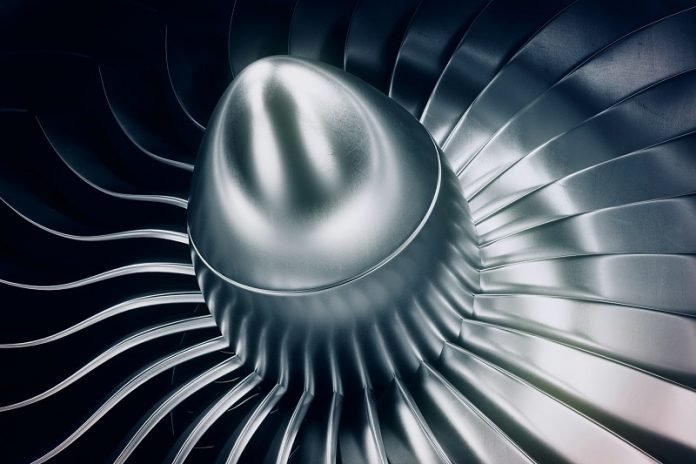
Researchers at Spain’s IMDEA Materials Institute are working on a sophisticated computer model designed to help engineers better predict how long protective coatings inside gas turbines will last. These coatings, called thermal barrier coatings, are thin ceramic layers that shield turbine parts from intense heat, corrosion, and oxidation. They are essential in aircraft engines and power generation turbines.
The ceramic layer acts as insulation, lowering the temperature of the underlying metal by approximately 100°C to 300°C. This allows turbines to operate at higher temperatures—sometimes near or above the melting points of their metal components—without risking damage. Running turbines at elevated temperatures improves efficiency and power output, and reduces fuel consumption. For aircraft, this means more thrust without extra weight, and for power plants, it means more effective electricity production and greater flexibility to respond to fluctuations in solar or wind energy.
Despite decades of success with zirconia-based ceramic coatings, the entire system remains vulnerable over time. Beneath the ceramic, a metallic bond coat is attached to the metal turbine part. During operation, this layer endures repeated heating and cooling cycles, chemical changes, oxidation, and mechanical stress. These factors can gradually weaken the bond coat, compromising the ceramic coating’s protective ability.
Another challenge stems from the different expansion and contraction rates of the ceramic coating, bond coat, and metal base as they heat and cool. This mismatch causes stress at the interfaces, leading to cracks that may grow and eventually cause the coating to detach from the turbine component.
Studying these damage mechanisms experimentally is difficult because turbines operate under extremely harsh conditions. Recreating years of heat, pressure, and chemical exposure in a lab is costly and time-consuming. To address this, the MIM-TBC project aims to develop a virtual testing platform that simulates these extreme conditions through computer modeling. Led by Dr. Mohammad Jalili and overseen by Professor Javier Segurado, the project integrates multiple processes that contribute to coating failure, including oxidation, chemical element movement, oxide growth, permanent deformation, long-term stress effects, and boundary damage.
Crucially, the model also captures how the microscopic structure of the coating evolves throughout its lifespan. By combining chemical, thermal, and mechanical effects within a single system, the researchers intend to create a more realistic depiction of damage development over time.
This approach aligns with Integrated Computational Materials Engineering (ICME), which leverages computer simulations to link a material’s internal structure and properties with its actual performance in service. Once validated through experimental testing, the framework could enable engineers to evaluate how different materials and microscopic structures influence coating longevity before production—potentially predicting maintenance needs more accurately.
The foundational concepts of this project were introduced at the Congress on Numerical Methods in Engineering in 2026. Future research papers are being prepared for peer-reviewed journals, and experimental validations are ongoing. The team believes they have already established a core modeling system capable of making physically-based lifetime predictions. Ultimately, this work could lead to the development of more durable coatings, safer turbines, and more efficient aircraft and power generation systems.