Understanding how stellar-mass black holes form is a fundamental aspect of astrophysics. When a star significantly larger than our Sun exhausts its nuclear fuel, the pressure generated by fusion diminishes. Eventually, this outward force can no longer counterbalance the inward pull of gravity, causing the star to collapse inward, resulting in a point known as a singularity—creating a black hole.
This classic scenario, however, faces a significant problem. General relativity (GR) accurately describes the process up until the moment a singularity is formed. Post-collapse, questions arise: how can so much mass be concentrated into an infinitely small point? How does spacetime bend infinitely? GR offers no answers at this stage.
This is where Einstein’s theory begins to break down. It doesn’t mean GR is invalid elsewhere; rather, in this context, it ceases to provide a complete explanation. The quest for a theory of quantum gravity is aimed at addressing these limitations.
Recent research indicates that Einstein’s equations might still reliably describe the collapse process. Instead of forming a traditional black hole, a collapsing star could produce a different kind of compact object called a gravastar. These objects mimic black holes but avoid some of the problematic aspects of traditional models.
The research, titled “Formation of gravastars,” is published in Physical Review D. The authors, Daniel Jampolski and Luciano Rezzolla of Goethe University Frankfurt, explore these possibilities.
Black holes are usually categorized into two main types: standard black holes, which feature an event horizon surrounding a singularity, and so-called “regular black holes,” which are modified versions with no singularity. Instead, they have well-behaved interiors where spacetime curvature remains finite, avoiding some of the issues associated with standard black holes.
Regular black holes still have an event horizon, but they don’t contain the singularities that challenge GR’s limits. However, their existence introduces the black hole information paradox, which raises questions about the fate of information that crosses the event horizon.
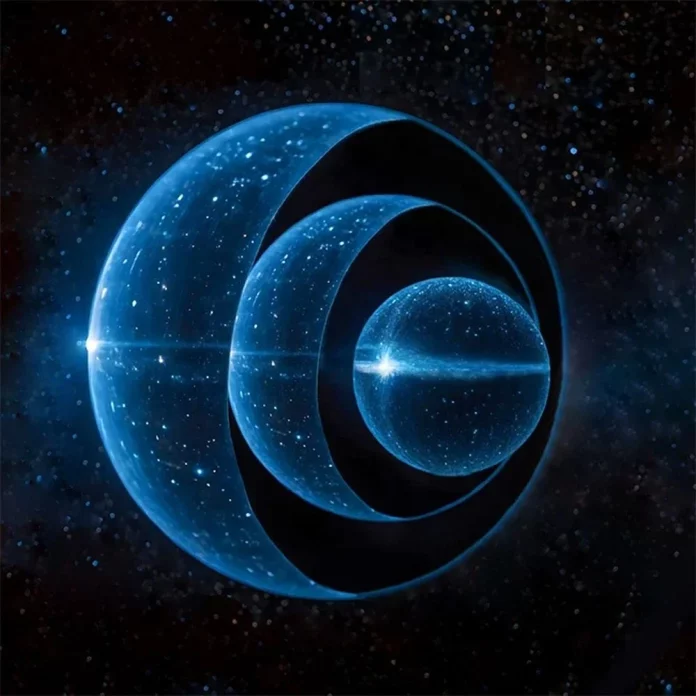
Enter gravastars—hypothetically horizonless objects that look a lot like black holes in their extreme compactness but do not violate GR. They are ultra-dense stars with outer layers composed of normal matter, while their interiors are filled with dark energy. This dark energy exerts an outward pressure that stabilizes the structure.
Physicists see gravastars as more consistent solutions since they don’t contain singularities or event horizons, sidestepping some paradoxes. But how do such objects form? The authors note that, although mathematically plausible, the formation mechanisms remain largely speculative. A key challenge is understanding the dynamics that could lead to their creation.
By solving Einstein’s equations, Jampolski and Rezzolla have proposed a scenario where a mini-universe forms inside a collapsing star, similar to the conditions at the universe’s birth during the Big Bang. In their model, dark energy inside the star keeps the collapse from reaching a singularity, resulting instead in a stable gravastar.
Surprisingly, Jampolski stumbled upon this solution during his master’s thesis, guided by Rezzolla. The concept is that the universe’s early explosion could occur in a similarly compressed state, giving rise to new structures when matter is extremely dense.
Rezzolla emphasizes that exploring alternatives to black holes isn’t a sign of skepticism; rather, it’s a way to broaden our understanding. Black holes remain the simplest and most accepted explanation for gravitational collapse, but science benefits from remaining open-minded about other possibilities. History has shown that what seems exotic today can become accepted tomorrow.
However, the proposed model faces hurdles. It requires precise fine-tuning—such as perfect uniformity and pressureless conditions within the collapsing sphere—conditions unlikely to be perfectly met in reality. Moreover, while the model predicts a static equilibrium, the gravastar’s shell could still be unstable to minor disturbances, like stray photons, which might cause it to collapse into a traditional black hole once again.
If that happens, the gravastar’s existence becomes fleeting—more an intermediate state during black hole formation than a distinct object. The real observational challenge is distinguishing gravastars from standard black holes, which remains an open question.
Ultimately, future research must focus on how to detect and tell these objects apart, if they exist at all. Many questions remain unanswered, waiting to be explored.
Written by Evan Gough for Universe Today.