Tag: Economy

  • Cuban Lawmakers Approve Major Reforms Amid US Pressure

    Cuban Lawmakers Approve Major Reforms Amid US Pressure

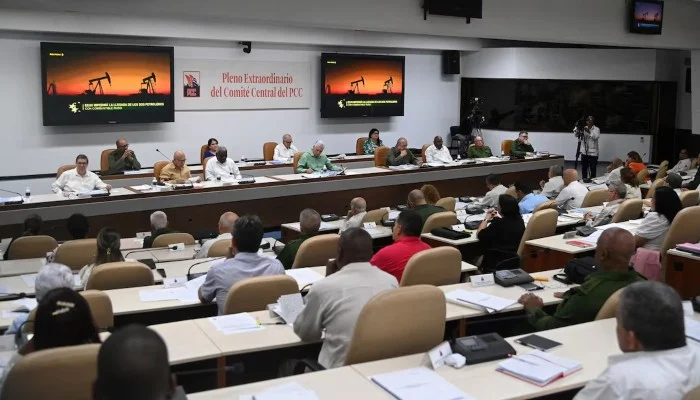
    Members of Cuba’s political bureau gather for an extraordinary session of the Communist Party’s Central Committee to review proposals for economic and social reforms announced by President Miguel Diaz-Canel in Havana on June 17, 2026. — Reuters

    – Private banks and investments allowed to enter the financial sector
    – Companies can employ over 100 workers
    – Entrepreneurs permitted to own multiple businesses

    The Cuban legislature has unanimously approved major reforms supported by the Communist Party and ex-leader Raul Castro, aiming to privatize large portions of the country’s socialist economy to better withstand harsh U.S. sanctions.

    If fully enacted, these changes would mark the most significant shift away from Cuba’s socialist system since Fidel Castro’s 1959 revolution. They open avenues for private real estate development, propose converting state-owned enterprises into private firms with shares and equity stakes, and permit private banks to operate within Cuba’s once state-controlled financial industry.

    The reforms also envisage the sale of state-owned properties to both domestic and foreign entities, including Cubans abroad, a notable move in a country where land and industry have long been government-controlled, as detailed in a televised presentation to lawmakers.

    Prior to the vote, President Diaz-Canel urged legislators to maintain faith in Cuba’s socialist legacy, emphasizing the importance of continuing the socialist project despite the long-standing blockade imposed by the United States. “This debate is about how to proceed with socialist development, which has faced history’s longest blockade by the world’s most powerful nation. We are not abandoning socialism,” he stated.

    Prime Minister Manuel Marrero highlighted that these reforms acknowledge the market as an essential tool for efficient resource distribution, a rare explicit nod to market principles from a top Cuban official, yet he asserted that the core of Cuba’s socialism remains intact: “The goal of updating our economic model is to improve our citizens’ quality of life.”

    The comprehensive list, comprising over 175 measures, was presented during nearly two hours of speeches before the National Assembly and received unanimous approval. It remains unclear how quickly or through what specific procedures these reforms will be put into place, raising questions about their implementation.

    Many of these economic liberalization efforts have been discussed for years, but the intensified U.S. sanctions under the Trump administration—especially an oil blockade—have dramatically constrained Cuba’s economic space, deepening its economic crises, leading to a diaspora of foreign businesses, and severely damaging the vital tourism industry.

    Diaz-Canel clarified that the decision to open up the economy is not related to ongoing negotiations with the U.S., which started earlier this year but appear to have stalled. The U.S. State Department did not immediately comment.

    Raul Castro, who still wields significant influence and has recently faced murder charges in the U.S., expressed support for the reforms through a written letter to the politburo and lawmakers, describing them as “beneficial” and urging swift implementation. These reforms include rolling back many socialist policies introduced after the Castros’ revolutionary rise.

    The proposed overhaul aims to significantly reduce the dominance of state-run enterprises in Cuba, encouraging private enterprise that the government has historically been wary of, and permitting private individuals and companies to grow their own businesses. For instance, businesses would now be allowed to employ more than 100 workers, and entrepreneurs could run multiple private firms—both firsts in Cuba.

    Private capital movement is expected to be facilitated by a more flexible, state-supervised banking system and a digital foreign exchange market with authorized agents. Cuba has long provided heavily subsidized public services—such as education, healthcare, and transportation—that have deterioration in recent years due to government inefficiencies and economic hardships.

    The new reforms introduce a tax system overhaul and aim to make both public and private sector businesses, including foreign ones, partly responsible for funding public services.

  • Switzerland Considers Population Cap of 10 Million Votes Pending

    Switzerland Considers Population Cap of 10 Million Votes Pending

    Switzerland held a referendum on Sunday to decide whether to implement a proposal that would cap the country’s population, a move compared to Britain’s Brexit vote, with potential significant impacts on its economy and its relationship with the European Union.

    The initiative, driven by worries over immigration, strain on public services, and housing shortages, was proposed by the right-wing Swiss People’s Party (SVP). It aims to limit the population to no more than 10 million by 2050, with official forecasts indicating this threshold could be reached as early as the early 2040s.

    This radical approach to legislating population limits aligns with a growing trend among Europe’s political right to tighten immigration controls, motivated by frustrations over rising costs of living, sluggish economic growth, and security concerns.

    Helen Gulea, a 58-year-old seamstress and part-time kiosk worker in Zurich, originally from Kenya, expressed her support for the cap. She said, “If the population exceeds 10 million, it will get tight, and immigration should be restricted.” Voting results were expected to start emerging around noon.

    If the proposal passes, reaching the 10 million mark would trigger steps that could lead Switzerland to revoke its free movement agreement with the EU, which provides the framework for much of the country’s labor force. Switzerland’s aging population has already surpassed 9 million, and public opinion appears to be closely divided. Recent polls indicated a shift against the measure, while earlier surveys suggested it could pass.

    Patrick Leisibach, an immigration specialist at the think tank Avenir Suisse, noted widespread concern about overcrowding placing excessive pressure on public infrastructure. He added, “There’s a traditional anti-immigration vote on the right, but nowadays, many on the left are feeling the weight as well.”

    Switzerland’s system of direct democracy means citizens vote on national referendums roughly four times annually, requiring a majority vote and support from a majority of cantons for approval. The government and parliament have urged voters to reject the so-called “sustainability initiative,” warning it could jeopardize Switzerland’s export-driven economy during a delicate period.

    Johanna Alves, a 33-year-old student, voted against the proposal, worried about its possible repercussions. “I work in an international environment, and I fear it could be in danger if this passes. It would also be disastrous for our economy, healthcare, and research,” she said.

    Last year, the U.S. under President Donald Trump imposed the highest tariffs on Swiss goods in Europe, highlighting how population policies could influence corporate planning. SVP lawmaker Thomas Matter argued that Switzerland’s rising prosperity hasn’t kept pace with increased immigration, and the country needs to slow things down.

    Months before Trump’s return to power, Switzerland signed agreements with Brussels to deepen economic ties with the EU—agreements that might be threatened if a population cap leads to the suspension of free movement.

    While Swiss voters have historically rejected measures harmful to the country’s long-term economic interests, recent decisions have been less predictable. In 2014, voters narrowly approved an SVP-backed measure to limit EU immigration, though its implementation was later softened through legislative adjustments.

    In the event the populist initiative passes, certain aspects, like the potential termination of free movement with the EU, could face further referendums, according to private sources. Some SVP members claim that the proposal isn’t intended to end free movement but is meant to serve as a wake-up call. Heinz Taennler, an SVP politician and finance director for the canton of Zug, stated, “I don’t want to end free movement. Another million people can still move here, but the government must take action.”

  • White House: China to buy $17B+ in US agricultural goods yearly

    White House: China to buy $17B+ in US agricultural goods yearly

    China has pledged to buy a minimum of $17 billion worth of U.S. agricultural products in 2026, 2027, and 2028, according to a fact sheet released by the White House on Sunday.

    This pledge was made during meetings last week between President Donald Trump and President Xi Jinping. The $17 billion amount excludes the soybean purchase commitments that China announced in October 2025.

    U.S. agricultural exports to China saw a significant decline last year due to a series of retaliatory tariffs, falling 65.7% compared to the previous year to $8.4 billion in 2025, based on data from the U.S. Department of Agriculture. Since Trump’s first term, China has considerably decreased its dependence on U.S. farm products, sourcing about 20% of its soybeans from the U.S. in 2024, down from 41% in 2016.

    The White House also announced that China plans to collaborate with U.S. regulators to lift bans on U.S. beef processing plants and resume poultry imports from states deemed free of avian influenza. Furthermore, both nations will set up a U.S.-China Board of Trade and a U.S.-China Investment Board to address market access issues for agricultural goods and foster trade growth through a framework of reciprocal tariff reductions, according to Chinese Foreign Minister Wang Yi last week.

  • Trump’s Approval Hits Record Low Amid Cost & Iran Tensions: Poll

    Amidst rising inflation, concerns about the cost of living are escalating as gasoline prices spike following hostilities with Iran. Support for President Donald Trump remains comparatively strong among Republicans, yet a significant portion of the populace disapproves of his response to the ongoing conflict. Independent voters are leaning toward the Democratic side ahead of the midterms, with many still undecided about their choices.

    A recent four-day Reuters/Ipsos poll indicates that Trump’s approval rating has fallen to 34%, the lowest in his current term, down from 36% in a previous survey conducted mid-April. Most responses were collected before the incident at the White House Correspondents’ Dinner Saturday night, where a gunman was stopped before entering the hall where Trump was speaking. It’s uncertain whether this event will influence public perception of the president. Federal prosecutors have charged the shooter with attempting to assassinate Trump.

    Since assuming office in January 2025, Trump’s approval ratings have steadily declined—initially at 47%. The war with Iran, which launched on February 28, has caused gasoline prices to jump over 40%, reaching approximately $4.18 per gallon and causing financial strain for many American households. This surge has generated anxiety among Trump’s supporters about the possibility of Democrats gaining control of Congress in November.

    While 78% of Republicans still support Trump, 41% are discontented with his handling of the cost of living. Meanwhile, independent voters, a critical swing group, favor Democrats by a 14-point margin—34% to 20%. A quarter of independents remain undecided. Trump’s economic approval rating has plummeted to 27%, significantly lower than during his previous term and even below Biden’s lowest economic ratings.

    Although the conflict with Iran has somewhat de-escalated after a ceasefire earlier this month, Iran’s threats continue to hinder oil shipments from the Persian Gulf. This instability sustains upward pressure on U.S. and global energy prices as reserves dwindle. Currently, 34% of Americans approve of the ongoing U.S. involvement with Iran, compared to 36% in April and 38% in March.

    During Trump’s first term, his approval hovered around 40% for extended periods. The current figure is slightly above his all-time low of 33% during that period. The survey, encompassing responses from 1,269 U.S. adults—including 1,014 registered voters—was conducted nationwide online, with a margin of error of 3 percentage points.

  • Canada updates Express Entry rules, includes military occupations

    Canada updates Express Entry rules, includes military occupations

    Canada has unveiled new immigration priority categories aimed at attracting skilled professionals across various sectors, including research, healthcare, aviation, and certain military recruits. These categories correspond with Prime Minister Mark Carney’s strategy to reduce the influx of newcomers while prioritizing highly skilled workers, academics, and bolstering defense capabilities to reduce dependence on the U.S.

    The government stated that this change seeks to restore immigration levels to sustainable numbers and address labour shortages in essential industries. In recent years, efforts have been made to curb immigration numbers to ease pressures on housing and social services.

    Immigration Minister Lena Metlege Diab emphasized that the 2026 updates to the Express Entry program will help draw talent that can immediately contribute to the economy, particularly in sectors facing critical staffing shortages. The new streams will prioritize researchers, senior managers, transportation workers such as pilots and aircraft mechanics, as well as internationally trained medical professionals with Canadian experience. Military applicants, including doctors, nurses, and pilots recruited by the Canadian Armed Forces, will also be part of the new categories.

    Diab highlighted that a resilient workforce is key to Canada’s economic future amid changing global conditions.

    In addition, Prime Minister Carney announced a new defense strategy that seeks to ramp up government investment in defense research by 85% over the next decade, significantly increase defense industry revenue, expand exports, and create up to 125,000 new high-quality jobs. Canada has committed to raising its defense spending to 5% of GDP by 2035, aligning with NATO’s goals.

    Existing Express Entry pathways—such as those for French speakers, healthcare workers, and skilled trades—will continue running alongside these new targeted streams.

  • Oxfam: Billionaires’ Wealth Soars Amid Rising Influence

    Oxfam: Billionaires’ Wealth Soars Amid Rising Influence

    Last year, the net worth of billionaires skyrocketed three times faster than recent averages, reaching an all-time high, according to the anti-poverty organization Oxfam. The report, released ahead of the World Economic Forum in Davos, states that the combined wealth of the world’s billionaires increased by 16% in 2025 to $18.3 trillion—a surge of 81% since 2020.

    Despite these extraordinary gains, a significant portion of the global population continues to grapple with poverty, with one in four people struggling to access regular food and nearly half living in impoverished conditions. The study, which incorporates academic research and data from sources like the World Inequality Database and Forbes, underscores a stark rise in political influence among the ultra-wealthy. Billionaires are now 4,000 times more likely than average citizens to hold political office.

    Oxfam attributes this wealth explosion partly to policies introduced during Donald Trump’s presidency aimed at tax cuts, protecting multinational corporations from international pressure, and reducing oversight on monopolies. Additionally, the rapid valuation of artificial intelligence companies has further amplified the pockets of already affluent individuals.

    Amitabh Behar, Oxfam’s executive director, warns that the widening gap between the rich and everyone else isn’t just a moral issue but a dangerously unsustainable political problem. The organization urges governments to implement national strategies to curb inequality, including increasing taxes on extreme wealth and creating stronger barriers between money and political influence—such as reforms on lobbying and campaign financing.

    Currently, wealth taxes exist in only a handful of countries, like Norway, while others including the UK, France, and Italy are debating similar measures. Oxfam’s analysis reveals that the $2.5 trillion added to billionaire fortunes last year is roughly equivalent to the total wealth held by the poorest 4.1 billion people worldwide.

    The billionaire population surpassed 3,000 for the first time, with Elon Musk, Tesla and SpaceX CEO, becoming the first individual to surpass a net worth of $500 billion. Behar expressed concern that governments are making the wrong choices by catering to elites—such as cutting aid and rolling back civil liberties—instead of addressing systemic inequalities.

    The report also highlights the expanding dominance of ultra-wealthy business tycoons over both traditional and digital media outlets. It notes that more than half of the world’s major media companies are owned by billionaires like Jeff Bezos, Elon Musk, Patrick Soon-Shiong, and Vincent Bolloré from France.

  • Iranian Embassy: Main Protesters Declare End of Legal Demonstrations

    Iranian Embassy: Main Protesters Declare End of Legal Demonstrations

    Pictures of people walking on a street as protests surge in Tehran, Iran, January 2, 2026, following the currency’s sharp decline — Reuters

    – The government held talks to address shopkeepers’ concerns, according to the embassy.
    – Security forces moved quickly to suppress scattered illegal demonstrations.
    – Internet services have been restored nationwide as cybersecurity measures continue.

    The Iranian Embassy in Islamabad announced Monday that the primary group of protesters—mainly shopkeepers and trade guild members—had officially announced the end of their peaceful protests after engaging in government negotiations and confidence-building efforts.

    Initially sparked last Sunday by shopkeepers striking over soaring prices and a stagnant economy, the protests have spread to various regions and have begun including political demands.

    Demonstrations were recorded in 25 of Iran’s 31 provinces, impacting at least 45 cities, mostly small to medium-sized communities in the western part of the country, based on official statements and media reports summarized by AFP.

    Since December 30, at least 12 individuals—including security personnel—have lost their lives in localized clashes, with reports of property damages particularly in western Iran.

    Fars News Agency highlighted that on Sunday night, the number of protests and their geographic spread decreased notably compared to previous nights.

    The embassy stated that recent protests stemmed from a sudden spike in the exchange rate, leading shopkeepers and professionals to take to the streets. The Iranian government responded swiftly by initiating dialogue through relevant authorities, with President Masoud Pezeshkian playing a central role in negotiations that aimed to address the protesters’ grievances.

    Officials also accused hostile foreign elements of attempting to exploit the situation to create nationwide instability, often inciting unrest via cyberspace. Supportive statements from Israel and the U.S. reportedly encouraged efforts to mobilize residents in smaller towns.

    Despite these challenges, the presence of security forces helped keep the crisis in check, quickly dispersing any illegal gatherings.

    Updates from the embassy indicated internet connectivity has been reestablished across Iran, with only minor, temporary speed reductions for security reasons. The government acknowledged the legal rights of protesters but also engaged in constructive dialogue with trade guilds and market associations, helping to stabilize the situation.

    The statement noted that in some remote areas, small clusters of illegal protests briefly surfaced but were swiftly dispersed. In many cities, peace and order have been fully restored under security supervision.

    It praised the disciplined conduct of lawful protesters, emphasizing their respect for legal procedures as a key factor in preventing escalation.

    The embassy also accused the U.S. and Israel of continuing efforts to incite unrest, with some detained rioters admitting to connections with foreign agencies and receiving financial backing from outside sources.

    Gholamhossein Mohseni Ejei, head of Iran’s judiciary, declared there will be no leniency for those involved in rioting, although he affirmed the public’s right to protest. He instructed prosecutors nationwide to act firmly against those supporting disorder, emphasizing unwavering enforcement of the law.

    He stated: “Iran listens to protesters and considers their criticisms, but it will not tolerate rioting.”

    The rial experienced another dip Monday after recent gains, trading on the informal black market at around 1.4 million rials to the dollar—significantly weaker than the approximately 770,000 rials per dollar recorded a year earlier.

  • Trump warns US will act if Iran harsher on peaceful protests

    Trump warns US will act if Iran harsher on peaceful protests

    Protests and clashes between demonstrators and law enforcement have significantly intensified the unrest. Economic hardship has led to violent incidents across several regions. Since the United States reimposed sanctions in 2018, Iran’s economy has been under strain.

    On Friday, President Donald Trump stated that if Iran resorts to shooting and killing peaceful protesters, the U.S. will intervene to protect them. He announced on Truth Social, “We are locked and loaded and ready to go.” This statement comes amid reports of multiple deaths during Iran’s largest protests in three years, sparked by economic struggles that have escalated across various provinces.

    The protests began peacefully last Tuesday in the capital and quickly spread after students from at least ten universities joined in. The unrest is centered around the government’s mishandling of a sharp currency depreciation and soaring prices. Shops and merchants initially led the demonstrations, which have since turned more violent.

    Iran’s economy has been in decline for years, especially after the U.S. reinstated sanctions three years ago following Trump’s withdrawal from the nuclear deal. Violence has broken out in places like Lordegan and Azna, where security forces clashed with protesters, resulting in casualties. In Lordegan, protesters reportedly threw stones at government buildings, prompting police to use tear gas; the buildings suffered considerable damage, and several leading figures were detained. In Azna, protesters targeted a police station during demonstrations.

    Earlier, state media reported that a security officer was killed in Kouhdasht during the protests. The deputy governor of Lorestan, Said Pourali, identified the fallen officer as a 21-year-old Basij volunteer, a force linked to Iran’s Revolutionary Guards. Several police and Basij personnel sustained injuries from stone-throwing during the clashes.

    The current protests are less intense than those in 2022, which erupted after Mahsa Amini’s death in custody—an event that triggered widespread outrage, resulting in hundreds of deaths, including security personnel. This week’s protests began peacefully but grew after students at multiple universities joined in.

    Iranian President Masoud Pezeshkian acknowledged the public’s legitimate concerns in a televised address, emphasizing the importance of resolving economic issues to prevent further unrest. He warned that neglecting the people’s livelihoods could lead to disastrous consequences. Meanwhile, authorities have vowed to take a firm stance and warned against exploiting the situation for chaos.

    Coverage of the demonstrations varies among Iranian media outlets, with some emphasizing economic difficulties and others depicting troublemakers inciting violence. Iran declared a bank holiday on Wednesday, citing energy conservation during cold weather, though officials did not link this to the protests. The official weekend begins on Thursday, with Saturday being a national holiday.

    The prosecutor general has affirmed that peaceful economic protests are protected, but any efforts to destabilize the country will be met with a decisive response. Recently, a viral video showed a protester sitting serenely in the middle of a Tehran street facing down motorcycle police, reminiscent of the 1989 Tiananmen Square incident—though authorities later claimed the footage was staged.

    Authorities have reportedly arrested several individuals believed to be connected to foreign-backed groups aiming to incite violence. Iran’s national currency, the rial, has plummeted over a third in value against the dollar in the past year, compounded by persistent hyperinflation, which has severely impacted citizens’ purchasing power. December’s inflation rate reached 52%, according to official statistics.

  • 2025: A Year of Challenges and Setbacks for India, Report Says

    2025: A Year of Challenges and Setbacks for India, Report Says

    India faced a historic military defeat against Pakistan, suffered diplomatic setbacks with Washington, and saw the rupee hit a record low of 91.14 against the dollar in 2025, according to The Financial Times’ annual review. The country’s strategic independence waned as it was forced to balance relations with the US, China, and Russia simultaneously.

    Efforts to finalize a trade agreement with the United States were repeatedly delayed, while American tariffs added economic strain on New Delhi. Similarly, partial implementation of GST reforms hindered economic progress. Throughout the year, the Indian rupee continued its decline against the US dollar, reflecting ongoing financial challenges.

    Earlier in the year, India and Pakistan clashed in what became their worst military confrontation in decades, ignited by an attack on tourists in Pahalgam, IIOJK, which India accused Pakistan of supporting. Islamabad denied involvement and called for an independent investigation. During the fight, Pakistan shot down seven Indian fighter jets, including three Rafale fighters, and numerous drones; the conflict ended after 87 hours with a ceasefire brokered by the US. Islamabad’s apparent victory in this skirmish helped strengthen Pakistan’s ties with Washington, while US President Donald Trump began taunting India, leveraging his closeness with Pakistani military leaders.

    The much-anticipated US-India trade deal failed to materialize. Following Trump’s electoral victory, New Delhi initially celebrated the prospect of a friendly US administration, with Modi visiting Washington early in 2025. However, negotiations stalled by mid-year amid escalating tariffs, including a 25% duty imposed by the US on Russian oil imports. Although officials from both sides expressed optimism earlier on, focus eventually shifted inward, aiming to bolster domestic growth amid the economic uncertainties.

    The Indian rupee experienced a sharp decline, losing 6% of its value in 2025 and reaching the record low of 91.14 against the dollar. Relations with neighboring countries also faced difficulties. Ties with Bangladesh deteriorated following the exile of ousted Prime Minister Sheikh Hasina after protests, while India’s attempts to recalibrate its foreign policy with China saw limited success. Modi’s visit to China—the first in seven years—led to reaffirmed commitments to cooperation but also highlighted lingering mistrust. India continues to accuse China of supporting Pakistan during recent hostilities, keeping tensions high on multiple fronts.

  • Iranian security officer dies amid protests

    Iranian security officer dies amid protests

    Protests over the plummeting value of the currency led to large swaths of shops in Tehran’s Grand Bazaar closing, as people walk past the shuttered storefronts on December 30, 2025, in Tehran, Iran. — Reuters

    A 21-year-old member of Iran’s security forces was reportedly killed last week amid ongoing protests, according to local authorities. The death was confirmed Thursday by state TV, citing a regional official. Said Pourali, deputy governor of Lorestan Province, stated, “A 21-year-old Basij member from Kouhdasht was killed Wednesday night by rioters while trying to maintain order.” This marks the first officially confirmed fatality since protests began last Sunday, initially peaceful in Tehran.

    The Basij are a volunteer militia closely associated with Iran’s Revolutionary Guard, which is the ideological branch of the Islamic Republic. Pourali also reported that during demonstrations in Kouhdasht, 13 police officers and Basij members sustained injuries from stone-throwing.

    The unrest started in Tehran, where shopkeepers staged a walkout over soaring costs of living and economic stagnation. The demonstrations soon spread to other cities, especially after students from at least 10 universities joined in on Tuesday. Iran’s president, Masoud Pezeshkian, urged the government on Thursday to take concrete steps to improve the economy, warning, “From an Islamic perspective… if we don’t address people’s livelihoods, we risk ending up in hell.”

    Authorities declared Wednesday a bank holiday at the last minute, citing energy conservation needs during cold weather, though there has been no official link made to the protests. Iran’s weekend kicks off on Thursday, with Saturday being a long-standing national holiday.

    Iran’s prosecutor general emphasized that peaceful economic protests are lawful, but any efforts to incite violence or spread insecurity would be met with firm action. “Any endeavor to turn economic protests into tools of chaos, property destruction, or externally orchestrated scenarios will be met with a legal, proportional, and decisive response,” he declared.

    On Wednesday evening, the Tasnim news agency reported the arrest of seven individuals suspected of being affiliated with groups hostile to the Islamic Republic, based in the United States and Europe. The agency said these individuals were assigned to incite violence during the demonstrations, though it did not specify when they were detained.

    Meanwhile, Iran’s national currency, the rial, has lost more than a third of its value against the U.S. dollar over the past year, with double-digit hyperinflation eroding the purchasing power of ordinary Iranians for years. The official inflation rate for December stood at 52% year-over-year, according to Iran’s Statistical Center.

  • Iran’s Govt. Calls for Dialogue Amid University Protest Surge

    Iran’s Govt. Calls for Dialogue Amid University Protest Surge

    Protests against Iran’s rising living costs extended to several universities on Tuesday, with students taking to the streets alongside shopkeepers and bazaar merchants, according to semi-official media reports. The government responded by calling for dialogue with the demonstrators.

    In 2025, Iran’s rial has depreciated nearly 50% against the dollar, with inflation reaching 42.5% in December. The nation continues to grapple with frequent unrest in recent years, U.S. sanctions, and threats of Israeli military strikes.

    President Masoud Pezeshkian announced on social media late Monday that he had instructed the interior minister to address the “legitimate demands” of the protesters. Government spokesperson Fatemeh Mohajerani stated that a dialogue process would be established, including talks with protest leaders.

    “We officially recognize the protests… We listen to their concerns and understand that this unrest stems from the economic hardships impacting people’s livelihoods,” she said on Tuesday, as reported by state media.

    Video footage verified by Reuters showed large crowds marching in Tehran, chanting “Rest in peace Reza Shah”—a historical reference to the founder of the monarchy overthrown during the 1979 Islamic Revolution. Iranian state television also broadcast images of protests in central Tehran.

    The semi-official Fars News Agency reported that hundreds of students demonstrated at four universities in Tehran on Tuesday. Social media users expressed varied opinions—some supporting the protests, citing high prices and corruption as reasons for the anger, while others warned of the spread of unrest nationwide.

    Authorities have historically suppressed similar protests, employing force and mass arrests over issues from economic grievances to drought, women’s rights, and political freedoms. The current government has not specified the format of upcoming dialogues, which follow the first major protests since Israeli and U.S. airstrikes on Iran in June, actions that united many Iranians in patriotic sentiment.

    Pezeshkian, speaking with trade unions and market activists Tuesday, assured that the government aims to resolve their issues and address their concerns, according to official reports.

    Iran’s economy has been under severe strain for years, especially after the reimposition of U.S. sanctions in 2018 when President Donald Trump withdrew from an international nuclear agreement. United Nations sanctions were reinstated in September, prompting reports of high-level efforts to prevent economic collapse, bypass sanctions, and manage public anger.

    Widespread economic inequality—between ordinary citizens and the ruling elite—and issues like mismanagement and corruption have fueled discontent. Inflation persists at high levels, with prices surpassing the means of many Iranians. The official exchange rate placed the rial at approximately 1.4 million to the dollar on Tuesday, a record low compared to 817,500 at the start of the year.

    Since late March, inflation has remained above 36.4% annually, according to official data. On Monday, the central bank chief resigned, citing the government’s recent economic liberalization efforts which put pressure on the open market for foreign currency—though most businesses continue to rely on official exchanges where the rial’s value is stabilized.

    Iran experienced major protests in 2022 over fuel prices and other living costs, notably for staples like bread. Meanwhile, unrest connected to the death of Mahsa Amini, a young Kurdish woman detained by morality police for allegedly violating dress codes, marked some of the most significant demonstrations in years.

    Internationally, Iran remains under intense scrutiny. U.S. President Biden has indicated the possibility of supporting renewed Israeli aerial attacks if Tehran advances its ballistic missile or nuclear weapons programs. In June, Israel and the U.S. launched a 12-day barrage of strikes targeting Iran’s military facilities and nuclear sites, aiming to halt efforts to develop atomic weapons. Iran insists its nuclear activities are peaceful and denies nuclear weapons ambitions.

  • Iran President urges govt to heed protesters’ valid demands

    Iran President urges govt to heed protesters’ valid demands

    Iran’s President Masoud Pezeshkian attended a press conference in Tehran on September 16, 2024, as reported by Reuters.

    Amid ongoing economic turmoil, shopkeepers in Tehran have closed their stores for a second consecutive day, protesting the sharp decline of the rial in the unofficial market. The US dollar has surged to approximately 1.42 million rials from 820,000 rials a year earlier, while the euro nears 1.7 million rials, according to currency tracking sites.

    President Pezeshkian urged the government to heed the protesters’ “legitimate demands,” calling for dialogue between officials and representatives of the demonstrators to address the economic crises responsibly, as reported by IRNA. Protesters are demanding immediate government actions to stabilize the exchange rate and implement a clear economic plan, according to ILNA.

    The volatile currency prices have hindered sales of imported goods, causing both buyers and sellers to hold off transactions until the economic outlook stabilizes. Protesters expressed frustration, stating that conducting business under current conditions has become impossible.

    Images from Fars news agency showed large crowds occupying a major central Tehran thoroughfare, known for its numerous shops, with some photos indicating the use of tear gas to disperse crowds. Minor clashes between protesters and security forces were reported, raising concerns about potential instability.

    Iran’s Chief Justice Gholamhossein Mohseni Ejei called for swift punishment of those responsible for currency fluctuations, according to Mizan Agency. The government also announced the appointment of Abdolnasser Hemmati as the new governor of the Central Bank—Hemmati, a former economy and finance minister, was dismissed by parliament in March due to the rial’s depreciation.

    Meanwhile, President Pezeshkian submitted the budget for the upcoming Persian year to parliament, vowing to combat inflation and high living costs. Inflation stood at 52% annually as of December, but prices for essentials continued to rise sharply beyond this figure.

    Iran’s already strained economy, heavily impacted by decades of Western sanctions, faced further pressure when the United Nations reinstated international restrictions linked to its nuclear program in late September. Western countries and Israel accuse Iran of pursuing nuclear weapons—a charge Tehran denies.

  • Syria Launches Currency Swap Program Starting January 1, Central Bank Announces

    Syria Launches Currency Swap Program Starting January 1, Central Bank Announces

    Syria plans to begin replacing old banknotes with new ones starting January 1, 2026, according to Central Bank Governor Abdelkader Husrieh on Thursday. This initiative aims to phase out currency notes from the Assad era to bolster the national currency’s value.

    The newly formed government in Syria, under President Ahmed al-Sharaa, is focusing on rebuilding government institutions and revitalizing the economy after more than ten years of conflict, sanctions, and economic isolation that significantly weakened the local currency.

    Husrieh explained that the central bank has authority over setting the deadline and locations for the currency exchange, and will release further instructions.

    In August, sources close to the matter informed Reuters that the country would issue new banknotes by removing two zeros from its current currency, attempting to restore public confidence amid severe devaluation of the Syrian pound.

    Some bankers worry that introducing a new currency could spark inflation and further reduce the purchasing power of Syrians already struggling with rising prices. Nonetheless, Husrieh assured that the exchange process will be conducted smoothly and systematically.

    A press conference is scheduled for December 27 to provide detailed information on the replacement process and deadlines.

    Following his departure from Syria to Russia in December 2024, Assad fled after rebel forces captured Damascus during an eight-day blitz, ending over six decades of his family’s authoritarian rule—more than 13 years after a popular uprising escalated into civil war.

    Earlier this month, Syria commemorated the first anniversary of Bashar al-Assad’s overthrow with large celebrations across major cities.

  • Trump Celebrates Wins in White House Address as Approval Drops

    Trump Celebrates Wins in White House Address as Approval Drops

    In a rare evening speech from the White House, President Donald Trump highlighted his achievements and pointed fingers at his Democratic predecessor for rising consumer prices as his party prepares for a challenging midterm election next year.

    “Eleven months ago, I inherited a mess, and I am fixing it,” Trump stated at the outset.

    The Republican leader, who often claims he doesn’t get enough credit for his successes, emphasized his administration’s efforts this year to address issues like decreasing border crossings and reducing the prices of certain goods.

    This speech was a chance for Trump, if he focused on consistency, to respond to public concerns about affordability—a topic Trump, a Republican, has repeatedly dismissed as a Democratic deception. Once again on Wednesday, he blamed the previous Biden-led administration, despite admitting that prices still remain high.

    “I’m bringing down those high prices, and I’m doing it very quickly,” he claimed.

    Next year’s midterm elections see Trump’s Republican Party aiming to keep its control over the House and Senate. Meanwhile, Democrats are focusing on affordability issues and healthcare policy differences in hopes of gaining power.

    High inflation during Biden’s four-year term contributed to Trump defeating Kamala Harris in last year’s election. However, Trump’s tariff strategies this year have created uncertainty, pushing prices higher in an economy that his administration has been overseeing for nearly a year—making it difficult for Trump and Biden before him to convince Americans that the economy is in good shape.

    A recent Reuters/Ipsos poll found that just 33% of U.S. adults approve of Trump’s economic management.

    Instead of the usual setting in the Oval Office, Trump delivered his remarks in the White House’s Diplomatic Reception Room.

    Ahead of the speech, Senate Democratic leader Chuck Schumer from New York criticized Trump for not fulfilling his campaign promises.

    “He vowed to lower costs on Day One—that was his top promise and the main reason he won. Yet, costs keep climbing, higher than ever,” Schumer said during a news conference on Capitol Hill.

  • How to Earn Money by Completing Economy Missions in Europa Universalis 5

    How to Earn Money by Completing Economy Missions in Europa Universalis 5

    When you start a new game in Europa Universalis 5, the game prompts you to select one of three mission trees: Economy, Expansion, or Politics. Each tree is rich with content, but you can only pursue one at a time, so choose wisely to align with your goals.

    If you want to focus on building a strong economy by boosting your markets and banking, the Economy mission tree is a great choice. It offers four key missions:

    1. Develop a Capital Economy
    2. Infrastructure Efforts
    3. The Development of Trade
    4. Traditional Economy

    Note that “Develop a Capital Economy” has two branches that cannot be pursued at the same time, requiring two separate playthroughs with a 25-year gap between them.

    Unlike other policy trees, completing these Economy missions provides tangible rewards, which can help your nation grow faster. To get the most out of these, it’s recommended to start with either Infrastructure Efforts or Developing a Capital Economy. These will give early boosts: Infrastructure provides extra Administrative, Diplomatic, and Military abilities, while the Capital Economy grants profits—Ducats—and increases Crown Power for a strong start.

    While you can set your own order, it’s best to aim to complete The Development of Trade last, as it requires more initial setup and resources.

    How to Complete “Develop a Capital Economy”

    This mission focuses on increasing your country’s wealth through production, trade, or loans. You’ll need to establish markets and improve infrastructure. Your first step is to grant privileges to your Burghers—artisans and vendors—raising their Satisfaction to 60%. Then, you should explore your Markets tab to start importing and exporting goods, which can be done instantly.

    Next, you’ll need to gain new Burghers by building new structures for them and weather economic pressures for a year. After that, choose your focus: either Manufactory Focus or Trade Focus.

    Manufactory Focus steps include:

    • Expand Construction Materials: produce 40 units of Clay, Lumber, Sand, or Stone, or fully develop the Resources Gathering Operations (RGO).
    • Import construction materials if preferred.
    • Ensure your city has a trade surplus of the goods.
    • Develop a way to produce specific goods, then upgrade or build additional manufactories.
    • Export the goods, aiming for a profit over one Gold, satisfying demand, and maximizing export profits.

    Trade Focus steps include:

    • Increase Trade Capacity by 10.
    • Gain 10 additional Trade Advantages.
    • Export and import four goods that turn a profit.
    • Increase overall trade income.
    • Expand into new markets by sending merchants.
    • Add at least eight Gold to your income from trade.

    Once these tasks are complete, you’ll receive Profit Dividends for 20 years.

    Infrastructure Efforts

    To develop your capital region, you need to own at least two territories, which is straightforward if starting with a good economy country. Focus on building four new structures in your capital—these could be anything that benefits your population.

    Your goals include:

    • Building Royal Courts or Republican Assemblies.
    • Increasing prosperity by 20%.
    • Raising employment to 75% and populating Nobles and Burghers.
    • Achieving full control over regions surrounding your capital.

    You should also push for centralization, control your region, and improve local food supplies. Building roads connecting regions helps, and boosting your ruler’s abilities is a bonus, especially as you control more territory.

    The Development of Trade

    This mission requires you to embrace banking and control two critical locations: a coastal port and a significant city outside your capital. Since banking is an institution that appears in specific locations, watch for it to spread naturally to your country.

    Key steps include:

    • Building a Wharf at your port, fully staffing it.
    • Upgrading to Docks if possible.
    • Constructing a Market and Entrepôt.
    • Securing the Market Center in your capital.

    Subsequently, you’ll improve your naval strength and trade influence, boosting your trade capacity and profitability.

    Traditional Economy

    This branch emphasizes rural and resource development. Tasks involve:

    • Fully expanding the local Resources Gathering Operations.
    • Waiting a year to stabilize your economy.
    • Increasing workforce by 1,000.
    • Building Rural Clothmakers to enhance prosperity.

    The final part of the Traditional Economy is building Village Marketplaces, which improves prosperity and unlocks further objectives, such as building Market Villages and achieving positive Prosperity in the region. Finishing these tasks will grant the entire region the Great Rural Center modifier for 20 years.

    By completing these missions carefully, your nation will see enhanced economic strength, better infrastructure, and increased wealth—setting a solid foundation for long-term success.

  • PIMEC’s Role in Localizing Our Maritime Economy

    PIMEC’s Role in Localizing Our Maritime Economy

    The second international expo features cutting-edge unmanned vessels, drone jammers, VR ship training programs, and aquaculture technologies.

    From autonomous maritime vehicles and first-person-view drones to aquaculture innovations, Pakistan’s second International Maritime Expo and Conference (PIMEC) has a wide array of displays. The four-day event launched Monday at Karachi’s Expo Centre, organized with support from the Ministry of Maritime Affairs, co-hosted by Badar Expo Solutions, and backed by the Pakistan Navy.

    During the opening, Planning Minister Ahsan Iqbal highlighted that despite Pakistan’s strategic position as a “natural maritime bridge” bridging East and West, the country’s maritime industry contributes less than 1% to its gross domestic product (GDP). Chief of Naval Staff Admiral Naveed Ashraf emphasized Pakistan’s vast maritime potential, stating that the nation’s economic growth is closely tied to developing its maritime sector.

    According to a post from Defense IDA, Admiral Naveed Ashraf welcomed the Saudi Minister of Transport and Logistics at PIMEC, which further underscores the importance of regional maritime cooperation.

    Tanvir Abbas, CEO of Badar Expo Solutions and the organizer of the event, noted that the local manufacturing share for maritime-related products has grown from 2% a decade ago to around 10%.

    “This is a significant improvement,” Abbas remarked, citing examples like locally produced vehicle armor and bomb-proofing—areas that previously depended heavily on imports. “We’re progressing rapidly, and I believe we’ll see exponential growth in indigenous production moving forward.”

    These advancements are designed not only to boost local capacity but also to turn into export opportunities. The expo hosts approximately 150 local and 28 international exhibitors, with participants from 45 countries—including the Saudi Transport Minister.

    A key reason to be interested in innovations from local companies is the high costs, delays, and unreliability associated with sourcing military and specialized equipment from abroad.

    Stingray Technologies

    A Pakistani defense company with over 20 years of experience in land, air, sea, and cyber technology, Stingray Technologies has developed unmanned surface vessels (USV) with ground control stations enabling remote operation. These vessels, currently used for reconnaissance but equipped with offensive capabilities, are 25 feet long and can travel 20–30 km, staying operational for 4–5 hours.

    They also showcased a maritime logistics drone capable of small-scale supply runs and IPMS, an integrated ship management system that consolidates ship maintenance data and monitoring into one platform. One spokesperson explained, “Ship management is often fragmented; this system provides all feeds in one place.”

    Additionally, Stingray is working on a virtual reality (VR) ship training program designed to create highly immersive experiences, including simulations of ship movement over moving platforms that mimic rough seas.

    National Electronics Complex of Pakistan (NECOP)

    NECOP specializes in designing advanced electronic systems. Their highlight at the expo was the SAFRAH drone jamming gun, an indigenous device engineered to combat the misuse of commercial drones.

    A NECOP representative explained that the device uses radar frequencies to intercept drones within a 1.5 km range. Weighing about nine kilograms, it can disable drone communications, preventing the drone from sending or receiving imagery, and compel it to land or return.

    The company plans to demonstrate the gun publicly on November 4, with sessions scheduled at 11 a.m. and 3 p.m. at the Expo Centre.

    Woot Tech and Winged Innovative Solutions

    Woot Tech, a Pakistani aerospace and unmanned systems firm, designs and builds drones and target aircraft for commercial and military applications. Their offerings include fixed-wing, multirotor, and hybrid VTOL platforms used for surveillance, mapping, cargo delivery, and target practice.

    Notably, they displayed a large remote-controlled drone and a USV equipped with a rotary camera, capable of reconnaissance or acting as a “suicide drone.” A smaller drone, designed by a Woot representative, was also on show.

    Winged Innovative Solutions (WIS) is another local company focusing on unmanned aerial systems tailored for industrial, commercial, and defense uses. Their portfolio includes VTOL systems, loitering munitions, and specialized drones for payload delivery, surveillance, and cloud seeding.

    A tweet from Mohsin Ali highlighted WIS’s debut at PIMEC, showcasing advanced loitering munitions, VTOL UAVs, and FPV drone technology.

    Baykee

    A subsidiary of a global power equipment manufacturer headquartered in Lahore, Baykee Pakistan Pvt Ltd draws on Chinese technology and supplies a wide range of power modules. Their products serve sectors such as mining, defense, railways, and satellite technology.

    The company presented an unmanned underwater vehicle (UUV) designed for underwater repairs and a portable military jammer system powered by batteries.

    Zarwah Enterprises and AquaTech Fisheries

    Zarwah Enterprises, led by CEO Minahil Yousaf, is Pakistan’s first female-led aquaculture company committed to sustainable practices. They provide consulting, site development, pond construction, and aquaculture solutions for fish and shrimp farms, along with selling seeds, feeds, and farm supplies.

    Their projects include biosecurity systems for Dhabeji Aqua Foods, reservoir construction for Aqua Hatch, and the design of the Al-Sumaka aquafarm in Nankana Sahib.

    AquaTech Fisheries, founded by Muhammad Kamran and Ahmad Hussain, is focused on eco-friendly fish farming and feed innovation. They produce fish feed, Biofloc systems—using microbial biotechnology to optimize feed utilization—and aquaponics systems, along with selling fish.

    This overview offers just a glimpse of the local companies innovating at PIMEC. The clear trajectory points toward expanding Pakistan’s maritime industry through homegrown solutions to local challenges.

  • Indian refiners plan to cut Russian oil imports amid US pressure

    Indian refiners plan to cut Russian oil imports amid US pressure

    Some Indian refineries are gearing up to reduce Russian oil imports gradually, according to three sources familiar with the matter, amid U.S. pressure on New Delhi to halt Russian crude purchases to help end the Ukraine conflict.

    U.S. President Donald Trump stated that Prime Minister Narendra Modi assured him India would cease buying oil from Russia, which is currently India’s largest source of imported oil.

    India emphasized Thursday that its primary objectives remain maintaining stable energy prices and securing supply. A foreign ministry spokesperson said, “Our consistent priority is to protect Indian consumers in a volatile energy market. Our import strategies are solely guided by this goal.” The statement made no mention of Trump’s comments on India’s Russian oil purchases.

    India’s officials are currently conducting trade negotiations in Washington, where the U.S. has doubled tariffs on Indian exports in an effort to persuade New Delhi to cut Russian oil imports. American negotiators believe reducing those purchases is key to lowering tariffs and concluding a trade deal.

    India and China are the leading consumers of Russian seaborne crude, capitalizing on discounted prices after European buyers shunned Russian imports and Western sanctions were imposed following Moscow’s invasion of Ukraine in February 2022.

    Trump expressed dissatisfaction, saying, “I was not happy that India was buying oil, but Modi assured me today they will stop buying Russian oil.” Meanwhile, India indicated that it is exploring deeper energy cooperation with the United States, with a spokesperson saying discussions are ongoing.

    Refiners in India have yet to receive official instructions from the government to halt Russian imports. Sources, speaking on condition of anonymity, indicated that an immediate switch away from Russian crude would risk pushing up global oil prices and fueling inflation.

    From April to September, India imported approximately 1.75 million barrels per day of Russian crude, which accounted for about 36% of its total oil imports—down from 40% in the same period last year. Additionally, India increased its US crude imports by 6.8% year-over-year to roughly 213,000 barrels per day, representing 4.3% of total imports. The share of Middle Eastern oil rose to 45% from 42% during this six-month period.