Tag: earthquake

  • Hagia Sophia Readies for Future Earthquake in Istanbul

    Hagia Sophia Readies for Future Earthquake in Istanbul

    An aerial view of scaffolding on the Hagia Sophia Grand Mosque in Istanbul, Turkey, taken on April 14, 2025. — AFP

    ISTANBUL: The Hagia Sophia in Istanbul is no stranger to transformations. Over its long history, this architectural masterpiece has transitioned from a church to a mosque, then to a museum, and back to a mosque once more.

    The current renovation project is designed not only to preserve the marvelous structure that has stood for 1,488 years but also to fortify it against the next earthquake that may strike this ancient city.

    From a distance, its magnificent dome, radiant stone, and elegant minarets continue to grace the Istanbul skyline, as they have for centuries.

    However, as visitors approach, they notice scaffolding enveloping its eastern facade and one of the minarets.

    While “the renovations do somewhat disrupt the exterior atmosphere” and “the scaffolding detracts from the monument’s aesthetics… repairs are crucial,” commented Abdullah Yilmaz, a tour guide.

    Hagia Sophia, a UNESCO World Heritage Site, is Turkey’s most frequented landmark. However, it “constantly faces various challenges,” noted Hasan Firat Diker, an architecture professor involved in the restoration efforts, in an interview with AFP. This is why the structure has undergone numerous repairs throughout the centuries.

    A ‘Global’ Restoration

    This renovation marks the first instance of a comprehensive restoration, affecting the dome, walls, and minarets, Diker explained.

    Scaffolding on the Hagia Sophia Grand Mosque in Istanbul, captured on April 14, 2025. — Reuters
    Scaffolding on the Hagia Sophia Grand Mosque in Istanbul, captured on April 14, 2025. — Reuters

    Upon its completion in AD 537, built on the site of previous churches, the Hagia Sophia became a beacon of Byzantine architectural excellence during the era when the city was known as Constantinople.

    It functioned as a church until the city fell to the Ottomans in 1453, and it was then converted into a mosque.

    In 1935, Mustafa Ataturk, the architect of modern Turkey who transformed the nation into a secular state, designated the building as a museum.

    This status persisted until 2020, when President Recep Tayyip Erdogan, a practicing Muslim associated with an Islamist-rooted party, restored its function as a mosque.

    Prepared for the Next Earthquake

    The Hagia Sophia, like many structures in this historically rich city, is not only influenced by its rulers but also faces the persistent threat of earthquakes. The last significant quake occurred in 1999.

    Visitors reading the Holy Quran in Hagia Sophia Grand Mosque, April 14, 2025. — AFP
    Visitors reading the Holy Quran in Hagia Sophia Grand Mosque, April 14, 2025. — AFP

    Located just a few kilometers from a seismic fault line, Hagia Sophia does not adhere to modern earthquake safety standards. The dome collapsed during an earthquake in 558, and the building has since suffered damage from subsequent quakes.

    The primary objective of the ongoing restoration is to “strengthen the structure in preparation for the next major earthquake,” ensuring that the ancient monument “endures with minimal damage,” stated Ahmet Gulec, a member of the scientific committee overseeing the project.

    At this stage, experts are examining the dome to devise the best strategies for reinforcement and restoration, according to Diker.

    The interior currently remains free of scaffolding, but eventually, four large pillars will be installed inside to support a platform for specialists to repair the dome’s paintings and mosaics.

    “Once you’re inside, it’s amazing,” exclaimed Ana Delgado, a 49-year-old tourist from Mexico, as she absorbed the lively ambiance filled with laughter and conversation following afternoon prayers.

    “It’s enchanting,” added her friend, Elias Erduran, who hails from the Dominican Republic.

    A Popular Destination

    Last year, Hagia Sophia welcomed a remarkable 7.7 million visitors.

    Visitors admiring Byzantine mosaics in Hagia Sophia Grand Mosque on April 14, 2025. — AFP
    Visitors admiring Byzantine mosaics in Hagia Sophia Grand Mosque on April 14, 2025. — AFP

    Approximately 2.1 million were international tourists, many of whom paid 25 euros for an entry ticket, contributing to substantial annual revenue.

    Officials are hopeful that the construction work won’t discourage people from visiting during this extensive renovation, which is expected to last several years. The total cost of the project has not been disclosed.

    “Our aim is for visits and prayers to continue throughout the renovation,” Gulec emphasized.

    Even if some visitors are disappointed that they cannot fully appreciate the building’s grandeur, the key takeaway is that “one day, my children will also get to experience the beauty of Saint Sophia,” said Yana Galitskaya, a 35-year-old visitor from Russia.

  • Quakes Shake Myanmar, Tajikistan, and Papua New Guinea

    Seismic scale displaying earthquake measurements. — AFP/File
    Seismic scale displaying earthquake measurements. — AFP/File

    Myanmar is still grappling with the devastation of a recent earthquake, when another moderate seismic event struck on Sunday. Papua New Guinea also experienced tremors, as did Tajikistan.

    A magnitude 5.6 earthquake occurred in Myanmar, according to the European Mediterranean Seismological Centre (EMSC), as the struggling nation mourns the loss of thousands during its New Year water festival.

    The quake struck at a depth of 35 kilometers (approximately 21.75 miles), stated the seismological center.

    Additionally, a magnitude 5.9 earthquake was recorded in Tajikistan at a depth of 16 kilometers (10 miles).

    The German Research Centre for Geosciences reported a magnitude 5.79 quake in Papua New Guinea, occurring at a depth of 10 kilometers (6.2 miles).

    Despite these earthquakes happening on the same day, the countries are geographically distant from each other.

    Myanmar Grieves the Losses

    The earthquake in Myanmar struck just as thousands were celebrating the start of the annual water festival, “Thingyan.” This festive occasion, which symbolizes renewal through water-splashing rituals, was overshadowed by the tragedy of the recent quake that hit the region.

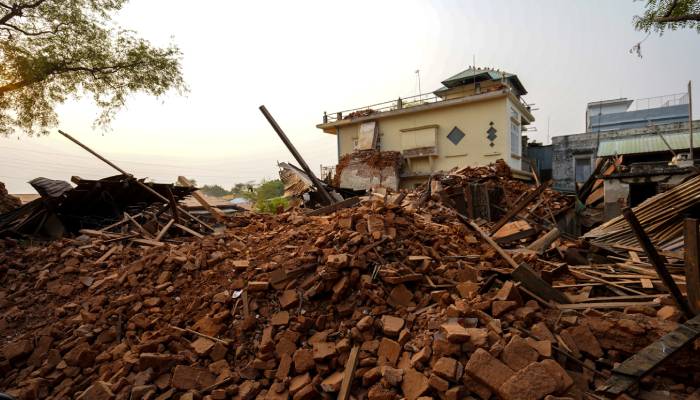
    The central cities of Mandalay and Sagaing have been left in ruins following the devastating 7.7 magnitude earthquake. Two weeks after the disaster, which claimed the lives of over 3,600 people, many survivors are still living in temporary encampments surrounded by collapsed buildings, destroyed tea shops, and flattened hotels.

    Numerous individuals lack access to basic sanitation facilities, while finding clean drinking water requires long waits in line. As heavy rain is forecast, fears are rising about the stability of their makeshift shelters.

    The ruling military junta in Myanmar has ordered that the five-day festival be conducted without any music or dance.

    Since the earthquake on March 28, temperatures in Mandalay have soared to a scorching 44 degrees Celsius (111 degrees Fahrenheit). At night, those living in tents face swarms of mosquitoes, waking early to queue for assistance.

    Officials report that over 5,200 structures have been destroyed, and the United Nations has indicated that more than two million people are currently in need due to this natural disaster.

    The tremors from the earthquakes were also felt as far away as Bangkok, where a high-rise building under construction collapsed, trapping dozens of workers.

  • Bangkok Residents Pursue Earthquake-Resistant Housing Options

    Bangkok Residents Pursue Earthquake-Resistant Housing Options

    A corridor in a high-rise condominium in Bangkok, showing damage after the earthquake on March 29, 2025. —AFP

    BANGKOK: Just hours after experiencing a powerful earthquake, Phatsakon Kaewkla returned home to find alarming cracks in the walls of his 22nd-floor apartment in Bangkok.

    Feeling increasingly uneasy about the structural damage caused by the most intense tremors the capital has faced in decades, the 23-year-old decided to stay away for two days until experts declared the building safe.

    Phatsakon is among numerous residents in Bangkok contemplating their housing options in a city where hundreds of residential structures were impacted by the 7.7-magnitude quake that struck Myanmar on March 28.

    While the condominium’s management assured him that engineers had inspected the building and deemed it inhabitable, he remains unsettled by the cracks.

    “I feel a little scared. My mom even suggested I should move out,” he stated.

    Located over 1,000 kilometers (620 miles) from the epicenter, Bangkok — characterized by its vivid skyline filled with numerous towers and glistening skyscrapers — rarely experiences such tremors.

    Owen Zhu, a 40-year-old real estate consultant based in Bangkok, informed AFP that the earthquake has significantly impacted his industry.

    “People are beginning to realize that living in high-rise buildings may pose higher risks concerning earthquake safety compared to low-rise structures,” he remarked.

    In the days following the quake, Zhu noted a surge in inquiries from residents looking to relocate, fueled by widespread fear and anxiety about residing at significant heights.

    ‘A Shift in Perception’

    Yigit Buyukergun from Turkey was at home with his wife when the earthquake struck. Once the shaking stopped, they emerged from sheltering under a table to assess the damage to their 22nd-floor apartment.

    “Everywhere is cracked, especially in the corridor. It’s clear that the roof is in poor condition,” said the 25-year-old.

    Even with the building owners declaring it “100% safe,” Buyukergun remains doubtful.

    “I don’t believe it,” he commented.

    In Bangkok’s extensive residential developments, many studio apartments are offered on long-term leases that require a two-month deposit. Most condominiums do not allow short-term rentals due to safety protocols, with only hotels permitted to rent for less than 30 days.

    Zhu pointed out that disagreements between tenants and landlords over the safety of earthquake-damaged apartments are becoming increasingly common, resulting from differing perceptions of habitability.

    “There’s a disconnect in perception and judgment between both parties,” he observed. “Landlords see the units as safe while tenants feel unsafe and insist on moving out to reclaim their deposits.”

    Raising Standards

    Prior to the earthquake, Thailand’s building safety standards were not particularly stringent. This was not a concern for many property-seeking clients, according to Zhu.

    Heightening this anxiety was the alarming collapse of a 30-story construction in Bangkok, which trapped dozens of workers, many of whom are still unaccounted for a week later. Authorities are currently investigating whether poor-quality materials were utilized in its construction.

    As a result of the quake, more of Zhu’s clients are now leaning toward low-rise buildings.

    For those still inclined towards high-rises, they often seek properties that sustained minimal or no damage in the recent earthquake, or at least were not severely impacted.

    Zhu believes that, in the long run, property values will increase as the demand for safer buildings stimulates the implementation of expensive seismic resistance measures, ultimately raising the standards within Thailand’s real estate market.

    However, Buyukergun feels that discussions surrounding building regulations won’t ease his worries regarding uncontrollable geological factors.

    His experiences with earthquakes in Turkey had already made him cautious, but he never expected to feel the same unease while living in Thailand.

    “I always thought Thailand was safe,” he recalled. “That’s why I found it hard to believe an earthquake could actually happen here.”

  • Heavy Rains Hinder Myanmar Quake Relief Efforts; Deaths Reach 3,471

    Heavy Rains Hinder Myanmar Quake Relief Efforts; Deaths Reach 3,471

    Update on the Earthquake Crisis in Myanmar

    BANGKOK — Over the past weekend, regions in Myanmar that were severely affected by a recent earthquake experienced rainfall, potentially hindering relief efforts and increasing the risk of disease outbreaks, according to aid organizations. The United Nations’ head of aid expressed the urgent need for additional tents to provide shelter for those displaced by the disaster.

    As reported by state media, the death toll from the devastating earthquake that struck on March 28 has now reached 3,471, with 4,671 individuals injured and 214 people still unaccounted for.

    Aid organizations have raised concerns that the unusual combination of rainfall and extreme heat could lead to outbreaks of illnesses like cholera among survivors who are living outdoors. "Families are sleeping outside amid the ruins of their homes, while the bodies of loved ones are being recovered from the rubble. The fear of more earthquakes looms large," said Tom Fletcher, the visiting UN aid chief. He emphasized the need to quickly deliver tents and hope to survivors as they work to rebuild their lives, stressing that coordinated action is vital to save as many lives as possible.

    Neighboring countries, including China, India, and other Southeast Asian nations, have sent relief supplies and rescue teams to support the recovery efforts in the earthquake-affected areas, which are home to roughly 28 million residents.

    Additionally, the United States—previously the world’s largest donor of humanitarian aid—has committed at least $9 million to assist communities in Myanmar impacted by the earthquake. However, both current and former U.S. officials noted that the recent cuts to foreign aid programs have hampered the response efforts. Marcia Wong, a former high-ranking USAID official, revealed that three USAID workers who traveled to Myanmar following the quake were informed they would be let go. "This team is putting in intense effort to deliver humanitarian aid to those in dire need. To hear about imminent job cuts is incredibly demoralizing," Wong stated.

    In neighboring Thailand, the death toll from the earthquake has risen to 24, with 17 fatalities reported at the site of a collapsed skyscraper in Bangkok that was under construction. There are still 77 individuals unaccounted for in this incident.

    Ceasefire Violations

    Since the military coup that ousted Nobel laureate Aung San Suu Kyi in 2021, the military has faced challenges in governing Myanmar, resulting in a damaged economy and collapsing basic services, including healthcare—a situation worsened by the earthquake.

    The ongoing civil conflict has displaced over 3 million people, leading to widespread food insecurity and leaving more than one-third of the population in need of humanitarian aid, according to the United Nations.

    Despite a ceasefire being declared last Wednesday, the UN Office of the High Commissioner for Human Rights reported on Friday that the junta was restricting aid in areas that oppose its authority. They are also investigating reports of attacks carried out by the junta against opposition figures, including actions taken during the ceasefire.

    A spokesperson for the junta did not respond to requests for comment.

    The relief organization Free Burma Rangers informed Reuters on Saturday that the military conducted bombings in Karenni and Shan states on Thursday and Friday, killing at least five people, including civilians. David Eubank, founder of the group, noted that there have been a minimum of seven military strikes since the ceasefire announcement.

  • Myanmar earthquake toll exceeds 3,000; rains complicate rescue efforts

    Myanmar earthquake toll exceeds 3,000; rains complicate rescue efforts

    Aerial view of damaged buildings after an earthquake on March 28 in the Mandalay region, Myanmar. Video screenshot taken March 31, 2025. — Reuters

    • Weather authorities issue warnings about unusual rainfall.
    • Expected rains may hinder search and rescue operations.
    • National leader plans to attend regional summit in Bangkok.

    BANGKOK: The death toll from the catastrophic earthquake in Myanmar has exceeded 3,000, with hundreds more unaccounted for, as forecasts of unseasonal rains pose a new challenge for rescuers and aid workers striving to assist those affected in a nation already embroiled in civil conflict.

    The 7.7-magnitude earthquake that struck last Friday, one of the strongest to hit the Southeast Asian nation in a century, devastated a region home to approximately 28 million people, collapsing structures, flattening neighborhoods, and leaving many without basic necessities like food, water, and shelter.

    As of Wednesday, the count of fatalities rose to 3,003, with 4,515 individuals injured and 351 still missing, according to a statement from Myanmar’s embassy in Japan on Facebook, while rescuers continue their arduous efforts to locate survivors.

    Conditions may deteriorate further as weather officials have predicted unusual rainfall from Sunday through April 11, threatening the areas most affected by the earthquake, including Mandalay, Sagaing, and the capital, Naypyidaw.

    “Rain is on the way, and there are still many individuals trapped,” reported an aid worker in Myanmar to Reuters. “Particularly in Mandalay, if it starts to rain, those who are trapped could drown even if they are still alive.”

    According to the embassy’s report, there have already been 53 airlifts of aid to Myanmar, while over 1,900 rescue personnel from 15 countries, including neighbors in Southeast Asia as well as China, India, and Russia, have arrived to assist.

    Despite the dire circumstances, General Min Aung Hlaing, the leader of the military junta, is set to depart the disaster-stricken nation on Thursday to attend a rare regional summit in Bangkok, as announced by state television.

    This trip is uncommon for a leader widely perceived as an outcast by many nations, facing severe international sanctions and an ongoing investigation by the International Criminal Court.

    Unseasonable Rainfall

    The anticipated rainfall adds to the challenges encountered by rescue and aid organizations, which have called for unhindered access to all affected regions despite the ongoing civil unrest.

    Since regaining power in a coup in 2021 that displaced the democratically elected government of Nobel laureate Aung San Suu Kyi, the military has struggled to maintain control over Myanmar.

    The military junta has faced global isolation since the coup, leading to economic decline and a breakdown of essential services, including health care.

    On Wednesday, state-run MRTV announced that a unilateral ceasefire would take effect for 20 days to facilitate relief efforts after the earthquake but cautioned that authorities would “react appropriately” if any rebel groups launched attacks.

    This decision follows a major rebel coalition’s declaration of a ceasefire on Tuesday aimed at supporting humanitarian efforts.

    Nearly a week after the quake, rescue operations in nearby Thailand continue as teams search through the wreckage of a collapsed skyscraper in Bangkok that was still under construction.

    Rescuers have been utilizing excavators and bulldozers to sift through 100 tons of concrete in search of survivors after the disaster claimed 15 lives, with 72 individuals still unaccounted for.

    The national death toll in Thailand currently stands at 22.

  • Junta Leader Departing Quake-Hit Myanmar for Summit Amid Aid Calls

    Junta Leader Departing Quake-Hit Myanmar for Summit Amid Aid Calls

    Myanmar’s military chief, Senior General Min Aung Hlaing, speaks at a press conference after discussions with Russian President Vladimir Putin in Moscow on March 4, 2025. — Reuters

    • Isolated junta leader may gain credibility from Thailand visit.
    • Reported death toll from 7.7 magnitude earthquake surpasses 3,000, according to CCTV.
    • Relief groups report hospitals are overwhelmed and medications are lacking.

    Min Aung Hlaing, Myanmar’s isolated leader, is set to depart his disaster-stricken country Thursday for an infrequent trip to a regional summit, as humanitarian organizations urged for the easing of restrictions to aid survivors from a catastrophic earthquake.

    The 7.7 magnitude earthquake, among the strongest in Myanmar in a century, shook a region populated by 28 million, damaging buildings, demolishing communities, and leaving many without food, water, or shelter. According to China’s state media, the official death toll has exceeded 3,000.

    The military junta has struggled since regaining power in a 2021 coup that ousted the elected government led by Nobel laureate Aung San Suu Kyi. Following the takeover, the generals have faced international isolation, leading to severe deterioration of Myanmar’s economy and essential services, including healthcare, amid ongoing civil conflict.

    On Wednesday night, state-run MRTV announced a 20-day unilateral ceasefire to support recovery efforts following the earthquake, while cautioning that they would “respond accordingly” if rebels initiated attacks.

    MRTV confirmed that Min Aung Hlaing would travel to Bangkok for a summit with mostly South Asian nations—an unusual trip for a general seen as a pariah by many countries, who faces Western sanctions and an investigation by the International Criminal Court.

    The junta leader has also been barred from ASEAN summit participation.

    Nevertheless, some analysts believe the earthquake and the upcoming summit, which includes leaders from Thailand, India, and Bangladesh, could enhance Min Aung Hlaing’s legitimacy as he moves forward with a largely criticized election in December that is expected to extend military rule.

    Humanitarian agencies reported extensive destruction and a medical emergency in central Myanmar, with hospitals overwhelmed and medications in short supply, alongside a rising threat of waterborne diseases.

    Mohamed Riyas, the Myanmar Director of the International Rescue Committee, described the humanitarian situation as “overwhelming.” He stated, “It may take weeks to fully comprehend the extent of the destruction caused by this earthquake due to downed communication networks and disrupted transport.”

    “People are in urgent need of medical assistance, clean water, tents, food, and other essentials. Providing life-saving health services is critical,” he added.

    Mikhael De Souza, a medical aid coordinator for MSF, mentioned that in Mandalay, the second-largest city, around 500 structures had completely collapsed, with an additional 800 sustaining partial damage.

    “Many individuals are still forced to live outdoors in deplorable conditions,” he noted. “The lack of safe drinking water poses significant survival challenges.”

    Military Readiness

    Human rights organizations have accused the junta of hindering humanitarian efforts by enforcing strict security measures in several severely affected quake regions.

    An incident highlighting the complications of delivering aid amid civil conflict occurred when junta troops reportedly fired warning shots at a Chinese Red Cross convoy that failed to stop in a conflict zone.

    Junta spokesperson Zaw Min Tun remarked that the group had neglected to inform the authorities of its movements.

    China was one of the first countries to provide assistance to Myanmar, sending rescue teams the day after the disaster and committing to 100 million yuan (about $13.76 million) in supplies.

    A spokesperson for China’s foreign ministry indicated that the aid team and supplies were safe and urged all parties in Myanmar to guarantee the safety of rescuers and maintain clear relief routes.

    Despite the nation facing its worst disaster in decades, the military has remained on high alert, conducting airstrikes and other operations near the affected areas, according to reports from rebel groups and Amnesty International.

    Min Aung Hlaing stated that the military had ceased offensives but warned that rebels were preparing to exploit the disaster for potential attacks. A key rebel alliance announced a unilateral ceasefire earlier this week to facilitate humanitarian efforts.

    Before the military’s declaration of a temporary ceasefire, Tom Andrews, the UN special rapporteur on Myanmar, condemned the junta’s post-quake assaults as “outrageous” and called for global leaders to denounce these actions vehemently.

    Presence of Soldiers

    Acquiring accurate information from areas like Sagaing has long been challenging due to a junta-imposed internet and cellphone blackout related to the ongoing conflict, which activists have urged be lifted following the earthquake.

    The military has declined requests from international journalists to cover the earthquake’s aftermath, citing a lack of water, electricity, and accommodations.

    “Soldiers are present throughout the town,” a man who visited Sagaing, close to the quake’s epicenter, told Reuters. “They are there for security rather than rescue operations, and they inspect every vehicle.”

    Human Rights Watch, based in New York, urged the junta to permit unrestricted access to humanitarian aid and lift barriers affecting aid organizations, urging donors to channel assistance through independent entities rather than solely through junta authorities.

    “Myanmar’s junta cannot be trusted to respond to a disaster of this magnitude,” stated Bryony Lau, HRW’s deputy Asia director. She implored agencies to pressure the junta to “provide full and immediate access to survivors, no matter where they are.”

    A woman in Mandalay reported to Reuters that authorities were busy preparing a stage for this month’s Thingyan water festival, despite many individuals being homeless and corpses lying beneath collapsed buildings.

    In Thailand, the death toll from the earthquake had risen to 22 by Wednesday, with search efforts continuing for survivors beneath the rubble of a skyscraper under construction in Bangkok, which has now entered its fifth day.

    Heavy machinery was utilized to dismantle 100 tons of concrete in hopes of discovering a survivor amid the heap, where 15 individuals were confirmed dead, and 72 remain missing.

    “We are continuing our search for survivors, but we are modifying our approach,” stated Bangkok Governor Chadchart Sittipunt. “We are creating a path for the rescue team to access the area.”

  • Myanmar Junta Warns Aid Convoy Amid Quake Death Toll Over 2,800

    Myanmar Junta Warns Aid Convoy Amid Quake Death Toll Over 2,800

    BANGKOK: On Wednesday, Myanmar’s military junta reported that its forces fired warning shots at an aid convoy from the Chinese Red Cross, highlighting the difficulties in providing aid amid ongoing civil conflict. This comes as humanitarian organizations advocate for improved access to assist those affected by a devastating earthquake.

    Since the military takeover in 2021, which ousted the elected government led by Nobel laureate Aung San Suu Kyi, Myanmar has been gripped by turmoil and conflict. The situation has severely damaged the economy and essential services including healthcare.

    According to junta spokesperson Zaw Min Tun, the Chinese Red Cross did not notify local authorities about its operations in a conflict area on Tuesday night. The security team reportedly discharged rounds into the air when the convoy, which included regional vehicles, did not halt.

    A spokesperson from the Chinese Foreign Ministry confirmed that the aid team and its supplies were unharmed, urging all parties in Myanmar to guarantee the safety of rescuers. "It’s vital to keep transportation routes for humanitarian assistance clear and operational," Guo Jiakun mentioned at a news briefing.

    The warning shots were fired as Myanmar state media reported that the death toll from last Friday’s magnitude 7.7 earthquake had risen to 2,886, with 4,639 individuals injured. Many rural areas in the Sagaing region, which bore the brunt of the quake, are primarily controlled by armed resistance factions opposing the military regime, as noted by the International Crisis Group.

    They added, “These areas will present substantial challenges for aid organizations due to regime constraints, fragmented local governance, and ongoing conflict.” Gathering accurate information in these regions had already been difficult before the earthquake due to a military-imposed internet and communication blackout, exacerbating the crisis.

    A resident of Sagaing shared with Reuters, “Soldiers are widely present in the area. They are here for security, not rescue, and they inspect every vehicle.”

    Human Rights Watch, based in New York, urged the junta to allow unrestricted access to humanitarian assistance and to remove barriers that hinder aid groups. The organization insists that donors should support independent organizations instead of solely relying on junta officials. "The military in Myanmar cannot be trusted to manage a disaster of this magnitude," emphasized Bryony Lau, the group’s deputy Asia director.

    The military has refuted claims of widespread human rights abuses amid its fight against a multifaceted insurrection that arose following the coup. Rebels allege that the military has conducted airstrikes even post-quake. On Tuesday, a significant rebel coalition declared a unilateral ceasefire to facilitate relief operations.

    Millions Affected

    According to the United Nations, more than 28 million individuals are impacted in the six regions struck by the earthquake, with the organization allocating $12 million for emergency responses, including food, shelter, water, sanitation, mental health support, and various services.

    The United Nations Office for Project Services (UNOPS) highlighted the ongoing crisis, stating, "The situation is dire, with disrupted communication and road access hindering response efforts, particularly in Sagaing."

    Australia has announced an additional A$6.5 million (approximately $4.1 million) in humanitarian aid for Myanmar, which will be distributed through well-vetted international and local partners. In a statement, Foreign Minister Penny Wong asserted, "We are taking proactive measures to ensure our assistance does not lend credibility to the military regime in Myanmar."

    A woman from Mandalay, near the earthquake’s epicenter, remarked to Reuters that authorities were constructing a stage for the upcoming Thingyan water festival, despite many residents being homeless and bodies left beneath collapsed structures. The military council has barred international journalists from covering the aftermath of the earthquake, citing shortages of water, electricity, and accommodation.

    In neighboring Thailand, the quake’s toll rose to 22, with numerous buildings sustaining significant damage.

    In Bangkok, the search for survivors continued beneath the rubble of a partially constructed skyscraper, which had claimed 15 lives with 72 individuals still unaccounted for. As part of the rescue effort, officials reassigned two rescue dogs to provide emotional support to the families of the missing. Children were seen comforting the golden retrievers clad in light-up vests at a temporary shelter, finding solace during these distressing times. Chanpen Keawnoi, whose mother and younger sister are among the missing, expressed, "As long as the dog keeps barking when it senses something, there’s hope someone may still be alive."

    The government has launched an investigation into the building’s collapse, with preliminary tests indicating that some steel samples from the site were substandard.

  • UN Alerts: Time Running Out to Rescue Myanmar Quake Survivors

    UN Alerts: Time Running Out to Rescue Myanmar Quake Survivors

    Chinese rescue workers on the scene of a collapsed building after a major earthquake in Mandalay, Myanmar, March 31, 2025. — Reuters

    • Civil war in Myanmar may hinder aid delivery, according to organizations.
    • Relief organizations highlight urgent requirements for water, food, and shelter.
    • A rebel coalition fighting the junta declares a unilateral ceasefire.

    On Tuesday, aid organizations in Myanmar painted a grim picture of chaos and destruction following an earthquake that has claimed over 2,700 lives. They emphasized the critical demand for food, water, and shelter, warning that the opportunity to locate survivors is rapidly diminishing.

    Myanmar’s military leader, Min Aung Hlaing, stated in a televised address that the death toll from the 7.7 magnitude earthquake that struck on Friday is expected to exceed 3,000. By Tuesday, the count was reported at 2,719, with 4,521 people injured and 441 still unaccounted for.

    This earthquake, the strongest to hit Myanmar in more than a century, struck during lunchtime on Friday, bringing down both ancient pagodas and contemporary buildings.

    Mandalay, Myanmar’s second-largest city, along with Naypyitaw, the capital built as a stronghold by the previous junta, suffered substantial destruction.

    In Thailand, the quake resulted in 21 fatalities as hundreds of buildings were damaged. Rescuers continue to search for survivors amidst the debris of a collapsed construction skyscraper in Bangkok, though they acknowledge that time is not on their side.

    In Myanmar, UN agencies reported that hospitals are overwhelmed, and rescue efforts are being hampered by damaged infrastructure and ongoing civil conflict. Rebels have accused the military of conducting airstrikes despite the earthquake, prompting a rebel coalition to announce a one-month ceasefire to facilitate aid efforts.

    Aid organizations raised alarms regarding shortages of food, water, and sanitation as the tremors continue to rock the region on Tuesday.

    Julia Rees from UNICEF, who just returned from one of the hardest-hit areas near the epicenter, noted that entire communities have been decimated, resulting in overwhelming destruction and psychological distress.

    “This crisis continues to unfold. The aftershocks persist. Search and rescue operations are ongoing, with bodies still being retrieved from the rubble,” she stated. “Let me be clear: the needs are enormous and increasing by the hour. The time for life-saving responses is running out.”

    Civil War Complicates Relief Efforts

    In the vicinity of Mandalay, 50 children and two teachers lost their lives when their preschool collapsed, according to the UN humanitarian agency.

    In a rare success story, a 63-year-old woman was rescued from the debris of a building in Naypyitaw after being trapped for 91 hours. She was discovered on Tuesday morning and extracted an hour later, thanks to collaborative rescue efforts from teams from India, China, and Russia.

    The ongoing civil war in Myanmar, sparked by the military coup in 2021, has complicated access to the injured and homeless, exacerbated by strict controls on internet and communication networks.

    A rebel faction, the Karen National Union, reported that the junta carried out airstrikes in eastern Myanmar at a time when the focus should have been on earthquake relief efforts.

    On Tuesday, the Three Brotherhood Alliance, consisting of three major rebel groups opposed to the junta, declared a unilateral ceasefire for one month to facilitate effective humanitarian assistance.

    Amnesty International called on the junta to allow aid to reach areas beyond its control, with its Myanmar researcher Joe Freeman emphasizing, “The military has a history of denying aid to regions where resistance groups are active. It must grant unimpeded access to all humanitarian organizations immediately.”

    In his address, junta leader Min Aung Hlaing noted “lessons learned” and criticized the poor quality of construction, stating that some buildings were constructed cheaply and without adequate investment.

    It remains unclear if Min Aung Hlaing will proceed with a rare trip abroad later this week to attend a regional summit in Bangkok as scheduled. The foreign ministry in Thailand indicated that he might participate via teleconference.

    “We Will Keep Going”

    In Bangkok, rescue teams continue to scour the wreckage of a collapsed skyscraper for any signals of life, even as the days since the quake increase the skepticism regarding survival chances.

    Approximately 70 bodies are estimated to be trapped under the debris, with experts confirming that 12 have been located through scanners. However, large debris remains in the way, prompting rescuers to cut through concrete slabs to reach them.

    “Our focus remains on finding survivors. Cases exist where individuals have survived for up to a week,” stated Bangkok Governor Chadchart Sittipunt during a news briefing. “We cannot declare that hope is lost… as long as there is structure, air, and no direct heat. We will continue our efforts.”

    Multinational teams, including personnel from the U.S. and Israel, are assisting in the search and rescue operations as families and friends remain anxious for news of their loved ones.

    “The rescue teams are doing everything they can. I can see that,” said 19-year-old Artithap Lalod, anxiously awaiting updates about his brother.

    Initial tests indicated that some steel samples from the collapsed site did not meet standards, prompting the Thai government to initiate an investigation into the collapse’s cause.

    So far, 14 deaths have been confirmed at the building site, with seven additional fatalities reported elsewhere in Bangkok.

  • Woman Saved from Myanmar Quake Rubble as Rescue Efforts Intensify

    Woman Saved from Myanmar Quake Rubble as Rescue Efforts Intensify

    Rescue Efforts Underway Following Earthquake in Myanmar and Thailand


    Rescue worker searching through rubble of the collapsed Great Wall Hotel in Mandalay, Myanmar, on March 31, 2025. — Reuters

    • Rescuers are urgently searching for survivors in Myanmar and Thailand.
    • The death toll has exceeded 1,700 in Myanmar, with 18 confirmed fatalities in Thailand.
    • Myanmar’s ongoing civil conflict is hampering earthquake relief efforts.

    BANGKOK: Hope emerged on Monday as rescuers successfully freed a woman from the debris of a hotel in Myanmar. This occurred three days after a powerful earthquake claimed the lives of nearly 2,000 people, prompting urgency among search teams in both Myanmar and Thailand to locate more survivors.

    The woman was rescued after being trapped for 60 hours beneath the rubble of the Great Wall Hotel in Mandalay. A collaborative effort involving Chinese, Russian, and local rescue teams led to her extraction following a five-hour operation. Reports indicate she is currently in stable condition.

    Mandalay lies near the epicenter of the 7.7-magnitude quake that struck on Friday, causing widespread destruction across Myanmar and inflicting damage in neighboring Thailand.

    In Bangkok, the capital of Thailand, emergency crews are using cranes and search dogs in a tense search for 76 individuals believed to be trapped under the debris of a collapsed construction site. Bangkok Governor Chadchart Sittipunt assured that efforts to find survivors would persist beyond the typical 72-hour critical window.

    “The search will continue even after 72 hours. We have seen cases in Turkey where individuals trapped for a week have survived, so our efforts are not ceasing,” said Chadchart. He also mentioned that machines scanning the wreckage indicated potential signs of life and that rescue dogs were being dispatched to help locate survivors.

    While Thailand’s official death toll stood at 18 as of Sunday, authorities fear it may rise without further rescues at the site of the collapse.

    In Myanmar, state media reported at least 1,700 confirmed deaths. According to The Wall Street Journal, citing the military government, the death toll may have reached 2,028, though this has not been independently verified by Reuters. The United Nations has announced it is sending relief supplies to about 23,000 survivors affected by the earthquake in central Myanmar.

    “Our teams in Mandalay are ramping up our humanitarian response, despite facing trauma themselves,” stated Noriko Takagi, the UN refugee agency’s representative in Myanmar. “Time is critical as Myanmar needs global solidarity and support to cope with this immense disaster.”

    Myanmar’s neighboring countries—including India, China, and Thailand—have begun sending relief materials and teams, along with support from Malaysia, Singapore, and Russia.

    The United States has pledged $2 million in humanitarian aid through local organizations in Myanmar. An emergency response team from USAID, which is experiencing substantial cuts under the Trump administration, is being deployed to assist.

    The earthquake’s devastation adds to the challenges facing Myanmar, which is already grappling with the chaos of an ongoing civil war that arose from a nationwide uprising following a military coup in 2021 that overthrew the democratically elected government of Nobel Peace Prize winner Aung San Suu Kyi.

    Reports from rebel groups indicate that the military government continues to carry out airstrikes on villages affected by the earthquake. Singapore’s foreign minister has called for an immediate ceasefire to facilitate relief efforts.

    Critical infrastructure across the country—such as bridges, highways, airports, and railways—sustained damage, complicating humanitarian responses while the conflict continues to impact the economy, displace over 3.5 million people, and cripple the health care system.

  • Myanmar Quake Toll Reaches 1,700 Amid Growing Aid Efforts

    Myanmar Quake Toll Reaches 1,700 Amid Growing Aid Efforts

    Earthquake in Myanmar Causes Widespread Damage and Casualties


    Image caption: A general view of a collapsed building in the aftermath of a powerful earthquake in Mandalay, Myanmar, March 30, 2025. — Reuters

    • 3,400 Injured, 300 Missing Following Earthquake
    • Rescue Teams From India, China, Singapore, and Thailand Mobilized
    • UN Agency Reports Hospitals Struggling in Hard-Hit Regions

    BANGKOK: The death toll from Myanmar’s recent earthquake has been steadily increasing, prompting foreign rescue teams and aid to flood into the impoverished nation. The disaster has overwhelmed hospitals, and affected communities are hastily trying to orchestrate rescue operations with limited resources.

    The 7.7-magnitude earthquake struck the war-torn Southeast Asian country on Friday, marking one of the most powerful quakes in Myanmar in a century. By Sunday, official reports indicated approximately 1,700 casualties, 3,400 injuries, and over 300 people unaccounted for.

    The military government’s leader, Senior General Min Aung Hlaing, acknowledged the devastating impact and indicated that the death toll might rise. This admission came three days after he publicly requested international assistance, according to state media.

    Neighboring countries, including India, China, and Thailand, have sent relief supplies and teams, with additional support coming from Malaysia, Singapore, and even Russia.

    Car Trapped Under Rubble
    Image caption: A vehicle trapped beneath the debris of a collapsed building in Mandalay, Myanmar, March 30, 2025. — Reuters

    "The devastation is severe, and humanitarian needs are escalating rapidly," said a statement from the International Federation of Red Cross and Red Crescent Societies. They emphasized the urgent requirement to stabilize affected communities, especially as temperatures rise and the monsoon season approaches.

    The United States has committed $2 million in aid through local humanitarian organizations and has dispatched an emergency response team from USAID, which has been experiencing budget cuts under the Trump administration.

    This catastrophe further compounds the suffering in Myanmar, already grappling with a civil conflict following a military coup in 2021 that ousted the democratically elected government led by Nobel laureate Aung San Suu Kyi.

    Search and Rescue Operations
    Image caption: Search and rescue operations ongoing in Mandalay, Myanmar, March 29, 2025. — Reuters

    Critical infrastructure—including bridges, highways, airports, and railways—has been damaged across the country, hampering humanitarian operations amid ongoing conflict that has displaced over 3.5 million individuals and severely weakened the health system.

    In some areas near the epicenter, residents reported a lack of government assistance, forcing them to fend for themselves. “Restoring transportation routes swiftly is essential,” Min Aung Hlaing instructed officials, as state media reported on efforts to repair railway lines and reopen airports to make rescue efforts more effective.

    According to predictive models from the U.S. Geological Survey, the death toll in Myanmar could eventually exceed 10,000, with economic losses surpassing the nation’s annual GDP.

    ‘No Assistance, No Rescuers’

    Rescue Workers at Collapse Site
    Image caption: Rescuers working at a collapsed building site in Mandalay, Myanmar, March 30, 2025. — Reuters

    Hospitals in central and northwestern Myanmar, including the city of Mandalay and the capital Naypyidaw, are struggling to accommodate the influx of injured individuals, as reported by the UN Office for the Coordination of Humanitarian Affairs.

    The earthquake’s tremors also impacted parts of Thailand, where an under-construction skyscraper collapsed, resulting in 18 fatalities, according to reports from Thai authorities. Recovery efforts continued for the third day, with 76 individuals trapped under the debris.

    The opposition National Unity Government of Myanmar, which comprises remnants of the previous administration, declared a two-week halt to offensive military actions starting Sunday.

    In regions like Sagaing, near the earthquake’s epicenter, the extent of destruction is significant. “We are witnessing widespread devastation—counts of buildings reduced to rubble,” resident Han Zin reported. He noted that much of the town has been without power and is running short on drinking water. “We have not received any aid, and there are no rescue personnel present.”

    Sections of a major bridge connecting Sagaing with Mandalay have collapsed, with satellite images revealing parts of the historical structure submerged in the Irrawaddy River. “With the bridge out, even aid from Mandalay is hardly making its way here,” stated the Sagaing Federal Unit Hluttaw, associated with the NUG, on social media.

    Rescuers Carrying Bodies
    Image caption: Rescuers transporting a deceased victim in Mandalay, Myanmar, March 30, 2025. — Reuters

    “Food and medical supplies are scarce, and the number of casualties is overwhelming our local hospital, which is not equipped to handle the influx of patients.”

    ‘Can You Hear Me?’

    Mandalay’s extensive damage has left many people trapped beneath collapsed buildings, with heavy machinery required for rescue operations that are currently out of reach, according to humanitarian workers stationed in the area.

    "Our teams are utilizing gloves, ropes, and basic tools to dig for survivors," one worker said, on the condition of anonymity due to security concerns. “Countless people are still trapped and we cannot ascertain the death toll at this time because we don’t know who is alive or who is lost.”

    A video taken by a local Mandalay resident revealed patients lying outside a 500-bed orthopedic hospital where no space was available.

    Public and private healthcare facilities in Mandalay, including the Mandalay General Hospital and sections of Mandalay Medical University, suffered damage from the quake, the World Health Organization reported.

    Rescue personnel from Russia and India are en route to Mandalay, with multiple teams from China, Thailand, and Singapore already on-site.

    In Bangkok, rescuers have been tirelessly working at the site of the demolished 33-story building, surrounded by piles of concrete and twisted metal, in hopes of rescuing workers sealed beneath the wreckage.

    Teerasak Thongmo, a Thai police commander, mentioned that his team is racing against time to locate any survivors. “Our immediate goal is to find those who might still be alive. We have a crucial 72-hour window to act,” he noted.

    Nearby, relatives of the missing and trapped construction workers gathered, anxiously awaiting news. Some were visibly distressed. “Ploy, Ploy, I’m here for you!” cried one woman, overwhelmed with emotion. “Ploy, can you hear me?”

  • Aid Floods into Myanmar After Devastating Earthquake Claims 1,600

    Aid Floods into Myanmar After Devastating Earthquake Claims 1,600

    Rescue teams at the scene where a building collapsed following a severe earthquake in Mandalay, Myanmar, on March 29, 2025. — Reuters

    • Teams from India, China, Singapore, and Thailand are on the ground.
    • The opposition pledges to pause military offensives for two weeks.
    • Local residents report a lack of government aid and inadequate equipment for rescue operations.

    In response to the devastation from a massive earthquake that struck Myanmar, neighboring countries have deployed warships and aircraft filled with relief supplies and rescue teams. The international aid response has been ramping up following the disaster that severely impacted this impoverished Southeast Asian nation.

    According to the military government, the 7.7-magnitude earthquake, one of the strongest in the last century, resulted in at least 1,600 fatalities and left 3,400 individuals injured.

    “All military and civilian hospitals must coordinate efficiently to ensure a prompt medical response,” stated Senior General Min Aung Hlaing, chief of the junta, as reported by Myanmar media.

    The United States Geological Survey projected that the death toll in Myanmar could exceed 10,000, with damages potentially surpassing the nation’s annual GDP.

    The tremors were felt in parts of Thailand as well, leading to the collapse of a skyscraper under construction and claiming 17 lives in the capital. Reports indicated that at least 78 individuals remained trapped beneath the rubble.

    Classified as the deadliest natural calamity in Myanmar in years, the earthquake inflicted significant damage to vital infrastructure, including an airport, highways, and bridges, thereby hampering humanitarian efforts according to the United Nations.

    ‘No aid, no rescue workers’

    The earthquake struck amid an ongoing civil war, which has intensified since the military coup in 2021 that removed the democratically elected government of Nobel laureate Aung San Suu Kyi and ignited a nationwide armed insurrection.

    Ongoing hostilities have devastated Myanmar’s agriculture-based economy, displaced over 3.5 million citizens, and severely damaged essential services such as healthcare.

    The National Unity Government (NUG), which consists of remnants from the previous administration, has declared that anti-junta militias will suspend all military offensives for two weeks starting Sunday.

    In a statement, the NUG announced, “We, along with resistance forces, allied organizations, and civil society groups, will undertake rescue operations.”

    In some of the most severely impacted areas, locals shared with Reuters that government assistance was nearly nonexistent, forcing many to manage on their own.

    Han Zin, a resident from Sagaing, near the earthquake’s epicenter, described the scene: “What we’re witnessing is widespread devastation—numerous buildings have crumbled to the ground. Since the disaster, much of our town has been without electricity, and drinking water is dwindling.” He lamented, “We have not seen any relief, and there are no rescue teams in sight.”

    In Mandalay, nearby the Irrawaddy River, a rescue worker reported that most operations in Myanmar’s second-largest city were being undertaken by small, self-organized local groups that lacked the necessary tools.

    “We have reached collapsed structures, but some remain unstable as we work,” he said, requesting anonymity due to security matters.

    Field hospital

    Rescue teams feared that many individuals might still be trapped under the rubble throughout Mandalay, but most could not be rescued due to a lack of heavy machinery, as noted by another humanitarian worker and two residents.

    A resident, wishing to remain unnamed, stated, “People are still stuck inside the buildings; we can’t get them out.” Hospitals in various regions, including Mandalay and Sagaing, were overwhelmed with casualties, according to the U.N. Office for the Coordination of Humanitarian Affairs.

    Countries such as India, China, and Thailand have dispatched relief supplies and teams, along with aid from Malaysia, Singapore, and Russia.

    On Saturday, Indian military aircraft conducted multiple flights into Myanmar, delivering supplies and search-and-rescue personnel to Naypyitaw, the designated capital, which suffered extensive damage due to the earthquake.

    The Indian army plans to establish a field hospital in Mandalay, and two navy ships carrying aid have set sail for Yangon, the commercial hub of Myanmar, as stated by Indian Foreign Minister Subrahmanyam Jaishankar.

    Teams of Chinese rescue workers, including a contingent traveling from Yunnan province, have arrived, as announced by China’s embassy in Myanmar on social media.

    A 78-member team from Singapore, accompanied by search and rescue dogs, has started operations in Mandalay, according to local media.

  • Survivor Rescued from Mandalay Rubble 30 Hours Post-Quake

    Survivor Rescued from Mandalay Rubble 30 Hours Post-Quake

    Mandalay Earthquake: Woman Rescued After 30 Hours in Rubble

    Mandalay, Myanmar: A woman has been successfully rescued from the debris of a collapsed apartment building in Mandalay, more than 30 hours after a devastating earthquake struck the region, leaving many feared trapped underneath the rubble.

    Rescue teams cheered as Phyu Lay Khaing, 30, was carefully brought out of the Sky Villa Condominium on a stretcher. Her husband, Ye Aung, anxiously awaited her emergence and embraced her as she was lifted down.

    "Initially, I didn’t believe she would survive," Ye Aung shared with AFP as he watched for news of his wife. "I’m overjoyed to receive such good news." The couple has two sons, eight-year-old William and five-year-old Ethan.

    As the ambulance departed for the hospital, Ye Aung was seen gripping his wife’s hand tightly through the vehicle’s window.

    A representative from the Red Cross previously indicated that over 90 individuals might still be trapped within the collapsed structure.

    The earthquake, measuring 7.7 on the Richter scale, struck northwest of Mandalay on Friday afternoon, quickly followed by a 6.7 aftershock. The tremors resulted in extensive damage, toppling buildings, destroying bridges, and buckling roads across large parts of Myanmar, particularly in Mandalay, which is the country’s second-largest city with a population of over 1.7 million.

  • Rescuers in Myanmar’s Quake-Hit City Urgently Seek Aid

    Rescuers in Myanmar’s Quake-Hit City Urgently Seek Aid

    Rescuers Race Against Time After Devastating Earthquake in Myanmar

    In a heartbreaking scene, overwhelmed rescue workers in Myanmar’s second-largest city called for urgent assistance on Saturday as they desperately attempted to save hundreds trapped in buildings that collapsed during a powerful earthquake.

    The 7.7-magnitude quake, which struck on Friday, caused widespread destruction in Mandalay, a cultural hub housing over 1.7 million residents. Streets bore the marks of the disaster, including a monastery’s clock tower that lay toppled, its hands forever frozen at 12:55 PM—the very moment the quake hit.

    Among the most severely impacted sites was the Sky Villa Condominium, where more than 90 individuals are feared trapped beneath the rubble. The building, initially 12 stories tall, now stands reduced to just six, with chunks of its pastel green facade precariously resting on the debris below.

    In a poignant sight, a woman’s arm and hair were visible from beneath the wreckage as rescue teams painstakingly navigated the debris, carefully removing rubble to reach those still caught inside.

    Scattered across the site were remnants of daily life—a child’s plastic bunny toy, pieces of furniture, and a picture depicting New York’s skyline—evoking the harrowing reality of the disaster.

    Amid the sorrow, a stunning moment of hope emerged when rescuers successfully pulled Phyu Lay Khaing from the rubble of the Sky Villa Condominium after she had been trapped for 30 hours. She was gently carried out on a stretcher and embraced by her husband, Ye Aung, before being rushed to the hospital.

    "I didn’t think she would survive initially," Ye Aung recounted to AFP, his heart heavy as he awaited news of his wife. "I am relieved to hear she’s alive," he expressed, grateful for her rescue as they both worry about their two young sons, William, eight, and five-year-old Ethan.

    "More Help is Needed"

    Nearby, some residents sought refuge beneath the shade of trees, having spent the night there with only a few salvaged belongings—blankets and helmets—to keep warm. Unsung heroes in flip-flops and minimal protective gear continued to scour through the wreckage, calling out in hopes of hearing the faintest response from anyone still trapped.

    "There are many victims in the condo apartments. We rescued over 100 people last night," one anonymous rescue worker informed AFP.

    As night fell on Saturday, reporters witnessed numerous individuals preparing to sleep in the streets for a second consecutive night. Widespread power outages further complicated rescue operations, forcing emergency personnel to rely on portable generators.

    After a grueling 24 hours of searching, many rescuers voiced their exhaustion and a pressing need for additional resources. "We have the manpower, but we lack vehicles. We’re using small trucks to transport bodies—10 to 20 at a time," one rescuer explained.

    Though Myanmar is no stranger to earthquakes, the ferocity of Friday’s upheaval was unprecedented. Official reports indicate over 1,600 fatalities and 3,400 injuries, with the final toll expected to escalate as assessments continue.

    "I was at home when the earthquake struck. It was terrifying," shared Ba Chit, a 55-year-old resident of Mandalay. "My family is safe, but I feel sorrow for those affected. It’s heartbreaking to witness such devastation."

    The nation’s ability to respond to this tragedy is further complicated by the ongoing civil war, which ravaged its healthcare and emergency systems. In an unusual move, the ruling junta has called for international aid—an extraordinary shift, given their historical reluctance to accept foreign assistance after calamities.

    "We need help. We are lacking in everything," implored Thar Aye, a 68-year-old resident. "It pains me to see this tragedy unfold. I’ve never witnessed anything like this before."

  • Amid Myanmar’s Disaster: Heroic Hand-Rescue Efforts for Survivors

    Amid Myanmar’s Disaster: Heroic Hand-Rescue Efforts for Survivors

    People gather around a collapsed temple after an earthquake in Mandalay, Myanmar, on March 28, 2025. — Reuters

    In the aftermath of a powerful earthquake that devastated buildings in Mandalay, Myanmar, on Friday, survivors frantically searched through the rubble with their hands, desperately trying to rescue those who remained trapped.

    Local residents and rescuers in Myanmar’s second-largest city reported to Reuters that, without heavy machinery or government assistance, they faced significant challenges in reaching the survivors who were calling for help.

    Htet Min Oo, 25, miraculously escaped when a brick wall fell on him, leaving him partially buried. He lamented that his grandmother and two uncles were still trapped beneath the debris of a building, which he desperately tried to clear with his hands.

    “There’s just too much debris, and no rescue teams have arrived yet,” he said, tears streaming down his face.

    Myanmar has faced turmoil since a military coup in 2021 removed an elected government, leading to brutal crackdowns on protests and igniting a widespread armed resistance.

    According to humanitarian organizations, the earthquake, which registered a magnitude of 7.7 and claimed over 1,000 lives, struck at an especially vulnerable time for the nation, following four years of military rule and civil conflict that have devastated infrastructure and displaced millions.

    “The recent earthquake struck at the worst possible time for Myanmar,” stated Sheela Matthew, deputy country director for the World Food Program. “The nation cannot withstand another disaster.”

    Amid “widespread violence,” the country’s healthcare system has been severely damaged by conflict and overwhelmed by outbreaks of cholera and other diseases, noted Mohammed Riyas, country director for the International Rescue Committee.

    He added, “The added burden of addressing the needs of those injured in the earthquake is going to put immense pressure on already strained resources.”

    Requests for comment from Myanmar’s military junta went unanswered.

    The foreign minister of the National Unity Government, a parallel civilian authority representing pro-democracy factions, informed Reuters that anti-junta forces would be deployed to aid in disaster relief.

    Polycrisis

    In January, the United Nations described Myanmar as facing a “polycrisis” characterized by economic collapse, escalating conflict, climate emergencies, and increasing poverty. Over half of the population lives without electricity, and many hospitals in conflict zones are non-functional.

    Motorcyclists pass by a damaged structure after a strong earthquake hit Mandalay, Myanmar, on March 28, 2025. — Reuters
    Motorcyclists pass by a damaged structure after a strong earthquake hit Mandalay, Myanmar, on March 28, 2025. — Reuters

    More than 3.5 million individuals have been internally displaced, with many fleeing across borders due to ongoing clashes between the military and various armed groups taking control of large areas.

    On Friday, military planes were reported to have carried out airstrikes and drone assaults shortly after the earthquake in Karen state, near the stronghold of one of the largest ethnic armed groups, according to Free Burma Rangers, a humanitarian organization.

    Nyi Nyi Kyaw, an academic from Myanmar currently at Bristol University, commented on social media that the loss of a “significant proportion of the youth, especially young men, to forced military conscription” would severely limit the disaster response efforts.

    “Cities and towns are deserted by young men who once would have mobilized for rescue and relief,” he noted.

    He continued, “There is no properly functioning—let alone legitimate—government in the regions most affected by the earthquake.”

    A rescue worker attempting to liberate 140 monks trapped beneath the rubble of a collapsed building in Amarapura, Mandalay, expressed frustration, saying, “We cannot assist because we lack sufficient manpower and machinery to clear the debris.”

    Nevertheless, he emphasized, “We will continue our efforts.”

    No Assistance

    The junta has made an unusual request for international aid, with disaster relief teams from Russia, China, Singapore, and India planning to arrive on Saturday.

    However, human rights advocates have expressed concern that relief efforts may not reach those in need, given the regime’s history of obstructing aid to areas controlled by opposing forces.

    Thomas Andrews, the UN’s special rapporteur for human rights in Myanmar, stated in a post on X that the military’s response to a recent cyclone and typhoon demonstrated its “willingness to exploit aid during natural disasters.”

    In December, Reuters reported that the junta had intimidated aid organizations and stifled information about a severe food crisis by pressuring researchers to avoid collecting data on hunger.

    Residents in Mandalay told Reuters that they had yet to see any assistance from military authorities.

    One rescue worker noted they had borrowed equipment from local businesses to help search through the ruins, stating they had received no support from the military government, but refrained from providing further details out of fear of retaliation.

    Some residents have taken to Facebook to request machinery for rescue efforts.

    One user wrote that family members were trapped under the rubble of a mosque and urged, “We desperately want to recover their bodies.”

    “We need to rent a crane to lift the heavy concrete blocks. If anyone knows where we can rent one, please let us know,” they pleaded.

  • Myanmar Quake Claims Nearly 700 Lives; Aid Efforts Underway

    Myanmar Quake Claims Nearly 700 Lives; Aid Efforts Underway

    Rescue efforts at the site of a collapsed building following a powerful earthquake in Bangkok, Thailand, March 29, 2025. — Reuters

    • 2,376 individuals reported injured, with 30 unaccounted for.
    • USGS predicts potential toll could reach the thousands.
    • International relief operations underway, with a Chinese aid team now in the region.

    The toll from a 7.7 magnitude earthquake that struck Myanmar has risen to 1,002, according to the state-run MRTV, as international aid has begun to arrive for relief efforts.

    Rescue teams continue to search for survivors in the Southeast Asian nation, where the death count is likely to rise. Reports indicate that 2,376 people have been injured and 30 individuals are still missing.

    “Infrastructure including roads, bridges, and buildings has been severely impacted, resulting in numerous civilian casualties. Efforts to locate and rescue individuals are ongoing in the affected regions,” stated the ruling junta in a media release.

    The junta leader, General Min Aung Hlaing, cautioned on Friday of an increase in deaths and injuries, extending an invitation to “any country” to assist with donations and support.

    A Chinese rescue team arrived on Saturday, while both Russia and the US have offered aid following the disaster that occurred during lunchtime on Friday, inflicting damage on hundreds of buildings in neighboring Thailand.

    The United States Geological Survey (USGS) has modeled projections suggesting the death toll could exceed 10,000 in Myanmar and that financial losses may eclipse the country’s gross domestic product. Susan Hough, a scientist with the USGS’s Earthquake Hazards Program, explained to Reuters that various factors make it difficult to predict earthquake fatalities, such as the time of day. When earthquakes strike during daylight hours, survivors are more alert and better able to react, she noted.

    Searching for Construction Workers in the Tower Rubble

    Much of the devastation has been concentrated in Mandalay, Myanmar’s second-largest city, near the quake’s epicenter.

    In Bangkok, located approximately 1,000 kilometers (620 miles) from the epicenter, rescue operations intensified on Saturday to locate construction workers trapped under the debris of a collapsed 33-story tower.

    A 37-member Chinese team arrived in Yangon, Myanmar’s former capital, early Saturday, bringing with them medical supplies and equipment for detecting signs of life, according to a post by the Chinese embassy on Facebook.

    Russia reported it would send 120 skilled rescuers along with medical personnel and search dogs, according to the state news agency TASS.

    US President Donald Trump stated on Friday that he had held discussions with Myanmar officials, indicating his administration’s intention to provide some form of assistance.

    Hough, who has worked on Myanmar’s local seismology network, commented that the mix of modern structures with traditional buildings would also influence the outcome. Traditional constructions “are generally less hazardous than concrete,” she added.

    In Thailand, authorities confirmed that nine people have died and 101 remain missing in Bangkok, predominantly laborers trapped in the rubble of the collapsed tower.

    “We will exhaust all resources and will not halt our efforts to save lives,” stated Bangkok Governor Chadchart Sittipunt at the site on Saturday, as excavators cleared debris and drones scanned for survivors.

    Bangkok’s activity ground to a halt on Friday, and Chadchart noted that numerous individuals spent the night in city parks, though he indicated that conditions were improving.

    This revised version has been rewritten in American English with unique phrasing to ensure it is human-written and free from plagiarism.

  • Deadly Southeast Asia Quake: Myanmar Declares State of Emergency

    Deadly Southeast Asia Quake: Myanmar Declares State of Emergency

    Emergency responders gather near a collapsed building in Bangkok. — Reuters

    • USGS reports earthquake measured 7.7 on the Richter scale.
    • Three fatalities reported in Bangkok; skyscraper under construction has collapsed.
    • Structures and bridges have given way in Myanmar.

    A significant earthquake struck Southeast Asia on Friday, resulting in multiple fatalities, the collapse of a skyscraper still being built in Bangkok, and the destruction of buildings and bridges in neighboring Myanmar, where the junta has declared a state of emergency in various regions.

    Eyewitness accounts in the town of Taungoo, Myanmar, indicated that at least three people lost their lives due to a partially collapsed mosque, while local news sources reported that two fatalities and 20 injuries occurred from the collapse of a hotel in Aung Ban.

    In Thailand, Bangkok’s Governor Chadchart Sittipunt confirmed three deaths attributed to the earthquake. He warned residents about the possibility of aftershocks but emphasized that the situation was mostly under control.

    As emergency services worked, they reported at least one death and rescued dozens of workers trapped under the rubble of the skyscraper in Bangkok, according to the National Institute of Emergency Medicine in Thailand.

    In a chaotic scene, panic swept through the streets of the Thai capital, with people, including hotel guests in bathrobes and swimsuits, rushing outside as water poured down from an upper-level pool at a luxury hotel, witnesses recalled.

    The United States Geological Survey (USGS) recorded the earthquake as a 7.7 magnitude, occurring at a depth of 10 kilometers (6.2 miles). The epicenter was located approximately 17.2 kilometers from Mandalay, Myanmar, a city with a population of around 1.5 million.

    Following the initial quake, a strong aftershock and numerous smaller ones were reported.

    The tremors caused significant destruction across five cities and towns in Myanmar, including the collapse of a railway bridge and a road bridge on the Yangon-Mandalay Expressway, state media indicated.

    A resident of Mandalay recounted, “We all rushed outside as our house began to shake. I saw a five-story building come down right in front of me. Everyone in my neighborhood is in the streets, afraid to re-enter any buildings.”

    The military government in Myanmar has declared a state of emergency in several areas, stating, “The government will quickly investigate the situation and conduct rescue operations, including providing humanitarian aid,” via the Telegram app.

    Having taken power in a coup in 2021 that sparked civil unrest, the junta remains internationally isolated.

    Mandalay, known as Myanmar’s historical royal capital, lies at the heart of the country’s Buddhist culture.

    Reports on social media displayed images of collapsed structures and debris littering the streets of the city. Reuters was unable to independently verify the authenticity of these posts.

    Images shared by Myanmar Now showed a clock tower that had fallen and significant damage to a wall near Mandalay Palace. A local resident, Htet Naing Oo, described the situation: “A tea shop collapsed with several individuals trapped inside. We couldn’t get in; the situation is dire.”

    In Taungoo, at least three people perished when a mosque partially fell, according to eyewitness accounts.

    Local news outlets reported that a hotel in Aung Ban crumbled, trapping around 20 individuals. Reports indicated that two people had been confirmed dead.

    Video footage showed significant structural damage in a market in Naypyitaw, the capital, while residents in Yangon reported a mass evacuation of buildings.

    Office Building in Bangkok Swayed

    The Stock Exchange of Thailand halted all trading activities for the afternoon session.

    An office building in downtown Bangkok swayed for roughly two minutes, with doors and windows creaking alarmingly, according to eyewitnesses. Thousands of employees evacuated via emergency stairs, while some remained frozen in shock.

    “Initially, I didn’t realize it was an earthquake,” office worker Varunyou Armarttayakul told Reuters. “But as I noticed the table shaking, and my chair and computer swaying, I recognized the danger when I heard the cracking walls and glass. The ceiling even came down! That’s when I ran out.” Outside, many gathered under the afternoon sun, with medical staff assisting the elderly and those in shock.

    China’s Xinhua news agency noted that substantial tremors were felt in the southwestern Yunnan province, close to Myanmar, but there were no reported casualties.

    Pakistan Mourns Following Deadly Quake

    Pakistan expressed its heartfelt sorrow over the devastating earthquake impacting Myanmar, Thailand, and surrounding nations.

    Pakistan lauded the bravery of rescue workers and emergency responders diligently engaged in aid and relief efforts. “Their courage and determination during this urgent situation are deeply commendable.”

    “We send our solidarity to the governments and communities facing challenges during this difficult time. May strength and perseverance lead those affected toward healing and recovery,” the spokesperson concluded.