Tag: earthquake damage

  • Philippine Quake Death Toll Reaches 41, Ongoing Outdoor Hospital Relief

    Philippine Quake Death Toll Reaches 41, Ongoing Outdoor Hospital Relief

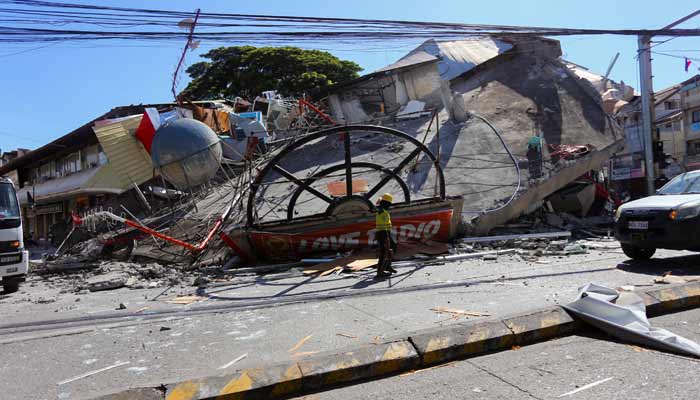
    A laborer walks near a destroyed structure after a magnitude 7.8 earthquake hit General Santos in southern Philippines on June 8, 2026. — Reuters

    – A young mother delivered her baby outside the hospital.
    – Damage to roads and bridges has isolated several communities.
    – Tsunami warnings were lifted after the threat subsided.

    Doctors treated patients in tents under the intense Philippine sun on Tuesday, including assisting a young mother with childbirth. The death toll from the powerful earthquake, which caused building collapses and triggered tsunami alerts, surpassed 40.

    Thousands remain displaced, and over 450 people are injured following the magnitude-7.8 quake that struck off Mindanao on Monday. Based on reports from national and local disaster agencies, only four individuals are now missing.

    In Sarangani Province, one of the hardest-hit areas, some regions are only accessible via helicopter. Rescue efforts are slowed by ongoing aftershocks, according to local officials briefing reporters Tuesday.

    “There are still aftershocks, so rescue teams are proceeding with caution. That’s a challenge,” said Rodrigo Sosmena, regional civil defense chief.

    Multiple strong aftershocks rattled the region within hours of the initial quake, along with hundreds of smaller tremors.

    Structural damage means some communities will be cut off for at least a week due to destroyed roads and a collapsed bridge.

    At a hospital near General Santos— the largest city in the region— AFP journalists heard a woman cry out “push” followed by the newborn’s cries outdoors, behind a makeshift screen, as she delivered her baby.

    In Glan municipality, where at least 13 residents were buried inside landslide-affected homes, staff at another hospital reported more than 60 patients were placed on beds outside the facility because of safety concerns about the building’s stability.

    “The hospital sustained extensive damage,” said a hospital staff member. “The municipal engineer decided it’s unsafe to keep using the building.”

    By Tuesday morning, provincial sources reported the death toll had reached 41.

    Rescue teams resumed efforts outside a collapsed grocery store in General Santos after an overnight pause, attempting to recover two workers trapped inside when the building fell.

    AFP cameras watched as search dogs and handlers combed through heaps of broken concrete and jagged metal.

    A rescue official indicated the focus had shifted from rescue to recovery, though this had not been officially confirmed.

    At a nearby beach resort, a Coast Guard vessel searched for two missing swimmers caught in turbulent waters caused by the quake.

    Social media videos verified by AFP showed the collapse of a shopping mall housing a Jollibee restaurant and the destruction of an unoccupied school building in General Santos.

    Another video depicted school children screaming as they were held by teachers during the tremor, with a background shot of a collapsing metal structure. The school’s official Facebook page stated no one was underneath the structure when it fell.

    Thousands of people in coastal areas of the southern Philippines and neighboring Indonesia were ordered to evacuate, as multiple countries and the regional tsunami center issued warnings. However, by midday, the threat had passed, and alerts were canceled.

    Waves that did reach Japan’s Pacific coast, where a tsunami advisory was issued, measured no more than 8 inches (about 20 centimeters).

    In October, eastern Mindanao experienced two earthquakes of magnitudes 7.4 and 6.7, which caused at least eight deaths.

  • 7.6 Magnitude Quake Off Japan Sparks Tsunami Alert

    7.6 Magnitude Quake Off Japan Sparks Tsunami Alert

    A powerful earthquake hit Japan’s northern coast on Monday, prompting the country’s meteorological agency to record two tsunami waves, each measuring 40 centimeters. Local media reported some injuries as the quake caused widespread disruption.

    According to the United States Geological Survey, the quake had a magnitude of 7.6 and struck at 2:15 p.m. GMT off Misawa on Japan’s Pacific shoreline, at a depth of 53 kilometers (about 33 miles). The Japan Meteorological Agency issued a tsunami warning, with the initial wave reaching a port in Aomori, near Misawa, at 11:43 a.m. local time (2:43 p.m. GMT).

    Later, at 11:50 p.m., another 40-centimeter wave arrived in Urakawa, in Hokkaido. Photographs and footage captured shattered glass scattered across roads, indicating the significant impact. In Hachinohe, a hotel staff member confirmed injuries, and images showed debris and broken glass cluttering the streets.

    The tremor was also strongly felt in Sapporo, where residents received alerts on their smartphones. An NHK reporter in Hokkaido described the quake’s horizontal shaking lasting about 30 seconds, making it impossible to stand.

    Early warnings from the meteorological agency suggested that a tsunami of up to three meters (around 10 feet) could hit Japan’s Pacific coast. Japan’s location atop four major tectonic plates along the Pacific “Ring of Fire” makes it one of the world’s most tectonically active nations. With roughly 125 million residents, the country experiences about 1,500 tremors annually—most are mild, but their effects can vary dramatically depending on their strength and depth underground.

  • Major quake triggers damage and panic on central Philippine island

    Major quake triggers damage and panic on central Philippine island

    A strong 6.9 magnitude earthquake struck off the coast of central Philippines on Tuesday evening. The tremor caused buildings and roads to shake, with some structures collapsing and power outages affecting parts of the region as rescue teams searched for possible victims.

    Municipal authorities inspected a collapsed public building and a gym in northern Cebu within hours of the quake, which occurred at 9:59 p.m. (1359 GMT) off the island’s northern tip, according to provincial rescue official Wilson Ramos.

    “There may be people trapped beneath collapsed buildings,” Ramos told AFP, mentioning ongoing rescue operations in San Remigio and Bogo, a city near the epicenter with a population of around 90,000. The number of missing persons remained unknown at that time.

    Darkness and aftershocks hindered recovery efforts. The U.S. Geological Survey recorded four aftershocks of magnitude 5.0 or greater following the initial quake.

    The local seismology office warned residents of the central islands—Leyte, Cebu, and Biliran—to avoid beaches and coastlines due to the potential for minor sea-level disturbances.

    Cebu firefighter Joey Leeguid shared with AFP that he felt the tremor at his station: “It was so strong. Our lockers moved side to side, and I felt slightly dizzy for a moment, but everyone is safe now.”

    In Bantayan, a nearby resort town close to the epicenter, resident Martham Pacilan recounted being near a church that was damaged by the quake: “I heard a loud booming noise from the church’s direction, then saw rocks falling. Fortunately, no one was hurt.” He added, “I was in shock and panic, unable to move, just waiting for the shaking to stop.”

    Power outages were widespread after the quake caused power lines to trip. Agnes Merza, a caretaker in Bantayan, said her kitchen tiles cracked when the earth shook: “It felt like the whole house might fall apart. My neighbors rushed outside, and my teenage helpers hid under a table following scout safety instructions.”

    The provincial government reported the collapse of a school and a commercial building in Bantayan, along with damage to several village roads.

    The authorities urged calm, with Cebu’s governor Pamela Baricuatro advising residents via a live Facebook broadcast to evacuate to open areas, stay away from structures that could collapse, and remain alert to aftershocks. She explained that officials were assessing the situation and coordinating with local officials.

    While the USGS initially estimated the quake at magnitude 7.0, that figure was later revised downward. The Pacific Tsunami Warning Center announced there was no tsunami threat from this seismic event.

    Earthquakes are common in the Philippines due to its location on the Pacific “Ring of Fire,” a zone of frequent seismic activity stretching from Japan through Southeast Asia and across the Pacific. Most are minor and go unnoticed, but occasionally, powerful quakes occur without warning, posing ongoing risks with no precise prediction methods available.