الوسم: durability

  • Innovative Spray-On Coating Boosts Air Filter Longevity and Pollution Capture

    Innovative Spray-On Coating Boosts Air Filter Longevity and Pollution Capture

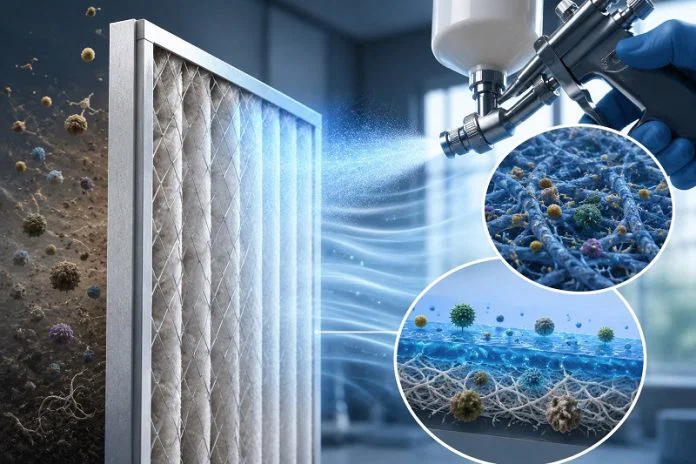
    Credit: DALLE. For illustrative purposes only.


    Air filters are essential for keeping the air we breathe free of contaminants.

    They are commonly used in homes, offices, hospitals, factories, vehicles, and various other settings to trap dust, pollen, smoke, and harmful airborne particles.

    Nevertheless, even the most effective filters have their limitations. While they can capture tiny pollutants, some of these particles can become dislodged over time and re-enter the air.

    Researchers have now developed an easy-to-apply spray coating that could address this persistent problem.

    This new material significantly improves a filter’s ability to retain trapped particles, enhancing overall performance and nearly doubling the lifespan before replacement is needed.

    The study was led by Sanghyuk Wooh from Chung-Ang University and Chae Bin Kim from Pusan National University in South Korea, with findings published in Advanced Materials.

    Traditional filters mainly rely on weak physical forces to hold particles in place. As air flows through, some dust and pollutants can loosen and escape, reducing the filter’s efficiency and shortening its service life.

    To overcome this, the researchers created a special coating called Dynamic Imine Bond Adhesive (DIBA). Unlike typical adhesives, this coating continually refreshes its surface, acting like a blend of solid and liquid. This allows particles to settle into the coating while exposing new sticky surfaces to trap additional pollutants.

    The coating can be applied using a straightforward spray method, making it easy to upgrade existing commercial filters without altering their manufacturing process.

    Laboratory tests assessed the coating’s chemical makeup, strength, and ability to hold particles under different scenarios. They also examined how well the coated filters performed at various airflow speeds and how long they remained effective.

    The results were remarkable. The coating increased the force to retain trapped particles by nearly 70 times compared to uncoated filters, greatly reducing the likelihood of pollutants escaping back into the environment.

    Additionally, overall filtration efficiency improved by 10% to 30% across multiple types of commercial filters. This upgrade moved the filters from a MERV 6 rating to MERV 11, a substantial boost in their ability to eliminate airborne particles.

    Crucially, the coating did not impede airflow, an important factor since increased resistance can lead to higher energy use by fans. The researchers confirmed that filtration performance improved without causing additional pressure drops.

    Durability was another key benefit. Since particles get embedded into the sticky coating rather than clogging the pores quickly, the coated filters experienced slower clogging and lasted nearly twice as long as standard filters before needing replacement.

    The team believes this technology could be beneficial in a variety of settings, including HVAC systems, home air purifiers, medical ventilation, industrial dust collection, cleanrooms, vehicle cabin filters, and even face masks.

    Beyond air filtration, the same self-renewing adhesive technology might enhance water purification, environmental remediation, and specialized manufacturing processes where controlling tiny particles is crucial.

    This research demonstrates how a relatively simple materials innovation can make everyday air filters more effective, longer-lasting, and environmentally friendly, helping to provide cleaner air while reducing waste and maintenance costs.

  • Self-Healing Waterproof Electronic Skin Enhances Dive and Robotics Safety

    Self-Healing Waterproof Electronic Skin Enhances Dive and Robotics Safety

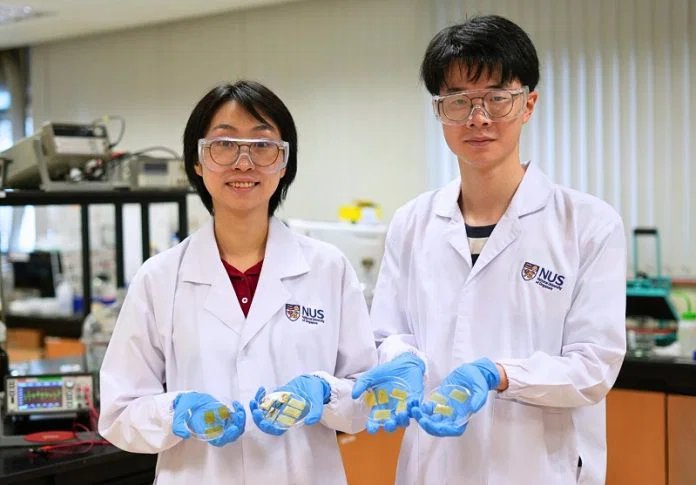
    Scientists at the National University of Singapore (NUS) have created a new type of electronic skin capable of sensing touch, detecting damage, and healing itself underwater. This breakthrough could significantly enhance the durability and reliability of underwater robots, diving gear, and wearable tech operating in difficult environments.

    Led by Assistant Professor Tan Yu Jun from the NUS College of Design and Engineering, the research was documented in the journal Advanced Materials.

    Handling electronics in underwater settings presents unique challenges. Sensors used by divers and robotic submersibles are vulnerable to damage from sharp rocks, shells, and other hazards. When these sensors suffer damage, they typically cease functioning and need repairs, often requiring removal to land-based facilities. Additionally, they usually depend on batteries or external power sources, which can be limiting underwater.

    The innovative system, dubbed the self-healing magnetoelectric sensory system (SMES), addresses multiple issues simultaneously. It can sense touch and nearby objects without external power and recognize when it’s been damaged, initiating automatic repairs. Modeled after human skin—which perceives touch, pain, and heals injuries—this electronic skin reacts when punctured or cut. It consists of a flexible, rubber-like material embedded with tiny liquid-metal conductors. Damage causes a rapid change in electrical resistance, signaling issues instantly.

    This material has a self-healing ability. Small damages, like needle punctures, can recover their original electrical properties in seconds without external assistance. Larger cuts take longer to mend; however, pressing the damaged surfaces together starts the healing process, and given enough time, the device restores its strength and sensing capabilities. The system performs especially well underwater, where many self-healing materials fail; tests demonstrated near-complete recovery of performance even after underwater healing.

    An impressive feature of the sensor is that it powers itself. It works through electromagnetic induction—the same principle behind electric generators. A small magnet inside moves past a coil of liquid-metal wire during touch or approach, generating a tiny electrical signal. This allows the sensor to detect pressure and nearby objects without batteries.

    The system is both fast and durable. It responds to touch in approximately 41 milliseconds and can be used over 10,000 times without loss of function. Even after 10 days submerged— including in simulated seawater—the sensing performance remained intact.

    To showcase its practical applications, the researchers developed a smart diving glove equipped with this electronic skin. Different hand gestures produced distinct electrical signals transmitted wirelessly to a smartphone, enabling commands like “Going up,” “Going down,” “Holding,” and “Help.” The glove also had warning lights to alert the user if it sustained serious damage.

    Additionally, a robotic hand fitted with the sensors was tested underwater. The robot successfully grasped objects and detected punctures from sharp shells, recovering from the damage during operation.

    The team envisions this technology being integrated into underwater robots, prosthetic limbs, wearable electronics, and other soft robots capable of sensing damage and self-repair. Such advancements promise to make these devices safer, more durable, and better suited for complex, challenging environments.

  • A Gentle Touch to Extend Solar Cell Lifespan

    A Gentle Touch to Extend Solar Cell Lifespan

    A recent study has uncovered an unexpectedly simple way to address one of the primary challenges facing next-generation solar cells. Researchers from Korea University and the University of Surrey demonstrated that merely bringing two specialized solar materials into contact can significantly enhance both their efficiency and longevity—without the need for additional chemicals or coatings.

    This breakthrough, published in Nature Energy, centers on perovskite solar cells, which have gained worldwide interest due to their lower production costs and easier manufacturing compared to traditional silicon panels. Over the past few years, the efficiency of these cells has rapidly improved, making them strong contenders in the solar industry. However, their tendency to degrade quickly—especially when exposed to heat and moisture—has limited their commercial viability.

    The new method addresses this issue through a straightforward approach. Instead of altering the material’s composition, scientists simply placed two different perovskite films in contact with each other. This contact initiated a natural interaction at the boundary, leading to a more organized and stable internal structure throughout the entire layer—not just on the surface.

    This refined structure enhances the performance of the solar cells. When sunlight strikes the material, it produces tiny charged particles that carry energy. In less stable materials, these particles tend to lose energy rapidly as heat. But in the improved material, they last longer and move more efficiently, resulting in higher electricity output. The innovative design achieved a power conversion efficiency of 25.61%, a notably high mark confirmed through independent testing.

    The process, dubbed “contact-triggered cationic interaction” (CCI), involves the rearrangement of internal charged particles upon contact, which reduces tiny defects that can cause energy loss. Using advanced nanoscale imaging techniques, the team visualized these changes directly, confirming that the alignment and structure improved exactly as anticipated.

    Additionally, this new structural stability translates into greater resistance to damage. Stress tests simulating real-world conditions revealed that the treated materials required about twice as much heat energy to break down compared to untreated samples. This indicates that solar panels built using this technique could last significantly longer under everyday conditions.

    The real elegance of this discovery is its simplicity. By controlling how two layers of material touch and interact, scientists can simultaneously boost both the efficiency and durability of perovskite solar cells. Scaling this approach could accelerate the adoption of perovskite technology, offering a more affordable and capable way to produce clean energy in the future.

  • iPhone Air Bends Well but Avoid Sitting on It

    iPhone Air Bends Well but Avoid Sitting on It

    The iPhone Air stands out as Apple’s thinnest smartphone to date, and the company asserts that it’s “more durable than any previous iPhone.” Recently, they shared a bending test video with the media, demonstrating the device’s ability to withstand stress and even recover from it.

    The Key Takeaway

    Apple incorporated a grade 5 titanium frame into the iPhone Air, reinforced further with Ceramic Shield, which provides four times the drop resistance. Despite its ultra-slim profile of just 5.5 millimeters, doubts about its strength naturally arise. However, initial impressions suggest that the phone is indeed quite resilient.

    Inside the Rigorous Testing

    Apple showcased a behind-the-scenes demonstration of the iPhone Air’s durability using specialized equipment. During the test, the device endured a vertical load of 130 pounds without any cracks or permanent deformation. After applying this pressure, the phone was placed on a table and, remarkably, returned to its original flat shape within seconds, all while remaining fully functional.

    A YouTube view of the test reveals the remarkable resilience of the iPhone Air under significant weight. According to reports from MobileSyrup, pushing the device with 130 pounds of force resulted in no damage at all, showcasing its robustness despite its incredibly slim frame.

    Proceed with Caution

    While these laboratory results are promising and suggest that the iPhone Air may avoid the “bendgate” issues that earlier models faced, it’s important to remember that real-life scenarios can differ. For instance, an average adult weighing over 130 pounds might accidentally sit on the device for an extended period, or it could face other substantial forces that tests don’t replicate.

    Costly Repairs Ahead

    Replacing a damaged screen or back glass isn’t going to be inexpensive. AppleCare covers certain types of damage—specifically, damage limited to the screen or back glass—but only under specific conditions. According to the latest support documents, the device must not have additional damage, such as dents or deformation of the enclosure, that would prevent Apple from replacing the screen or back glass.

    In summary, the iPhone Air demonstrates impressive strength for its slender design, but users should still handle it with care to avoid costly repairs.

  • Do all-in-one computers last?

    Do all-in-one computers last?

    All-in-one computers have surged in popularity due to their compact design and sleek aesthetics. These devices combine the monitor and CPU into a single unit, offering a minimalist alternative to traditional desktop setups. However, many consumers wonder about their longevity. How do all-in-one computers hold up over time?

    Understanding All-in-One Computers

    Before diving into their lifespan, it’s essential to understand the basic characteristics of all-in-one computers.

    Features of All-in-One Computers

    • Compact Design: They save space by integrating all components into one device.
    • User-Friendly: Often equipped with touch screens and intuitive interfaces.
    • Aesthetically Pleasing: Available in various designs and colors to match different decors.
    • Limited Upgradeability: Difficulty in upgrading hardware compared to traditional desktops.

    Factors Influencing Longevity

    Several elements play a crucial role in determining how long an all-in-one computer will last.

    Quality of Components

    • Processor Performance: A higher-quality CPU can enhance longevity.
    • Storage Type: Solid-state drives (SSDs) typically offer better durability compared to traditional hard drives.
    • Cooling Systems: Efficient cooling mechanisms help prevent overheating, which can damage internal parts.

    Usage Habits

    • Frequency of Use: Daily heavy usage may wear components faster.
    • Maintenance: Regular cleaning and software updates can extend a computer’s life.

    Technology Evolution

    • Rapid Advancements: New technologies emerge frequently, making older models feel outdated quickly.
    • Software Requirements: Demands from new software may exceed the performance of older hardware.

    Average Lifespan of All-in-One Computers

    On average, all-in-one computers can last anywhere from 3 to 8 years. However, the actual lifespan varies based on careful considerations:

    Entry-Level vs. Premium Models

    • Entry-Level Models: Typically designed for lighter tasks, these might last 3-5 years.
    • Premium Models: Built with better components, they often last longer, around 5-8 years.

    Usage Scenarios

    • Home Use: Mainly for browsing and streaming may lead to a longer lifespan.
    • Business or Gaming Use: Intensive tasks can lead to quicker wear and tear.

    Signs Your All-in-One Computer Needs Replacing

    Recognizing when it’s time to replace your all-in-one computer is essential for optimal performance.

    Common Warning Signs

    • Sluggish Performance: Delay in processing commands or slower load times.
    • Frequent Crashes: Regular system failures can indicate major issues.
    • Incomplete Updates: Inability to run newer operating systems or applications.

    What to Consider

    • Cost of Repair vs. Purchase: Sometimes, the cost of fixing old components may not be worth it.
    • Compatibility Issues: New software may not run efficiently, rendering the device obsolete.

    Maintaining Your All-in-One Computer

    Taking proper care can significantly enhance the lifespan of your all-in-one computer.

    Tips for Maintenance

    • Regular Updates: Keep software and drivers updated for optimal performance.
    • Cleaning: Dust off the vents and hardware components to prevent overheating.
    • Use Surge Protectors: Protects the computer from electrical surges, thus preserving its internal systems.

    What to Avoid

    • Overloading with Apps: This can slow down the computer and may lead to crashes.
    • Ignoring Warning Messages: Act on notifications regarding software or hardware issues promptly.

    Future-Proofing Your All-in-One

    • Choose Higher Specs: Opt for higher specifications if you plan to use the computer for a long time.
    • Evaluate Requirements Regularly: Regularly assess your usage needs to ensure your computer remains suitable.

    All-in-one computers indeed last, but their longevity hinges on various factors, including quality, usage habits, and the ever-evolving tech landscape. By being mindful of these elements, users can enjoy their all-in-one devices for many years without the need for frequent replacements.