Tag: drone attacks

  • US strikes persist into 11th night amid Iran warning of retaliation

    US strikes persist into 11th night amid Iran warning of retaliation

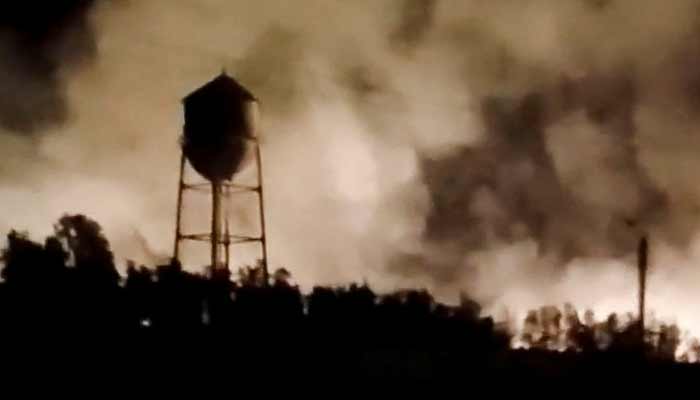
    A water tower stands outlined against smoke rising from a fire following an alleged strike in Behbahan, Khuzestan Province, Iran. — Reuters

    • Negotiations with the U.S. are ongoing through mediators: Baghaei.
    • Iran’s military issues threats of retaliation against the U.S.: report.
    • Regional countries are using Iranian drones in their engagements.

    Fresh American airstrikes prompted anti-air defense responses in Tehran on Wednesday. President Donald Trump warned he isn’t finished with the conflict with Iran, which has already cost the U.S. approximately $37.5 billion.

    Following clashes over the strategic Strait of Hormuz resulting in the collapse of an initial agreement, conflict in the Middle East has extended to include other critical oil transit routes in the region.

    Top U.S. diplomat Marco Rubio reaffirmed that Washington remains open to diplomatic efforts to reach an agreement with Tehran.

    “The challenge we face now is that Iran isn’t taking negotiations seriously,” Rubio stated during a Southeast Asia ministers’ meeting in Manila.

    Iranian Foreign Ministry spokesperson Esmaeil Baghaei mentioned that diplomatic discussions with Washington, mediated by third parties, are still taking place.

    The latest wave of attacks saw U.S. forces target infrastructure including military logistics facilities. Iranian state media reported strikes across the country, including in Bushehr, which is home to a nuclear power plant.

    “Sources just reported hearing air defense activity in the western, eastern, and northeastern parts of Tehran,” state television posted on Telegram.

    As this conflict approaches five months and with November’s legislative elections near, Trump faces mounting political pressure to de-escalate. The war has become increasingly unpopular even among some of his supporters.

    Critics point out the financial toll: Pentagon Chief Pete Hegseth noted Tuesday that costs have risen to $37.5 billion, justifying requests for tens of billions more to support military operations.

    The U.S. military announced it had conducted an 11th night of strikes targeting Iranian military sites with the goal of diminishing Iran’s capacity to threaten maritime traffic through the Strait of Hormuz.

    Earlier, Trump suggested that the next target could be an underground complex called Pickaxe Mountain, near Natanz, where Western intelligence suspects Iran is developing an undeclared uranium enrichment facility.

    Iran has warned of retaliation, with Khatam Al-Anbiya military command stating that any such attack would be seen as an expansion of regional war. The group threatened to strike U.S. interests and allies worldwide, according to state media IRIB.

    This warning coincides with Tehran expanding its strikes against U.S.-aligned Gulf states after its Houthi allies threatened to blockade Saudi ports.

    Two weeks after renewed fighting between longstanding enemies, Trump claimed Iran would need over 20 years to rebuild from the damage inflicted, emphasizing the ongoing conflict.

    “If we withdraw right now, Iran would take 20 to 25 years to recover,” Trump said. “We’re not done yet… we’re not leaving at this moment.”

    Houthi Threats and Regional Tensions

    Kuwait’s military reported engaging with drone attacks believed to be originating from Iran, signaling another round of Tehran’s retaliatory actions.

    Bahrain reported intercepting Iranian assaults last Tuesday, with sirens sounding repeatedly. Kuwait and Jordan also announced intercepting drones and missiles.

    Iran claims it targeted U.S. assets in Kuwait and Bahrain, including air defense systems, radar facilities, and administrative buildings.

    “The enemy should prepare for even stronger waves of drone and missile attacks,” Iran’s Guards announced via state news agency IRNA.

    Trump stated he would intervene if the Houthis carried out their threat to blockade Saudi ports but expressed uncertainty on how they would enforce such a blockade.

    Maritime intelligence providers, like Vanguard Tech, reported that a Singapore-flagged tanker and a Liberia-flagged vessel changed course in the Red Sea after loading crude at Saudi Arabia’s Yanbu port.

    If the Houthis implement the blockade, it could obstruct Saudi Arabia’s ability to export some oil bypassing the Strait of Hormuz, with significant impacts on the global economy.

    Recently, Saudi Arabia and the Houthis exchanged fire, ending a brief lull since the 2022 ceasefire. Still, the rebels have mostly remained silent since Israel and the U.S. launched strikes against Iran in late February.

    Iran’s Revolutionary Guard announced Tuesday that two tankers attempting to traverse the Strait of Hormuz were hit by explosions, causing fires that halted their progress.

    Earlier, the UK Maritime Trade Operations reported an unknown projectile striking a tanker off Oman’s coast.

  • Putin Warns Trump: Russia Will React to Ukraine Drone Strikes

    Putin Warns Trump: Russia Will React to Ukraine Drone Strikes

    Putin Warns Trump of Potential Response to Ukrainian Drone Attacks

    During a phone call on Wednesday, Russian President Vladimir Putin informed former U.S. President Donald Trump that Moscow is likely to retaliate following recent drone strikes in Ukraine. Trump shared the details of their conversation, stating they discussed incursions into Russia, including attacks on Russian aircraft.

    According to Trump, Putin made it very clear that he would need to respond to the strikes on airfields. The former president described the conversation as "productive," but he cautioned that it didn’t indicate an immediate path to peace.

    Moscow had previously announced that various military options were being considered in response to the Ukrainian assaults deep within Russian territory. Russia also called on Western nations like the U.S. and the U.K. to encourage restraint from Kyiv after Ukrainian officials praised the attacks, asserting they demonstrated Ukraine’s resilience after more than three years of conflict.

    Both U.S. and British representatives denied any prior knowledge of the attacks on Russian long-range bombers capable of carrying nuclear weapons.

    In addition to the topic of Ukraine, Trump mentioned that he and Putin spoke about Iran. Putin showed willingness to engage in discussions aimed at reaching a new nuclear agreement with Tehran. Trump insisted that Iran should not be allowed to possess nuclear weapons and claimed that they seemed to agree on this issue. However, he accused Iran of delaying key decisions regarding the negotiations.

    Trump expressed increasing frustration toward Putin, primarily due to Russia’s obstruction of his ambitious goal to end the conflict within 24 hours—despite not providing a clear plan on how he intended to achieve this.

    The call between Trump and Putin also hinted at possible collaboration on global issues, particularly concerning Iran. Trump emphasized the urgency for Tehran to respond to U.S. proposals for a deal.

    On Tuesday, the Kremlin indicated that Moscow was prepared to facilitate negotiations for a new nuclear agreement, but Iran’s Supreme Leader, Ayatollah Ali Khamenei, rejected the U.S. proposal as contrary to Tehran’s national interests, especially regarding uranium enrichment.

  • Ukraine Faces Record Drone Attack Following Trump’s Putin Critique

    Ukraine Faces Record Drone Attack Following Trump’s Putin Critique

    Emergency Response to Rocket Strike in Ukraine

    Emergency personnel worked tirelessly to extinguish flames from a private home wrecked by a Russian missile attack in Markhalivka, Kyiv region, Ukraine, on May 25, 2025. — Reuters

    • Russia launched a historic wave of attacks, firing "355 Shahed-type drones" and nine cruise missiles.
    • The Kremlin warned that expanding missile capabilities for Ukraine is perilous.
    • Donald Trump labeled Putin as "crazy" in an unusual critique of the Russian leader.

    The Latest Developments

    On Monday, authorities reported that Russia executed its largest drone strike on Ukraine, coinciding with Trump’s comment on social media, wherein he warned that further Russian aggression could lead to new sanctions. The U.S. President has aimed to mediate an end to the ongoing conflict, but efforts have yet to yield significant concessions from the Kremlin.

    For three nights in a row, Ukraine faced extensive drone assaults, overwhelming its air defenses and resulting in at least 13 fatalities on Sunday alone. According to Ukraine’s air force, the unprecedented strike involved "355 Shahed-type drones," some serving as decoys, as well as nine cruise missiles.

    German Chancellor Friedrich Merz indicated on Monday that Western allies had lifted restrictions on the range of arms supplied to Ukraine, enabling Kyiv to target "military installations within Russia." However, the timeline for this policy shift and the countries involved remain unclear.

    The Kremlin responded to any potential increase in missile capabilities for Ukraine as "dangerous," claiming it contradicts ongoing peace efforts. In a rare critique, Trump stated, "I’ve always had a great relationship with Vladimir Putin, but he has absolutely lost it." He emphasized that Putin aims to control all of Ukraine, a fate that could lead to Russia’s own downfall.

    Trump also expressed his discontent with the ongoing Russian attacks and confirmed he was "absolutely" considering stronger sanctions against Moscow. Meanwhile, French President Emmanuel Macron expressed hope that Trump’s outrage would translate into actionable measures, emphasizing that Putin remains unwilling to pursue peace.

    A Pivotal Moment

    The Kremlin downplayed Trump’s statements, asserting that Putin’s actions are aligned with ensuring Russia’s security. Kremlin spokesperson Dmitry Peskov described the current situation as a "critical moment" filled with emotional strain for everyone involved.

    Ukrainian President Volodymyr Zelensky remarked that the rise in Russian assaults signifies a perception of "impunity." He insisted that the escalation should prompt increased sanctions against Russia.

    Since Russia’s invasion of Ukraine in February 2022, tens of thousands of lives have been lost, and numerous towns and cities have been devastated, sparking the most significant crisis in U.S.-Russia relations since the Cold War.

    Kyiv reported no casualties from the latest drone assault; however, a civilian was killed due to Russian shelling in the northern Sumy region within the past 24 hours.

    Ukrainian Air Force spokesperson Yuriy Ignat warned that countering the overwhelming volume of drones is becoming increasingly difficult. He urged for "rational and more affordable methods" to intercept them. A military source advised that while Ukraine is effectively engaging with its current air defense capabilities, there is no reason to panic. They stressed the importance of Western weapon deliveries, including Patriot missiles and NASAMS medium-range systems.

    In the Sumy region, Russia claimed to have seized two border villages as part of an ongoing offensive.

    Diplomatic Efforts Intensify

    In recent weeks, diplomatic initiatives aimed at ending the conflict have gained momentum, with Russian and Ukrainian officials engaging in direct talks in Istanbul for the first time in three years. They conducted their largest prisoner exchange to date, returning 1,000 individuals over the weekend. Russia is reportedly preparing to outline its peace terms.

    Further potential prisoner exchanges depend on ongoing discussions with Ukraine, according to Peskov, who noted that Moscow is still drafting a ceasefire memorandum.

    Russia has consistently dismissed proposals for a 30-day ceasefire put forth by Kyiv and its Western allies while steadily advancing along the front lines. Instead, Putin has suggested creating a document that lays out ceasefire conditions, drawing criticism from Ukraine for what is perceived as stalling tactics.

    Ukraine’s SBU security service announced on Monday that several individuals, including a teenager, have been detained for allegedly acting as informants for Moscow, aiding Russian strikes against Ukraine.