الوسم: DND

  • Understanding Spell Range and Area of Effect in DND

    Understanding Spell Range and Area of Effect in DND

    In Dungeons & Dragons, every spell is accompanied by a specific tag indicating its range and area of effect (AoE), if applicable. Grasping how these ranges and AoEs operate is crucial for planning your strategy in gameplay, and it can often be the deciding factor between winning and losing during tough battles.

    For those who are new to being a Dungeon Master or playing the game, understanding the intricacies of spell ranges and areas of effect can be overwhelming. Here’s a straightforward guide to help you begin casting spells effectively in your journey.

    Understanding Spell Range


    The Wizard Melf by Martin Mottet

    Each spell includes a range tag that indicates how far it can be cast and the starting point for its effect.

    In total, there are three primary types of ranges you might encounter:

    1. Distance – Measured in feet, indicating that the spell can be cast at a specified distance.
    2. Touch – The spell can only be used on a target that the caster can physically touch.
    3. Self – The spell can only affect the caster, not other beings.

    Spells with movable effects are not confined by their range unless specifically stated otherwise in the spell’s description.

    Examples of Ranged Spells


    A woman in a colorful skirt and blouse casting a spell with a wand in Dungeons & Dragons.
    A Human Sorcerer via Wizards of the Coast

    For instance, take Fireball, which has a range of 150 feet. This indicates that the spell can be cast up to 150 feet away from the caster in any direction. On the other hand, Fire Shield has a range of Self, meaning it can only be applied to the caster and not to others from a distance.

    If a spell targets a specific creature without an Area of Effect, that creature must not only be within range but also not be behind Total Cover.

    Understanding Areas of Effect


    Evard casts Evard's Black Tentacles in Dungeons & Dragons.
    Evard’s Black Tentacles by Craig J Spearing

    If a spell specifies an Area of Effect in its details, it means that it can impact multiple targets or anyone within that area.

    Most Area of Effect spells require targets to make saving throws, making them useful if you know what weaknesses your opponents have.

    The Area of Effect of a spell consists of three main parts:

    1. Dimensions
    2. Shape
    3. Point of Origin

    Each Area of Effect has specific dimensions, which may include measurements like radius, height, length, width, or various combinations of these factors, along with a shape that defines the area covered by the spell.

    Moreover, every spell has a distinct point of origin from which the Area of Effect extends.

    Keep in mind that many Area of Effect spells do not allow for ally exclusion, so be cautious and ensure your teammates are out of range.

    While dimensions may seem straightforward, understanding shapes and points of origin can be trickier. Here’s a detailed overview of the various shapes and points of origin associated with spells:

    While the rules mentioned above are common, every spell can differ. Be sure to carefully read each spell’s complete description before casting, as some may have unique rules or exceptions.

  • Understanding D&D’s Play Tiers: A Comprehensive Guide

    Understanding D&D’s Play Tiers: A Comprehensive Guide

    In a Dungeons & Dragons campaign, your group will experience various tiers of gameplay. These tiers influence everything about your adventure, including the atmosphere, conflicts, and even the monsters you may encounter. The progression through these tiers is a significant aspect of your journey.

    Whether you’re a new Dungeon Master (DM) or guiding seasoned players, it’s important to adjust your gameplay according to the appropriate tier. But how exactly do these tiers work? This guide will provide you with all the information you need to understand and utilize tiers in your campaign.

    Understanding Tiers of Play


    A Floating City by Calder Moore

    In Dungeons & Dragons, there are four main tiers of play that determine the adventures a party embarks on. These tiers are based on the group’s combined levels and help shape the nature of their quests.

    Tier of Play

    Level

    Details

    Local Heroes

    1-4

    The party will face lower-stakes challenges, such as protecting farms or towns from minor creatures.

    Heroes of the Realm

    5-10

    The party may deal with issues affecting a kingdom or territory.
    They will encounter stronger foes that could have intricate plans in motion.

    Masters of the Realm

    11-16

    At this tier, adventurers are entrusted with the destiny of a nation, continent, or even the world.
    Extraplanar travel and formidable enemies lie ahead.

    Masters of the World

    17-20

    The party will embark on quests across the multiverse, influencing the fate of entire realms.
    They will confront malevolent deities, ancient dragons, and incredibly powerful adversaries.

    Most campaigns begin at the Local Heroes tier, but you can start at a higher level if your group prefers.

    However, it’s not advisable to begin at Masters of the World, as it limits the tonal progression of your campaign’s adventures.

    Local Heroes


    A low-level adventuring party on a wagon in Dungeons & Dragons.
    Different Players by Katerina Ladon

    Local Heroes is usually where most gameplay begins, even if characters start slightly above level one.

    This tier features low-stakes adventures, allowing players to explore their capabilities while learning the essence of heroism.

    Chapter Four of the 2024 Player’s Handbook offers several adventure hooks suitable for this tier and others.

    Example Adventure Hooks for Local Heroes

    Here are a few potential adventures that might suit Local Heroes:

    • A village is under threat from a band of goblins.
    • A family of farmers requires protection as they travel through a perilous forest.
    • A group of climbers is trapped after an avalanche and needs assistance.

    Generally, these quests will not be lethal for the group and will involve less impactful favors and low-level adversaries.

    Heroes of the Realm


    An adventuring party wielding various weapons in Dungeons & Dragons.
    The Weathermay-Foxgrove Twins by Zoltan Boros

    As the party reaches levels beyond five, they transition into Heroes of the Realm, meaning they will face stronger creatures.

    As players level up and move between tiers, create a memorable roleplaying moment to mark this change, underscoring their sense of advancement.

    This tier is marked by higher stakes and more formidable monsters, with the party’s choices impacting a larger area, whether it’s a region, city, or kingdom.

    Example Adventure Hooks for Heroes of the Realm

    Consider these adventure ideas for the Heroes of the Realm:

    • A plague of magic is spreading across a kingdom.
    • A crime syndicate plots to overthrow a ruling nation.
    • A cabal of mages seeks to steal magical artifacts for nefarious purposes.

    Masters of the Realm


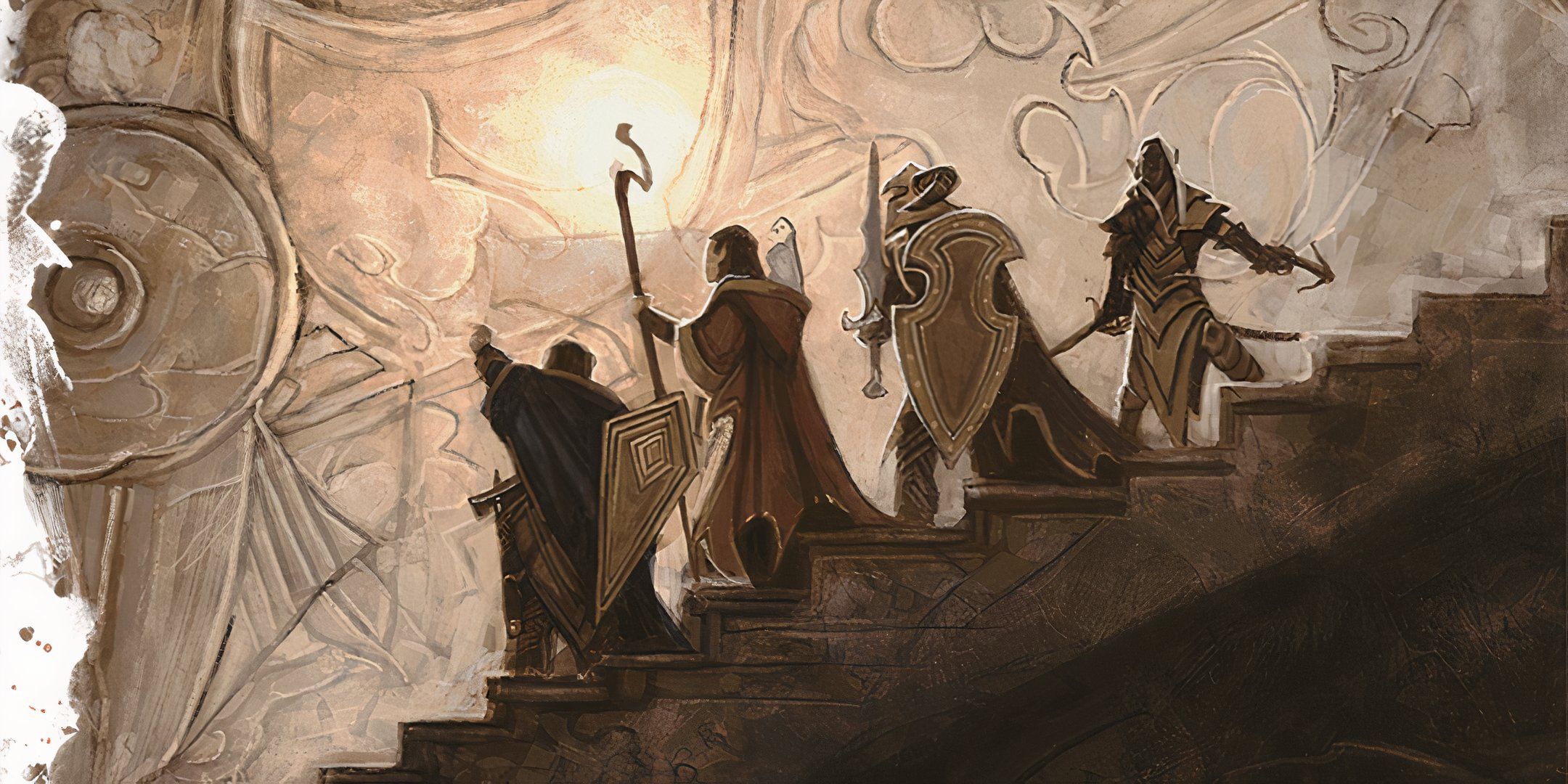
    An adventuring party climbs down a dark staircase in Dungeons & Dragons.
    Exploration By William O’Connor

    Once the party hits level 11, the stakes must increase dramatically. This stage signifies that they should have engaged in various high-stakes missions with significant outcomes.

    At this level, powerful adversaries like Ancient Dragons and Archmages can serve as antagonists.

    The party must now prove their capabilities by defending a continent or a large population in their world.

    Example Adventures for Masters of the Realm

    Here are some suggested quests for Masters of the Realm:

    • Two kingdoms are at war, on the brink of using magical weapons of mass destruction.
    • A dangerous cult aims to resurrect an ancient creature of horrific origins.
    • Extraterrestrial beings are invading from another dimension, seeking chaos and bloodshed.

    Masters of the World


    The cover art for the 2024 Player's Handbook, featuring an adventuring party fighting a dragon.
    2024 Player’s Handbook Cover Art via Wizards of the Coast

    The final tier is for characters at level 17 and above, marking the peak of your campaign. This tier should feature the climactic moments, where players face their most formidable threat yet.

    Keep in mind, tone is as critical as Challenge Rating or creature type when setting a tier of play. As players advance, enhance the severity and high-stakes atmosphere of their challenges.

    By this stage, players should have a good grasp of their abilities, and the threat of death looms large. Challenges must be lethal, with serious implications for the Material Plane and beyond.

    Example Adventures for Masters of the World

    Consider these adventures for the Masters of the World:

    • A cunning lich seeks to ascend to godhood.
    • A tyrant from the Material Plane threatens to enslave all existence.
    • A Mind Flayer cult plans to unleash a plague to wipe out humanity.
  • Mastering Animated Objects for Combat in D&D

    Mastering Animated Objects for Combat in D&D

    In Dungeons & Dragons, animated objects add a playful twist to combat scenarios. From suits of armor to lively braziers, these magical creations can leap into action, providing fun options for both players and Dungeon Masters.

    So, how do you effectively utilize animated objects? If you’re a player, you’ll want to explore the Animate Objects spell. As a Dungeon Master, incorporating these animated items into combat can be more nuanced. Regardless of your role at the table, this guide will cover all you need to know about animated objects.

    What Are Animated Objects?

    In Dungeons & Dragons, animated objects refer to everyday items brought to life through magic. They can be called into battle, assist with chores, or serve a variety of other purposes.

    Here are some common examples of animated objects:

    • Animated Armor
    • Animated Brooms
    • Animated Swords
    • Animated Rugs

    The items listed above are the four primary animated objects featured in the 2025 Monster Manual. Each possesses unique stat blocks and abilities for use in gameplay.

    Using Animated Objects as a DM

    Animated objects are excellent for creating engaging combat scenarios, particularly for low-level encounters with medium-sized groups.

    While they can be a great addition to battles, you can also use magically enchanted items for roleplay or to set a specific mood.

    For instance, players might stroll into an enchanting shop and see an animated broom bustling about, not necessarily ready to fight, but enhancing the atmosphere.

    How to Create Your Own Animated Object

    Since the 2025 Monster Manual includes only four stat blocks for animated objects, consider creating your own unique animated object stat block for use in your adventures.

    Follow these simple steps to craft your own animated object:

    Step Details
    Select An Object

    Begin by selecting a household item you want to animate. This should be something commonly found in the environment where your players are adventuring.

    For example, if the party is in a tavern, think about animating tankards, kegs, chairs, or tables.

    Choose Method of Animation

    The 2025 Monster Manual encourages DMs to decide how the object is animated for narrative depth.

    This choice can be crucial if you want to enhance a boss fight. For instance, the archmage your players face could be the source of the object’s animation, making the duel more meaningful.

    Create Stat Block

    Next, you’ll need to develop a stat block that includes HP, AC, speed, and other details.

    When crafting this stat block, reference the 2025 Monster Manual. Most animated objects will share similarities, so use other stat blocks as a guide when determining their HP, AC, and capabilities.

    When creating stat blocks, drawing inspiration from existing blocks is always beneficial.

    However, feel free to innovate and explore new ideas as a DM; just be sure to maintain a balanced encounter.

    If you’re uncertain about selecting an animation method, the 2025 Monster Manual offers a table to roll on for animated object origins.

    1d10 The Object Was Animated By…
    1

    A Celestial or Fiend using the object to protect or torment a mortal.

    2

    A mix of magic and technology, like alchemy or alien science.

    3

    The essence of someone transformed by a supernatural trickster.

    4

    Fey influence, as part of their games or schemes.

    5

    A fortunate accident that brings an object to life after many years of service.

    6

    A magic-user in need of an assistant or protector.

    7

    The melody of a magical instrument.

    8

    A spirit inhabiting the object.

    9

    Wild magic, a spell gone awry, or a chaotic artifact.

    10

    The influence of a powerful psychic entity.

    How to Use Animated Objects as a Player

    Players also have access to animated objects just like their Dungeon Master. However, you will need to be a higher-level spellcaster to access this potential.

    This involves understanding the Animate Objects spell, which you’ll need to have configured.

    Spell Name Animate Objects
    Level 5th Level Transmutation
    Classes Bard, Sorcerer, Wizard
    Components Verbal, Somatic
    Duration Concentration, up to 1 minute

    When you cast Animate Objects, you can select a number of nonmagical items equal to your spellcasting ability modifier (that aren’t worn, carried, or secured) to animate. These objects will follow your commands and act on your initiative during combat.

    You can use a bonus action to give commands to any animated object created by this spell within 500 feet.

    You can also choose not to issue any commands, in which case the objects will automatically take the Dodge action without further instructions.

    Each animated object operates under a standard stat block that differs from those in the 2025 Monster Manual.

    Creature Animated Object
    AC 15
    HP
    • 10 (Medium or smaller)
    • 20 (Large)
    • 40 (Huge)
    Speed 30 feet

    While the Animate Objects spell is often used in combat, don’t hesitate to employ it for distractions, reconnaissance, or to intimidate NPCs with your magical abilities.

  • Mastering Improvised Weapons in DND Adventures

    Mastering Improvised Weapons in DND Adventures

    Has your Dungeons & Dragons group ever found themselves waking up in a cell, stripped of their weapons and gear? Did your main weapon fail right in the middle of battle, leaving you defenseless? When you’re in a tight spot in D&D and need to keep fighting, improvised weapons can be a lifesaver.

    If you’re new to Dungeons & Dragons or even if you’ve been playing for a while, you may not have had the chance to use improvised weapons before. This guide will equip you with everything you need to know about recognizing and effectively using improvised weapons in the game.

    What Are Improvised Weapons?

    Improvised weapons are items discovered during your Dungeons & Dragons adventure that you can use as makeshift weapons for combat.

    Examples of improvised weapons include:

    • A frying pan
    • A chair
    • A log
    • A book

    In short, an improvised weapon is anything used to make an attack that isn’t listed under the simple or martial weapon categories in the Player’s Handbook.

    There’s an interesting twist to this rule: improvised weapons can also include simple or martial weapons when they’re used in unconventional ways or for purposes they weren’t originally designed for.

    Take a look at the table below for examples of standard weapons that can be repurposed as improvised weapons.

    Weapon

    Image

    Type

    Unconventional Usage

    Light Crossbow

    Simple, Ranged

    Using the blunt end in melee combat.

    Pike

    A pike in Dungeons & Dragons.

    Martial, Melee

    Throwing the pike at an enemy 20 feet away.

    Greataxe

    A greataxe in Dungeons & Dragons.

    Martial, Melee

    Using the flat side for non-lethal damage to incapacitate an opponent.

    How Do Improvised Weapons Work?

    Once you and your DM agree that something can be classified as an improvised weapon, you might wonder how they function in-game.

    Here are a few basic rules to remember with improvised weapons; these rules imply that improvised weapons are usually more of an emergency solution instead of powerful game-changers:

    1. Proficiency Bonus – Do not apply your proficiency bonus to attack rolls.
    2. Range – If throwing the weapon, its default range is 20 feet, with a long range of 60 feet.
    3. Weapon Equivalents – If you and your DM decide the improvised weapon resembles a simple or martial weapon, it may follow that weapon’s rules.

    What Kind of Damage Does an Improvised Weapon Do?

    Determining damage when using an improvised weapon is straightforward. When an attack successfully hits, the damage for all improvised weapons defaults to 1d4, with the type of damage based on the object’s nature as determined by the DM.

    For instance, if you strike someone with the blunt side of your sword, the DM might rule that it inflicts 1d4 bludgeoning damage.

    If you throw a glass bottle to attack and it connects, the DM may conclude that this results in 1d4 piercing damage.

    Ultimately, the type of damage caused by an improvised weapon is up to the DM’s discretion, rather than the player’s choice.

    Can You Become Proficient with Improvised Weapons?

    By default, players do not have proficiency with improvised weapons. However, there is a way around this if you take a specific feat at your character’s first level.

    If you choose the Tavern Brawler feat at first level, you gain several perks, including improvised weapon proficiency.

    1. Enhanced Unarmed Strike – Your unarmed strikes deal 1d4 bludgeoning damage plus your Strength modifier.
    2. Damage Rerolls – You can reroll any ones for unarmed strike damage.
    3. Push – You can push targets five feet away when dealing damage with an unarmed strike.
    4. Improvised Weaponry – You gain proficiency with improvised weapons.

    With this feat, you can add your proficiency bonus to rolls when using improvised weapons.

    If you’re looking to play a rough-and-tumble character who often relies on improvised weapons, consider selecting the Tavern Brawler feat during character creation.

  • Mastering Centaurs: A Guide for D&D Players

    Mastering Centaurs: A Guide for D&D Players

    Quick Links

    In the realm of Dungeons & Dragons, many creatures are borrowed from traditional fantasy, and one of the most iconic are centaurs. With the upper body of a human and the lower body of a horse, these guardians of the forest have captivated players for generations.

    If you’re thinking about integrating centaurs into your campaign, there are several important factors to consider, especially with respect to how your players might interact with them. This guide will explore the roles that centaurs can fill and how they might function as a playable character option.

    Using Centaurs as NPCs in Your D&D Campaign

    Art via Wizards of the Coast

    Centaurs are fey beings and can be easily incorporated into any setting if you leverage their lore. Typically, they act as protectors of nature, embodying neutral good alignments. They are likely to coexist peacefully with other creatures unless their environment is threatened.

    Centaurs’ Lore and Society

    Centaurs in the Feywild.
    Art by Simon Dominic

    As a Dungeon Master, you might create unique lore for your world’s inhabitants, but a valuable resource is Mordenkainen’s Monsters of the Multiverse. This book details various centaur tribes, including their names and appearances.

    In essence, centaurs typically reside in forests, drawing only what they need from nature, and they are often governed by wise elders, many of whom are druids. These elders teach the younger generations about nature conservation and organize hunts for threats that could disrupt the balance of their ecosystems.

    Classic centaur traits align closely with those of wood elves, enabling you to blend the characteristics of both in your world-building.

    Centaurs can also lead nomadic lifestyles, traveling to greener pastures as the seasons change. This detail can be useful if you keep track of time in your campaign, providing an explanation for why players can no longer encounter a specific centaur tribe they previously relied on.

    As fey beings, centaurs often inhabit the Feywild or forests that link the Feywild to the Material Plane. They tend to trade items rather than use traditional currency like gold, although you might adapt this based on your campaign’s unique setting.

    Centaurs in Urban Areas

    A centaur navigating a city.
    Art by Quintin Gleim

    While you might envision having centaurs as part of your city landscape, they shouldn’t necessarily be portrayed solely as forest guardians. D&D accommodates various species coexisting, and centaurs can easily fit into that narrative, although you should consider their unique physicality.

    Although centaurs have room for travelers on their backs, they’re unlikely to consent to carry someone unless absolutely necessary.

    It’s impractical for centaurs to visit crowded taverns where they can’t move freely, so they might need special accommodations within buildings. Keeping centaurs on the outskirts of a city can allow for easy encounters with players without logistical complications.

    Centaurs: Encounters and Combat Strategies

    Centaurs engaging in battle.
    Art by Eric Belisle

    The centaur from the 2014 Monster Manual is categorized as a CR two creature and relies heavily on charging attacks to pose a serious threat. To maximize their effectiveness, you’ll want to find ways for them to consistently execute charge attacks, which can sometimes be challenging without the right environment.

    In the 2025 Monster Manual, the centaur has evolved into the centaur trooper. Unlike the classic centaur, this version does not use hoof attacks but gains a new ability called the Trampling Charge. This action allows them to move at their full speed and forces creatures they pass to make a Strength saving throw, taking damage and being knocked prone if they fail.

    However, this is a recharge action, meaning the centaur trooper cannot perform it every turn, making them easier for newer Dungeon Masters to handle. Simply using the Trampling Charge when it’s available often ensures a balanced encounter.

    Centaurs in combat.
    Centaur by Eric Belisle

    The 2025 Monster Manual also introduces the CR seven centaur warden, a leader ideal for commanding groups of centaur troopers against threats to nature. Like the trooper, they combine melee and ranged attacks with a rechargeable charge.

    Typically, centaurs won’t initiate combat first. Instead, a few warning shots from the troopers can signal to the players to reconsider their actions, with the warden clarifying the reasons for their hostility and outlining how to earn their trust.

    Centaurs as Playable Characters

    A child centaur.
    Art via Wizards of the Coast

    You can find the most updated version of centaurs as playable characters in Mordenkainen’s Monsters of the Multiverse. All sources agree on making centaurs viable but balanced, focusing on how their equine form aids and limits their interaction with the world.

    • Size: Centaurs are considered medium size, differing from the large classification of other centaurs. This build allows players to engage with the world like any other race, although they cannot sit in chairs.
    • Hooves: Their hooves serve as natural weapons, causing 1D4 plus Strength modifier damage. Additionally, if they make a charge attack, they can follow up with a bonus action hoof attack.
    • Equine Build: When it comes to pushing, pulling, or carrying, centaurs act as large creatures. They have a movement speed of 40 feet, but their horse legs complicate climbing, although it’s not impossible.

    These traits make centaurs a playable species that are neither overly limiting nor overly powerful. If your party encounters larger centaurs, simply categorize them as medium to maintain consistency.

    Centaurs as Mounts

    Centaurs and a griffon.
    Art by Johan Grenier

    Even if a party encounters a friendly, gigantic dragon, a centaur player may struggle to ride on its back due to size. This challenge will persist across all play levels, so keep this in mind if considering a centaur as a playable character.

    In lower-level play, centaur players might enjoy a movement speed of 40 feet, similar to draft horses. However, if the party gains access to riding horses or warhorses, those with a speed of 60 feet may outpace the centaur.

    At higher levels, centaurs may find themselves unable to ride a celestial pegasus bound for pivotal encounters. Other narrative options like larger airships can be utilized, but having a centaur in the party may ultimately restrict your storytelling opportunities.

    Best Classes for Centaurs

    A Druid casting a spell.
    A Druid by Jessica Fong.

    Using the 2024 Player’s Handbook when creating a centaur character is recommended because it connects your starting Ability Scores with your chosen background rather than your race. As such, any class can suit a centaur, from melee frontliners to spellcasting support.

    Being a barbarian is particularly advantageous, as their unarmored defense allows centaur players to dodge the complexities of armor fitting. The emphasis on Strength also complements the centaur’s natural abilities.

    Another excellent option is to choose druid, both for flavor and functionality. Regardless of subclass, reaching at least level two grants access to Wild Shape, allowing transformations into various animals capable of navigating spaces that may be difficult for a centaur.

  • Mastering Spell Preparation in DND: A How-To Guide

    Mastering Spell Preparation in DND: A How-To Guide

    Magic and spellcasters are key components of Dungeons & Dragons. Out of the thirteen available classes in D&D, nine can naturally cast spells, while the remaining four can access subclasses that provide a hint of magical ability.

    However, the way various spellcasters access their magic differs greatly. Some spellcasters acquire new spells as they journey, while others decide on a set of spells to prepare each day. This can be confusing for those new to spellcasting, so we’ll break down everything you need to know about spell preparation in the fifth edition of D&D!

    Last updated February 16, 2025, by Jack Filsinger: With the debut of the 2024 Player’s Handbook, there have been some adjustments to the rules regarding how many spells you can prepare in 5e. This update includes fresh guidelines for spell preparation and tables detailing how preparing spells operates across different classes and levels.

    What Is Spell Preparation?

    Mordenkainen by Helge C. Balzer

    Preparing spells in D&D involves selecting which spells you can cast from your class’s spell list. This means you can use any spell from that list, instead of being restricted to only the few you know.

    Even when prepared, spellcasters still need to have available spell slots to cast their chosen spells.

    While there’s more flexibility with spell preparation, a character must choose which spells to cast from their list at the beginning of each day and get them ready.

    This adaptability allows players to prepare spells that will be beneficial for any upcoming challenges, enabling them to respond effectively to diverse situations.

    Which Classes Can Prepare Spells?

    A scholarly wizard casts a spell in Dungeons & Dragons.
    A Scholarly Magic-User by Billy Christian

    While various classes can cast spells, not all of them have the ability to prepare spells each day. Below is a list of classes that can prepare spells daily, along with how many spells they can prepare.

    Class Change Prepared Spells Number Of Spells
    Cleric After completing a long rest Any
    Druid After completing a long rest Any
    Paladin After completing a long rest One
    Ranger After completing a long rest One
    Wizard After completing a long rest Any

    Unlike clerics, druids, and paladins, while wizards can also prepare spells, their available spells come from their spellbooks instead of their class list.

    How Do Bards, Sorcerers, and Warlocks Prepare Spells?

    A magic user conjures a magical skull using necromantic spells in Dungeons & Dragons.
    Necromancy by Javier Charro

    Unlike the other classes mentioned, bards, sorcerers, and warlocks do not select new spells at the start of each day. Instead, they prepare spells as follows:

    Class Change Prepared Spells Number Of Spells
    Bard When you level up One
    Sorcerer When you level up One
    Warlock When you level up One

    This means these classes are somewhat less flexible with their spells, but they can still replace a spell they don’t use often with a different one whenever they level up.

    How Many Spells Can You Prepare?

    A woman in a colorful outfit casts a spell using a wand in Dungeons & Dragons.
    A Human Sorcerer via Wizards of the Coast

    The number of spells a character can prepare depends on the rulebook your group is using. Rules vary between the 2024 Player’s Handbook and the one from 2014.

    How Many Spells Can You Prepare In The 2024 PHB?

    In the 2024 Player’s Handbook, the spells a player can prepare is based on their character’s level. For instance, here’s how many spells a druid can prepare based on their level:

    Druid Spells Prepared
    Level Cantrips Prepared Spells Spell Slots
    1 2 4
    2 2 5
    3 2 6
    • Four First-Level
    • Two Second-Level
    4 3 7
    • Four First-Level
    • Three Second-Level
    5 3 9
    • Four First-Level
    • Three Second-Level
    • Two Third-Level

    All spellcasting classes include a table to show how many spells they can prepare in their class descriptions. Check the 2024 Player’s Handbook for more class-specific details.

    How Many Spells Can You Prepare In The 2014 PHB?

    The cover art of the 2014 Player's Handbook, featuring a warrior fighting a fearsome monster.
    2014 Player’s Handbook Cover Art by Tyler Jacobson

    In the 2014 Player’s Handbook, the number of spells a character can prepare is determined by the class’s spellcasting ability modifier plus their character level (sometimes rounded down).

    Additionally, preparing spells requires one minute of meditation per spell level for each new spell prepared.

    Class Number Of Spells Prepared
    Cleric Wisdom modifier + cleric level.
    Druid Wisdom modifier + druid level.
    Paladin Charisma modifier + half of paladin level, rounded down.
    Wizard Intelligence modifier + wizard level.

    In the 2014 Player’s Handbook, Rangers do not prepare spells daily; they instead have a set list of known spells.

    For other classes that can cast spells, including subclasses like the Eldritch Knight fighter or the Arcane Trickster rogue, spells are just known rather than prepared.

    All other classes have a limited number of spells they know, which changes based on their level, as detailed in each class description. This is similar to the rules in the 2024 Player’s Handbook, but be sure to check each class’s specific rules.

    The same rules from the 2024 Player’s Handbook regarding swapping out spells when leveling up apply to bards, sorcerers, warlocks, and rangers.

    How Do Spell Slots Affect Prepared Spells?

    Tasha brews a potion over a cauldron in Dungeons & Dragons.
    Tasha by Linda Lithen

    When preparing spells, there’s no obligation for a specific number of prepared spells to be of the same level. For instance, a level five Druid can have any combination of first-level, second-level, or third-level spells.

    A character could choose to prepare only first-level spells if they desire. The selection is entirely up to the player.

    Even though a character can prepare any number of spells at any level, it’s crucial to keep track of available spell slots.

    While higher-level spells may be stronger, only preparing high-level spells means a character may not utilize their lower-level spell slots adequately.

    Can You Cast Spells That Aren’t Prepared?

    Evard casts Evard's Black Tentacles in Dungeons & Dragons.
    Evard’s Black Tentacles by Craig J Spearing

    While the rules governing spell preparation are followed in most games, there are exceptions to these norms. There are several methods to bypass these rules.

    Exception Details
    Always-Prepared Spells

    Some class features might allow spells to be always prepared.


    If so, it does not count against your total prepared spells.

    Cantrips

    Cantrips are always prepared and do not need slots or preparation.

    Special Abilities

    Certain races or classes grant abilities that let them cast spells at will.


    Generally, you don’t need to have the spell prepared unless specified.

    Magic Items

    Magic items that let you cast spells typically don’t require preparation or spell slots.


    This also applies to spell scrolls unless stated otherwise.

    If you are uncertain whether an ability or item counts against your prepared spells, check its description or consult your DM.

  • Understanding Expertise in DND: A Deep Dive

    Understanding Expertise in DND: A Deep Dive

    Understanding Expertise in Dungeons & Dragons

    In Dungeons & Dragons, a character’s skill proficiencies play a significant role in determining their strengths outside of combat. These proficiencies can significantly influence how well a character performs in various scenarios. For instance, a ranger skilled in Survival is well-equipped to navigate through the wilderness, thanks to their proficiency modifier, which increases their likelihood of success when making specific checks.

    However, having proficiency doesn’t guarantee success. For players seeking to master a particular skill, there’s the concept of Expertise. This feature is incredibly advantageous for any character, and in this guide, we’ll unpack what Expertise is, how it works, and how to acquire it.

    Updated on February 10, 2025 by Jack Filsinger: Since the release of the 2024 Player’s Handbook, there have been slight updates to how Expertise functions in D&D 5e. This guide highlights the recent changes and details how your character can gain Expertise.

    Changes to Expertise in the 2024 Player’s Handbook

    While the core aspects of Expertise have not changed significantly, a few key distinctions have arisen:

    1. New Feats for Expertise – Players can now acquire Expertise through additional feats, even if their selected class does not provide it.
    2. Timing for Gaining Expertise – The specific levels at which classes gain Expertise have been adjusted, as have the classes that can access this feature. Details of these changes follow.

    What Exactly is Expertise?

    Expertise is a crucial feature that can elevate a character’s abilities in D&D, particularly for players aiming to hone their skills in certain areas.

    Typically, when a character is proficient in a skill, they will add their proficiency bonus to the ability score modifier during skill checks. The proficiency bonus is determined by the character’s level, as illustrated in the table below:

    Character Level Proficiency Bonus
    Level 1-4 +2
    Level 5-8 +3
    Level 9-12 +4
    Level 13-16 +5
    Level 17-20 +6

    However, when a character has Expertise in a skill, they double their proficiency bonus whenever they make a relevant skill check.

    Note: Expertise cannot stack; it’s not possible to apply it to a single skill more than once.

    Expertise is linked to a specific skill rather than the overall ability score. Therefore, if a character has Expertise in Intimidation, they can apply that bonus exclusively to Intimidation checks and not to other Charisma-related checks like Performance or Persuasion.

    For instance, a level-five character with Expertise might achieve a total of 30 on a skill check, with higher-level characters able to exceed that if they have Expertise.

    Character Level Expertise Modifier
    Level 1-4 +4
    Level 5-8 +6
    Level 9-12 +8
    Level 13-16 +10
    Level 17-20 +12

    Classes That Can Gain Expertise

    The easiest avenue for obtaining Expertise is through class selection. The following five classes can automatically gain Expertise:

    • Artificer
    • Bard
    • Ranger
    • Rogue
    • Wizard

    Here is how each class gains Expertise:

    Class Expertise Level(s) Details
    Artificer 6th Gains Expertise with any tools they are proficient in.
    Bard 2nd, 9th Chooses two skills to gain Expertise at levels two and nine.
    Ranger 2nd, 9th Gains Expertise in one skill at level two and two skills at level nine.
    Rogue 1st, 6th Gains Expertise in two skills of their choice at levels one and six.
    Wizard 2nd May gain Expertise in Arcana, History, Investigation, Medicine, Nature, or Religion if proficient.

    Feats That Grant Expertise

    If you prefer not to choose one of these classes or want to avoid multiclassing, there are specific feats that can grant Expertise:

    Feat Prerequisite(s) Details
    Keen Mind Level 4+, Intelligence 13+ Gain Expertise in Arcana, History, Investigation, Nature, or Religion if already proficient.
    Observant Level 4+, Intelligence or Wisdom 13+ Gain Expertise in Insight, Investigation, or Perception if already proficient.
    Skill Expert None Choose any skill you are proficient in and gain Expertise in it.
    Boon Of Skill None Choose any skill you are proficient in and gain Expertise in it.

    These feats come with additional benefits, so check Chapter Five of the 2024 Player’s Handbook for more details.

    The Impact of Expertise on Combat

    While most skill proficiencies are beneficial outside of combat, having Expertise in certain skills can be advantageous during battles. For example, if a rogue has Expertise in Stealth, they’ll excel when using the Hide action, maximizing the effectiveness of their Cunning Action.

    Additionally, for characters focusing on grappling opponents, having Expertise in Athletics can significantly increase their chances of successfully restraining foes.

    In summary, whether through class features or carefully selected feats, gaining and utilizing Expertise can greatly enhance a character’s effectiveness in both role-playing scenarios and combat situations.

  • Your Ultimate Guide to the DnD Event in Dead by Daylight

    Your Ultimate Guide to the DnD Event in Dead by Daylight

    Many fans of Dungeons and Dragons share some common interests: they love rolling dice, exploring imaginative worlds, outsmarting terrifying monsters, and even taking control of those creatures at times. Exciting news, then, as Dead By Daylight is launching its latest event packed with all these fun elements!

    That’s right, Dead By Daylight is reviving the popular gameplay mode, Chaos Shuffle, from January 16 to 28. This event adds a Dungeons and Dragons twist, so gear up with your magical items, review your abilities, and prepare for some chaotic fun—Chaos Shuffle: Dungeons and Dragons is back!

    What Is Chaos Shuffle?


    If you’re new to this Modifier, here’s a quick overview: during Chaos Shuffle, neither Survivors nor Killers can select their Perks. Instead, everyone gets a random set of Perks at the start of each match.

    The exciting twist is that these Perks can come from any character, allowing you to try out perks you might never have used before. If you’re unfamiliar with certain Perks, you can always check the options menu and hover over them for descriptions.

    What’s In The Event Tome?


    The first level of the Dungeons and Dragons Chaos Shuffle Event Tome in Dead by Daylight.

    As always, this limited-time event features a unique Event Tome that you can complete by playing the related Modifier. The Challenges in the Chaos Shuffle: Dungeons and Dragons Event Tome include:

    Tome Level One

    Amateur Ornithologist

    Disturb 20 Crows.

    Salvation or Sacrifice

    Hook two Survivors or safely Unhook two Survivors.

    Escape Route


    (Survivor Only)

    Escape two Chases.

    Anger Management


    (Killer Only)

    Destroy six dropped Pallets.

    Glyph Seeker

    Commune with one Red Glyph.

    Patch or Dispatch

    Succeed at four Healing Skill Checks or down four Survivors.

    Silver Age

    Earn two Silver Emblems.

    Bloody Rewards

    Earn 50,000 Bloodpoints.

    Tome Level Two (opens January 21)

    Cat or Mouse

    Spend 60 seconds in a Chase.

    Bloody Rewards

    Earn 100,000 Bloodpoints.

    Reverent


    (Killer Only)

    Sacrifice three Survivors.

    Escape Artist


    (Survivor Only)

    Escape one Trial.

    Destroy or Rebuild

    Succeed at five Generator Skill Checks or Damage five Generators.

    Leap of Faith


    (Survivor Only)

    Vault a Pallet or Window while in Chase three times.

    Knockout


    (Killer Only)

    Down five Survivors.

    Glyph Pursuer


    (Optional)

    Commune with one Green Glyph.

    Silver Age

    Earn three Silver Emblems.

    When choosing between a Survivor Only Challenge or a Killer Only Challenge, you only need to complete one to move forward.

    Of course, you can attempt both to earn extra Bloodpoints and Rift Fragments.

    Event Rewards


    Rewards from the Dungeons and Dragons Chaos Shuffle Event Tome in Dead by Daylight, featuring The Cuddly Dragon Charm.

    By accomplishing the Chaos Shuffle Event Challenges, you will earn the following items:

    Tome Level One

    Cuddly Dragon Charm

    Tome Level Two:

    Knight Vs. Dragon Badge, Greedy Dragon Banner

    For each level of the Event Tome you complete, you’ll also earn 10 Rift Fragments, aiding you in acquiring items from the current Rift.

    Bonus Bloodpoints


    The first January Advent Calendar reward during Dungeons and Dragons Chaos Shuffle in Dead by Daylight.

    In addition to gaining Bloodpoints from the Event Challenges, there will be a Bloodhunt from January 21 to 28, doubling your Bloodpoint earnings in all trials. Furthermore, from January 16 to 28, a free rewards Advent Calendar offers a total of 525,000 Bloodpoints by the end of the event. So dive in and let the dice determine your fate—you might find some unexpected treasures waiting for you in the Fog.

  • Understanding Alignment Mechanics in DND

    Understanding Alignment Mechanics in DND

    Understanding Alignment in Dungeons & Dragons

    In Dungeons & Dragons, one of the most debated aspects among players is the concept of alignment. This system categorizes a character’s worldview, beliefs, and motivations into one of nine distinct groups, based on their moral compass and behavior.

    It’s crucial to understand that alignment doesn’t define a character’s personality; instead, it reflects their beliefs, actions, and connections. Since nearly every character in D&D has an alignment, it often becomes a focal point of discussion and, at times, contention among players. Here’s a guide to help you navigate the different alignments in D&D.

    About Alignment Changes
    The 2024 Dungeon Master’s Guide has revised alignment guidelines, providing more flexibility for players and Dungeon Masters alike. This guide has been updated to incorporate these new insights.


    Lawful Good

    Ideal Class: Paladin
    Main Attribute: Heroic ideals
    Main Flaw: Easily swayed
    Example Monsters: Gold Dragons, Celestials

    Lawful Good characters are champions of honor and justice. They cherish the order brought by laws and often believe in a personal code that guides their decisions. A classic example would be a character attempting to dethrone a wicked ruler and replace them with a just leader. Often associated with the Paladin class, Lawful Good characters can also be related to creatures like Gold Dragons and most Celestials.

    Note: Sometimes, Lawful Good characters may come off as overly strict or the “fun police” in a party setting, as their sense of duty can overshadow spontaneous fun.


    Neutral Good

    Ideal Class: Ranger
    Main Attribute: Adventurous spirit
    Main Flaw: Caught between roles
    Example Monsters: Sprites, Werebears

    Neutral Good characters strive to do good for the sake of goodness itself, regardless of laws or chaos. They will side with either based on the situation but ultimately want to make the world a better place. For instance, while a Lawful Good character might work to establish a new government, a Neutral Good character might prioritize taking down a tyrant to prevent further harm.


    Chaotic Good

    Ideal Class: Fighter
    Main Attribute: Free-spirited
    Main Flaw: Lack of commitment
    Example Monsters: Unicorns, Treants

    Chaotic Good characters are often driven by their desire for freedom. They believe in helping others but resist constraints imposed by laws or authority. This alignment encourages their open-minded approach to righting wrongs, often leading them to challenge existing norms for the greater good.


    Lawful Neutral

    Ideal Class: Monk
    Main Attribute: Code adherence
    Main Flaw: Possible monotony
    Example Monsters: Modrons

    Lawful Neutral characters prioritize their belief systems or codes above personal morals. They may uphold order rigorously and follow laws strictly, regardless of whether their actions result in good or evil outcomes. This can sometimes lead them to act in ways that may feel impersonal or detached.


    True Neutral

    Ideal Class: Druid
    Main Attribute: Centered approach
    Main Flaw: Can frustrate allies
    Example Monsters: Oozes, Animals

    True Neutral is often seen as the hardest alignment to pin down. Characters in this category may seek to maintain balance between good and evil and law and chaos. They often avoid conflict, preferring to let situations unfold naturally unless action is necessary for equilibrium.

    Note: Operating under this alignment can be challenging, as it may deter engagement in quests that tip the scales one way or another.


    Chaotic Neutral

    Ideal Class: Bard
    Main Attribute: Prioritized freedom
    Main Flaw: Flaky reliability
    Example Monsters: Satyrs, Marids

    Chaotic Neutral characters value personal freedom above all else. They act based on their whims, which can lead to unpredictable behavior. This results in them often being seen as unreliable partners, although they can be rewarding to play, providing a fluid and unpredictable narrative experience.


    Lawful Evil

    Ideal Class: Warlock
    Main Attribute: Discipline within chaos
    Main Flaw: Underhanded methods
    Example Monsters: Devils, Blue Dragons

    Among evil alignments, Lawful Evil characters often blend their ambition with a respect for structure. They see systems as opportunities to exploit for personal gain, manipulating rules and hierarchies to achieve their ends without abandoning their ethical frameworks entirely.


    Neutral Evil

    Ideal Class: Rogue
    Main Attribute: Self-serving actions
    Main Flaw: Infrequent allies
    Example Monsters: Liches, Frost Giants

    Neutral Evil characters act solely for their self-interest. They often disregard laws and ethics if it means fulfilling their own ambitions, demonstrating a purely selfish approach to their alignment.


    Chaotic Evil

    Ideal Class: Barbarian
    Main Attribute: Unrestrained violence
    Main Flaw: Incompatibility with team dynamics
    Example Monsters: Demons, Dragons

    Chaotic Evil characters care only about satisfying their desires and wreaking havoc. Their disregard for authority and a total lack of moral compass often make them destructive forces, choosing chaos and cruelty for personal pleasure.


    How Important Is Alignment?

    While alignment is an interesting aspect of character development, it’s not the primary concern for players designing their characters. In-game, alignment is rarely referenced, usually coming into play in specific circumstances.

    Tip: Wizards of the Coast have relaxed the rules regarding alignments in recent editions, suggesting that players create characters without being overly bound by these categories.

    Roleplaying with Alignment

    Understanding your character’s alignment helps enhance your role-playing experience. It acts as a foundation for making consistent choices in your character’s behavior. Ultimately, what matters most is how your character’s choices reflect their alignment as they navigate the adventures in the game.

    Working with Mixed Alignments

    Characters with varying alignments can team up, adding layers of tension and intrigue to the game. However, it’s vital that all players are comfortable with these dynamics to ensure a good experience.


    Using Alignment as a Dungeon Master

    Alignment serves as a valuable tool for setting the personalities and reactions of both players and NPCs. Delineating NPCs by their alignment provides clarity on how they might interact with player characters, enriching the storytelling experience.

    In sum, alignment can deepen the narrative and foster interesting dynamics in a Dungeons & Dragons game. Understanding and using it wisely can add new dimensions to character interactions and plotlines.

  • Crafting or Crushing a Lich’s Phylactery in DnD

    Crafting or Crushing a Lich’s Phylactery in DnD

    Quick Links


    In Dungeons & Dragons, one of the most formidable opponents you might encounter is the Lich, an ancient spellcaster that has become undead. But it’s not just their magical abilities or their undead status that define them; a Lich is truly a Lich only when they possess a phylactery.

    This object is crucial as it allows the Lich to resurrect after being defeated. Instead of a simple encounter, facing a Lich can turn into a major quest since the existence of the phylactery raises the stakes. So, how exactly does a phylactery work, and is it possible for players to create one?

    What Is a Phylactery?

    A phylactery is a vessel that contains a part of a Lich’s soul, connecting them to the material world (or whichever realm the phylactery resides in). In earlier versions of the game, it was typically a jar or metal container, but now it could just as easily be an ordinary ring or necklace.

    Creating a phylactery is often the first step in becoming a Lich, but more than that is needed. A Lich must also perform sinister rituals and may need to consume a dark potion, varying by game edition. The specifics are usually determined by the Dungeon Master.

    In editions where drinking a potion is required, there’s always a risk that it could prove fatal.

    How Does a Phylactery Work?

    In gameplay, a phylactery allows the Lich to revive nearby within 1d10 days after being destroyed. There appears to be no restrictions on how far away or how many times this can happen, though each Lich is limited to one phylactery.

    While the phylactery retains a fragment of the Lich’s soul, this alone is insufficient for resurrection. Older editions required a fresh body next to the phylactery (similar to the Clone spell), but newer rules necessitate a steady influx of souls instead.

    This mechanic provides the Lich with an evil incentive to terrorize the living, ensuring that they remain active antagonists in your story. If a Lich fails to provide souls to their phylactery for too long, they risk becoming a Demilich—essentially a floating skull devoid of spellcasting abilities.

    If the Demilich successfully feeds a soul to the phylactery, it can revert to its previous Lich form.

    Finding The Phylactery

    The essence of a phylactery is that it is well concealed, as its destruction would mean the end of the Lich’s life. However, because defeating the Lich is often the goal of a quest, the Dungeon Master will typically provide clues about its location. It could be stashed in a place significant to the Lich’s former life or hidden in a remote dungeon.

    When searching for the phylactery in a social setting, Detect Magic is your most effective tool. Regardless of how ordinary the phylactery may appear, it will always emit necromantic magic, marking it as different from mundane objects.

    Destroying The Phylactery

    In past editions, a phylactery had 40 hit points, meaning it could be destroyed by simply dealing damage to it. Fifth Edition treats the phylactery more as an Artifact, with most damage being ineffective unless a specific condition is fulfilled.

    The DM will ultimately decide the unique conditions required to destroy a phylactery. Still, it stands to reason that throwing it into lava or a Sphere of Annihilation would likely do the job.

    How Are Phylacteries Made?

    The pressing question arises: Can players create phylacteries? The answer is yes, but it is a daunting task. Knowledge about the dark rituals for crafting a phylactery is often hidden, and your DM might not offer any insights.

    The Clone spell can offer many benefits of a phylactery without undergoing the transformation into a Lich; however, it requires a wizard and is an eighth-level spell.

    A quick path to uncovering these rituals might involve serving Orcus, the Demon Prince of Undeath. He could provide a pre-powered phylactery, though it would come with a steep price: your eternal soul.

    If making a deal with Orcus isn’t appealing, work with your DM to find a way for your character to learn these dark rites. One official means is through the Book of Vile Darkness, which includes dangerous information alongside useful details about becoming a Lich.

    Possible Phylactery Recipe

    Creating a phylactery should be a costly venture, potentially requiring an expense of 100,000 gold pieces, representing either the cost of the physical container or the components for the necessary spells.

    According to the 2024 Dungeon Master’s Guide for Magic Item Crafting, you will also need proficiency in tools related to the item that functions as a phylactery. The tools vary depending on the item type—for instance, crafting a box would need tinker’s tools, while a ring requires jeweler’s tools.

    Phylacteries are considered Legendary items, which would take around 250 days to create. While you won’t be able to cast spells with it, you’ll need to have certain spells prepared during the crafting period, like Magic Jar, Reincarnate, and Clone.

    You can split the workload with assistants, reducing crafting time significantly.

    Older editions imposed a cost where the creator would be weakened when forming a phylactery, as a piece of their soul would remain within it. You might lose a hit point die or experience points sufficient to drop a character level during this process.

    The Ritual And Potion

    If you’re moving towards phylactery creation, you probably wish to become a fully-fledged Lich, which includes several more steps. The emphasis in older editions was on dark rituals and a dread potion, which can be simplified into one combined event.

    These ‘dark rituals’ generally refer to the process of transforming into a freely-willed undead, with the potion involving sacrificing innocent lives. You could envision the entire process as one grand dark ritual involving the sacrifice of innocents to fully transform into undead.

    While there might be a monetary cost, that has already been addressed with the phylactery creation. The ritual should center on the evil nature necessary to become a Lich, with difficulty stemming from locating pure-hearted souls for sacrifice amidst the complex logistics.

  • Crafting a Land Druid Circle in DnD: A Step-by-Step Guide

    Crafting a Land Druid Circle in DnD: A Step-by-Step Guide

    Understanding the Circle of the Land Druid in Dungeons & Dragons

    In Dungeons & Dragons, druids are generally divided into two types: one that transforms into animals and charges into battle, and another that harnesses nature’s forces to eliminate evil. The Circle of the Land druids fall firmly into the latter category.

    If your aim is to be a spellcasting druid who focuses on magic, then you should choose the Circle of the Land. These druids gain access to powerful spells based on their chosen terrain, along with a unique ability to recover spell slots during short rests, similar to wizards. Keep reading to discover how to master the role of a nature-inspired support caster by selecting the Circle of the Land.

    Circle of the Land Druid Features

    Opting for the Circle of the Land grants you the full spectrum of nature-infused magic. At level 2, you learn an additional cantrip and gain the Nature’s Recovery ability, enabling you to regain spell slots equal to half your druid level (rounded down) with every short rest.

    Upon reaching level 3, you’ll start learning Circle Spells. The specific spells you acquire depend on the terrain type you’ve selected, as detailed in the following sections.

    Terrain-Based Spell Selections

    Here’s a look at the spells you can learn based on different terrains:

    Arctic

    Druid Level Spells
    Third Level [Empty]
    Fifth Level [Empty]
    Seventh Level Freedom of Movement, Ice Storm
    Ninth Level Commune with Nature, Cone of Cold

    Coast

    Druid Level Spells
    Third Level [Empty]
    Fifth Level Water Breathing, Water Walk
    Seventh Level Control Water, Freedom of Movement
    Ninth Level Conjure Elemental, Scrying

    Desert

    Druid Level Spells
    Third Level [Empty]
    Fifth Level Create Food and Water, Protection from Energy
    Seventh Level Blight, Hallucinatory Terrain
    Ninth Level Insect Plague, Wall of Stone

    Forest

    Druid Level Spells
    Third Level [Empty]
    Fifth Level Call Lightning, Plant Growth
    Seventh Level Divination, Freedom of Movement
    Ninth Level Commune With Nature, Tree Stride

    Mountain

    Druid Level Spells
    Third Level Spider Climb, Spike Growth
    Fifth Level Lightning Bolt, Meld Into Stone
    Seventh Level [Empty]
    Ninth Level [Empty]

    Grassland

    Druid Level Spells
    Third Level Invisibility, Pass Without Trace
    Fifth Level [Empty]
    Seventh Level Divination, Freedom of Movement
    Ninth Level [Empty]

    Swamp

    Druid Level Spells
    Third Level [Empty]
    Fifth Level Water Walk, Stinking Cloud
    Seventh Level Freedom of Movement, Locate Creature
    Ninth Level [Empty]

    Underdark

    Druid Level Spells
    Third Level [Empty]
    Fifth Level Gaseous Form, Stinking Cloud
    Seventh Level Greater Invisibility, Stone Shape
    Ninth Level [Empty]

    As you can see, while some terrains offer fewer spells, you can switch among options depending on the needs of your adventure.

    Key Features and Abilities

    Upon reaching level 6, you’ll gain Land’s Stride, allowing you to traverse non-magical difficult terrains effortlessly. You won’t take damage from non-magical plants either. At level 10, Nature’s Ward grants immunity against charm and fear effects from fey and elementals, while also providing immunity to poison and diseases.

    At level 14, Nature’s Sanctuary enables plants and creatures to make a Wisdom saving throw before they can attack you. If they fail, they must target someone else or miss their attack.

    2024 Player’s Handbook Updates

    Changes in the 2024 Handbook adjust how Circle of the Land druids engage with their chosen terrain. While spellcasting remains their primary feature, your options have become more streamlined. You can now swap your selected land during a long rest, allowing more flexibility in your spellcasting strategy.

    Selecting the Best Species for Your Druid

    Any D&D species can embrace the path of nature, but some provide distinct advantages for a Circle of the Land druid:

    • Autognome: Access to Mending without using a spell slot and poison immunity.
    • Elf: High-elf subclass offers access to a useful wizard cantrip like Produce Flame.
    • Firbolg: Receive Disguise Self and Detect Magic, plus the ability to communicate with plants and animals.
    • Human: Variants provide early access to a free feat, giving an edge in spellcasting.

    Best Ability Scores

    To maximize your potential as a Circle of the Land druid, focus on Wisdom (for spellcasting) and Constitution (to maintain concentration and improve hit points). Ideally, your score distribution might look like this when using the point buy method:

    Strength Dexterity Constitution Intelligence Wisdom Charisma
    8(-1) 14(+2) 16(+3) 10(0) 17(+3) 8(-1)

    Starting Equipment Recommendations

    Your equipment choices should primarily support your spellcasting goals. Opt for a wooden shield over a weapon, along with either a quarterstaff or a sling for cantrip use. For armor, leather armor, an explorer’s pack, and a druidic focus will set you up nicely for your adventures.

    Ideal Spells for Your Circle of the Land Druid

    Given the importance of spells to your role, here are some solid choices across different levels:

    • Cantrips: Guidance, Produce Flame, Thorn Whip
    • 1st Level: Animal Friendship, Detect Magic, Goodberry
    • 2nd Level: Enhance Ability, Lesser Restoration
    • 3rd Level: Conjure Animals, Revive
    • 4th Level: Dominate Beast, Polymorph
    • 5th Level: Greater Restoration, Awaken
    • 6th Level: Heal, Sunbeam
    • 7th Level: Fire Storm, Plane Shift
    • 8th Level: Earthquake, Tsunami
    • 9th Level: Shapechange, True Resurrection

    By choosing your spells wisely, you can optimize your spellcasting prowess and make a significant impact in-game, embodying the full essence of nature in your adventures.

  • Crafting Spells at Home: A 2024 DM’s Guide for D&D

    Crafting Spells at Home: A 2024 DM’s Guide for D&D

    Designing your own custom Dungeons & Dragons (D&D) spell can be a fulfilling experience for both seasoned DMs and players. So, what’s the process for doing this in the 2024 Dungeon Master’s Guide? The new guide provides ample flexibility for creating your own magical effects.

    However, there are many potential challenges to navigate when it comes to homebrewing in D&D. Striking the right balance and ensuring that damage or healing feels appropriate can be difficult. Here’s a comprehensive guide on how to create a new spell using the 2024 Dungeon Master’s Guide.

    What Will Your Spell Do?

    An Open Portal by Michele Giorgi

    Before diving in, the first thing to consider is: What does the spell do? Here are several questions to consider:

    • Does This Spell Already Exist? – First and foremost, check if the spell effect you want already exists in the game.
    • Can I Modify an Existing Spell? – If similar spells are out there, consider how you can alter your version to make it distinct.
    • Does This Spell Deal Damage? – Decide whether your spell will inflict harm on enemies.
    • Is This Spell a Healing Spell? – Determine if your spell primarily offers healing or buffs rather than dealing damage.
    • Does This Spell Enhance Roleplay? – If your spell doesn’t heal or cause damage, think about its benefits for character interactions or roleplaying scenarios.

    Answering these questions will help you lay the groundwork for your spell. Take a moment to jot down the effects you envision for your new spell.

    Remember, the purpose of your spell shouldn’t be overly narrow. For instance, if it only targets a specific monster or disarms a specific type of trap, it may have limited utility. If players can’t find many opportunities to use it, they might lose interest.

    How to Create Spell Rules

    A wizard in blue robes conjuring a spell in his golden study in Dungeons & Dragons.
    Mordenkainen by Helge C. Balzer

    Once you have a clear idea of what you want your spell to achieve, it’s time to develop the rules that guide its use. Here are some essential elements to consider:

    School of Magic

    It’s important to categorize your spell within one of the eight Schools of Magic:

    • Abjuration: These provide protection and can cancel out other spells.
    • Conjuration: Spells range from summoning creatures to teleporting allies.
    • Divination: This school deals with foresight and identifying magical effects.
    • Enchantment: Spells that charm or manipulate creatures’ thoughts fall into this category.
    • Evocation: These spells focus on dealing significant damage, such as Fireball.
    • Illusion: Spells that create deceptive effects, like Minor Illusion, belong here.
    • Necromancy: This school deals with life and death effects.
    • Transmutation: Spells that alter physical reality fit into this category.

    If you’re unsure about your spell’s elements or its school of magic, refer to a similar spell from the Player’s Handbook for inspiration.

    How to Balance Your Spell

    A druid casting lesser restoration on a fallen warrior in Dungeons & Dragons.
    Lesser Restoration by Martin Mottet

    With the spell defined and rules established, it’s time for balancing. The key is ensuring that the spell remains fair and well-calibrated for both players and DMs. Here are some guiding questions:

    • Is the Spell Overpowered? – If the spell’s effects seem excessive for its level, it might need to be toned down. Consider its frequency of use during gameplay.
    • Is the Spell Too Weak? – If players rarely use the spell, it may need adjustment. Make it impactful enough to influence the game’s direction.
    • Are the Rules Too Restrictive? – Evaluate whether aspects such as duration, concentration, or range limit the spell’s usability.

    The best way to fine-tune your spell is through playtesting. By trying it out in your campaign, you’ll discover if it needs any adjustments.

    Determine Damage and Healing

    After ensuring your spell is balanced, you’ll need to decide how much damage or healing it does. Generally, the spell level should guide these numbers. Below is a reference table from the 2024 DM’s Guide:

    Spell Level Single Target Multiple Targets
    Cantrip 1d10 1d6
    1 2d10 2d6
    2 3d10 3d6
    3 5d10 6d6
    4 6d10 7d6
    5 7d10 8d6
    6 10d10 11d6
    7 11d10 12d6
    8 12d10 13d6
    9 15d10 16d6

    Beyond this, consider whether your spell would be better balanced with lower-value rolls instead of using a single high die (like d10 or d12). This can help keep damage numbers more consistent and manageable.

    How to Make the Spell Unique

    A red dragonborn character in Dungeons & Dragons holds an arcane focus in his claw.
    A Draconic Warlock by Ignatius Budi

    With your rules and balance set, the final step is to infuse your spell with uniqueness. Here are a few aspects to consider:

    Spell Components What to Consider
    Naming Conventions The names of spells often add charm! Aim for a name that conveys what the spell achieves. If it’s created by a character, consider adding their name, as seen in spells like ‘Tasha’s Hideous Laughter.’
    Visual Description When detailing your spell, use vivid language that brings it to life. Avoid simply listing effects—be creative and descriptive.
    Material Components Adding material components can add character to your spell. You might choose to restrict usage with costly components or introduce playful elements, like a stick of butter for the Grease spell.
  • Crafting the Ultimate Homebrew Kingdom for DND Adventures

    Crafting the Ultimate Homebrew Kingdom for DND Adventures

    Creating a kingdom for your Dungeons & Dragons campaign can be both exciting and overwhelming. While it might seem like a hefty task, it’s also one of the most enjoyable aspects of being a Dungeon Master (DM). Whether you’re a newcomer or a seasoned DM, figuring out where to begin can be challenging.

    Many tabletop books offer a plethora of ideas for crafting continents, worlds, and towns. This guide aims to help you focus on developing your kingdom, laying out the essential steps to create captivating realms for your adventures.

    Establish Basic Kingdom Facts

    Starting off, it’s crucial to outline broad concepts before diving into the specifics. To effectively create your kingdom, concentrate on some key foundational elements instead of getting lost in the minutiae like characters or specific street layouts. Here’s where you should begin:

    Geography

    The geographical setting of your kingdom is essential. Consider where it’s located—whether it’s on a coastal region or nestled in a mountain range—as this will greatly shape its identity and influence. Here are a few questions to guide your thinking:

    • Size of Your Kingdom: Understand its physical dimensions. Is it a small island, or does it span an entire continent?
    • Location: Analyze its positioning relative to other regions. Does it share a continent with rival kingdoms, or is it isolated on a remote archipelago?

    Weather & Terrain

    The climate and environment will play a pivotal role in the kingdom’s character. As you define its geography, think about various climates that could fit the kingdom, and whether it will feature varied weather patterns.

    Weather and Terrain Example
    Pastoral and Calm (Image of serene farmland)
    Wintery and Harsh (Image of a snow-covered landscape)
    Tropical Archipelago (Image of a lush island)
    Mountainous (Image of towering peaks)
    Scorching Desert (Image of a hot desert landscape)
    Dense and Urban (Image of a bustling city)

    History

    It’s common for DMs to outline extensive backstories spanning centuries for their realms. However, you don’t need to sketch an exhaustive history to create a rich setting. Consider constructing a timeline that covers major phases and key events in your kingdom’s past.

    Points in History Description
    Founding When was your kingdom established?
    Early Beginnings What were its formative years like?
    Golden Age What represented the peak of its prosperity?
    Dark Age What was the low point in its history?
    Current Age Describe the current state of your kingdom.

    You might feature significant events such as the rise of a new ruler, wars, disasters, or technological advancements within those timeframes.

    Government

    It’s important to define how your kingdom operates. Most often, kingdoms will be led by a monarch, but consider varying government structures like:

    • Oligarchy: Rule by a small group.
    • Autocracy: Governance by a single leader.
    • Theocracy: Rule by religious leaders.
    • Republic: Rule by elected representatives.

    You should also create a few important non-player characters (NPCs) who take on leadership roles, determining their leadership styles—be it harsh, benevolent, or somewhere in between.

    Crafting Settlements

    Once you’ve defined your kingdom, start designing the settlements within it. Depending on the size of your kingdom, you can create several settlements for your players to explore.

    Kingdom Size Number of Settlements
    Small (An island) 5-7+
    Medium (Part of a continent) 8-12+
    Large (Entire continent) 13-20+

    Detailing Each Settlement

    For every settlement you create, think through key components like names, population size, significant areas of interest, and any local governance structures. Develop a simple table for each settlement to keep track of these details.

    Points of Interest

    Enhance your kingdom by incorporating points of interest, including unique natural features or mysterious man-made structures. These could range from ancient ruins to haunted forests or magnificent castles.

    Understanding the Present

    With your kingdom mapped out, reflect on what it looks like today. Consider intriguing hooks that might draw adventurers into your realm, whether it’s a looming threat, a regional conflict, or the discovery of ancient secrets.

    Adventure Hooks to Consider

    • Low Levels: A gang of thieves threaten a local village.
    • Mid Levels: A magical rivalry disrupts peace in the capital.
    • High Levels: A dragon endangers the livelihoods across the lands.

    By crafting a compelling backdrop and considering adventure hooks that tie into your kingdom’s story, you can firmly establish an engaging setting that will draw your players in. With these details in place, you’ll have a well-rounded, eclectic kingdom ready for exploration and adventure.

  • Effective Strategies for Fairly Disciplining D&D Players

    Effective Strategies for Fairly Disciplining D&D Players

    How to Handle Consequences in Your Dungeons & Dragons Campaign

    When running a Dungeons & Dragons campaign, addressing player actions with consequences is essential. If players always succeed, even with questionable decisions, the game can lose its challenge and excitement. Introducing punishment can enhance the stakes and keep the story grounded.

    However, it’s crucial to implement consequences in a way that feels fair and justified. You want your players to understand that the challenges they face stem from their choices, not arbitrary decisions made by the Dungeon Master (DM). Here are some guidelines for determining when and how to impose consequences while maintaining a sense of fairness.

    When to Impose Consequences

    As a DM, it’s vital to recognize the appropriate moments for punishment. You never want to come off as overly authoritative or arbitrary. Here are situations where punishment is not warranted:

    1. Creative Solutions: If players solve a puzzle or riddle in an unexpected way, don’t penalize them for thinking creatively.
    2. Misunderstood Rules: If a player acts based on a misunderstanding, it’s better to correct the miscommunication rather than impose a penalty.
    3. Confusion or Indecision: Give players time to figure things out. If they’re actively working on a solution, there’s no need to rush or punish them.

    By avoiding unnecessary punishments, you set a solid foundation for a balanced gaming experience. However, when is it appropriate to sanction players? Start by looking at neutral situations where outcomes are clearly defined, such as:

    • Poor dice rolls
    • High-damage attacks
    • Specific status effects
    • Unexpected spell outcomes (like Wild Magic Surges)

    All these scenarios are guided by established game rules, making it easier for players to accept the outcomes.

    Managing Player Disagreement

    If a player challenges your ruling, it may be beneficial to pause the session to discuss it privately to prevent group tension. Be ready to explain the reasoning behind the consequence and assure them it’s a temporary setback.

    Cases for Subjective Punishments

    There are also moments where a DM may implement more subjective punishments. Use these sparingly, but don’t shy away from them when appropriate:

    1. Failed Plans: If the party devises a strategy that doesn’t pan out, let the narrative naturally lead to a fitting consequence.
    2. Ignoring Advice: If you warn a player about the risks of a certain action and they proceed regardless, it’s okay to show them that their choices have ramifications.
    3. Going Off-Track: If the party ignores their main quest to pursue something less significant, consider introducing consequences that encourage them to realign with their objectives.

    Ensuring Fairness in Punishments

    Fairness can vary significantly within a group, so it’s crucial to create consequences that don’t feel discouraging. Here are some pointers to ensure your punishments are perceived as fair:

    Consider the context of the players’ actions. Here’s how to align actions with consequences while maintaining fairness:

    Party Action Consequence and Punishment Fairness Reasoning
    The party’s plan fails The party attempts to sneak past guards but is caught, leading to arrest. Society has laws; the party was aware of the risks.
    Advice is ignored A player attempts a risky jump despite warnings and suffers fall damage. The player was cautioned about the challenge’s difficulty.
    The party is off-course Ignoring their duty leads to being banned from the magic shop after a burglary occurs. Player decisions impact the game world.

    Turning Punishments into Opportunities

    In addition to ensuring fairness, think creatively about how to make punishments twist the narrative in rewarding or beneficial ways. A consequence can act as a springboard for new plot developments or unique player opportunities.

    Consequence/Punishment Rewards or Silver Linings
    The party gets arrested While jailed, they discover a hidden route into a stronghold they aimed to infiltrate.
    A player takes severe fall damage The fall leads them to a treasure chest with a riddle or a vantage point to navigate better.
    The party is banned from a magic shop This introduces them to the black market, where better rewards might be found.

    Always keep in mind that rewarding players for creatively overcoming their challenges can turn a negative experience into something heroic. By doing so, you reinforce the idea that their actions carry weight, allowing them to feel like true adventurers in your Dungeons & Dragons universe.

  • Crafting Unique Combat Scenarios for DnD Adventures

    Crafting Unique Combat Scenarios for DnD Adventures

    Combat is an exciting highlight of any Dungeons & Dragons session. However, when players become weary of the same combat scenarios, it’s crucial for a Dungeon Master (DM) to introduce fresh elements. While battling monsters for experience points is thrilling, breaking the mold can lead to a more engaging and dynamic experience.

    One effective strategy is to implement unconventional combat objectives. Players often assume the primary goal of a battle is to eliminate their foes. To enhance their experience and prompt creative thinking, you might alter the encounter’s objective, encouraging players to utilize a range of skills beyond just fighting.

    How to Disrupt the Expectation of Violence

    The first step in designing a unique combat scenario is to remove the default option of violence. Traditional gameplay often centers around defeating enemies, but by shifting this focus, your players will approach encounters in new and exciting ways.

    Next, consider alternative objectives that can drive the encounter. These can incorporate elements of combat while compelling players to use different tactics. Here are some potential objectives:

    • Recovering a stolen item or magical artifact.
    • Rescuing a captured NPC or ally.
    • Neutralizing a powerful magical device.
    • Stopping a dark ritual from occurring.
    • Stealing crucial information or blueprints.

    You can select from these examples or devise your own inventive goals. The aim is to push players to utilize their broader skill set rather than resort to attack as their first recourse.

    Linking Objectives to Your Story

    Whatever non-combat objective you create, it’s advantageous to connect it to the overarching narrative of your campaign. This alignment not only strengthens the immersion but also enriches the combat experience.

    If you’re using a Campaign Journal, refer to your Campaign Conflicts sheet. Ensure that each combat scenario ties back to a significant story conflict, as outlined in the Dungeon Master’s Guide.

    For instance, if a goal involves “retrieving a magical artifact,” ensure that this item holds importance to a player’s background, adding emotional weight to the task. The character might discover that it’s a long-lost heirloom crucial for their family legacy.

    Creating Surprises for Players

    The element of surprise can significantly enhance your sessions. After establishing a non-traditional combat objective and embedding it into your campaign narrative, think about creative ways to reveal these objectives to your players. It’s typically more engaging to show rather than directly tell; offering hints and clues during the encounter can create a more rewarding experience.

    To introduce the unexpected nature of your combat goals, you can subtly lead players to discover these objectives as the fight unfolds. For instance, after several turns of battle, an enemy might activate a magical machine, unveiling the true nature of the conflict.

    Incorporating Twists and Stakes

    Adding twists and stakes to your combat encounters is key to keeping your players on their toes. Incorporate various challenges like time limits, unexpected reinforcements, or evolving environmental hazards. Avoid allowing straightforward combat solutions, as these can diminish the thrill and complexity of the scenario.

    In summary, here’s a concise guide on how to create engaging and unconventional combat encounters:

    1. Choose an Unconventional Objective – Prioritize creative problem-solving over violence.
    2. Connect This Objective to the Narrative – Ensure the goal resonates with your players’ backstories or larger party objectives.
    3. Introduce Surprises – Gradually reveal the unique nature of the objective during combat.
    4. Incorporate Twists and Stakes – Use time limits or other complications to maintain tension and challenge.

    With these strategies, you can craft memorable combat scenarios that will keep your players engaged and excited, enhancing both the gameplay and storytelling elements of your campaign.

  • Crafting a Stronghold: Defensive Strategies in DND

    Crafting a Stronghold: Defensive Strategies in DND

    Quick Links

    Bastions in Dungeons & Dragons serve as a central hub for players, allowing them to create items, assemble allies, and conduct various research activities. These structures can come under attack either through unexpected events or when the Dungeon Master decides it fits the storyline.

    Players can collaborate to create a single, large bastion that acts as a stronghold for the entire group, safeguarding their combined efforts. Players have the freedom to design their own fortresses, incorporating several facilities that enhance defensive capabilities.

    Why Create a Defensive Bastion?

    If you examine the 2024 Dungeon Master’s Guide, you will notice that it’s quite challenging for a bastion to face an attack. For one, a bastion can only be assaulted if the players fail to give orders during a week, which is easily managed with spells like Sending, no matter where the characters are in the multiverse.

    Additionally, even if a bastion does come under siege, the consequences aren’t terribly severe. If there are no defenders present, one facility may be damaged, but it will automatically repair itself after a week. Therefore, if players choose not to issue orders, they can skip taking turns for a month without experiencing significant repercussions.

    Roleplay

    Your bastion represents your character’s home. The non-playable characters (NPCs) you include may have strong connections to your character, influencing their personalities and motivations. For instance, if you designate one of your hirelings as your character’s spouse, you’d likely feel an urge to protect them, as an assault on the bastion could be dangerous.

    House Rules

    Your Dungeon Master might opt to use bastions differently than described in the 2024 Dungeon Master’s Guide, making attacks more frequent or disruptive than the standard rules suggest. They might also conduct attacks outside of random event tables, particularly when it suits the campaign narrative.

    As the game progresses, particularly at higher levels, your party will likely gain notoriety as champions of the realm. Antagonists may frequently aim to undermine the party’s bastion, initiating attacks through various means.

    Bastion Level Five

    Upon reaching level five, you’ll need to determine which party member will primarily focus on constructing the defensive bastion. It doesn’t make much sense for multiple people to be building the same structure unless your DM states that defenders of one bastion cannot guard another.

    You might feel inclined to surround your bastion with walls, but the cost of doing so is likely higher than simply replenishing any defenders who fall during combat. Considering the scale of bastions will increase as more players join, building walls might only be feasible at higher tiers of play.

    Special Facilities

    At level five, the barrack is your key facility and the sole method of recruiting defenders. Each time you take a bastion turn, you can enlist four new defenders, with the basic barrack having the capacity for twelve.

    Surprisingly, you won’t need to provide food or pay for these defenders, as they automatically defend your bastion against threats. You always have the option to expand your barrack for 2,000 gold pieces, enabling it to accommodate up to 25 defenders.

    It’s wise to establish two barracks at this level, ensuring that you start with eight defenders right off the bat. This strategy is particularly beneficial if your DM sets the campaign in a perilous terrain prone to frequent attacks.

    You may consider adding an armory instead of a second barrack, but bear in mind that the armory’s purpose is to outfit your defenders, which does incur costs. This expenditure may not guarantee their survival during an attack, making it a less viable option compared to simply having more free defenders.

    Bastion Level Nine

    At this stage, you have the opportunity to introduce two additional special facilities, with several new options available. However, many of these facilities may not offer new defensive strategies, so adding more barracks could be optimal, allowing you to build a small army for protection.

    While previously costly, you can now add both an armory and a smithy at level nine, making it easier to outfit your defenders. The smithy cuts the armory’s service costs in half, and it can even craft magical weapons for you at this level.

    One notable option at this tier is the teleportation circle, which is beneficial since only one bastion requires this feature for everyone to utilize it. By focusing your bastion on defense, you can channel your party’s resources toward research or gaining riches, helping free up facility slots for others.

    Bastion Level 13

    When you reach this level, you’ll have a clear understanding of how effective your defensive investments have been. Depending on your findings, you can decide to increase those efforts or pivot elsewhere. Each time you level up, you have the option to modify one of your special facilities, allowing for experimentation with varied combinations.

    The meditation chamber offers a unique way to bolster your defenses. By having your hirelings meditate there, you can roll twice during a bastion event and select the result that benefits you the most. While this doesn’t guarantee that your Dungeon Master won’t impose an attack, it’s valuable if you expect to spend time away from your bastion in upcoming adventures.

    Although the menagerie allows for the recruitment of animals as defenders, they require upkeep and lack any special abilities compared to regular defenders, making them a less effective option in many cases.

    Bastion Level 17

    At this level, the special facilities unlocked will heavily depend on your character’s abilities. Some may require spellcasting capabilities or specific expertise. While there may not be many new defensive strategies available, the choices offered can be particularly engaging.

    The guild hall is simple to qualify for as it only demands expertise in a single skill, which can be achieved through various feats. From the options presented in the 2024 Dungeon Master’s Guide, the Masons’ guild stands out, allowing you to construct walls around a bastion—yours or your party’s—without any cost.

    For a more aggressive approach, the war room may be beneficial, especially if your character possesses a combat style or unarmored defense feature. This can enable you to command an army ready to engage in battles, unlike your free bastion defenders that may not be permitted to leave the bastion during gameplay.

  • Crafting a Unique Campaign in Greyhawk D&D

    Crafting a Unique Campaign in Greyhawk D&D

    Quick Links

    Greyhawk stands as one of the most iconic environments within Dungeons & Dragons. Created by Gary Gygax, one of the original developers of D&D, Greyhawk is a vibrant campaign setting that centers around the free city of Greyhawk and its neighboring regions. This rich world is filled with opportunities for epic adventures.

    However, diving into the depths of Greyhawk can be challenging without a clear starting point. With a wealth of lore and rules, it’s easy to feel overwhelmed. If you’re planning to lead a campaign in Greyhawk, here’s what you should consider.

    What Is Greyhawk?

    Greyhawk is a free city situated on the fantastical continent of Oerik, one of four continents in the world of Oerth, all crafted by Gygax himself. The city serves as a bustling hub, inhabited by both adventurers and everyday citizens.

    Yet, Greyhawk is constantly at risk from those aiming to exert control over the city and its surroundings. Despite the magical dangers lurking just outside the city walls, Greyhawk boasts a thriving community filled with arcane wonders, exciting secrets, and numerous factions and guilds.

    From noble knights and powerful mages to affluent aristocrats and shrewd merchants, the city offers a dynamic backdrop for any type of adventure, whether it be political intrigue or dungeon exploration. Below are some notable aspects of the city, and keep in mind, this is just a glimpse into the extensive and rich history of Greyhawk.

    City Highlight Examples Details
    Diverse Neighborhoods – Artisans’ Quarter
    – Clerkburg
    – Garden Quarter
    – Thieves’ Quarter
    Overview: Each neighborhood in Greyhawk has its own unique characteristics. The university district, Clerkburg, contrasts with the treacherous Thieves’ Quarter, making urban adventures ideal in this setting.
    Example: An NPC knowledgeable about Greyhawk could invite the party to visit the Great Library in Clerkburg, where they can learn about intriguing locations and the city’s rich history.
    Notable Locations – Black Dragon Inn
    – Grand Citadel
    – Unearthed Arcana
    Overview: Greyhawk is home to a variety of shops, inns, and taverns. The cozy Black Dragon Inn offers affordable lodgings, while the magic shop, Unearthed Arcana, features rare and unique items.
    Example: A chaotic party may be tempted to embark on a quest to infiltrate the Grand Citadel’s treasury for hidden treasures.
    Storied Factions & Guilds – Circle of Eight
    – Scarlet Order
    – Knights of the Watch
    Overview: Greyhawk hosts various factions. The powerful Circle of Eight is comprised of formidable mages, while the Knights of the Watch guard the western mountains from threats.
    Example: A rogue in the party might find themselves drawn to the enigmatic Scarlet Order, a group of spies and assassins expert in stealth and infiltration, offering a great introduction to the factions of Greyhawk.

    Providing your players with a map of Greyhawk is an effective way to engage them. A printer-friendly version can be found in Chapter Five of the 2024 DM’s Guide.

    How To Start Your Campaign In Greyhawk

    Having a solid grasp of Greyhawk is crucial for launching a campaign in this setting. The next steps involve two important tasks:

    1. Get your players invested in the wellbeing of Greyhawk, especially if you’re starting the adventure in the city rather than its outskirts.
    2. Choose a conflict for your players to engage with.

    Getting Your Party Invested

    Gaining your players’ interest in a new setting or plot point can be difficult. It’s essential that they not only find Greyhawk appealing but also feel emotionally committed to protecting the city when challenges arise.

    Many conflicts in Greyhawk present existential threats to the city’s existence. Thankfully, the setting provides some shortcuts to help you encourage player investment.

    Point of Interest Details
    Bastions Providing players with a bastion early in the campaign gives them a personal stake in the city’s protection, enabling character growth as they enhance their own property throughout the adventure.
    Faction Membership Granting players membership in a local group can deepen their ties to Greyhawk. It also introduces pivotal NPCs and allies, instilling a sense of connection to the setting.
    Mysteries The surrounding regions of Greyhawk are full of enigmas, such as the Bat-Folk of Hepmonaland or the Land of Black Ice. Presenting these intriguing locales will pique players’ curiosity about exploring Greyhawk further.

    What Conflicts Plague Greyhawk?

    After getting your party invested in Greyhawk, it’s time to decide on some initial adventure hooks. You might consider utilizing one of Gygax’s classic conflicts that threaten the city and its surroundings.

    Of course, you can always create your own unique storyline or adapt many pre-written adventures in the 2024 DM’s guide to fit within the world of Greyhawk.

    Key Conflicts Summary Antagonist Goals
    Chromatic Dragons Bands of malevolent chromatic dragons inhabit the lands beyond Greyhawk. Their increasing boldness has put the city in danger, as they aim to plunder and expand their dominion into the region. – Plunder Greyhawk
    – Gather treasure
    – Extend control
    Elemental Evil Forces tied to Elemental Evil surround Greyhawk, as demon lords and other extraplanar entities once wreaked havoc in the city, with many seeking to escape their imprisonment. – Release extraplanar beings
    – Obtain magical artifacts
    Iuz the Evil Recently freed from his prison beneath Greyhawk, Iuz the Evil plots in the northern areas, amassing power and followers while threatening the city’s safety. – Exact revenge on Greyhawk
    – Grow followers

    In summary, as you prepare to launch your campaign in Greyhawk, remember to seamlessly tie all these elements together. Keeping your players excited depends on several key factors:

    1. Introductions to Greyhawk & Key NPCs – Nurturing player connection to vital NPCs and reinforcing their ties to the city is crucial. Offering them personal spaces within the city enhances their sense of commitment.

    2. Setting Up Key Conflicts – As the campaign progresses, escalate the threat facing Greyhawk. This allows players’ affection for the city to come into conflict with the campaign’s antagonists, leading to memorable confrontations.

    3. Resolving Arcs & Expanding The World – Once a major conflict is resolved, Greyhawk can offer broader adventures beyond the city and into the vast world of Oerth. This ensures that campaigns can continue for months or even years, paving the way for grand, long-running narratives.

    With a comprehensive understanding of Greyhawk, player engagement, and exciting hooks ready, your campaign is set to embark on an unforgettable adventure!