Tag: devastation

  • Venezuela Earthquake Deaths Near 3,000

    Venezuela Earthquake Deaths Near 3,000

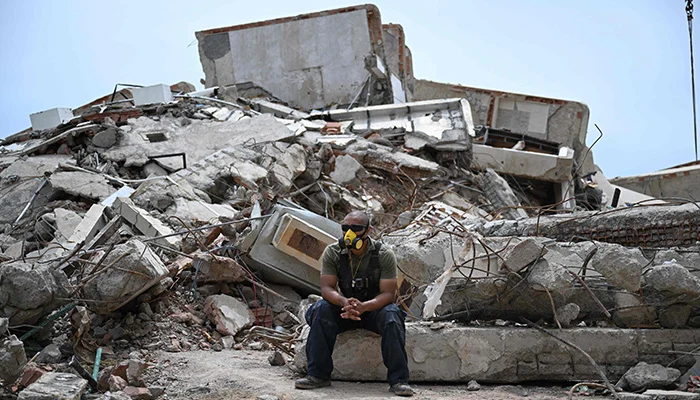
    A volunteer takes a break beside debris in La Guaira, Venezuela, on July 4, 2026, after the twin earthquakes that struck on June 24. — AFP

    – Tens of thousands remain unaccounted for following the devastating twin quakes.
    – Over 16,000 people are still homeless across the impacted regions.
    – Hospitals are under increasing pressure amid fears of a potential disease outbreak.

    Venezuela’s catastrophic twin earthquakes have resulted in nearly 3,000 deaths, according to official reports released Saturday, as international rescue teams begin to wind down efforts to find survivors amid the rubble.

    The death toll has risen by more than 300 since Friday, reaching 2,954, after the June 24th tragedy that displaced thousands onto the streets and into shelter camps.

    A large number of individuals are still missing.

    The hardest-hit area is La Guaira, a coastal region north of Caracas, where numerous residential buildings have been destroyed.

    Ten days after the magnitude 7.2 and 7.5 double shocks, rescue crews are starting to conclude their search for survivors, although families continue to search the debris for loved ones’ remains.

    The critical rescue window for earthquakes usually closes after 72 hours, yet a few survivors have been found in recent days.

    In what appears to be a sign that rescue efforts are winding down, interim President Delcy Rodriguez held a ceremony to award medals to international teams, including some to their rescue dogs.

    Venezuela is experiencing profound grief, with families still clinging to hope of finding loved ones alive, despite losing everything, Rodriguez stated.

    Teams from around South America and some U.S. squads are finishing their rescue operations, according to team members.

    The Los Angeles County fire crew has completed its mission after no additional signs of life were found, and teams from Florida and Virginia are preparing to leave this weekend.

    Many Venezuelans are angry over what they perceive as the government’s sluggish response, saying families spent the initial hours trying to rescue loved ones themselves before international aid arrived.

    Rodriguez defended her government’s actions, stating that thousands of troops and officials have been sent to the affected areas.

    In La Guaira, workers with heavy machinery began demolishing collapsed structures Saturday, while families continued to extract bodies for funerals.

    “We’re still working, still searching for bodies. We’re still going. It hasn’t been easy,” said Francisco Sasquia, a Venezuelan volunteer assisting in the recovery efforts.

    “We’ve already given two bodies to their families.”

    Over 16,000 people have lost their homes in the quakes, and hospitals are overwhelmed, raising concerns about the risk of disease outbreaks.

    Victor Colivert is focused on staying by his nephew’s body, recovered from the wreckage and now placed in a black body bag.

    He fears losing it amid the chaos and prevented forensic workers from removing the body.

    “If I need to go to China, or anywhere else, I won’t leave him alone,” he said. “I’m staying with him.”

  • Southeast Asia Storm Toll Reaches Nearly 700 Amid Disaster Unveiled

    Southeast Asia Storm Toll Reaches Nearly 700 Amid Disaster Unveiled

    A woman stands among tree trunks stranded on the shore after deadly flash floods and landslides in Padang, West Sumatra, Indonesia, on November 30, 2025. — Reuters

    Indonesia, Malaysia, and Thailand are experiencing widespread destruction. At least 176 people have died in Thailand and three in Malaysia. Indonesia’s death count has risen to 502, with 508 individuals still missing.

    Rescue teams in western Indonesia are working tirelessly to reopen roads blocked by cyclone-triggered landslides and floods. As clearer weather emerges, the full extent of the disaster becomes apparent, with nearly 700 lives lost across Southeast Asia.

    The catastrophic event originated from a rare tropical storm in the Malacca Strait, bringing relentless rains and strong winds for a week, complicating rescue efforts in stranded communities hit by mudslides and severe flooding.

    In Thailand, the death toll has increased slightly to 176 due to flooding in eight southern provinces, impacting approximately three million residents. The military has been mobilized to evacuate critical patients and assist those trapped for days by rising floodwaters.

    In the province of Songkhla, where 138 deaths have occurred, officials report that about 85% of water services have been restored, with full service expected by Wednesday. The hardest-hit city, Hat Yai, received a record 13 inches of rain on November 21—the highest in 300 years—followed by days of persistent downpours.

    Prime Minister Anutin Charnvirakul has announced a seven-day timeline for residents to return home, as part of the ongoing recovery efforts.

    Meanwhile, Malaysia has evacuated 11,600 people to shelters, remaining on alert for potential second and third waves of flooding.

    In Palembayan, West Sumatra, locals are clearing mud, trees, and debris from roads under bright sunshine, while some residents attempt to salvage belongings such as documents and motorcycles from their damaged homes. Men in camouflage gear sift through twisted metal and broken poles, as trucks circulate, looking for missing relatives and distributing water to those in knee-deep mud.

    Government officials are prioritizing infrastructure repairs—restoring roads, bridges, and communication networks. Indonesia has reported over 28,000 homes affected and 1.4 million people impacted by the disaster.

    Indonesian President Prabowo Subianto visited the affected regions Monday, commending the resilience and solidarity of the local communities amid what he called a catastrophe. “Some roads remain inaccessible, but we are doing everything possible to overcome these difficulties,” he said in North Sumatra. “Our nation is strong enough to get through this.”

    This widespread destruction follows months of severe weather across Southeast Asia, including typhoons impacting the Philippines and Vietnam, leading to frequent and prolonged flooding. Scientists warn that climate change is likely to increase the frequency of such extreme weather events.

  • Super Typhoon Fung-wong Hits Philippines, Two Fatalities

    Super Typhoon Fung-wong Hits Philippines, Two Fatalities

    Super Typhoon Fung-Wong made landfall in the Philippines on Sunday, resulting in two deaths and prompting the evacuation of around one million residents ahead of one of the strongest storms this year. The cyclone traversed the northern part of Luzon, the country’s most populated island, bringing torrential rains, sustained winds of 115 mph (185 kph), and gusts reaching up to 140 mph (230 kph), according to PAGASA, the local weather bureau. This marks the 21st storm to hit the Philippines in 2025, following shortly after Typhoon Kalmaegi, which caused 224 fatalities in the Philippines and five in Vietnam.

    Christopher Sanchez, 50, described evacuating early after hearing warnings about the storm’s severity. His family moved their belongings to their roof in advance of the flooding and took refuge in a sports arena filled with tents, elderly people on plastic chairs, and children playing nearby. “We’re scared. We’re here with our grandchildren and kids,” he said.

    Early damage reports indicate Luzon and Eastern Visayas bore the worst impact, with one person drowning and another trapped under debris amid the heavy rains and winds. The storm is forecast to diminish as it moves inland, heading north of the country, and is expected to remain a typhoon into Monday morning before moving out to sea, weakening near western Taiwan by Thursday.

    Pope Leo XIII expressed concern and offered prayers for the Filipino people, many of whom are Catholic. “I am close to the people of the Philippines affected by this violent typhoon. I pray for the deceased, their families, the injured, and those displaced,” he said on Sunday.

    In Aurora province, where the storm made landfall, power outages occurred but communication lines remained operational, according to civil defense officials. Several airports, including Sangley near Manila and those in Bicol, temporarily closed operations in response to the storm.

    Fung-Wong is expected to track northward, reaching coastal waters on Monday, before moving out to sea and gradually losing strength as it approaches western Taiwan on Thursday.

  • Tornadoes Tear Through Three States, Leaving Over 25 Dead

    Aerial view of houses damaged by a tornado in St. Louis, Missouri, USA, May 17, 2025. — Reuters
    Aerial view of houses damaged by a tornado in St. Louis, Missouri, USA, May 17, 2025. — Reuters

    Over 25 lives have been lost following severe storms and tornadoes impacting parts of Kentucky, Missouri, and Virginia. Numerous homes were devastated, trees uprooted, and nearly 200,000 residents were left without electricity.

    Locals are working to navigate the aftermath of the destruction.

    Kentucky Governor Andy Beshear announced on social media that at least 18 fatalities occurred during the storms on Friday night. Meanwhile, Missouri officials reported an additional seven deaths in their state.

    Reports indicate that two individuals were killed by falling trees in Virginia.

    In London, Kentucky, 38-year-old Jamie Burns, who lives in a trailer with her husband and son, took refuge in her sister’s basement as the storm obliterated around 100 to 200 houses in the vicinity.

    “It’s unbelievable. Things that have been here for over 30 years are just gone,” Burns recounted during a phone conversation with AFP, her voice trembling.

    “It’s shocking. You look at one spot, and it’s completely flattened, like it was never there.”

    Drone images released by local outlets revealed shocking scenes in London, with homes turned to rubble and tree trunks standing stripped of their branches.

    Governor Beshear noted that more than 100,000 people in Kentucky are without power, prompting five counties to declare states of emergency.

    The eastern region of Kentucky, historically linked to coal mining, is among the nation’s most economically challenged areas.

    “Many residents live in manufactured homes that are not equipped to withstand tornadoes,” Burns stated.

    ‘One of the most devastating storms’

    In Missouri, five individuals were killed in the major city of St. Louis, with authorities labeling this as one of the most destructive storms in the city’s history, and two more deaths were reported in Scott County, according to a statement from the State Highway Patrol.

    Approximately 80,000 people found themselves without power, and three emergency shelters were set up locally. Forecasts predict further severe weather on Sunday night and Monday.

    When asked by a reporter if this was the most severe storm to hit St. Louis, Mayor Cara Spencer responded, “I would characterize this as one of the worst storms — absolutely. The destruction is incredibly heartbreaking.”

    The mayor reported that 38 people were injured and about 5,000 buildings suffered damage.

    In one St. Louis neighborhood, a church was significantly damaged, as seen in CBS footage, with rescue workers tending to victims in the area Saturday morning.

    “It’s tragic to see such destruction inflicted on our residents and our church,” said Derrick Perkins, a pastor at Centennial Christian Church, expressing deep sorrow. “Our hearts are shattered.”

    Bruce Madison, who also serves at the church, remarked on the community’s resilience amidst the tragedy. “Right now, all we can do is pray for everyone involved.”

    Despite having prior warnings about the severe weather— Governor Beshear had declared a state of emergency on Friday—the rising death toll may lead to concerns regarding potential staffing shortages in the National Weather Service due to budget cuts made during the Trump administration.

    It is estimated that around 500 of the 4,200 National Weather Service employees have either been laid off or opted for early retirement this year, according to The Washington Post.

    Last year, the United States experienced its second-highest number of tornadoes on record, with nearly 1,800, according to the National Oceanic and Atmospheric Administration (NOAA), second only to 2004.