الوسم: deployment

  • USS Abraham Lincoln Crew Under Rising Stress Amid Iran Conflict

    USS Abraham Lincoln Crew Under Rising Stress Amid Iran Conflict

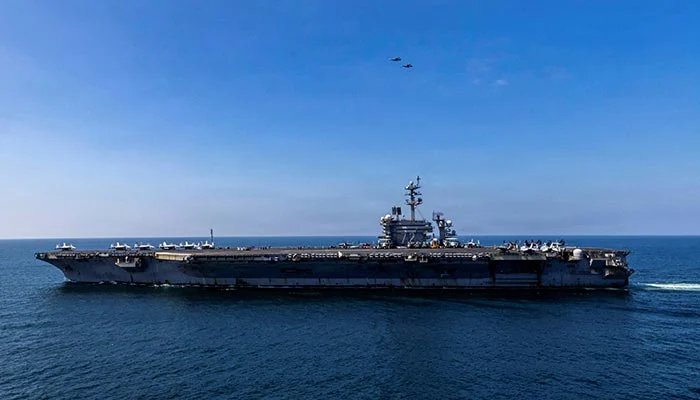
    Some crew members have reportedly tried to throw themselves overboard as basic supplies become scarce and sanitation deteriorates. Life aboard America’s massive Abraham Lincoln aircraft carrier is growing more challenging as the Iran conflict continues.

    Now in its ninth month at sea, the ship is expected to be replaced in the Middle East by the George Washington carrier, a move likely to be welcomed by the sailors and their families. However, serious concerns about living conditions on the Lincoln have prompted lawmakers to seek explanations from Pentagon officials, with some claiming the situation has been “mischaracterized” by the military.

    Jonathan Schroden, chief research officer at the Center for Naval Analyses, explained that sailors endure considerable hardships due to prolonged deployments at sea. “Even during peaceful times, crew quarters are tight, work shifts are long, food quality leaves much to be desired, and opportunities for fresh air and exercise are limited—plus getting a good night’s sleep is often difficult,” he said.

    He added that the added pressure of being involved in combat operations—where the ship is under constant threat—further complicates life for crew members. The Lincoln left California in November 2025 to serve in the South China Sea but was rerouted to the Middle East before the U.S.-Israeli military actions against Iran that commenced in late February.

    Schroden pointed out that carrier strike groups are normally deployed for about six months to ensure the well-being of the crew. Exceeding this duration leads to a host of problems, like rising maintenance costs and shrinking windows for readiness while the ships prepare for future missions.

    Alarmingly, there have been reports of suicide attempts onboard the Lincoln, with the Navy Times noting two sailors tried to jump off the ship recently. Schroden mentioned that such incidents are rare but not unheard of, and each one is deeply tragic.

    The U.S. Navy has not immediately responded to AFP’s inquiries, but U.S. Central Command issued a statement on X (formerly Twitter) asserting that the crew “remains resilient and committed after more than 260 days at sea.” They also confirmed that no service members had died aboard the vessel, and that a sailor who went overboard on August 3 was quickly recovered safely.

    In recent meetings, family members have clashed with Navy officials over the difficult conditions—such as food shortages—faced by the approximately 5,000 sailors and Marines aboard the Lincoln, demanding to know when loved ones will return home. The Lincoln’s extended at-sea time is not unique; the USS Gerald R. Ford experienced similar issues during a recent 326-day deployment. During that time, it participated in operations in the Caribbean, where U.S. forces targeted suspected drug-smuggling vessels and seized Venezuelan leader Nicolas Maduro, before moving to the Middle East.

    A fire in the Ford’s laundry room in March injured two sailors and caused significant damage to around 100 beds. Additionally, reports have surfaced of serious problems with the ship’s toilet systems while underway.

    The conditions aboard the Lincoln have drawn criticism from some lawmakers. Senator Ruben Gallego called for an official, bipartisan Senate review to investigate these alarming reports. Another Democrat, Senator Richard Blumenthal, highlighted widespread issues such as shortages of essentials, water contamination, plumbing failures, declining mental health among crew members, and deck safety concerns.

    Hegseth, however, dismissed these reports as “completely misrepresented,” asserting that every ship and crew member receives all necessary support at all times. Blumenthal questioned whether the Navy can sustain the demanding operational tempo it is currently under, given these reports.

    Schroden believes the Lincoln is still capable of fulfilling its assigned missions. However, he noted that as any sailor knows, the longer a ship remains at sea, the more problems it accumulates, and the more challenging each day becomes for those onboard.

  • Germany Calls for Defense Boost as US Plans Troop Reductions

    A planned withdrawal of 5,000 U.S. troops from Germany has ignited renewed debate about Europe’s defense duties. German Defense Minister Boris Pistorius emphasized that this move should motivate European allies to bolster their own military capabilities. The Pentagon confirmed the reduction in Germany, which hosts the largest U.S. military presence in Europe, amid escalating tensions between Washington and European capitals over issues such as the Iran conflict and trade tariffs.

    President Donald Trump indicated that this troop drawdown might just be the start, stating, “We’re going to cut way down, and we’re cutting a lot further than 5,000” during remarks in Florida on Saturday when questioned about the plan. The announcement has also raised concerns among prominent Republican lawmakers who believe the troops should remain in Europe, highlighting divisions within Washington about America’s military footprint on the continent.

    Additionally, a Biden-era initiative to deploy a U.S. battalion equipped with long-range Tomahawk missiles to Germany has been canceled—a move seen as a setback by Berlin, which viewed it as a critical deterrent against Russia. Senators Roger Wicker and Mike Rogers, leaders of the Senate and House Armed Services Committees, expressed their “very concerned” stance, asserting that the number of troops should not be reduced in Europe but rather repositioned eastward. They warned that “prematurely reducing America’s forward presence in Europe before those capabilities are fully developed risks weakening deterrence and sends the wrong message to Vladimir Putin.”

    German officials, including Pistorius, said the partial withdrawal was anticipated and would impact the current U.S. force of nearly 40,000 soldiers stationed in Germany. Pistorius reinforced the idea that Europeans need to shoulder more responsibility for their security, citing Germany’s efforts to expand its armed forces, accelerate military procurement, and upgrade infrastructure.

    Trump has long advocated for a smaller American military presence in Germany, urging Europe to take more responsibility for its defense. His recent hardline stance, intensified after disagreements with German Chancellor Friedrich Merz over Middle East exit strategies, underscores his push for Europe to do more independently.

    The Pentagon estimates the troop withdrawal will be completed within six to 12 months, though details remain unclear about which bases might be affected or whether the soldiers will return to the U.S. or be redeployed elsewhere in Europe. NATO has stated it is collaborating with Washington to clarify the specifics of this decision.

    Polish Prime Minister Donald Tusk, representing a country eager for continued U.S. support along NATO’s eastern flank amid ongoing Russia-Ukraine tensions, voiced concern about this setback. Tusk tweeted that “the greatest threat to the transatlantic community isn’t external enemies, but the disintegration of our alliance,” urging efforts to reverse the trend.

    This news comes amid broader tensions, as Trump announced plans to hike tariffs on EU auto imports to 25%, accusing the EU of failing to uphold a trade agreement. This move risks damaging Germany’s economy by potentially costing billions. A foreign policy official from Chancellor Friedrich Merz’s CDU party suggested these actions may stem from external pressures and domestic challenges faced by Trump, including poor polling and unresolved conflicts in Ukraine, Venezuela, and Iran. Peter Beyer remarked that both the troop withdrawal and trade measures seem more like reactive responses fueled by frustration than parts of a coherent strategy.

    Despite commitments from NATO members to bolster their defense capabilities, significant gaps in military readiness and constrained budgets mean regional security improvements will take years. Germany aims to increase its active-duty forces from 185,000 to 260,000, though critics call for even greater expansion in light of perceived threats from Russia.

    Historically, the U.S. military presence in Germany—peaking in the 1960s with hundreds of thousands of troops during the Cold War—includes strategic bases like Ramstein and Landstuhl. These facilities have supported U.S. military operations in Iran, Iraq, and Afghanistan. The current plan involves withdrawing one full brigade and canceling a long-range fires battalion scheduled for deployment later this year. This battalion had been viewed as an important element of deterrence against Russia, especially as Europeans develop their own long-range missile capabilities.

    Christian Moelling, director of the European Defense Think Tank EDINA, stated, “The U.S. holds a factual monopoly inside NATO on long-range fires—that’s why this is more operationally significant than troop numbers.”

  • US to Deploy 200 Troops for Gaza Security Mission

    US to Deploy 200 Troops for Gaza Security Mission

    The United States plans to send 200 troops to support efforts in Gaza, forming a joint task force focused on stability in the region. However, no U.S. troops will be physically present inside Gaza itself. These troops, whose exact deployment location is still undecided, will work alongside security forces from Egypt, Qatar, Turkey, and possibly the United Arab Emirates. They will establish a centralized command and coordinate with Israeli forces to prevent any clashes.

    White House spokesperson Karoline Leavitt clarified that up to 200 existing personnel from CENTCOM will oversee a ceasefire in Gaza alongside international allies. This confirms the first stage of a U.S.-mediated agreement between Israel and Hamas, announced by President Trump on October 8, 2025. The agreement includes the release of hostages and a partial Israeli withdrawal from Gaza, which Israel approved earlier today.

    Officials hope the ongoing Gaza negotiations will reduce regional tensions, paving the way for broader normalization agreements between Israel and neighboring Arab countries. During his first term, President Donald Trump facilitated the Abraham Accords, which established relations between Israel and Bahrain, the UAE, Morocco, and Sudan. Currently, Saudi Arabia, Indonesia, Mauritania, Algeria, Syria, and Lebanon are all being considered as potential partners for similar accords.