الوسم: demonstration

  • India’s ‘Cockroach’ Youth Shift: Why they Opposed Modi

    India’s ‘Cockroach’ Youth Shift: Why they Opposed Modi

    Thousands of protesters cheered as Education Minister Dharmendra Pradhan resigned in New Delhi on July 25, 2026. — Reuters

    SITAMARHI: Ashok Kumar knows Narendra Modi transformed his life for the better.

    He recalls as a child watching his farming parents struggle financially—and how life changed after Modi took office in 2014. His government expanded benefits like affordable cooking gas and direct farm subsidies, sparking hope for a brighter future for Ashok and his younger brother Abhishek. Their parents rewarded Modi with votes in three elections.

    But last week, 25-year-old Ashok found himself protesting alongside others at Jantar Mantar, a historic observatory that serves as Delhi’s main gathering site. The protests were led by the Cockroach Janta Party, a satirical movement that has become a voice for India’s disillusioned youth.

    The protests erupted after the government canceled the results of a national medical exam for around 2 million students, including Abhishek, after test questions were leaked.

    In India, standardized tests serve as a pathway into the middle class. The country limits access to thousands of public sector jobs—including diplomats, administrators, clerks, and forest rangers—through tough exams that students spend years and small fortunes preparing for.

    Success is statistically more difficult than gaining admission to Harvard, but the rewards include lifelong job security, pensions, and housing benefits unavailable in the private sector. Corporate job growth has slowed from 11% annually before 2020 to about 3%, according to Marcellus Investment Managers.

    Since 2014, at least two dozen exams have had results invalidated due to leaks, according to a Reuters review of public records and media reports. Yet this recent incident triggered one of India’s largest protests in decades.

    Tens of thousands took to the streets in Delhi and other cities to express outrage over the repeated failures of an exam system that acts as a barrier to upward mobility—often called the “iron rice bowl” in Asia, symbolizing job security.

    Four years ago, Ashok moved from his home state of Bihar—India’s poorest per capita—to Delhi. He earned a master’s degree and enrolled in a test-prep school, trying repeatedly but failing to crack the highly competitive civil service exams. His younger brother Abhishek later joined him to prepare for a similar medical school test.

    Many young people, frustrated by unfulfilled promises, have joined demonstrations, highlighting issues often overshadowed by India’s impressive economic growth. Complaints include widening income inequality, rising youth unemployment, and declining free speech rights, according to Reuters interviews with dozens during the six days of protests. Youth unemployment for those under 30 is three times higher than the overall rate.

    Protesters held up posters mocking Modi and his ministers using strong language, challenging the image of the indomitable leader who has defeated India’s once-powerful Congress party and intimidated the free press, critics say.

    Modi’s office declined to comment. The government claims that claims of an unemployment crisis are exaggerated and that India’s economic fundamentals remain solid.

    ### The People’s Party

    The Cockroach Janta Party (or “People’s Party”) was named after a remark made by India’s chief justice earlier this year, referring to unemployed youth.

    He later clarified that his comments were misunderstood.

    On July 20, over 50,000 people tried to march on Parliament. Police responded with force, injuring 118 officers, but the demonstrators garnered sympathy online. The crowd of diverse age groups and social backgrounds grew, with Bollywood celebrities expressing support on social media.

    Ashok shows a bruise from a police baton he received during a protest. “People normally divide themselves by religion, caste, or language,” he said. “But this was the first time they united over education.”

    Delhi Police did not respond to questions about their handling of the protests.

    By week’s end, the government bowed to the pressure, and Education Minister Dharmendra Pradhan resigned—one of the few times Prime Minister Modi has conceded to public demands.

    In response, the government announced stricter laws against exam leaks with harsher penalties, and Modi addressed India’s youth via video, promising to review the examination system. They also pledged compensation for families of students who committed suicide after exam leaks and promised to drop prosecutions of protesters.

    Pradhan declined to comment.

    ### Living on rice and buffalo milk

    India’s rapid economic growth took off in the 1990s after ending decades of protectionism and opening up to global markets.

    Today, the country hosts leading firms that provide back-office services for Wall Street and Silicon Valley. It has been among the world’s fastest-growing large economies, with around half a billion people now considered middle class.

    But in Bihar, Ashok and Abhishek’s home state, poverty remains rampant. Reuters journalists visited their family home—set in a remote part of Bihar—where a buffalo tethered in a dung-filled yard provides milk, which their mother sells to supplement their father’s income from rice farming.

    The recent invalidation of the medical entrance exam crushed Abhishek’s hopes. He tried three times and failed.

    “I thought becoming a doctor would help me buy my mother jewelry and a TV,” Abhishek said. Now, he’s worried about even asking for money to replace his worn flip-flops.

    “How much can I study?” he asked. “I can’t prepare this much again.”

    Ashok had decided early on to pursue a government job, one of the few opportunities for ambitious Biharis eager to escape farm life.

    He attended exam-prep schools while living at home, studying by lantern when the electricity was out. “I thought hard work alone would be enough,” he remembered.

    But a series of cheating scandals, especially in Bihar, disillusioned him. In 2015, headlines worldwide showed relatives and friends of exam candidates climbing buildings to sneak answers through windows.

    “Cheats Climb High,” one American news site headlined.

    As recently as 2024, hundreds protested online over alleged leaks of a civil service exam. The Bihar government, which is led by Modi’s party, claimed results were only slightly irregular and certified the results.

    Ashok still fell short, missing the cutoff by just ten points. Having prepared for more competitive exams, he felt bitter about his near-miss.

    Over the past four years, he’s taken seven exams but failed each time, spending over $10,000—mostly saved from his father’s hard work.

    Back in his cramped Delhi apartment, peeling walls are decorated with posters, including one quoting Hindu monk Swami Vivekananda: “Arise, awake, and stop not until your goal is achieved,” though Ashok admits the sentiment feels distant.

    “The public exam system has pretty much collapsed,” he said simply.

    ### For the future of the children

    Divya Unny is one of India’s “winners.”

    She grew up during India’s economic liberalization and worked for a popular fashion magazine before moving into filmmaking and directing. Her feminist short films have gained millions of views on YouTube.

    But in July, she joined thousands of disillusioned protesters at Jantar Mantar. Chanting “Inquilab Zindabad”—meaning “Long Live the Revolution”—and with Michael Jackson’s “They Don’t Care About Us” blasting from loudspeakers, she expressed her frustrations.

    Based in Mumbai, Unny criticized the film industry’s focus on Hindu-nationalist themes and said wages haven’t kept pace with inflation.

    Her reasons for protesting weren’t just personal. She had built a bond with Simran Singh, the 21-year-old daughter of her housekeeper, Mamta. After Simran’s medical exam results were invalidated, she was deeply upset.

    Unny, accompanied by her husband, traveled a 17-hour train ride with her to join the demonstration, wearing her late mother’s sari and a flower in her hair.

    “We just wanted to support the future of this country’s children,” she explained.

    Mamta, her housekeeper, came to Mumbai from Bihar seeking a better life for herself and Simran. She worked long hours but also spent over $3,000 on coaching for her daughter. Simran dedicated herself entirely to her studies, isolating from friends to prepare.

    After the exam cancellation, Mamta said, Simran expected to score enough to enter medical school. But media reports of irregularities haunted her, and she shut herself away for days, refusing to eat.

    Later, the government announced the results void due to leaks and promised an investigation. The July retest saw her score drop below her expectations, leading her to abandon her dream of medicine altogether.

    “Now she’s 21,” Mamta sighed. “By next year she’ll be 22, and we’ll keep doing this forever. When will she get to just live her life?”

  • Indian Student Claims ‘Pakistani Agent’ Label Silences Protest Voices

    Indian Student Claims ‘Pakistani Agent’ Label Silences Protest Voices

    A student from India, who went on a 23-day hunger strike during recent protests, has criticized Indian media for labeling protesters as “Pakistani agents.” Neha Bora, one of thousands who demonstrated at Delhi’s Jantar Mantar, explained that such accusations are a tactic to suppress dissent. She recalled that similar claims had been made against people in illegally occupied Jammu and Kashmir (IIOJK). Bora pointed out that the world remained silent on the violence in Kashmir, and now those same issues have come to Delhi’s Connaught Place.

    She stated, “Today, when students are protesting for their rights, they are being called ‘Pakistani agents.’” She added, “People now realize these previous accusations were false.” Bora’s comments came after the young protesters ended their demonstration following the resignation of the education minister and a government commitment to address their demands. Among the protesters’ other goals were compensation for those impacted by exam irregularities and the dropping of legal cases against participants.

    Following these events, Prime Minister Narendra Modi announced the formation of a task force led by tech entrepreneur Nandan Nilekani to reform India’s exam system, addressing concerns over paper leaks. Modi emphasized on Instagram that the new system should be trustworthy and transparent, with maximum use of technology, and that legislation to prevent paper leaks would be introduced in parliament on Monday.

  • India Protests Persist: Food, Fury, and Supporters Near and Far

    India Protests Persist: Food, Fury, and Supporters Near and Far

    A constant flow of food delivery riders bringing meals, snacks, and bottled water has become essential to supporting a youth-led protest movement centered in India’s capital. Motorcycles navigate through traffic, stopping alongside groups of volunteers who are delivering donations from supporters both within India and abroad, all unable to physically join the rare public protest against Prime Minister Narendra Modi’s government.

    “Orders are coming from everywhere,” said Suraj Kumar, 25, a rider with a bag of kachoris — a popular deep-fried snack — as volunteers climbed over police barricades to collect the packages. A volunteer received the food and handed it over in a relay to the protest site about a few hundred meters away, around Delhi’s Jantar Mantar observatory, where hundreds of protesters gathered around an elevated platform.

    Leaders of the Cockroach Janta Party (CJP), a movement that started as an online satire in May, have been demonstrating here since last month, demanding the resignation of Education Minister Dharmendra Pradhan due to ongoing exam paper leaks. The protest gained significant momentum in recent days after a prominent activist began an indefinite hunger strike in support.

    Despite a significant police crackdown on Monday when tens of thousands of young people attempted to march on Parliament, the encampment persists. Young Indians under 30 make up more than half of the country’s population of approximately 1.42 billion, many of whom have expressed frustration that years of economic growth have not translated into enough job opportunities.

    “People are angry, especially after police started beating innocent students. But not everyone can be here physically, so they’re sending food,” explained Raj Rathore, 25, a volunteer who has been managing deliveries of water bottles, fruit, and biscuits over the past few days. These contributions and volunteer support networks have been crucial in sustaining the protest around the clock, students indicated.

    “This protest is only possible because of people’s kindness and our unity,” said Rina Rawat, a 20-year-old Delhi University student organizing queues inside the protest site. Rawat herself was hit on the left leg with police batons on Monday but returned the next day to continue her participation.

    Modi has not directly addressed the protests, although a coalition minister mentioned after a recent meeting that the Prime Minister assured them that the “strongest possible steps are being taken to protect students’ interests.” Education Minister Pradhan also promised “answers, reforms, and accountability.”

    By late Wednesday afternoon, despite intermittent monsoon showers, the protest crowd had swelled to about 5,000, mostly Generation Z students holding signs, playing patriotic Bollywood songs, and chanting slogans. One protester shouted, “Modi, we won’t tolerate your autocracy,” drawing cheers — an unusual display of open criticism against a leader who has dominated Indian politics since 2014.

    Mukesh, who chose not to disclose his last name, shared, “I was a Modi supporter until 10 days ago, but seeing police brutality shocked me.” Many of the young demonstrators drew inspiration from India’s fight for independence, carrying portraits of revolutionary Bhagat Singh, copies of the Constitution, and handing out roses. Several donned Spider-Man masks and called themselves “baddies,” emphasizing their defiant spirit.

    Nearby, 19-year-old Arpita Verma remarked, “There’s been too much Hindu-Muslim politics in India,” referencing the increasing religious polarization under Modi’s party, which is mainly supported by the Hindu majority. She added, “But here, we are united by a common cause — and we’re not afraid.”

  • Delhi Protesters Call for IIOJK Statehood

    Delhi Protesters Call for IIOJK Statehood

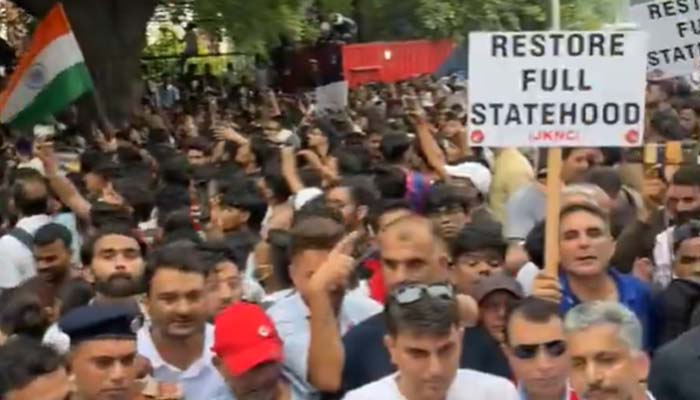
    Hundreds of individuals, led by the chief minister of Indian Illegally Occupied Jammu and Kashmir (IIOJK), chanted slogans and organized a demonstration in New Delhi on Monday, demanding that the region be granted statehood—seven years after it was reclassified as a federal territory.

    Authorities prevented the protesters from carrying out their march, according to a post by Omar Abdullah on X, which included videos and photos of people holding signs and shouting slogans.

    “This is just the start of our fight for statehood, our rights, our dignity, and everything else that has been taken from us,” Abdullah stated in his post.

    In August 2019, Prime Minister Narendra Modi annulled the region’s semi-autonomous status, stripped it of its statehood, and split it into two federally governed territories: Muslim-majority Kashmir with Hindu-majority Jammu, and the Buddhist region of Ladakh.

    Since then, the government has stated that statehood for the disputed Himalayan area will be restored at the “appropriate time,” but no specific deadline has been provided.

    Abdullah and his party, the Jammu and Kashmir National Conference, insist that statehood should be reinstated as soon as possible, in line with the government’s promise.

    Members of Modi’s Bharatiya Janata Party accuse the protest of being an effort to distract from what they describe as governance failures by Abdullah’s administration.

  • London Police Arrest 212 at Palestine Action Protest

    London Police Arrest 212 at Palestine Action Protest

    On Saturday, authorities reported the arrest of 212 individuals during a protest in Trafalgar Square, London, protesting Britain’s ban on the Palestine Action group. This marked the first demonstration following the High Court’s February decision declaring the ban—labeling the group as a terrorist organization—as unlawful. UK Interior Minister Shabana Mahmood is currently seeking to appeal this ruling.

    The banned organization, Palestine Action, has accused the UK government of complicity in what it claims are Israeli war crimes in Gaza. The ban was enacted last July after some members infiltrated a Royal Air Force base. During Saturday’s rally, protesters—some donning black and white Palestinian scarves and waving flags—sat on the ground or on camping chairs while holding signs.

    London’s Metropolitan Police stated on X (formerly Twitter) that they are “continuing to make arrests where individuals are supporting a proscribed organization.”

  • ‘US Protesters Rally Against Trump on “No Kings” Day’

    ‘US Protesters Rally Against Trump on “No Kings” Day’

    Protests against President Donald Trump erupted nationwide, with demonstrations happening across all 50 states and extending into other countries. Over 3,200 rallies are scheduled, including smaller communities and even remote Alaskan towns like Kotzebue. Organizers anticipate a record turnout, surpassing the millions who participated in previous protests on Trump’s birthday last June and in October, which drew an estimated seven million participants.

    The protests originated as a display of defiance in 2025 but have since evolved into a broad movement called “No Kings,” representing widespread opposition to Trump’s policies. The current anger is fueled by his handling of the Iran conflict, perceptions of authoritarian tendencies, and various domestic issues including climate change denial and efforts to weaken diversity programs. Critics condemn his use of executive power, the Justice Department’s actions against opponents, and his hawkish military stance despite campaigning as a peacemaker.

    Major cities like New York, Atlanta, and Detroit saw thousands gather, with some carrying signs like “We Are Losing Our Democracy.” In West Bloomfield, Michigan, protesters braved freezing temperatures. Prominent figures such as Bruce Springsteen plan to perform in Minneapolis, where he recently composed a protest song inspired by the deaths of two Americans at the hands of federal agents during immigration protests.

    The movement’s momentum is driven partly by President Trump’s declining approval ratings, now below 40%, and the upcoming midterm elections, where control of Congress may shift away from his party. Notably, two-thirds of those planning to protest on Saturday reside outside big cities, reflecting widespread discontent.

    The protests are also international, with gatherings in European capitals like Amsterdam, Madrid, and Rome. The movement continues to grow, illustrating a deep-seated disagreement with the current administration’s approach and vision for the country.

  • Australian Mosque Protesters Interrupt PM Albanese Over Israel Support

    Australian Mosque Protesters Interrupt PM Albanese Over Israel Support

    Protesters booed and shouted at Prime Minister Anthony Albanese during his visit to Australia’s largest mosque on Eid al-Fitr, expressing their anger over his support for Israel’s military actions in Gaza. Videos captured the scene roughly 15 minutes after Albanese and Home Affairs Minister Tony Burke arrived at Lakemba Mosque in western Sydney to observe Ramadan’s end.

    The demonstrators jeered, instructing Albanese and Burke to leave and branding them as “genocide supporters,” in reference to Israel’s casualties in Gaza. An organizer urged the crowd to remain calm and stop recording, emphasizing that it was a joyful Eid celebration. A security guard was seen physically removing a heckler from the scene before escorting him out.

    As Albanese and Burke departed, hecklers continued to shout insults, including “Shame on you!” Despite the disruption, Albanese later described the event as “incredibly positive,” noting that the community managed to handle the few troublemakers.

    He explained that some of the unrest was tied to the government’s recent designation of Hizb ut-Tahrir as a banned hate organization, a move partly motivated by laws enacted after a deadly shooting at Bondi Beach in December. Notably, protesters had also gathered in February when Israeli President Isaac Herzog visited, to show support for Jewish Australians reportedly targeted by gunmen inspired by ISIS during the Bondi attack, leading to multiple arrests during clashes with police.

  • Pro-Iran Demonstrations Sparks Tensions in Ladakh

    Pro-Iran Demonstrations Sparks Tensions in Ladakh

    Pro-Iran demonstrators held up posters of Supreme Leader Ayatollah Ali Khamenei and shouted slogans in support of Iran in the Indian-controlled Ladakh region. The protest took place on January 14, 2026, as Iran’s government works to suppress internal dissent. According to a report by The Times of India, the rally was organized by the Imam Khomeini Memorial Trust.

    Multiple procession groups departed from various parts of Kargil, with large crowds carrying banners of Khamenei and chanting in his favor. These rallies merged at the Old Taxi Stand in Kargil, where the main gathering drew thousands of men and women from across the district.

    During the protests, demonstrators expressed opposition to the United States and Israel, specifically targeting U.S. President Donald Trump and Israeli Prime Minister Benjamin Netanyahu. Tehran aims to deter Trump’s repeated threats of intervention on behalf of anti-government protesters.

    Experts and regional diplomats warn that military action could backfire—either by quashing protests in Iran, leading to harsher crackdowns on participants, or provoking Iranian missile strikes against U.S. military bases in the Middle East.

    A U.S. official announced on Wednesday that some personnel are being evacuated from Middle Eastern bases amid escalating tensions, following warnings from an Iranian official that Tehran had warned neighboring countries it would strike American bases if Washington took retaliatory action.

    Despite the mounting tensions, Trump stated late Wednesday that violence during Iran’s protests was decreasing and that there are no plans for mass executions of protesters. Iranian Foreign Minister Abbas Araqchi also clarified that Iran has no intention of hanging protesters, saying, “There is no plan for hanging at all. Hanging is out of the question,” during an interview on Fox News.

  • Protesters Clash with U.S. Police Over Officer-Involved Woman’s Death

    Protesters Clash with U.S. Police Over Officer-Involved Woman’s Death

    On Thursday, protesters clashed with law enforcement officials in Minneapolis following the fatal shooting of a woman by an immigration agent, an incident that sparked widespread anger. The authorities insisted that she was involved in “domestic terrorism,” a claim that sparked outrage among protesters.

    Federal agents, equipped with pepperball guns and teargas, confronted a large crowd near a government building in Fort Snelling, just outside Minneapolis, according to witnesses. The crowd chanted slogans condemning Immigration and Customs Enforcement (ICE), while officers pushed back, detaining several individuals, including one who hit an officer with a cardboard sign.

    The woman shot on Wednesday was identified as 37-year-old Renee Nicole Good. Witnesses said she was shot at close range as she tried to leave in her car, which law enforcement claimed was obstructing their way. Video footage shows a masked ICE agent attempting to open her car door before another agent fired three rounds into the vehicle. Her SUV then lost control and collided with parked cars, prompting onlookers to voice their outrage. Her bloodied body was later seen slumped inside the wrecked vehicle.

    President Donald Trump and senior officials quickly alleged that Good was attempting to harm the officers, a statement that Minneapolis Mayor Jacob Frey dismissed as false. Trump later stated that the shooting was justified as self-defense. Meanwhile, the Department of Homeland Security (DHS) chief Kristi Noem labeled the incident as “domestic terrorism.”

    Minneapolis police chief Brian O’Hara clarified that Good was not the target of immigration enforcement and was only suspected of blocking traffic. Vice President JD Vance also posted on social media calling Good “a deranged leftist.”

    The protests intensified after Minnesota Governor Tim Walz urged demonstrators to exercise their First Amendment rights “safely” and described dissent as a “patriotic duty.” ICE agents continue to play a prominent role in the Trump administration’s immigration deportation efforts, despite criticism about insufficient training of new officers. Last summer, the DHS launched a campaign to hire 10,000 additional ICE agents, swelling the force from 6,000.

    The incident occurred during a protest against immigration enforcement in southern Minneapolis. Eyewitness Brandon Hewitt reported hearing three gunshots and saw responders carry Good’s body into an ambulance. Another witness described the scene as gruesome, noting that the survivor from the vehicle was covered in blood. He also recounted witnessing a man claiming to be a doctor being denied access to Good by police.

    Her mother, Donna Ganger, told the Minnesota Star Tribune that Good was likely frightened during the altercation. She also emphasized that her daughter was not involved in challenging ICE officers and described her as a mother and a poet who studied creative writing at Old Dominion University in Virginia.

    U.S. authorities reported deploying up to 2,000 officers in Minneapolis for immigration operations. A similar incident in Chicago in September saw an undocumented immigrant shot dead after allegedly attempting to resist arrest by driving into officers.

  • Iran President urges govt to heed protesters’ valid demands

    Iran President urges govt to heed protesters’ valid demands

    Iran’s President Masoud Pezeshkian attended a press conference in Tehran on September 16, 2024, as reported by Reuters.

    Amid ongoing economic turmoil, shopkeepers in Tehran have closed their stores for a second consecutive day, protesting the sharp decline of the rial in the unofficial market. The US dollar has surged to approximately 1.42 million rials from 820,000 rials a year earlier, while the euro nears 1.7 million rials, according to currency tracking sites.

    President Pezeshkian urged the government to heed the protesters’ “legitimate demands,” calling for dialogue between officials and representatives of the demonstrators to address the economic crises responsibly, as reported by IRNA. Protesters are demanding immediate government actions to stabilize the exchange rate and implement a clear economic plan, according to ILNA.

    The volatile currency prices have hindered sales of imported goods, causing both buyers and sellers to hold off transactions until the economic outlook stabilizes. Protesters expressed frustration, stating that conducting business under current conditions has become impossible.

    Images from Fars news agency showed large crowds occupying a major central Tehran thoroughfare, known for its numerous shops, with some photos indicating the use of tear gas to disperse crowds. Minor clashes between protesters and security forces were reported, raising concerns about potential instability.

    Iran’s Chief Justice Gholamhossein Mohseni Ejei called for swift punishment of those responsible for currency fluctuations, according to Mizan Agency. The government also announced the appointment of Abdolnasser Hemmati as the new governor of the Central Bank—Hemmati, a former economy and finance minister, was dismissed by parliament in March due to the rial’s depreciation.

    Meanwhile, President Pezeshkian submitted the budget for the upcoming Persian year to parliament, vowing to combat inflation and high living costs. Inflation stood at 52% annually as of December, but prices for essentials continued to rise sharply beyond this figure.

    Iran’s already strained economy, heavily impacted by decades of Western sanctions, faced further pressure when the United Nations reinstated international restrictions linked to its nuclear program in late September. Western countries and Israel accuse Iran of pursuing nuclear weapons—a charge Tehran denies.

  • Viral Gen Z Protests Erupt in Mexico After Mayor’s Killing

    Viral Gen Z Protests Erupt in Mexico After Mayor’s Killing

    On Saturday, thousands across Mexico took to the streets under the banner of “Generation Z” to rally against the escalating violence following the recent assassination of Mayor Carlos Manzo, an outspoken advocate against crime. The protests spanned the nation, including a notable gathering in Mexico City where a small group of hooded individuals managed to dismantle fences surrounding the National Palace, where President Claudia Sheinbaum resides. This confrontation resulted in clashes with riot police, who responded with tear gas, witnesses told Reuters.

    According to Pablo Vazquez, Mexico City’s Public Safety Secretary, the unrest caused injuries to approximately 100 police officers, with 40 needing hospital care. An additional 20 civilians also suffered injuries. Law enforcement made 20 arrests and issued 20 administrative referrals during the chaos.

    Protests were also seen in various other cities, notably in Michoacán, where anger remains high over the November 1 shooting death of Uruapan Mayor Carlos Manzo during a public Day of the Dead celebration. Some demonstrators in Mexico City directed their frustrations at Sheinbaum’s party, Morena, chanting “Out, Morena,” and demanding more robust state action to combat crime, with the phrase “Carlos did not die, the government killed him” echoing through the crowds.

    A group self-identifying as “Generation Z Mexico,” which called for the protests through a manifesto circulating on social media, claims to be non-partisan and represents youth fed up with violence, corruption, and abuse of power. Generation Z includes individuals born between 1997 and 2012, and global protest movements with the same label have emerged to advocate for social and political reform.

    The government criticized the protests, suggesting they were largely orchestrated by right-wing political opponents and amplified by bots and coordinated campaigns on social media platforms.

  • Five Dead in Protests Over Ladakh Statehood, Police Report

    Five Dead in Protests Over Ladakh Statehood, Police Report

    Protesters set fire to a police vehicle and the BJP office in Leh. Police responded with tear gas and batons, resulting in dozens of injuries. Activist Sonam Wangchuk is currently on a hunger strike, calling for either full statehood for Ladakh or constitutional safeguards for its tribal communities, land, and delicate environment.

    At least five people lost their lives during the clashes, with police reports indicating a significant number of injuries. Authorities subsequently restricted public gatherings, limiting assemblies to no more than four individuals.

    The region, characterized by its sparse population and high-altitude desert landscape, is home to approximately 300,000 residents and shares borders with both China and Pakistan. Around half of Ladakh’s population is Muslim, while roughly 40% adhere to Buddhism.

    Ladakh is designated as a “Union Territory,” meaning it elects representatives to India’s national parliament but is governed directly by New Delhi. The protests were organized in support of Wangchuk, who has been on a two-week hunger strike. He demands either full statehood or legal protections for tribal lands, communities, and the environment.

    Wangchuk argued that social unrest stems from persistent unemployment among youth and lack of democratic rights, urging people to avoid violence at all costs. The Indian military maintains a substantial presence there, especially in disputed border zones with China. In 2020, clashes in these areas resulted in the deaths of at least 20 Indian soldiers and four Chinese soldiers.

    In 2019, Modi’s government bifurcated Ladakh from the region formerly known as Indian-administered Kashmir, imposing direct rule. The government has yet to fulfill its pledge to incorporate Ladakh into the “Sixth Schedule” of the Indian Constitution, which would grant autonomous legislative powers to local communities.

    Wangchuk highlighted the absence of democratic platforms in the region, lamenting that the promised Sixth Schedule has not been implemented, thereby limiting the people’s self-governance.

  • Thousands rally in London against Trump’s second state visit

    Thousands rally in London against Trump’s second state visit

    Protesters with signs and chants gathered in central London on Wednesday to oppose US President Donald Trump’s second official visit to the UK, a visit marked by a stark contrast in receptions. The Metropolitan Police estimated around 5,000 demonstrators participated in a rally outside Parliament, as Trump was received with a red carpet at Windsor Castle, located about 22 miles west of London.

    Participants expressed their disapproval through banners and slogans. Former teacher Dave Lockett, 67, remarked, “We’re protesting generally against everything about Donald Trump. There are so many reasons to dislike him, it’s hard to choose just one.” He added, “He’s spreading chaos and destruction worldwide. If his ideas start influencing Britain, it could lead to fascism here.”

    Left-wing politicians, including Zack Polanski, leader of the Green Party, addressed the crowd during the rally organized by comedian Nish Kumar. Polanski stated, “We’re gathered here united to say this isn’t in our name. It’s time to challenge everything Trump represents and reject the politics of division and hate.”

    Ahead of the main demonstration, crowds assembled near the BBC headquarters, holding a variety of signs from supporting Palestine to condemning fascism. Participants recreated the inflatable Trump wearing a diaper balloon from his 2019 visit, with some holding signs like “End the genocide. Stop Trump.” The protest was organized by the Stop Trump Coalition, supported by groups such as Amnesty International UK, Black Lives Matter UK, Palestine Solidarity Campaign, and Greenpeace.

    The coalition questioned Trump’s brief visit to London, suggesting it was because he’s avoiding protests. “He’s opting to hide and ride in a parade at Windsor, far from public view. Our protest is making him cautious,” a statement read.

    Throughout the evening, demonstrators chanted “Say it loud, say it clear: Donald Trump is not welcome here,” as speakers criticized him. Police deployed over 1,600 officers, including 500 from other jurisdictions, to maintain order. No significant disturbances or arrests were reported, though a single supporter held a “We Love Trump” sign amid booing crowds.

    Polls show Trump remains unpopular among the British public, with nearly half of respondents believing his second visit shouldn’t have been extended. Only a quarter think it will improve UK-US relations. London’s mayor, Sadiq Khan, a staunch critic, highlighted Trump’s divisive policies and rhetoric, citing his actions like scapegoating minorities, deporting citizens the wrong way, and deploying military force in diverse cities. Khan has long been outspoken against Trump, even permitting the famous “Trump baby” blimp to fly during his visits.

    Last weekend, a rally attended by approximately 150,000 people, organized by far-right activist Tommy Robinson, resulted in clashes and injured police officers. Khan characterized Trump’s tactics as reminiscent of autocratic regimes, emphasizing that such conduct is incompatible with Western values.

  • DC residents rally against Trump’s troop deployment

    DC residents rally against Trump’s troop deployment

    Several thousand residents of Washington, D.C., took to the streets on Saturday to protest the presence of National Guard troops patrolling their neighborhoods. The rally, titled “We Are All D.C.,” drew a diverse crowd—including undocumented immigrants and supporters of Palestine—who voiced their opposition to federal law enforcement in the city. Protesters held signs reading “Trump must go now,” “Free D.C.,” and “Resist Tyranny,” while chanting against President Trump.

    One demonstrator, Alex Laufer, explained, “I’m here to oppose what I see as an occupation of D.C.,” emphasizing the need to remove federal police and National Guard forces from the streets. The deployment, announced last month by Trump, was justified by officials as necessary to restore law and order amid concerns over rising crime levels. Trump also placed the city’s Metropolitan Police Department under federal control and sent federal personnel—including Immigration and Customs Enforcement agents—into the city.

    Despite the government’s assertions, data from the Justice Department indicated that violent crime in Washington hit its lowest point in three decades in 2024, despite the increased federal presence. The National Guard in D.C. is tasked as a state militia, reporting to the president, except when activated by the states’ governors.

    Critics, like Casey who preferred not to reveal his last name, warned that the federal government’s tactics in D.C. resemble oppressive measures seen in authoritarian regimes. “What they’re doing in D.C. is a test — and if people accept it, it could spread to other areas,” Casey warned. Currently, more than 2,000 troops, from six Republican-led states, are patrolling the city. The Army recently extended their deployment through November 30, with no clear end in sight.

    Local authorities have challenged this move; D.C. Attorney General Brian Schwalb filed a lawsuit to block the troop deployment, arguing it violates constitutional rights and federal laws. Meanwhile, some residents have welcomed the presence of the Guard, especially in less affluent neighborhoods where crime has been more severe.

    Mayor Muriel Bowser has praised the federal law enforcement surge but hopes that the National Guard’s mission will conclude soon, citing notable declines in crime, including carjackings, since the deployment began. She also signed a directive to improve coordination with federal agencies.

  • Jordan Bans Muslim Brotherhood, Seizes Assets and Offices

    Jordan Bans Muslim Brotherhood, Seizes Assets and Offices

    A member of the Muslim Brotherhood protests in front of riot police during a demonstration at the Press Syndicate in Cairo, Egypt, on April 15, 2016. — Reuters

    • Group has operated legally in Jordan for many years.
    • Fraya states that all activities of the group will be prohibited.
    • Critics label it a “dangerous terrorist” organization.

    AMMAN: On Wednesday, Jordan declared the Muslim Brotherhood, the nation’s most prominent opposition group, illegal and seized its assets following revelations of its members’ involvement in a sabotage scheme, according to Interior Minister Mazen Fraya.

    The group, which has maintained a legal presence in Jordan for decades and enjoys substantial grassroots support in major cities and numerous offices nationwide, had not issued an immediate response.

    Fraya announced that all activities related to the group would be prohibited, and any individual promoting its ideology would face legal consequences.

    The ban encompasses any publications from the group, as well as the closure and seizure of all its offices and properties, he specified.

    Opponents of the Brotherhood, which has been banned in several Arab nations, contend that it poses a serious terrorist threat that needs to be eliminated. However, the group asserts that it abandoned violence decades ago, aiming to realize an Islamist vision through peaceful means.

  • France Holds Major Protests Against Racism and Far-Right Surge

    France Holds Major Protests Against Racism and Far-Right Surge

    PARIS: A Wave of Protests Against Racism

    On March 22, 2025, thousands of individuals gathered in various cities across France, including Paris, to voice their opposition to racism and the increasing influence of far-right politics. Tensions escalated during some demonstrations, leading to confrontations between police and protesters.

    Particular criticisms were directed toward the former U.S. administration under Donald Trump. In Paris, clashes broke out as law enforcement and some attendees collided during the demonstrations.

    These protests occurred against a backdrop of a rightward shift in French politics, with the government announcing intentions to tighten immigration regulations and border security.

    The French interior ministry reported that approximately 91,000 individuals participated in protests nationwide, with about 21,500 people rallying in Paris alone. The ministry also confirmed that two arrests were made, and injuries were reported for three individuals, including a riot police officer. In total, three additional arrests took place elsewhere in France.

    Many demonstrators condemned the rising power of reactionary political movements, recognizing a concerning trend not only in France but also in the United States. In Paris, throngs took to the streets, waving placards with messages such as, "Fascism is a disease from Washington to Paris."

    Evelyne Dourille, a 74-year-old retiree, expressed her alarm: "The far-right is gaining momentum across Europe. It’s alarming as, in France, we’re seeing these ideas infiltrating even among ministers in the current government."

    ‘Worrying Surge’ in Racism

    One American protester articulated the urgency for similar demonstrations to take place in the U.S. "America is sliding toward fascism," remarked a 55-year-old woman.

    Aurelie Trouve, a member of the left-wing France Unbowed (LFI) party, raised concerns over the growing popularity of Marine Le Pen’s far-right party, emphasizing, "Far-right ideologies are becoming ingrained within the government."

    In Marseille, approximately 3,300 people joined the protests, while around 2,600 rallied in Lille, according to local police reports. Many participants carried signs proclaiming "Against state Islamophobia" and "Tesla is the new swastika."

    Ines Frehaut, a student attending her first protest, expressed disquiet over recent statements made by France’s hardline interior minister. "What Bruno Retailleau has said regarding Islam, Algeria, and the wearing of the veil is serious!" she stated.

    These demonstrations took place just a day after the International Day for the Elimination of Racial Discrimination. The Human Rights League described the situation as "serious," warning about a "worrying surge" in racist incidents.

    Dominique Sopo, head of SOS Racisme, condemned the "global reactionary offensive against foreigners and their children, against Muslims," along with the increase in racist and anti-Semitic incidents.

    In the lead-up to the protests, the LFI party sparked controversy by sharing an image of Cyril Hanouna, a prominent right-wing media figure in France, in a campaign promoting attendance at the anti-racism rallies. Critics accused this move of perpetuating anti-Semitic tropes reminiscent of the Third Reich. LFI leaders later acknowledged that using the image was a "mistake" and retracted it.