الوسم: defense spending

  • NATO Boosts Defense Spending as Trump Advocated for Mutual Support

    NATO Boosts Defense Spending as Trump Advocated for Mutual Support

    NATO Secretary General Mark Rutte and Heads of State and Government at the summit in The Hague, Netherlands, June 25, 2025. — NATO website

    • NATO member countries to boost defense spending to 5% of GDP.
    • Trump criticizes Spain’s position on spending goals.
    • Macron connects spending increases to transatlantic trade issues.

    NATO leaders gathered on Wednesday endorsed a significant increase in defense spending, as advocated by U.S. President Donald Trump, and reaffirmed their solidarity in mutual defense following a short summit in the Netherlands.

    While Trump achieved his aim at this annual meeting designed with him in mind, his NATO allies were likely relieved at his reaffirmation of the essential principle of collective defense after his earlier ambiguous remarks on Tuesday.

    During a press briefing, Trump mentioned, “We had a tremendous victory today,” expressing his hope that the increased funding would be allocated to military equipment manufactured in the United States.

    Trump’s Warning to Spain

    However, he warned of potential repercussions for Spain after Prime Minister Pedro Sanchez indicated that the nation could fulfill its NATO responsibilities while spending significantly less than the newly set 5% of GDP target.

    “I find that unacceptable. Spain is doing very well economically. But if something negative occurs, their economy could take a hit,” Trump stated, adding that Spain may receive a harsher trade deal from the U.S. than other European Union nations.

    The NATO leaders issued a five-point communiqué that supported the augmented defense spending goal, addressing not only Trump’s demands but also Europe’s increasing concerns about a potential threat from Russia following its invasion of Ukraine in 2022.

    The statement from the 32 allies read: “We reinforce our unwavering commitment to collective defense as defined in Article 5 of the Washington Treaty — an attack on one is an attack on all.”

    When pressed about his stance on Article 5 amid recent unclear statements, Trump affirmed, “I support it. That’s why I am here. If I didn’t, I wouldn’t be here.”

    Macron Raises Trade Tensions at NATO Summit

    Trump has persistently urged other nations to elevate their spending to lessen NATO’s heavy dependence on U.S. support.

    Despite the appearance of consensus, French President Emmanuel Macron brought attention to the steep tariffs threatened by Trump, which may hinder transatlantic trade and subsequently impact increased defense expenditure.

    “We can’t commit to increasing our spending while simultaneously igniting a trade war at the heart of NATO,” Macron remarked, labeling it as “absurd.” He indicated that he had discussed this issue with Trump multiple times.

    NATO Secretary General Mark Rutte, who hosted the summit in his hometown The Hague, described NATO as emerging as a “stronger, fairer, and more formidable” alliance.

    The former Dutch prime minister praised Trump for facilitating agreement among NATO members to raise defense budgets.

    When queried by a reporter about whether he had overly flattered Trump to keep him on board during the summit, Rutte replied that he and Trump were friends, and that judgment about his approach was subjective.

    New NATO Spending Objectives Are Challenging

    The newly established spending target, aimed to be achieved over the next decade, represents a significant increase worth hundreds of billions of dollars annually compared to the existing 2% GDP goal, although the measurement protocol will change.

    Nations committed to allocating 3.5% of their GDP towards core defense, which includes military personnel and equipment, while 1.5% is earmarked for broader defense-related initiatives such as cybersecurity and fortifying infrastructure to accommodate heavy military vehicles.

    This additional funding will be a significant challenge for many European countries, which are already grappling with tight budgets.

    Ukrainian President Volodymyr Zelenskiy was only able to join a pre-summit dinner on Tuesday night and miss the main discussions on Wednesday, although he did manage to meet Trump separately after the event.

    The Kremlin has accused NATO of escalating militarization and depicting Russia as a “dangerous adversary” to justify its substantial increases in defense budgets.

  • EU Defense Plan: €650B Boost to Economy, 1.5% GDP Growth

    EU Defense Plan: €650B Boost to Economy, 1.5% GDP Growth

    EU’s Defense Push: A Shift in Economic Strategy

    As geopolitical tensions rise, Europe is reassessing its defense policies and spending. The push to enhance military capacities comes with a significant economic implication, especially in light of current economic challenges facing the region.

    The ReArm Europe Initiative

    The European Union’s response to increasing defense demands is encapsulated in its ReArm Europe plan. This initiative proposes altering traditional fiscal frameworks that have historically restricted member states from expanding their defense budgets without strict budgetary controls. The European Commission is recommending a new approach that includes loosening the constraints laid out by the Stability and Growth Pact, which has largely dictated fiscal discipline across the EU.

    Fiscal Flexibility for Growth

    Under the ReArm Europe proposal, the EU envisions liberating member nations from rigid debt and deficit rules. This strategic shift could create an additional €650 billion in fiscal space over the next four years. By facilitating this financial maneuvering, the EU aims to align defense priorities with economic needs, effectively allowing for a more flexible budgetary approach that accommodates enhanced military spending.

    Economic Implications of Increased Defense Spending

    While increased defense budgets might initially seem to strain resources, experts argue that if managed correctly, they could stimulate economic growth. The emphasis here is on domestic investment—fostering local research, development, and production capabilities rather than relying heavily on foreign procurement of military equipment.

    The Argument for Growth

    Ethan Ilzetzki, an acclaimed economist and author of “Guns and Growth: The Economic Consequences of Defense Buildups,” argues that prudent increases in defense spending can yield significant economic benefits. He suggests that by prioritizing regional security needs without the shadow of potential economic crises, Europe can effectively manage the financial implications of military expansion.

    Estimating the Costs and Benefits

    Moritz Schularick, President of the Kiel Institute for the World Economy, points to the logistics of escalating defense expenditures. An increase in military spending from approximately 2% to 3.5% of GDP is projected to incur around €300 billion annually. However, he posits that if these funds are allocated wisely, the potential to generate an equivalent amount of additional economic activity exists, making the endeavor economically justifiable.

    Projected GDP Growth

    Ilzetzki’s analysis indicates that this surge in defense spending could foster GDP growth ranging from 0.9% to 1.5%. This projection is particularly critical given that the EU’s collective GDP growth was only 0.9% in 2024. Thus, augmenting defense expenditures not only addresses national security concerns but could also serve as a catalyst for renewed economic vitality across the continent.

    Strategic Considerations for Member States

    As EU member countries evaluate their defense budgets, the strategic imperative will revolve around ensuring that spending not only addresses immediate security needs but also contributes to broader economic objectives. This dual focus could reshape economic landscapes within Europe, encouraging countries to invest in defense-related industries while also stimulating significant employment and technological advancements.

    The ongoing discussions within the EU present an opportunity for member nations to rethink their fiscal strategies in light of evolving defense requirements and economic realities. Balancing these elements will be crucial in determining the long-term impact of Europe’s ambitious defense agenda.

  • €800B Defense Plan: Boosting EU Spending by 1.5% GDP

    €800B Defense Plan: Boosting EU Spending by 1.5% GDP

    Unveiling the ReArm Europe Initiative

    In recent discussions on the future of European defense, Ursula von der Leyen, the president of the European Commission, laid out a comprehensive five-point plan dubbed "ReArm Europe." This initiative comes ahead of a crucial European Council summit focused on bolstering European defense strategies and ensuring continued support for Ukraine amid ongoing geopolitical tensions.

    Key Components of ReArm Europe

    The ReArm Europe plan aims to significantly enhance European defense capabilities while simultaneously reducing reliance on the United States. Below are the primary components that comprise this ambitious strategy.

    1. Increased Defense Spending Freedom

    One of the cornerstone elements of the ReArm Europe initiative is the proposed allowance for EU member states to elevate their defense expenditures without falling afoul of the Excessive Deficit Procedure (EDP) as laid out in the EU’s Stability and Growth Pact. Established in 1997, this pact serves to impose fiscal discipline across member nations, mandating that government debt remain below 60 percent of GDP and that budget deficits stay within 3 percent of GDP.

    By exempting defense spending from these constraints, the European Commission aims to generate considerable fiscal leeway—projecting an increase of approximately €650 billion in defense spending over the next four years, assuming each member state increases its defense expenditure by an average of 1.5 percent of GDP.

    2. €150 Billion Loan Provision for Defense Investments

    The second aspect of the ReArm Europe strategy involves allocating €150 billion in loans to EU member states specifically designated for defense investments. This approach seeks to establish a structured framework overseeing these investments, thereby fostering better coordination among member states.

    This joint procurement initiative aims to minimize cost inefficiencies and fragmentation within the defense sector, thereby enhancing interoperability and fortifying Europe’s defense industrial base. The expectation is that such coordinated efforts will yield a more unified and robust European defense mechanism.

    Strategic Funding Approaches

    Alongside the aforementioned provisions, the ReArm Europe initiative proposes innovative funding strategies to ensure sustained investment in defense.

    3. Harnessing the EU Budget for Defense Investments

    The European Commission also envisions utilizing the EU budget to allocate more resources toward defense-related investments. This could involve creating targeted incentives aimed at encouraging member states to invest in their defense infrastructures. Such measures would not only amplify investment levels but also render the process more efficient and effective in addressing collective security concerns.

    4. Mobilizing Private Capital

    In a bid to catalyze additional investment for defense initiatives, the ReArm Europe plan aims to accelerate the Savings and Investment Union and leverage resources from the European Investment Bank. This strategy anticipates the mobilization of private capital, ensuring that a diverse array of funding sources contribute to the overall goal of enhancing European defense.

    Projected Impact of ReArm Europe

    Collectively, the elements of the ReArm Europe initiative are projected to mobilize up to €800 billion, aimed at fostering “a safe and resilient Europe.” With these substantial financial resources at its disposal, the European Commission is positioning Europe to not only strengthen its defensive capabilities but also to assert its autonomy in global security matters.

    As EU leaders converge at the summit, the discussions surrounding ReArm Europe underscore a pivotal moment in shaping the continent’s defense landscape. The embrace of such an extensive initiative signals a profound commitment to ensuring that Europe can navigate current and future threats independently while remaining a formidable ally on the world stage.

  • EU Must Boost Defense Spending by 1.5% to Deter Russia

    EU Must Boost Defense Spending by 1.5% to Deter Russia

    The Rising Call for Increased EU Defense Spending

    As tensions with Russia escalate and the geopolitical landscape shifts, the European Union (EU) finds itself at a crossroads regarding its defense strategy. Recent events, including a high-profile meeting at the White House, have underscored the need for Europe to reassess its military commitments and spending in light of the ongoing conflict in Ukraine.

    The Context of EU Defense Spending

    The backdrop of this discussion is a significant moment where European leaders reassured Ukraine of their unwavering support following a controversial meeting involving U.S. leaders and Ukrainian President Volodymyr Zelensky. The crux of the meeting highlighted a worrying trend: a potential decrease in U.S. military support for Ukraine. This shift casts doubt on Europe’s reliance on the U.S. for military backing, prompting urgent dialogue across EU nations about bolstering their defense capabilities.

    Financial Implications of Defense Spending

    According to research from the Kiel Institute for the World Economy, the European Union must significantly ramp up its military expenditures to effectively replace U.S. contributions and act independently in defense operations. Preliminary estimates suggest that the EU would need to allocate an additional 0.12% of its GDP annually to match the U.S. military assistance that has amounted to approximately €64 billion over the last three years.

    The Challenge of Deterring Russia

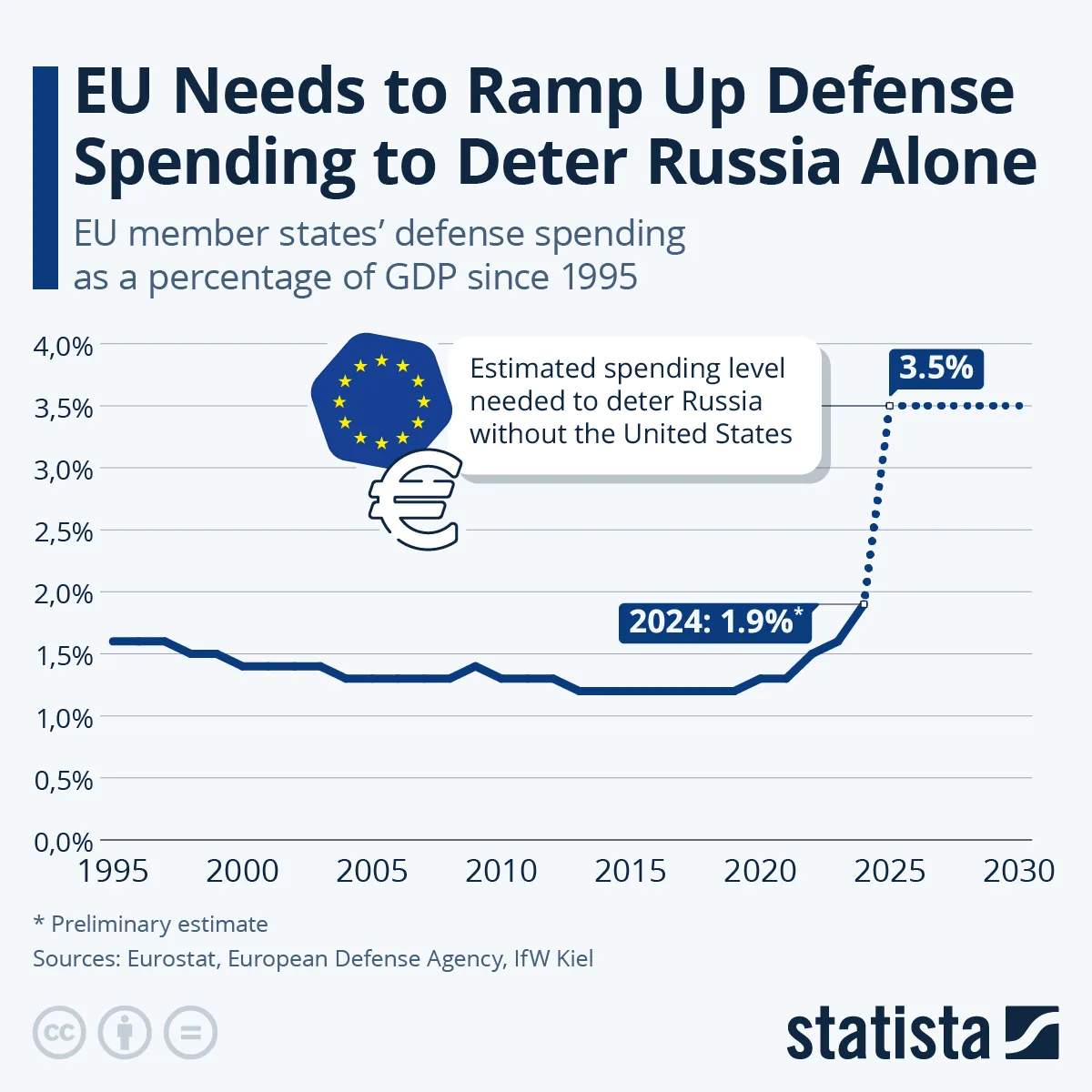
    However, the need for financial adjustments does not stop at merely compensating for U.S. aid. The researchers further indicate that to genuinely deter Russian aggression and provide substantial support to Ukraine, Europe would have to increase its military spending by about €250 billion each year. This increase would raise the EU’s defense spending from roughly 2% to an ambitious 3.5% of GDP annually.

    Economic Viability of Increased Defense Budget

    Professor Guntram Wolff, a co-author of the analysis, asserts that these financial requirements are manageable within the context of the EU’s economic strength. He remarked that the additional costs would only constitute around 1.5% of the EU’s gross domestic product. For comparison, this figure is considerably less than the financial mobilization required during the crisis of the Covid-19 pandemic, suggesting that Europe has the capacity to absorb increased spending on defense.

    Potential Economic Benefits

    Interestingly, beyond mere defense logistics, this proposed increase in military expenditure may bolster the European economy. A strategic approach that involves debt-financed defense spending could act as an economic stimulus, particularly if these funds are dispersed within EU nations experiencing declining external demand due to U.S. tariffs and ongoing trade disputes. The interplay of military investments and economic growth could provide a dual benefit for the region – enhancing both security and financial stability.

    Historical Spending Patterns in Defense

    Historically, the EU has maintained a defense spending average hovering around 1.5% of GDP for the past three decades. The data from Eurostat and recent estimates from the European Defence Agency illustrate the significant shift required to meet the new defense spending benchmark necessary to ensure regional stability.

    The Path Forward for EU Defense Initiatives

    As Europe navigates its complex security landscape, the necessity for a robust and independent defense framework has never been clearer. The challenges posed by potential reductions in U.S. military aid necessitate urgent and strategic dialogue among EU members regarding defense contributions and spending. The careful analysis of financial implications, coupled with the potential benefits to the European economy, positions this discourse at the forefront of contemporary EU policy considerations.