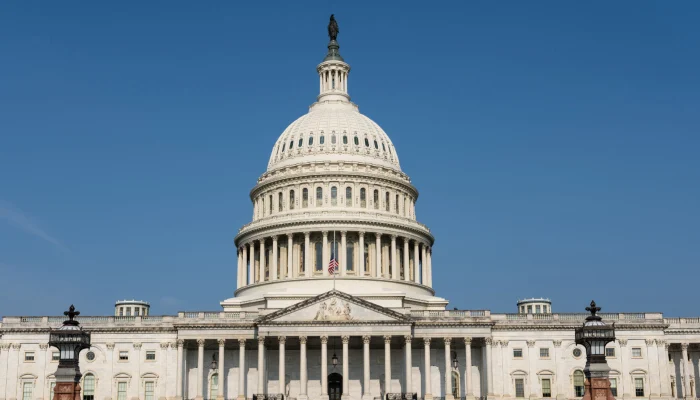
The US Capitol building in Washington, D.C., was photographed on July 22, 2026. — Reuters
– The House votes 214-208 in favor of a war powers resolution.
– The resolution mandates that President Trump stop military actions against Iran unless Congress approves.
– The Senate votes 49-47 to prevent the passage of a similar measure.
Washington, D.C.: The Republican-controlled House of Representatives approved a resolution Thursday urging President Donald Trump to cease military operations targeting Iran unless authorized by Congress. However, hours later, the Senate rejected a comparable measure with a close vote.
The House’s decision, reflecting increasing congressional disapproval of Trump’s military strategy, was 214-208, with four Republicans breaking ranks to support the resolution alongside Democrats.
In the Senate, the vote to block its own war powers measure was 49-47, just hours after the House vote.
This resolution, introduced by Washington Democrat Pramila Jayapal, instructed Trump to withdraw U.S. Armed Forces from hostilities with Iran unless given explicit congressional approval.
Despite its symbolic nature—similar resolutions have been passed repeatedly since the U.S. and Israel began strikes against Iran in late February—they haven’t resulted in ending the conflict.
The four House Republicans who supported the resolution were Tom Barrett (Michigan), Brian Fitzpatrick (Pennsylvania), Warren Davidson (Ohio), and Thomas Massie (Kentucky).
In the Senate, Republican Susan Collins (Maine) and Democrat John Fetterman (Pennsylvania) crossed party lines, voting in favor of and against the measure, respectively. Four Republican senators did not vote.
With slim majorities in both chambers, Trump’s Republican allies were divided. The votes underscore growing frustration among lawmakers — including some Republicans — over a conflict that Trump initially promised would be brief and decisive but has instead become increasingly complicated, with U.S. casualties and civilian deaths rising, and fuel prices climbing due to ongoing hostilities.
Ahead of the November midterm elections, where polls suggest Republicans may struggle to retain control of Congress, Democrats are attempting to connect unpopular military actions in Iran with economic concerns, especially fuel costs.
Critics argue that supporters of the resolutions are primarily interested in political leverage and undermining the president during a time of conflict. Republican Senator Tim Sheehy of Montana accused the resolution supporters of defending Iran and praised Trump for his aggressive policies.
The U.S. Constitution grants Congress alone the authority to declare war and authorize military interventions, although presidents have historically ordered limited military actions without prior congressional approval in immediate threats.
Recently, Trump announced an escalation of attacks on Iran, increasing U.S. casualties and promising “major military punishment” for Iran and the Houthis after Yemeni forces targeted two Saudi oil tankers in the Red Sea, broadening Middle Eastern hostilities.
Furthermore, two weeks after an interim truce to end the conflict collapsed, the U.S. military launched another series of nightly airstrikes on Iran, prompting retaliatory fire from Iran targeting U.S. bases in neighboring countries.


